
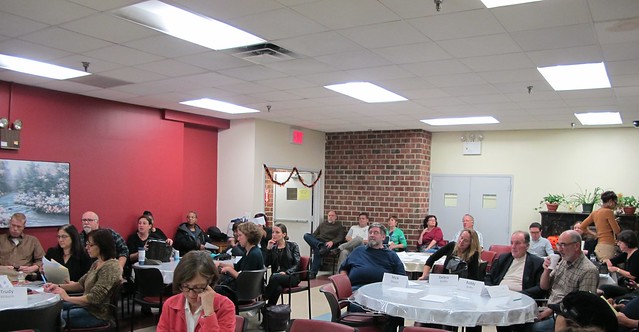
At Tuesday's General Gowanus Canal Community Advisory Committee meeting
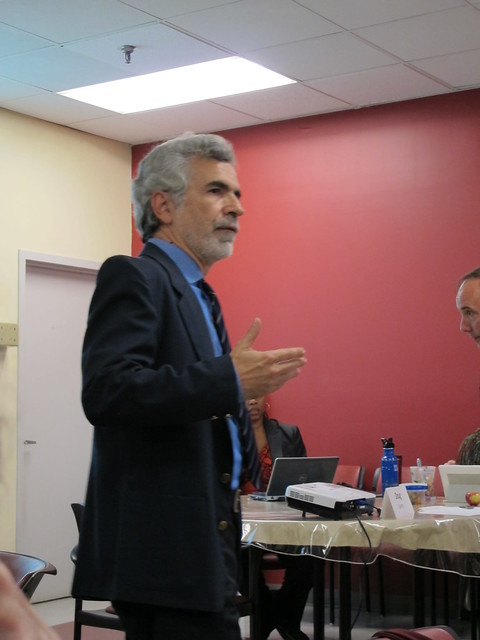
Christos Tsiamis, EPA Region 2 Project Manager for Gowanus Canal Superfund Site
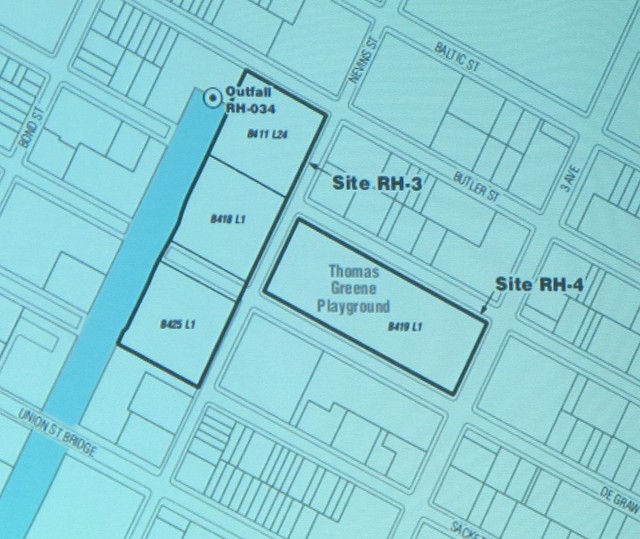
Two sites proposed by DEP for an 8 million gallon CSO retention tank at the top of the canal near Outfall Number RH-034 . One is Thomas Greene Park, the other is a site consisting of three privately owned lots adjacent to the park at Nevins Street between Butler, De Graw and Sackett Street.

The Double D Pool at Thomas Greene Park
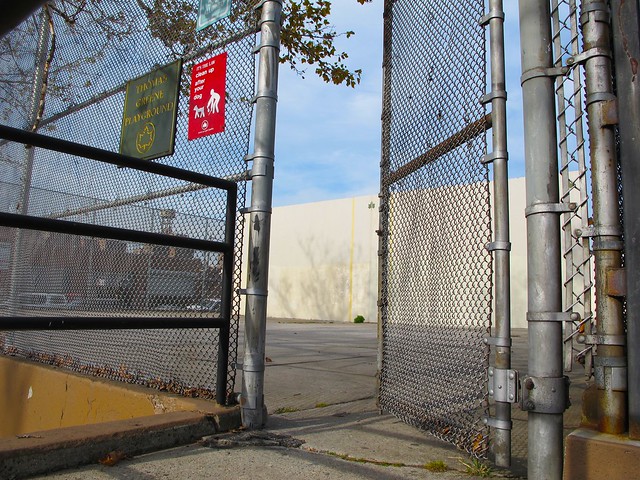
Handball court near Nevins Street at Douglass Greene Park
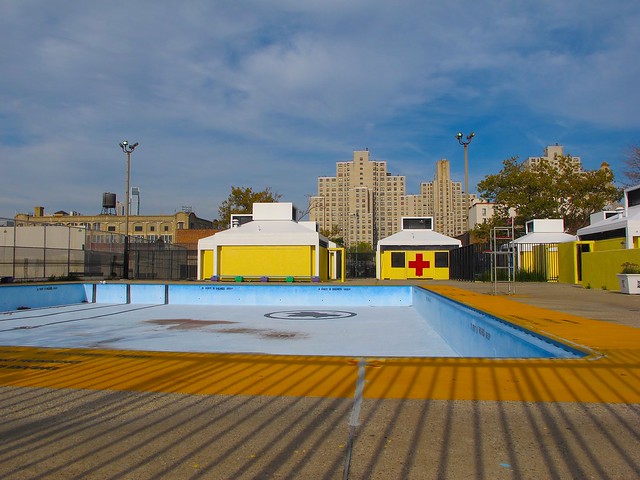
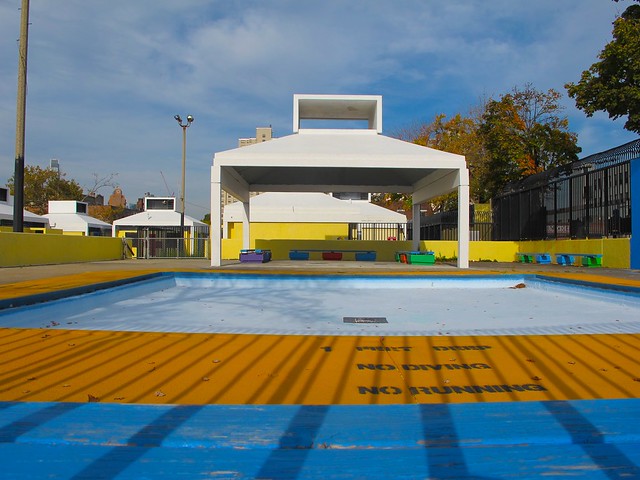

1928 photo of the former MGP site at Douglass Street, where Thomas Greene Park is now

The park, surrounded by industry, as seen from 4th Avenue looking towards the Gowanus Canal in the 1930s.
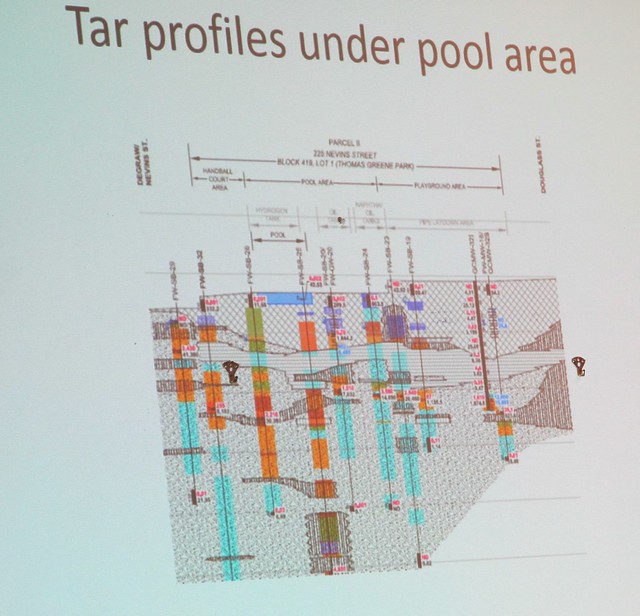
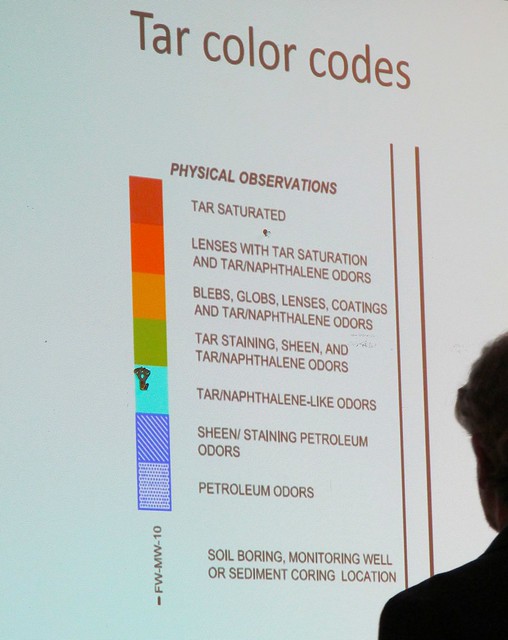
Schematic showing coal tar pollution under the Double D Pool at Thomas Greene Park
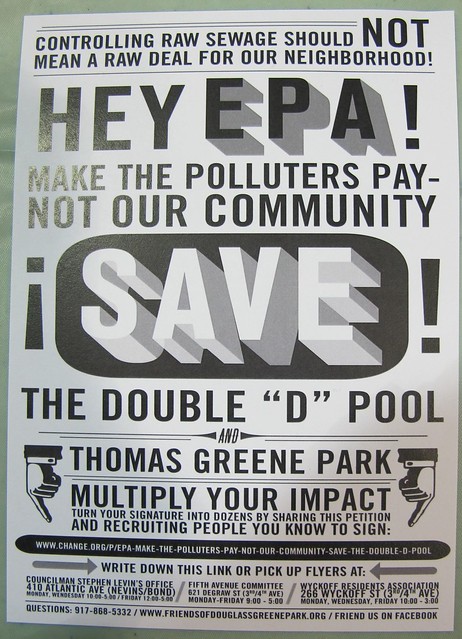
Flyer circulated by Friends Of Thomas Greene Park at a recent public meeting
The discussion at Tuesday night's general meeting of the Gowanus Canal Community Advisory Group (CAG) centered mostly around the siting of one of the two retention tanks the US Environmental Protection Agency is ordering the City of New York to build near two major Combined Sewer Outflows in the polluted waterway.
Last month, the NYC Department of Environmental Protection submitted to EPA two potential locations for each of the two tanks mandated by the Record of Decision (ROD). For the retention basin at the head of the canal, near Outfall RH-034, DEP has suggested Thomas Greene Park and a second location across from the park, consisting of three blocks between the canal and Nevins Street from Butler Street to Sackett Street.
Thomas Greene Park is publicly owned, so the city would not need to purchase the land. The alternative site across the street, however, is privately owned and would need to be purchased by the City, presumably by means of Eminent Domain. There are currently businesses operating on the three blocks in question, which would have to be relocated.
Complicating matters further, Thomas Greene Park sits on top of a former Manufactured Gas Plant (MGP) and coal tar is currently oozing under the Double D pool area and flowing towards the Gowanus Canal. New York State Department of Environmental Conservation is currently finalizing an environmental remediation plan under the State Brownfield Program to deal with the contamination.
The cost for the mandated clean-up will be assumed by the responsible party; National Grid.
The remediation at the site will most probably mean moving heavy equipment in and around the park. It may also mean that the pool needs to be dug up. That's why EPA suggested that the City place the retention tank there, since it would save money.
At a recent community meeting hosted by Congresswoman Nydia Velázquez, however, the City made clear that it favors placing the retention tank under the privately owned land across the street.
At Tuesday's CAG meeting, Christos Tsiamis of EPA wanted to provide some clarity to the community on this particular subject, especially since Friends Of Thomas Greene Park, a group with representation on the CAG, distributed a flyer that seemed short of information but full of subtext.
The flyer urged people to sign a petition addressed to Judith Enck, EPA Region 2 administrator , to "save our pool," and to "tell EPA to make the polluters pay!"
The actual online petition states: "the EPA Superfund clean-up needs to be an investment in our community, and not theft of our public land."
Tsiamis' response was clear: "The site needs to be remediated. If you don't remove the pool, the park will not be remediated." He pointed out that "this means the potential polluter does not need to pay. So when you send this [flier] out, you make the polluter NOT pay. "
He also pointed out that the only theft of land would involve the City taking the privately owned land by eminent domain if the owners refuse to sell. "That would be closer to theft than closing the park for two years." He added: "The [EPA] does not like taking land if there is an alternative."
"If Thomas Greene Park is used for the retention basin, it would be temporarily taken. You need to take the land in order to improve the land. Then you return it. This is usually called 'Capital Improvements'.
As for reconstructing the pool if it needs to be removed, Tsiamis suggested that the community work towards a better future for the facility as well as for a better clean-up of Thomas Greene Park.
He pointed at Riverbank State Park, a park with a pool built on the top of a sewage treatment facility on the Hudson River as an example of what is possible.
Indeed, if the City is prepared to pay millions for the privately owned land across the street, perhaps the money would better spent rebuilding the pool. Perhaps we could even get an indoor facility, which could be open during the entire year, instead of only 2 months. "Look at the better investment for the community," Christos told the CAG. "You need all the information to make an informed decision."
As for Friends Of Douglass Greene Park, it is unclear why they would try to protect the pool if it means the pollution underneath will not be fully remediated. By doing so they are (willingly or unwillingly) creating cover for DEP and National Grid.
The group was told by a representative of the New York City Parks Department back in 2008 that the Double D pool may need to be pulled up if DEC finds contamination underneath it. I can't imagine why the group is now so outraged after the presence of coal tar was confirmed.
Two additional points to consider are:
1) DEP did not consider cost when it suggested the two sites for the tank in the upper portion of the canal. When this is figured in, there is no doubt that purchasing the three blocks of private land on Nevins Street would be an outrageous waste of our taxpayer money, given the fact that the City already owns the park.
2) DEP appears to have forgotten to tell the private owners of its intention to buy their land. I spoke to one of the them a few days ago and he seemed surprised. He told me that the City had never approached him.
We all need to make sure that we understand what is at play here. For decades now, National Grid and the City have failed to assume responsibility for the environmental hazards they have exposed us to in Gowanus.
We are closer than ever to finally getting some resolution. Let's choose our battles and seize the moment. And most importantly, let's make sure we don't lose sight of the bigger prize: a clean canal, free of toxins and human waste.


