

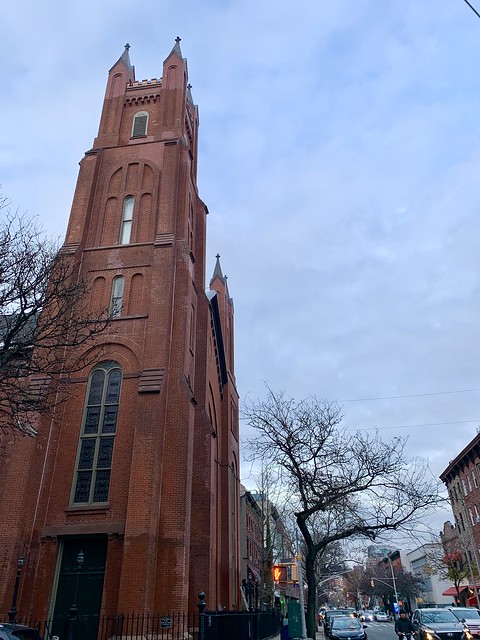


The renovation work included masonry repair, replacement of the copper sheathing on the spires and the total reconstruction of the church' tower piers. All the massive stained glass windows have been re-leaded and their wooden frames repaired. All woodwork along the façade has been replaced as needed, including the louvers on the tower piers. The original iron fence has also been painted.
The only part of the work that has not been completed at this point is the façade facing the small Ladies Auxilliary building along President Street.
The South Congregational Church, one of Brooklyn's oldest churches, was built in the 1850s at the edge of Carroll Park.
The South Congregational Church, one of Brooklyn's oldest churches, was built in the 1850s at the edge of Carroll Park.
The Church was listed on the National Register of Historic Places in 1982. In addition, it was declared a New York City Landmark on March 23, 1983 by the NYC Landmarks Preservation Commission.
From NYC's Landmark report:
"The idea of founding a Congregational church in the Carroll Gardens section of Brooklyn is attributed to Henry Ward Beecher, the minister of the nearby Plymouth Church and one of the best-known preachers of the period. In 1850 Beecher is reputed to have stood in a grassy field at what is now the corner of Court and President Streets and said, "Here, the next Congregational Church should be built."2 In that year, local residents James Freeland, H.C. Bowen, and John T. Howard purchased, for $7,500, the five lots that Beecher had indicated, and in 1851 they built a chapel with $6,500 of their own funds. 3 In February of that year the South Congregational Church was officially organized as it was believed "that the large and rapidly increasing population of this vicinity will, as soon as a faithful pastor can be obtained, find it easy to sustain public worship."4 During the following month, H.C. Bowen noted in the church vestry minutes that the founders were not disappointed by their endeavor. By 1857 the congregation was successful enough to erect a substantial brick church in front of the original chapel. The design and construction of the church probably had been planned by Bowen and his associates in 1850, prior to the official incorporation of the congregation and before records were kept. Thus the name of the architect remains unknown. The thriving Scandinavian congregation that once worshipped here began to dwindle in the 1940's. By the1980's only about twenty members remained. That is when the South Congregational Church building was turned into condo residences and offices. It is an amazing example of adaptive reuse of an historic structure."
"The idea of founding a Congregational church in the Carroll Gardens section of Brooklyn is attributed to Henry Ward Beecher, the minister of the nearby Plymouth Church and one of the best-known preachers of the period. In 1850 Beecher is reputed to have stood in a grassy field at what is now the corner of Court and President Streets and said, "Here, the next Congregational Church should be built."2 In that year, local residents James Freeland, H.C. Bowen, and John T. Howard purchased, for $7,500, the five lots that Beecher had indicated, and in 1851 they built a chapel with $6,500 of their own funds. 3 In February of that year the South Congregational Church was officially organized as it was believed "that the large and rapidly increasing population of this vicinity will, as soon as a faithful pastor can be obtained, find it easy to sustain public worship."4 During the following month, H.C. Bowen noted in the church vestry minutes that the founders were not disappointed by their endeavor. By 1857 the congregation was successful enough to erect a substantial brick church in front of the original chapel. The design and construction of the church probably had been planned by Bowen and his associates in 1850, prior to the official incorporation of the congregation and before records were kept. Thus the name of the architect remains unknown. The thriving Scandinavian congregation that once worshipped here began to dwindle in the 1940's. By the1980's only about twenty members remained. That is when the South Congregational Church building was turned into condo residences and offices. It is an amazing example of adaptive reuse of an historic structure."
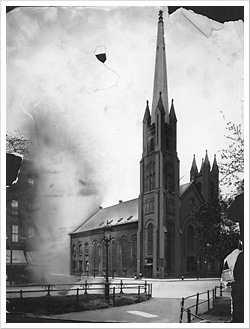
Here is another photo from 1928 taken from the corner of President Street at Smith Street with the church in the distance. (A Rite Aid now stands at this corner)

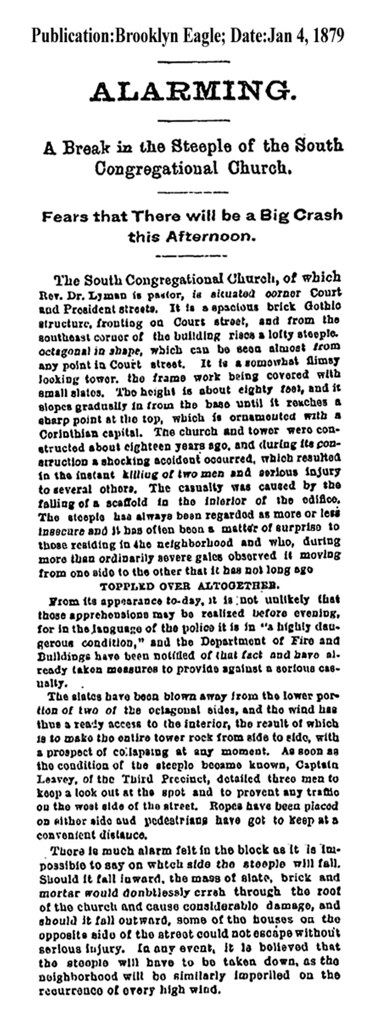
Also found in the Brooklyn Eagle archive is an article from January 4, 1879 reporting that high winds made the steeple sway dangerously. It was feared that it would collapse that afternoon. From the article:
"The steeple has always been regarded as more or less insecure and it has often been a matter of surprise to those residents in the neighborhood and who, during more than ordinarily severe gales observed it moving from one side to the other that it has not long ago toppled over altogether.
On that day in January, so long ago, the tower clearly rocked from side to side. Ropes around the church kept pedestrians at a safe distance.
"The steeple has always been regarded as more or less insecure and it has often been a matter of surprise to those residents in the neighborhood and who, during more than ordinarily severe gales observed it moving from one side to the other that it has not long ago toppled over altogether.
On that day in January, so long ago, the tower clearly rocked from side to side. Ropes around the church kept pedestrians at a safe distance.
There is much alarm felt on the block as it is impossible to say on which side the steeple will fall.
Should it fall inward, the mass of slate, brick and mortar would doubtlessly crash through the roof of the church and cause considerable damage, and should it fall outward, some of the houses on the opposite side of the street could not escape without serious injury."
The worst did not seem to have happened in January 1879 since photos above show the church with the steeple in the 1920s. Also, the brownstones next to and opposite the church remain intact to this day.
Should it fall inward, the mass of slate, brick and mortar would doubtlessly crash through the roof of the church and cause considerable damage, and should it fall outward, some of the houses on the opposite side of the street could not escape without serious injury."
The worst did not seem to have happened in January 1879 since photos above show the church with the steeple in the 1920s. Also, the brownstones next to and opposite the church remain intact to this day.
We have not found any mention of when the steeple actually came down.


.JPG)


