


Congresswoman Nydia Velázquez

Councilman Brad Lander

Councilman Stephen Levin




Bridging Gowanus has been convened jointly by Congresswoman Nydia Velázquez, State Senator Velmanette Montgomery, Assemblywoman Joan Millman, Council Member Stephen Levin, and Council Member Brad Lander. It has been promoted as "an inclusive community-driven planning process to develop a long-term vision for a safe, vibrant, and sustainable Gowanus."
The process started last August. Since then, several meetings have been held with community stakeholders to identify broadly shared goals and "build consensus around a neighborhood framework for the infrastructure and land use regulations needed in the Gowanus Canal area."
The goal of Bridging Gowanus, as it has been explained to participants, is a community supported blueprint to help shape the De Blasio Administration's thinking about the Gowanus Canal.
To facilitate the conversation Pratt Center for Community Development (not to be confused with Pratt Institute) has been hired as consultant in charge of running the process.
At this latest planning meeting, participants were encouraged to explore an "idea expo" which had been prepared by Pratt Center. The expo consisted of twelve poster boards that represented some of the shared commonalities that had come out of previous sessions. Some of these common goals included:
*strengthening and coming up with a true mixed-use zoning that will maintain a true mix of industrial and residential use.
*creating a diverse residential community by preserving and creating affordable housing.
*strengthening industry by investing in infrastructure and putting in place financial mechanisms to support industry.
*coordinating job and workforce developments with planned resiliency and environmental remediation initiatives
*flexible new school buildings that could be used by the community during the evenings and week-ends
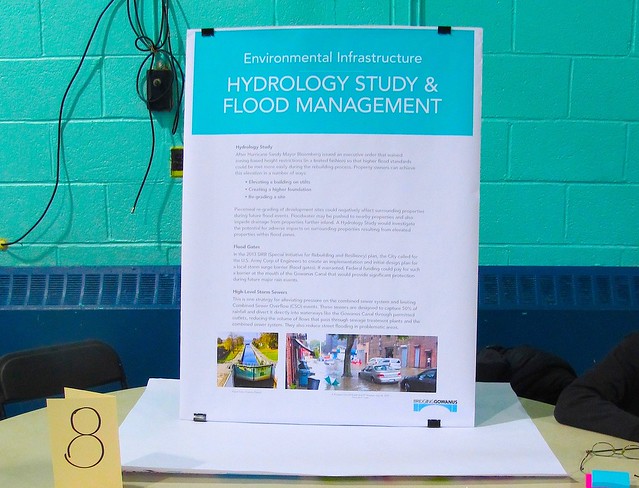
*undertake a hydrology study to investigate the effects of elevating building sites along the Gowanus corridor to meet new building codes in flood zones.
Each participant was given twelve red stickers to distribute on the twelve 'idea boards' to indicate importance or preference.
By far, the board that got the most stickers was the Hydrology Study/ Flood Management board.
The second part of the meeting involved dividing participants into groups for an exercise that was moderated by representatives of Pratt Center at each table.
Stakeholders were presented with a map of the Gowanus corridor. They were encouraged to discuss future land use in the Gowanus.
Each table was shown a map that had been divided into three parts:
*Number One was labeled "Industrial Buisness Zone"
*Number Two was labeled "Ombudsman Area"
*Number Three was unlabeled.
The map somehow looked eerily like the one presented to the Gowanus community back in 2009, when Amanda Burden, then-Commissioner of City Planning presented her agency's proposed re-zoning for the Gowanus Corridor. The map presented by Burden at that time had also divided the neighborhood into three parts. Click here for the 2009 re-zoning proposal.
At my table, the Pratt Center moderator seemed to want to steer the conversation into a very specific direction. She began by asking my group if the area labeled "Industrial Buisness Zone" on the map should or should not stay manufacturing. Most everyone agreed that it should. If that were the case, the moderator wanted to know, where would we put housing?
The moderator then appeared to be strongly suggesting that perhaps, area number 3 could be zoned to allow residential development. After all, the 700-unit Lighstone Group residential development had already been green lighted by the city and Gowanus Green at Public Place, with its 770 units was sure to follow.
I pointed out that dividing the Gowanus into three distinct areas went against everything that I had personally heard the community say: that there should be a fluid mix of uses everywhere in Gowanus.
Not only did the exercise remind me of playing Monopoly, the map and the direction of the conversation seemed specifically designed to support the City's 2009 proposed re-zoning.
I have now attended all except one of the Bridging Gowanus sessions. I have tried to put aside my cynicism and hoped that, as promised, the outcome of the process would allow the Gowanus community to plan for its own future.
But make no mistake, Gowanus has already been divided amongst developers who are ready to build residential development on the shores of the canal with the blessing of newly-elected Mayor De Blasio. The Bridging Gowanus process is, in my humble opinion, a carefully orchestrated process that gives the appearance of community input.
At the end, we will most likely just end up with what New York City has planned for the area since 2009.
NYCity proposed rezoning for Gowanus presented to the community in 2009


