

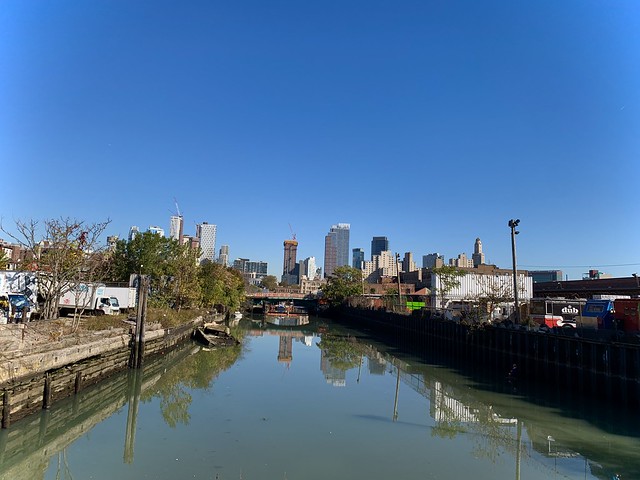
Just hours before the Gowanus Canal Community Advisory Group's October meeting this past Tuesday, the Environmental Protection Agency sent a letter to New York City warning that the proposed upzoning of the Gowanus neighborhood cannot compromise the EPA Superfund clean-up of the 1.8 mile toxic waterway.
The letter, written by EPA Region 2 Administrator Peter Lopez informs the New York Department of City Planning and the New York City Department of Environmental Protection that his agency anticipates a significant increase in wastewater generated as a result of the rezoning from manufacturing to residential.
EPA estimates that waste water will increase from the present 178,795 gallons per day to 1,977,302 gallons per day once the proposed development has been completely built out.
This should not come as a surprise to the City since the EPA had addressed the same concerns in its comments on the Gowanus Neighborhood Rezoning Draft Scope of Work for an Environmental Impact Statement (DSOW) back in May 2019.
The EPA is very clear that it does not get involved in land use issues. However, anticipating future use is an important component of designing the Superfund remedy. The Federal Agency is also protective of its environmental remedies and will get involved if there is a risk of re-contamination to a Superfund site.
The City of New York is one of the major polluters of the Gowanus canal, as a result of allowing sewage to discharge into the canal when waste water exceeds the capacity of our treatment facilities during periods of heavy rainfall. To remedy the situation, EPA has mandated that the City construct two retention tanks to capture the waste water during these rain events.
The City has been dragging its feet and using one delaying tactic after another to avoid taking responsibility for polluting the canal. As it stands, NYC DEP now anticipates the completion of the first tank in 2032.
EPA, for its part, is moving ahead at full speed. In November, the dredging of the toxic material in the canal will begin, followed by the installation of a multi-layer cap at the bottom of the waterway.
Since the City has not yet begun building its tanks, solids from the waste water discharges risk recontaminating the Superfund site.
It will be interesting to see how the City's Departments of Environmental Protection and Planning will try to engineer their way out of this, given the fact that the City has not yet managed to capture current CSOs into the waterway, let alone 10 times the amount.
Once again, it would appear that the EPA is stepping in to protect the environment and the health of the Gowanus community. The same cannot be said about Mayor deBlasio, as well as Councilmen Brad Lander and Steve Levin, who are all pushing for the rezoning before environmental remediation.
Below is Administrator Lopez's letter to the City.
Dear Director Lago and Commissioner Sapienza:
The U.S. Environmental Protection Agency (EPA) is in receipt of public notices indicating that
the Department of City Planning (DCP) has resumed the Gowanus rezoning process,
commencing with the public meeting on October 22, 2020 before the Brooklyn Community
Board 6 Land Use Committee.
As you know, the proposed rezoning affects an area surrounding the Gowanus Canal, which EPA
placed on the Superfund National Priorities List in March 2010. The Gowanus Canal Superfund
Site (Site) is defined as the approximately 100-foot wide, 1.8-mile-long Canal, and also includes
any areas that are sources of contamination to the Canal.
In 2013, EPA issued a Record of Decision (ROD) for the cleanup of the Canal that included the
dredging and off-Site disposal of much of the accumulated contaminated sediment within the
Canal, the capping of certain contamination remaining below the dredged material, and the
control of upland sources to prevent the recontamination of the clean Canal. See
https://semspub.epa.gov/workl02/692106.pdf
Such upland sources include certain contaminated sewer solids discharged into the Canal during
Combined Sewer Overflow (CSO) events when stormwater and sanitary sewage capacity is
exceeded within the approximately 1,758-acre Gowanus Canal watershed. The CSO portion of
the EPA-selected remedy requires the City, a potentially responsible party for the Site, to
construct and operate two CSO retention tanks. Pursuant to several EPA administrative orders,
the City is required to design those CSO tanks and to participate in the first stage of the dredging
and capping work. The City will be required to construct the CSO tanks pursuant to a future EPA
enforcement instrument.
EPA does not have a direct role in local land-use or zoning decisions. However, accounting for
current and anticipated future local land use is an important component in EPA's planning of
response actions under the Comprehensive Environmental Response, Compensation and
Liability Act ("CERCLA" or "Superfund"). EPA also has a role in ensuring that future land-use
changes do not adversely affect the integrity of Superfund cleanups, including the ongoing work
at the Gowanus Canal. Accordingly, in May 2019, EPA provided comments to DCP on the
Environmental Impact Statement (EIS) scoping documents for the rezoning, and also directed the
New York City Department of Environmental Protection (DEP) to provide rezoning-related
information to EPA as part of the CSO tank design process.
The first phase of the dredging and capping is to begin in mid-November 2020 in the upper
Canal, which is in the area where DCP has proposed rezoning for residential use. Progress on the
Canal cleanup is among the factors cited by the City in support of the rezoning.
Progress on the CSO tanks, however, has been delayed by DEP, as noted in recent EPA
communications to DEP. In June 2020, DEP requested that EPA grant an extension of time to
complete the CSO tanks. EPA is reviewing that request, which may impact the effectiveness of
the remedy and have implications on the rezoning.
In light of community interest associated with the start of dredging, DEP's CSO-related delays,
and the resumption of the rezoning process, EPA believes that it would be of assistance to the
City, the community, and other stakeholders to reiterate the cleanup-related discharge parameters
of the ROD.
In anticipation of potential redevelopment, the ROD requires that any future activities that fall
under the City's purview, including development, do not compromise the effectiveness of the
Gowanus Canal remedy. Among other things, the ROD specifically states:
EPA acknowledges the City's authority to engage in land-use planning and zoning. With that
said, however, EPA respectfully submits that any rezoning impacting the Canal must proceed in
a manner that is protective of human health and the environment, as envisioned in EPA's Canal
remedy.
EPA looks forward to engaging with the City, the community and other stakeholders in a
cooperative manner so that the appropriate information is available for a productive
consideration of rezoning issues.

Dear Director Lago and Commissioner Sapienza:
The U.S. Environmental Protection Agency (EPA) is in receipt of public notices indicating that
the Department of City Planning (DCP) has resumed the Gowanus rezoning process,
commencing with the public meeting on October 22, 2020 before the Brooklyn Community
Board 6 Land Use Committee.
As you know, the proposed rezoning affects an area surrounding the Gowanus Canal, which EPA
placed on the Superfund National Priorities List in March 2010. The Gowanus Canal Superfund
Site (Site) is defined as the approximately 100-foot wide, 1.8-mile-long Canal, and also includes
any areas that are sources of contamination to the Canal.
In 2013, EPA issued a Record of Decision (ROD) for the cleanup of the Canal that included the
dredging and off-Site disposal of much of the accumulated contaminated sediment within the
Canal, the capping of certain contamination remaining below the dredged material, and the
control of upland sources to prevent the recontamination of the clean Canal. See
https://semspub.epa.gov/workl02/692106.pdf
Such upland sources include certain contaminated sewer solids discharged into the Canal during
Combined Sewer Overflow (CSO) events when stormwater and sanitary sewage capacity is
exceeded within the approximately 1,758-acre Gowanus Canal watershed. The CSO portion of
the EPA-selected remedy requires the City, a potentially responsible party for the Site, to
construct and operate two CSO retention tanks. Pursuant to several EPA administrative orders,
the City is required to design those CSO tanks and to participate in the first stage of the dredging
and capping work. The City will be required to construct the CSO tanks pursuant to a future EPA
enforcement instrument.
EPA does not have a direct role in local land-use or zoning decisions. However, accounting for
current and anticipated future local land use is an important component in EPA's planning of
response actions under the Comprehensive Environmental Response, Compensation and
Liability Act ("CERCLA" or "Superfund"). EPA also has a role in ensuring that future land-use
changes do not adversely affect the integrity of Superfund cleanups, including the ongoing work
at the Gowanus Canal. Accordingly, in May 2019, EPA provided comments to DCP on the
Environmental Impact Statement (EIS) scoping documents for the rezoning, and also directed the
New York City Department of Environmental Protection (DEP) to provide rezoning-related
information to EPA as part of the CSO tank design process.
The first phase of the dredging and capping is to begin in mid-November 2020 in the upper
Canal, which is in the area where DCP has proposed rezoning for residential use. Progress on the
Canal cleanup is among the factors cited by the City in support of the rezoning.
Progress on the CSO tanks, however, has been delayed by DEP, as noted in recent EPA
communications to DEP. In June 2020, DEP requested that EPA grant an extension of time to
complete the CSO tanks. EPA is reviewing that request, which may impact the effectiveness of
the remedy and have implications on the rezoning.
In light of community interest associated with the start of dredging, DEP's CSO-related delays,
and the resumption of the rezoning process, EPA believes that it would be of assistance to the
City, the community, and other stakeholders to reiterate the cleanup-related discharge parameters
of the ROD.
In anticipation of potential redevelopment, the ROD requires that any future activities that fall
under the City's purview, including development, do not compromise the effectiveness of the
Gowanus Canal remedy. Among other things, the ROD specifically states:
Current and future high density residential redevelopment along the banks of the canal andwithin the sewershed shall adhere to NYC rules for sewer connections (Chapter 31 of Title 15of the Rules of the City of New York) and shall be consistent with current NYCDEP criteria(NYCDEP, 2012) and guidelines to ensure that hazardous substances and solids fromadditional sewage loads do not compromise the effectiveness of the permanent CSOcontrolmeasures by exceeding their design capacity. For example, redevelopmentto take mitigation measures to prevent or offset additional sewer loadings. Separatedstorm water outfalls will also require engineering controls to ensure that hazardoussubstances and solids are not discharged to the Canal. [ROD at page 84.]
In EPA's May 2019 comments on the EIS scoping documents, EPA noted that the City
preliminarily projects a significant increase in the wastewater generation in the neighborhood as
a result of the proposed development. Specifically, for residential development, wastewater
generation is estimated to increase from 178,795 gallons per day (gpd) at present to 1,977,302
gpd once the proposed development has been completed. (See Gowanus Neighborhood
Rezoning and Related Actions at Table B-1).
Consistent with EPA's May 2019 comments, the EIS process should accurately determine not
just the total wastewater generation, but also the incremental sanitary and stormwater volumes
and what appropriate mitigation measures, or combination of measures, are required to prevent
added CSO-related discharges to the Canal and adverse effects on the Canal remedy. In
particular, EPA believes that DEP must determine whether any infrastructure serving the parcels
that are to be rezoned requires upgrading to provide adequate conveyance and prevent overflows
to the Canal. EPA will review all such determinations and other relevant information related to
the impacts of the proposed rezoning on the Superfund Canal remedy and will assess whether
any mitigation measures proposed as part of the development, as a result of the rezoning, would
indeed be protective of the Canal remedy.
just the total wastewater generation, but also the incremental sanitary and stormwater volumes
and what appropriate mitigation measures, or combination of measures, are required to prevent
added CSO-related discharges to the Canal and adverse effects on the Canal remedy. In
particular, EPA believes that DEP must determine whether any infrastructure serving the parcels
that are to be rezoned requires upgrading to provide adequate conveyance and prevent overflows
to the Canal. EPA will review all such determinations and other relevant information related to
the impacts of the proposed rezoning on the Superfund Canal remedy and will assess whether
any mitigation measures proposed as part of the development, as a result of the rezoning, would
indeed be protective of the Canal remedy.
EPA acknowledges the City's authority to engage in land-use planning and zoning. With that
said, however, EPA respectfully submits that any rezoning impacting the Canal must proceed in
a manner that is protective of human health and the environment, as envisioned in EPA's Canal
remedy.
EPA looks forward to engaging with the City, the community and other stakeholders in a
cooperative manner so that the appropriate information is available for a productive
consideration of rezoning issues.
After the rains! Raw sewage floating on the Gowanus Canal




.JPG)


