Showing posts with label NYC DEP. Show all posts

Thursday, October 29, 2020

Reality Check! EPA Warns City Gowanus Area Upzoning Cannot Compromise The Canal Clean-up

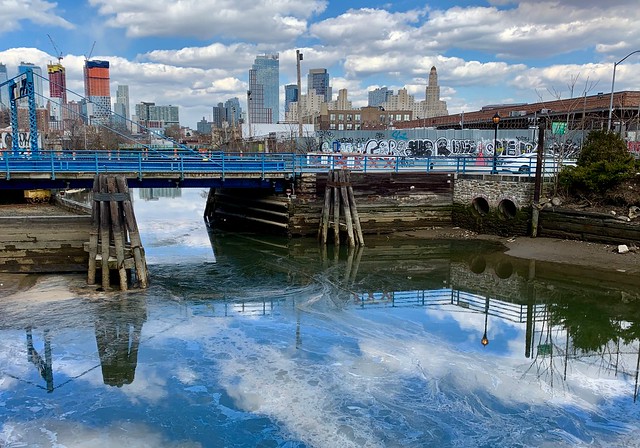
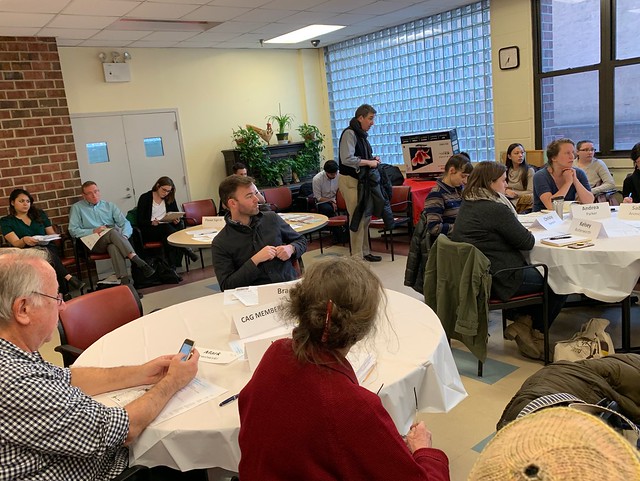
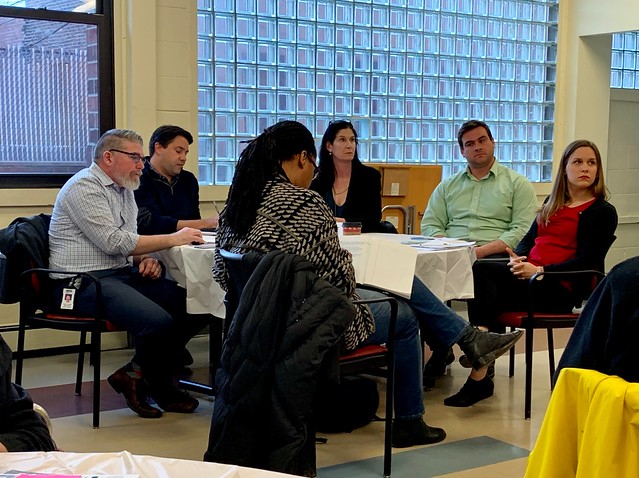
Just hours before the Gowanus Canal Community Advisory Group's October meeting this past Tuesday,  the Environmental Protection Agency sent a letter to New York City warning that the proposed upzoning of the Gowanus neighborhood cannot compromise the EPA Superfund clean-up of the 1.8 mile toxic waterway. 

The letter, written by EPA Region 2 Administrator Peter Lopez informs the New York Department of City Planning and the New York City Department of Environmental Protection that his agency anticipates a significant increase in wastewater generated as a result of the rezoning from manufacturing to residential.

EPA estimates that waste water will increase from the present 178,795 gallons per day to 1,977,302 gallons per day once the proposed development has been completely built out. 

This should not come as a surprise to the City since the EPA had addressed the same concerns in its comments on the Gowanus Neighborhood Rezoning Draft Scope of Work for an Environmental Impact Statement (DSOW) back in May 2019.

The EPA is very clear that it does not get involved in land use issues. However, anticipating future use is an important component of designing the Superfund remedy. The Federal Agency is also protective of its environmental remedies and will get involved if there is a risk of re-contamination to a Superfund site.

The City of New York is one of the major polluters of the Gowanus canal, as a result of allowing sewage to discharge into the canal when waste water exceeds the capacity of our treatment facilities during periods of heavy rainfall.  To remedy the situation, EPA has mandated that the City construct two retention tanks to capture the waste water during these rain events.

The City has been dragging its feet and using one delaying tactic after another to avoid taking responsibility for polluting the canal. As it stands, NYC DEP now anticipates the completion of the first tank in 2032.
EPA, for its part, is moving ahead at full speed.  In November, the dredging of the toxic material in the canal will begin, followed by the installation of a multi-layer cap at the bottom of the waterway.

Since the City has not yet begun building its tanks, solids from the waste water discharges risk recontaminating the Superfund site.

It will be interesting to see how the City's Departments of Environmental Protection and Planning will try to engineer their way out of this, given the fact that the City has not yet managed to capture current CSOs into the waterway, let alone 10 times the amount.

Once again, it would appear that the EPA is stepping in to protect the environment and the health of the Gowanus community. The same cannot be said about Mayor deBlasio, as well as Councilmen Brad Lander and Steve Levin, who are all pushing for the rezoning before environmental remediation.

Below is Administrator Lopez's letter to the City.

Dear Director Lago and Commissioner Sapienza:

The U.S. Environmental Protection Agency (EPA) is in receipt of public notices indicating that
the Department of City Planning (DCP) has resumed the Gowanus rezoning process,
commencing with the public meeting on October 22, 2020 before the Brooklyn Community
Board 6 Land Use Committee.

As you know, the proposed rezoning affects an area surrounding the Gowanus Canal, which EPA
placed on the Superfund National Priorities List in March 2010. The Gowanus Canal Superfund
Site (Site) is defined as the approximately 100-foot wide, 1.8-mile-long Canal, and also includes
any areas that are sources of contamination to the Canal.

In 2013, EPA issued a Record of Decision (ROD) for the cleanup of the Canal that included the
dredging and off-Site disposal of much of the accumulated contaminated sediment within the
Canal, the capping of certain contamination remaining below the dredged material, and the
control of upland sources to prevent the recontamination of the clean Canal. See
https://semspub.epa.gov/workl02/692106.pdf

Such upland sources include certain contaminated sewer solids discharged into the Canal during
Combined Sewer Overflow (CSO) events when stormwater and sanitary sewage capacity is
exceeded within the approximately 1,758-acre Gowanus Canal watershed. The CSO portion of
the EPA-selected remedy requires the City, a potentially responsible party for the Site, to
construct and operate two CSO retention tanks. Pursuant to several EPA administrative orders,
the City is required to design those CSO tanks and to participate in the first stage of the dredging
and capping work. The City will be required to construct the CSO tanks pursuant to a future EPA
enforcement instrument.

EPA does not have a direct role in local land-use or zoning decisions. However, accounting for
current and anticipated future local land use is an important component in EPA's planning of
response actions under the Comprehensive Environmental Response, Compensation and
Liability Act ("CERCLA" or "Superfund"). EPA also has a role in ensuring that future land-use
changes do not adversely affect the integrity of Superfund cleanups, including the ongoing work
at the Gowanus Canal. Accordingly, in May 2019, EPA provided comments to DCP on the
Environmental Impact Statement (EIS) scoping documents for the rezoning, and also directed the
New York City Department of Environmental Protection (DEP) to provide rezoning-related
information to EPA as part of the CSO tank design process.

The first phase of the dredging and capping is to begin in mid-November 2020 in the upper
Canal, which is in the area where DCP has proposed rezoning for residential use. Progress on the
Canal cleanup is among the factors cited by the City in support of the rezoning.
Progress on the CSO tanks, however, has been delayed by DEP, as noted in recent EPA
communications to DEP. In June 2020, DEP requested that EPA grant an extension of time to
complete the CSO tanks. EPA is reviewing that request, which may impact the effectiveness of
the remedy and have implications on the rezoning.

In light of community interest associated with the start of dredging, DEP's CSO-related delays,
and the resumption of the rezoning process, EPA believes that it would be of assistance to the
City, the community, and other stakeholders to reiterate the cleanup-related discharge parameters
of the ROD.

In anticipation of potential redevelopment, the ROD requires that any future activities that fall
under the City's purview, including development, do not compromise the effectiveness of the
Gowanus Canal remedy. Among other things, the ROD specifically states:

Current and future high density residential redevelopment along the banks of the canal and
within the sewershed shall adhere to NYC rules for sewer connections (Chapter 31 of Title 15
of the Rules of the City of New York) and shall be consistent with current NYCDEP criteria
(NYCDEP, 2012) and guidelines to ensure that hazardous substances and solids from
additional sewage loads do not compromise the effectiveness of the permanent CSOcontrol
measures by exceeding their design capacity. For example, redevelopment
to take mitigation measures to prevent or offset additional sewer loadings. Separated
storm water outfalls will also require engineering controls to ensure that hazardous
substances and solids are not discharged to the Canal. [ROD at page 84.]

In EPA's May 2019 comments on the EIS scoping documents, EPA noted that the City
preliminarily projects a significant increase in the wastewater generation in the neighborhood as
a result of the proposed development. Specifically, for residential development, wastewater
generation is estimated to increase from 178,795 gallons per day (gpd) at present to 1,977,302
gpd once the proposed development has been completed. (See Gowanus Neighborhood
Rezoning and Related Actions at Table B-1).

Consistent with EPA's May 2019 comments, the EIS process should accurately determine not
just the total wastewater generation, but also the incremental sanitary and stormwater volumes
and what appropriate mitigation measures, or combination of measures, are required to prevent
added CSO-related discharges to the Canal and adverse effects on the Canal remedy. In
particular, EPA believes that DEP must determine whether any infrastructure serving the parcels
that are to be rezoned requires upgrading to provide adequate conveyance and prevent overflows
to the Canal. EPA will review all such determinations and other relevant information related to
the impacts of the proposed rezoning on the Superfund Canal remedy and will assess whether
any mitigation measures proposed as part of the development, as a result of the rezoning, would
indeed be protective of the Canal remedy.

EPA acknowledges the City's authority to engage in land-use planning and zoning. With that
said, however, EPA respectfully submits that any rezoning impacting the Canal must proceed in
a manner that is protective of human health and the environment, as envisioned in EPA's Canal
remedy.

EPA looks forward to engaging with the City, the community and other stakeholders in a
cooperative manner so that the appropriate information is available for a productive
consideration of rezoning issues.

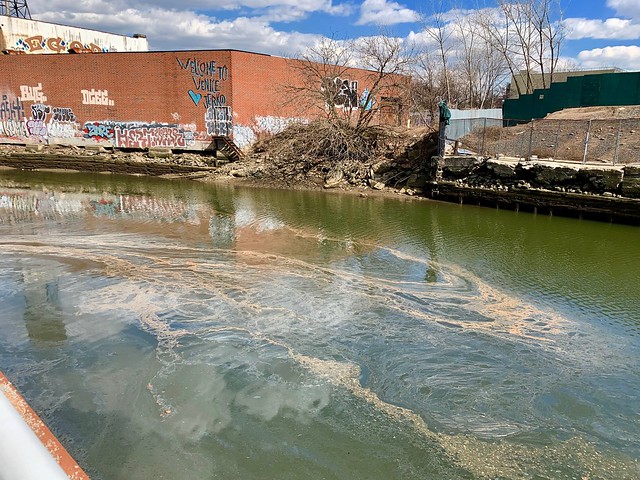
After the rains! Raw sewage floating on the Gowanus Canal 


Read more

Monday, April 15, 2019

Landersville: Important Scoping Meeting On Proposed Gowanus Rezoning Coming Up On April 25

Untitled
Untitled
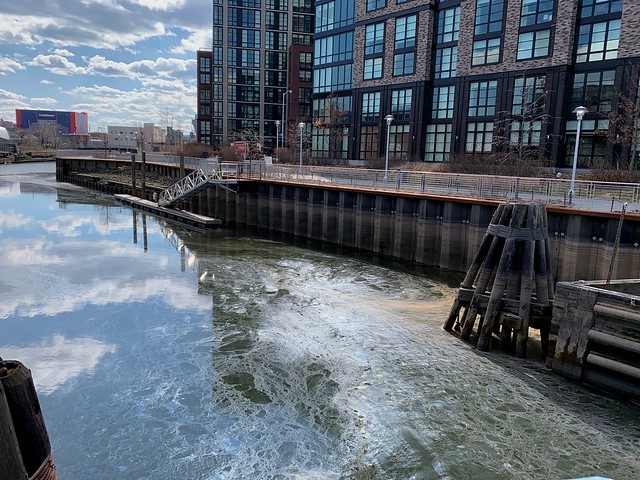
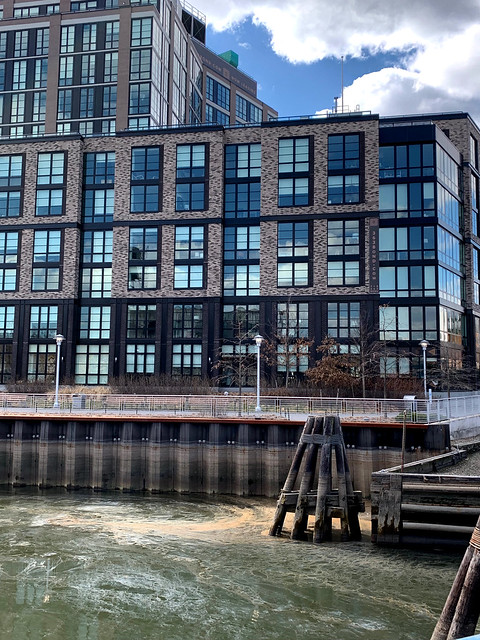
Combined Sewer Overflow floating on the surface of the Gowanus Canal
at 363 Bond Street building.
Photo taken April 15, 2019.

Leave it to NY City Department of City Planning (DCP) to schedule an important meeting regarding the up-zoning of the Gowanus Canal area during a school vacation week, when many families may be out of town. Let us try to stay involved despite the City's effort to make it harder for us to have our voices heard.

The proposed up-zoning of the Gowanus Canal area is moving along quickly.
Here is the next step in the massive re-zoning, and it is an important one.

The Department of City Planning is holding a very important meeting on Thursday, April 25th, 2019, at Middle School (M.S.) 51 at 350 5th Avenue starting at 4 pm to start the Environmental Review Process for the proposed Gowanus Rezoning. The meeting will go through the evening hours.

This meeting will give local residents an opportunity to identify potential effects that the proposed change in zoning will have on the area's infrastructure and the environment.
Here is the opportunity, for example,  to ask how the City aims to deal with the additional sewage produced by 20,000 new residents in around 8,000 units since it has not managed to address  the ouflow of Combined Sewage Overflow into the canal under current conditions.
Or how about asking the City if it is prepared to shelter all new Gowanus residents in the case of flooding since most of the rezoning footprint is in a FEMA Flood Zone A with mandatory evacuation.

According to DCP:
"The first step in the Gowanus environmental review process is to get community input on the Draft Scope of Work (DSOW), a technical document that lays out proposed methodologies and assumptions and that identifies the project and the types of environmental analyses that may be performed. The DSOW helps the public understand and participate in the CEQR review from the start and a necessary precursor to preparing a Draft Environmental Impact Statement. The DSOW and other documents are on our website."

DCP will also accept written comments until the close of business on Monday, May 27th, 2019, but it is better to show up at the meeting on April 25th, so please make sure to attend.

Further reading:


Read more

Wednesday, March 27, 2019

Same As It Ever Was In Gowanus: It Is Clear That New York City Plans To Allow New Housing First, Deal With Extra Sewage Later.

Untitled
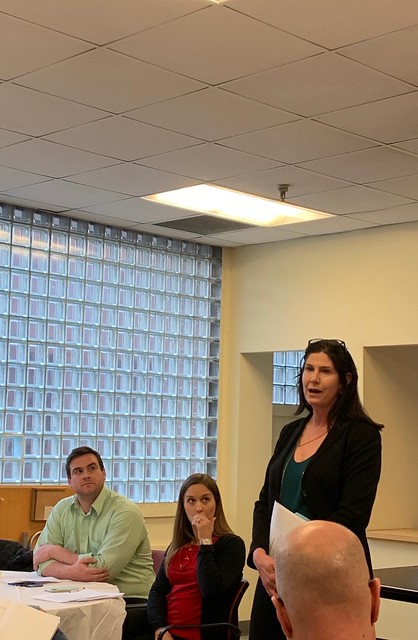
March 27 2019 meeting of the Gowanus Canal Community Advisory Group
Untitled
Untitled
Untitled
Jonathan Keller, NYC Department of City Planning
Untitled
Angela Licata, NYC DEP Deputy Commissioner
Untitled
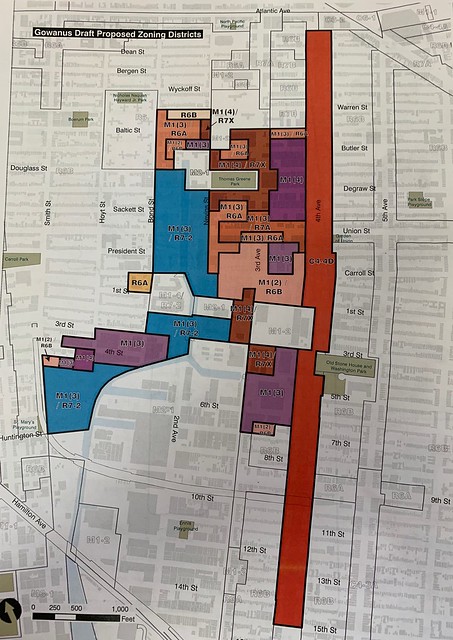
Proposed Gowanus upzoning  
Untitled
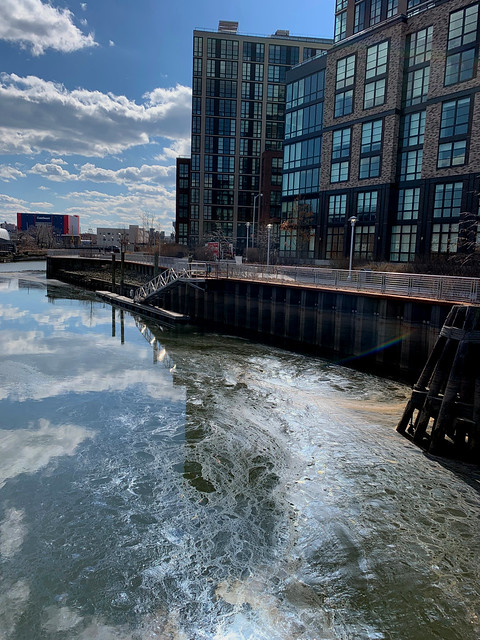
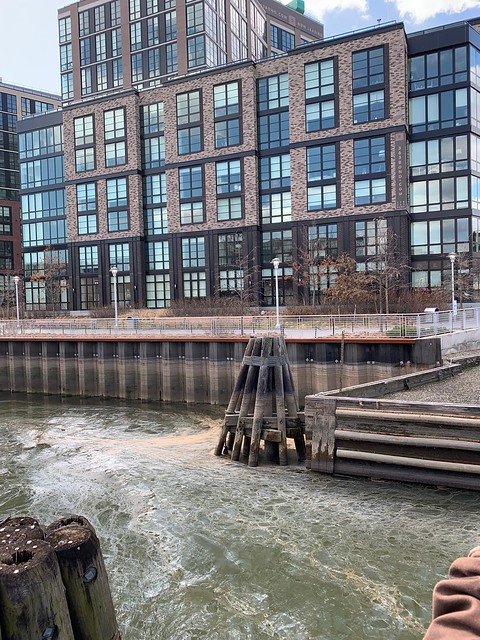
Raw Sewage and toxic discharges floating past 363 and 365 Bond Street in Gowanus
Untitled
A plume of sewage floating past 363-365 Bond Street
Untitled
How can New York City envision  an up-zoning that would bring thousands of new residents to the Gowanus Canal area when it has not yet addressed the fact that it still releases significant amounts of raw sewage into the waterway  and will continue to do so for at least another ten years?

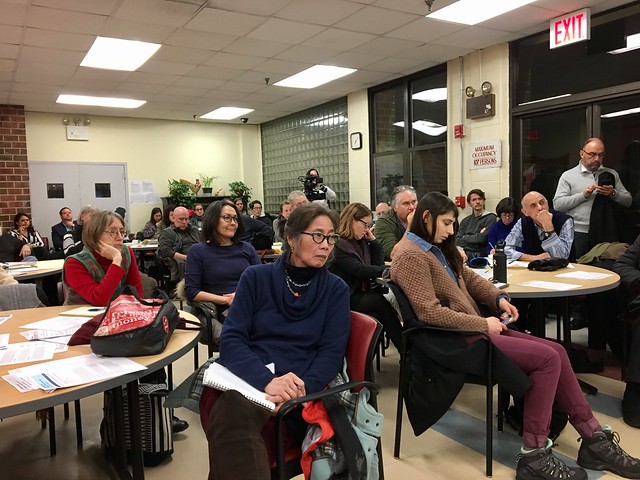
That is the question members of the Gowanus Canal Community Advisory Group asked  representatives of both New York City Department of City Planning (DCP) and NYC's Department of Environmental Protection (DEP) at the group's general meeting last night.

Either Jonathan Keller of NYC DCP or Angela Licata of NYC DEP were unprepared to give specific answers, but it became clear throughout the conversation that the City plans to allow new buildings to go up first, and then deal with the additional sewage afterwards
And that is all backwards.

How did we get here?
The City and developers have been itching to up-zone the Gowanus neighborhood to allow more residential developments. The proposal calls for buildings that may reach 22 to 30 stories along the heavily polluted canal, which the EPA declared a Superfund in 2010.

The rezoning is slated to move through the Uniform Land Use Review Procedure (ULURP) by the end of 2019. Since ULURP takes about 9 months to 12 months to complete, developers could potentially begin building their residential towers by the end of next year.

Everyone may also remember that EPA, as part of its Superfund clean-up, has mandated that NYC DEP must finally cease the practice of dumping raw sewage into the Gowanus Canal during heavy rain events. The Federal Government has ordered New York City to build two Combined Sewer Overflow tanks to remedy the situation and to protect its Superfund clean-up, once it is completed. The larger of the two tanks, is planned for the head of the Canal, next to the largest CSO outfall.

Instead of swiftly moving ahead with fulfilling its obligation in light of the City's rezoning efforts, DEP has managed to delay the completion date for the head of Canal tank, by first insisting on building it on land that needed to be taken by eminent domain instead of placing it under a City-owned park. Recently, the City has switched course entirely by proposing a tunnel under the canal, in place of the tank.

The community is looking at a scenario in which thousands more residents may be living next to an open sewer by 2020, while DEP is pushing the completion date for a CSO tunnel or tank  to 2030 and probably beyond.

Though Angela Licata last night told the Gowanus community that DEP had already invested significantly to reduce Combined Sewer Overflows (sewage) into the canal, with projects like a sponge park, rain gardens, high level storm sewers, investments on the Gowanus Pumping Station and controls of "floatables."

However, Licata revealed that even with the construction of the two EPA mandated CSO tanks, the City is dealing strictly with current CSO conditions, and is not addressing any additional measures to offset new development.
In other words, the current CSO remedy will be outdated the moment the up-zoning goes through and new high-rises get built.

Members of the CAG urged both DEP and City Planning to plan ahead and to think outside of the box. One of the  CAG suggestions was to write into the proposed rezoning that new buildings should be required to separate gray and black water to reduce the burden on our sewers.
Neither agencies seemed eager to push that idea forward.

In the absence of logical thinking by the City of New York, it is reassuring to know that the EPA, at least is planning for the future. The 2013 Gowanus Canal Superfund Record of Decision, the legal blueprint for the clean-up of the polluted canal, specifically requires that "the capacity of the retention tanks will need to accommodate the projected additional loads  to the combined sewer system as a result of current and future residential development, including future rainfall increases that may result from climate change."

DEP and DCP better figure out what more housing, more residents, and more poop would mean to a neighborhood that has literally been dumped on for decades.
Otherwise, we as a community, have a right to tell the City that no rezoning should be allowed to go forward before adequately sized CSO tanks are completed.


Read more

Tuesday, March 26, 2019

NYC Planning And DEP To Jointly Attend Gowanus Community Advisory Group Meeting Tonight

Untitled
Untitled
Untitled
Untitled
Raw sewage and toxic discharges floating on the serface of the Gowanus Canal, past 363 Bond Street and 365 Bond Street apartment buildings along the Gowanus Canal on March 19, 2019.

Tonight's Gowanus Canal Community Advisory Group's general meeting should be an interesting one, and since it is open to the public, I encourage local residents to attend.
On the agenda tonight are the New York City Department of City Planning (DCP) and NYC's Department of Environmental Protection (DEP). The two agencies have been invited by the CAG to "provide information on how the tunnel proposal and land use changes in the neighborhood will impact the Superfund process and remedy."

Here is why having both agencies in one room is important.
Everyone is hopefully aware by now of the upcoming upzoning of the Gowanus neighborhood. The rezoning will allow more residential developments along the Gowanus Canal, which the EPA declared a Superfund in 2010.
The proposal calls for buildings that may reach 22 to 30 stories along the heavily polluted waterway

The rezoning is slated to move through the Uniform Land Use Review Procedure (ULURP) by the end of 2019.  Since ULURP takes about 9 months to 12 months to complete, developers could potentially begin building their residential towers by the end of next year.

Everyone may also remember that EPA, as part of its Superfund clean-up, has mandated that NYC DEP must finally cease  the practice of dumping raw sewage into the Gowanus Canal during heavy rain events.  The Federal Government has ordered New York City to build two Combined Sewer Overflow tanks to remedy the situation. The larger of the two tanks, which will have an 8 million gallon capacity, is planned for the head of the Canal.

Instead of swiftly moving ahead with fulfilling its obligation in light of the City's rezoning efforts, DEP has managed to delay a completion date for the tank, by first insisting on building it on land that needed to be taken by eminent domain instead of placing it under a City-owned park,  and then to switch course entirely, by proposing a tunnel under the canal, instead of the tank.

So now, the community is looking at a scenario in which thousands of new residents may be living next to an open sewer by 2020, while DEP is still talking about a CSO tunnel/tank completion date of 2030.

Tonight's CAG meeting will therefore give the community an opportunity to ask these conflicting timelines. I hope you will take time to attend.


Full CAG Meeting
Tuesday, March 26, 2019
6:30pm
Mary Star of the Sea Senior Apartments, 41 1st Street, Brooklyn
Read more

Thursday, January 24, 2019

CSO Tank Vs CSO Tunnel: Is DEP's New Alternative Yet Another Way To Delay A Solution To Untreated Sewage Flowing Into The Gowanus Canal?


Untitled
Untitled
Untitled
Gowanus Canal CAG member Brad Vogel facilitating the meeting
Untitled
Kevin Clarke, NYC DEP project manager giving presentation


CSO TUNNEL vs. the CSO TANKS
Reflections on DEP's Presentation to the Gowanus Canal Community Advisory Group
on January 22, 2019

Dear Neighbors,
You may remember that as part of the Gowanus Canal Superfund Cleanup, the Environmental Protection Agency has named the City Of New York the second largest Potentially Responsible Party (PRP) for discharging "hazardous substance-contaminated untreated sewage" into the canal.

For decades, the City of New York has diverted Combined Sewer Overflow (raw sewage mixed with rainwater) into our canal during rain events, when our sewage treatment facility is overburdened.

As part of the Gowanus Canal Superfund Record of Decision signed in September 2013, a legally binding blueprint for the environmental clean-up of the canal, EPA has mandated that New York City construct an 8-million gallon tank and a 4-million gallon tank to address CSOs from outfalls RH-034 at the head of the canal and OH-007 at the Salt Lot in the middle of the canal, near Whole Foods.
These two tanks are a control measure meant to significantly reduce overall contaminated solid discharges to the waterway during heavy rain events and will protect the canal from being recontaminated after the Superfund clean-up.

EPA Region 2 suggested placing the 8-million gallon tank underneath the Double D pool at Thomas Greene Park near Nevins Street. The Agency reasoned that the pool needs to be removed anyway because it sits on the former Fulton Municipal Manufactured Gas Plant ,which needs remediation. Also, the parkland is owned by the City, which would save the acquisition cost.

Though this all sounded logical and very necessary to the Gowanus residents, the City came up with ways to shirk its responsibility, which it has successfully done since construction of this man -made canal began in 1849.

First, the NYC Department Of Environmental Protection (DEP) argued that a 5 million gallon at RH-034 and 2 million gallon tanks at OH-007 would be enough to meet the City's obligations.
When the EPA flatly said no, the City tried to complicate the project in the hope to delaying it. In the process, they also made it mind-blowingly expensive. ($1.2 billion so far)

First,  the City lobbied to place the 8-million gallon tank on two privately-owned parcels at 234 Butler Street and 242 Nevins Street that needed to be seized by eminent domain. (A third seized parcel will be used for staging during construction.)
The City also insisted on constructing an elaborate head-house for odor mitigation equipment and various screens,.

The City scored a victory of sorts, when, in June 2016, then-EPA Regional Administrator Judith Enck was willing to make concessions to the City by signing a settlement agreement allowing the siting of the 8-million gallon tank at  the head-of-the- canal site.
The agreement also:
- allowed the City to take land by eminent domain
-costs local residents more money in taxes and water rates.
-egregiously allows the City to re-contaminate  the canal with CSO for 2-7 years after the EPA's dredging and capping of the canal, because the tank will be completed after the Superfund clean-up.

Just as it seemed that New York City was finally moving forward, it threw another wrench in the works.  It proposed a CSO TUNNEL vs. the CSO TANKS.

In November 2018 at its monthly meeting, the Gowanus Community Advisory Group
(CAG) was shocked to hear DEP's bombshell announcement that the agency was advancing an alternate proposal for a Combined Sewer Overflow storage tunnel under the Canal, instead of the two CSO tanks that DEP has been advancing.

This past Tuesday, DEP's Kevin Clarke gave the CAG a presentation on the agency's newly proposed tunnel alternative, which will be 28-31 feet in diameter, 1/2 mile long, running from outfall RH-34 at the head of the canal to outfall OH-007 at the Salt Lot, following the alignment of the canal.  The soft ground tunnel will be 100 feet below the canal and is expected to have a 100 year life expectancy.

Clarke admitted that all work on the tunnel so far "has been conceptual" and that "the tank program" is "still moving ahead." He did tout several tunnel benefits:
-increased storage capacity
-provide equivalent solids reduction
-requires less disruption to the neighborhood during construction
-requires a comparable investment:$1.28 billion
-and provides a scalable system, allowing for future extensions to improve neighborhood flood resilience, accommodate future development and population  growth.

DEP expects the tunnel to be completed by 2030, which according to Clarke "is a little bit longer time frame" than the tanks.
This means that NO CSO WILL BE CAPTURED BY THE CITY IN THE GOWANUS CANAL BEFORE 2030. 

Unfortunately, the EPA was not at Tuesday's meeting because of the government shut-down, so there was no fact checking by the Federal Government.
Ultimately, it is EPA that will evaluate whether  the CSO tunnel alternative is acceptable.

Personally, I have listened to DEP presentations in regards to the CSO issue for more than ten years.
These are my take aways and thoughts after Tuesday's presentation:
- Let us never forget that New York City would never have addressed this grave environmental issue if it had not been compelled to do so by the EPA as part of the Superfund designation.
-To this day, the City's efforts to reduce raw sewage flowing into our canal has cost over 100 million and has so far only resulted in acquiring two parcels of real estate at the head of the canal by eminent domain.
-DEP seems to be in no hurry to build either tank or tunnel.  Why would it take 11 or more years to construct either one? 
-If DEP really wanted to capture more CSOs, why not make the two tanks larger to match the tunnel's 16 million gallon capacity?
-The City's argument that the CSO tunnel provides a more scalable system because it can be made longer may be compelling, but anyone in the community who believes that the City will come back any time soon to add additional sections may be too optimistic.
In all these years, we have only seen pretty slides and heard much empty talk from New York City. That is not about to change.

And on a rainy day like today, raw sewage still makes its way into our canal.
If you have forgotten what a CSO event in the Gowanus Canal looks like, here is a reminder.


Read more

Friday, May 18, 2018

'Not Gowanusy Enough' And "Save The Gowanus Station Building": Local Residents React To DEP's Proposed Gowanus Canal Combined Sewer Overflow Facility Design

Untitled
Untitled
Council Member Stephen Levin, in whose district the facility will be built.
Untitled
Michael DeLoach, DEP Deputy Commissioner of Public Affairs and Communications
Untitled
Alicia West, DEP Director of Public Design Outreach
Untitled
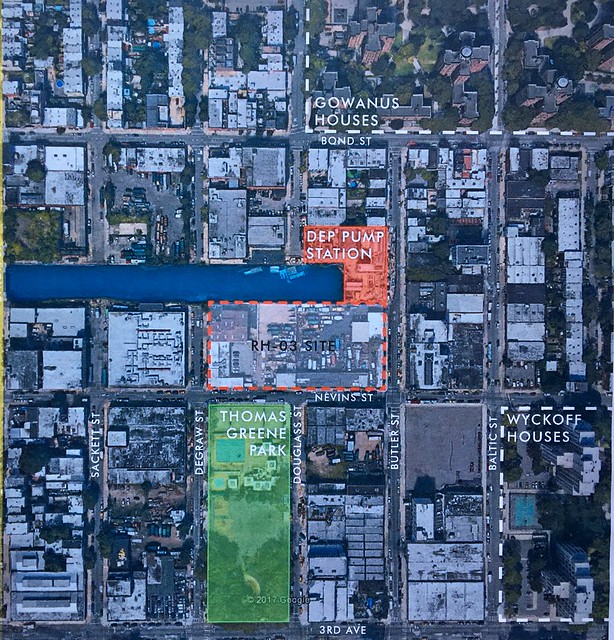
RH-03, the 2.4 acre site in Gowanus, where DEP is planning on building the facility.
Untitled
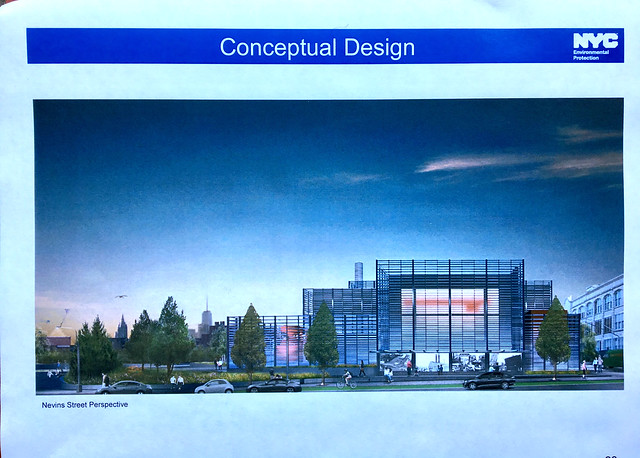
Conceptual Design for proposed Gowanus Canal CSO Facility at head of Canal
Conceptual design for the open public space planned over the retention tank.

Last night, New York City Department of Environmental Protection and Council Member Stephen Levin held a joint public meeting to give the community a preview of the proposed design for the Gowanus Canal Combined Sewage Overflow facility at the head of the canal at Butler Street.

You may remember that D.E.P. is required by the U.S. Environmental Protection Agency to build an 8-million gallon sewage retention tank at the head-end of the Gowanus Canal to reduce the volume of untreated wastewater entering the waterway as part of the Superfund clean-up.

D.E.P. has taken the requirement for a simple tank to a whole new level by insisting that the C.S.O. tank will also need a massive head house. The building will hold screens, a de-gritter and odor control equipment, as well as an electric room, boiler and other mechanical spaces.

Because of D.E.P.'s insistence that the 8-million gallon CSO Facility be constructed on two privately owned properties at Butler Street between Nevins and DeGraw Street instead of using City-owned parkland across the street as E.P.A. had suggested, the price tag has mushroomed. D.E.P. has estimated the cost for land acquisition of the two lots at $90 million alone, with an additional $400 million for the construction of the facility.

At a City Council hearing in March 2018, Kevin Clarke of D.E.P. spoke of a combined cost of $1.2 billion for both the 8-million gallon tank and a 4-million gallon tank in the middle portion of the canal  that the City is also required to build.
(It is important to note that the E.P.A. had estimated the cost for both the 8-million gallon AND the smaller 4-million gallon Canal at $77 million for both.)

At last night's meeting Council Member Stephen Levin, in whose district the head-of-the-canal facility will be constructed, defended this large expenditure and this financial burden to New York City taxpayers.

"The cost for both of these tanks is likely to be over $1 billion, which is massive. It deserves a long conversation and a real discussion on why that is. I think when you see [DEP's] presentation tonight, you'll get a sense of the scale of this project and why it could possibly cost that much. I just want to say, as an overall perspective, capital projects in New York City always cost much more than we think that they should. Whether it is a park, or a school, or a massive infrastructure project like this one, it is always, always more expensive," he explained." So when that price tag comes up, don't be shocked."

The City also hired Selldorf Architects and DLandStudios, the landscape firm currently positioning itself to make the most of the upcoming Gowanus Canal corridor re-zoning with their Gowanus Canal Sponge Park Masterplan.

Alicia West, DEP Director of Public Design Outreach gave the public its first real look at the proposed design of the massive head house at the northern end of the 2.4 acre site, and the public accessible open space over the tank itself.
To camouflage much of the more unsightly air intakes and outflows  required for the head house Selldorf Architects is proposing a 'breathable cloak" made of terra cotta louvers, like a 'Venetian blind.'
The architectural goal, according to D.E.P. was to establish a 'thoughtful architectural design that respects the character and feel of the neighborhood", by employing "materials that are evocative" of Gowanus.

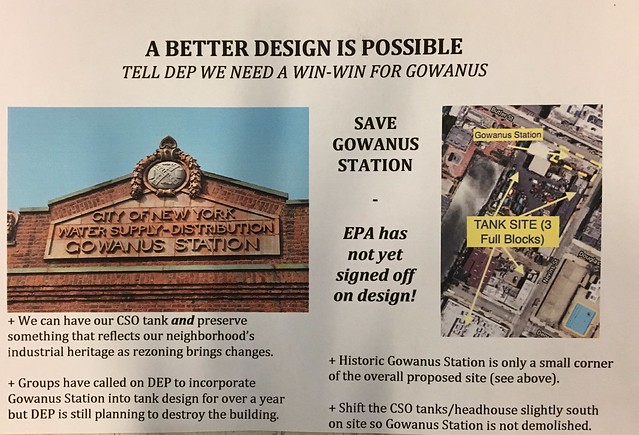
Michael DeLoach, DEP Deputy Commissioner of Public Affairs and Communications, left no doubt that his agency plans on demolishing the iconic and historic beaux-arts Gowanus Station building on the site, despite repeated calls from the community that is should be saved and incorporated into the overall facility. Instead, D.E.P. maintains that the building is in deplorable shape and can not be saved.
DeLoach explained that 'significant architectural elements' from the building will be saved and integrated on the site.

Most of the residents present seemed unconvinced that D.E.P. was really trying to save the building.
Gowanus resident Brad Vogel felt that D.E.P.'s design for the facility had "not started from a place where the Gowanus Station building would be preserved." He argued that saving 'tidbits' of the building was just not good enough and that pieces of a building, once stored in a warehouse, have a tendency to get lost.

The main goal for many who spoke up last night was to save the entire building, and to perhaps, use it as a community space.

As for the design of the head house and its Venetian-blind cladding, there was little enthusiasm.
People felt that is really did no truly reflect the neighborhood's character, as D.E.P. was claiming.
It was not "Gowanusy" enough, as one resident pointed out.

Suggestions for the 1.6 acres of proposed open space above the tank included a more active use, water access for boaters, indoor community spaces, and  covered areas for a makers market.
The community also urged D.E.P. to consider New York City's 2050 projections for sea level rise and to incorporate resiliency standards.

The most important aspect of all of this is that E.P.A. has yet to approve of D.E.P. 's engineering plans for the facility. It is also significant that E.P.A. will make the final determination whether the Gowanus Station will be saved or not.


Below is a flier handed out by a member of the community in regards to saving the Gowanus Station.
Untitled

Read more

Tuesday, May 15, 2018

We Must Pay Attention: D.E.P. To Hold Meeting For Community To Review Design For Gowanus Canal CSO Facility

I am encouraging begging everyone to attend a very important community meeting sponsored by the New York City Department of Environmental Protection and Council Member Stephen Levin on Thursday, May 17, 2018 to review the proposed design for the Gowanus Canal Combined Sewage Overflow facility at the head of the canal at Butler Street.

Why is this meeting important?

You may remember that D.E.P. is required by the U.S. Environmental Protection Agency to build an 8-million gallon sewage retention tank at the head-end of the Gowanus Canal as part of the Superfund clean-up to reduce the volume of untreated wastewater entering the waterway

D.E. P. has taken the requirement for a simple tank to a whole new level by over-designing, over-complicating, and over-spending with uncommon zeal for an agency that has happily allowed the canal to be used as an open sewer for decades and lobbied against the Gowanus Canal being declared a Superfund by E.P.A..

The cost of this tank has spiraled out of control. E.P.A. had estimated the cost of both the 8-million gallon and the cost for a smaller 4-million gallon in the middle section of the Canal at $77 million for both.
Because of D.E.P.'s insistance that the the 8-million gallon tank be constructed on private property instead of City-owned parkland as E.P.A. had suggested, the price tag has mushroomed.  D.E.P. has estimated the cost for land acquisition at $90 million alone, with an additional $400 million for the construction of the tank.
At a City Council hearing in March 2018, Kevin Clarke of D.E.P. spoke of a combined cost of $1.2 billion for both tanks.

Now, that is a crazy amount of money, prompting many in the community to wonder what D.E.P. is actually building: a simple retention tank or, as one local resident expressed, the Taj Mahal of sewer treatment facilities.

Now, keep in mind, the E.P.A. will have lots to say on the final design of the Gowanus facility at the head of the canal . However, the meeting on Thursday gives the community an opportunity to ask some real questions regarding run-away cost,  necessity of such an over-designed facility, the
protection of the iconic Gowanus Station building, a sweet old indutstrial brick structure situated on the project site and which D.E.P. wants to demolish despite calls from Gowanus residents to incorporate it into the final design. More broadly, we can ask what we actually get in return.

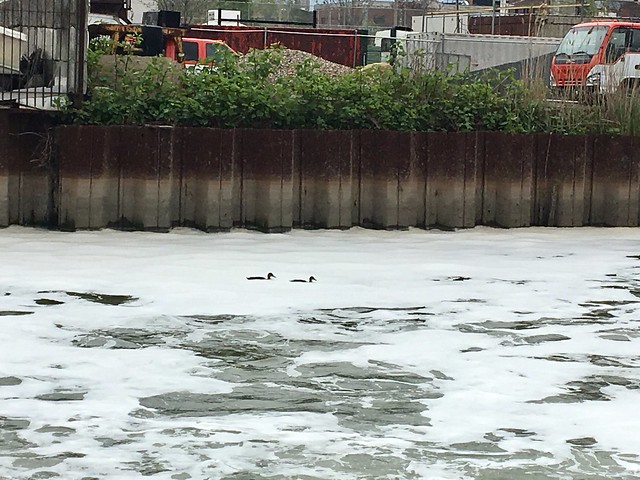
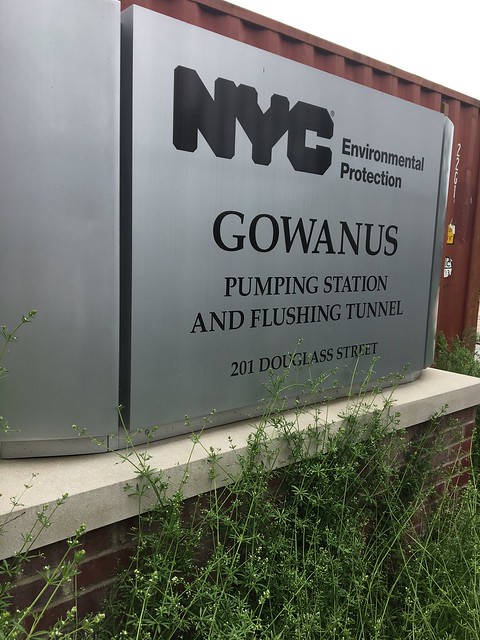
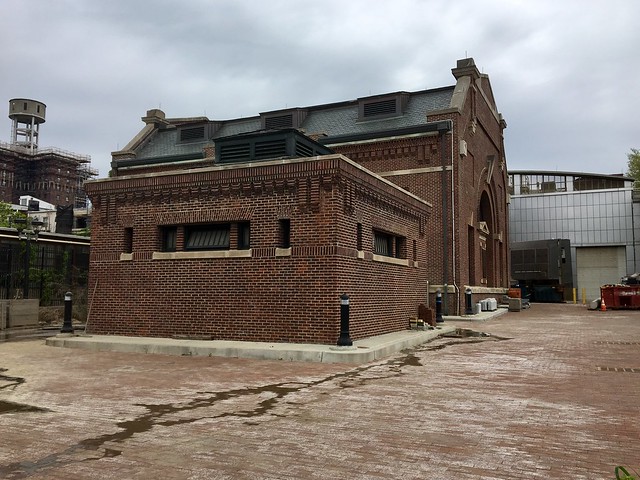
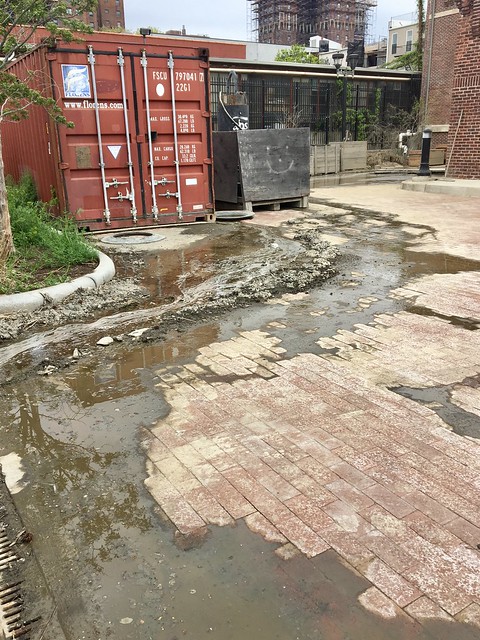
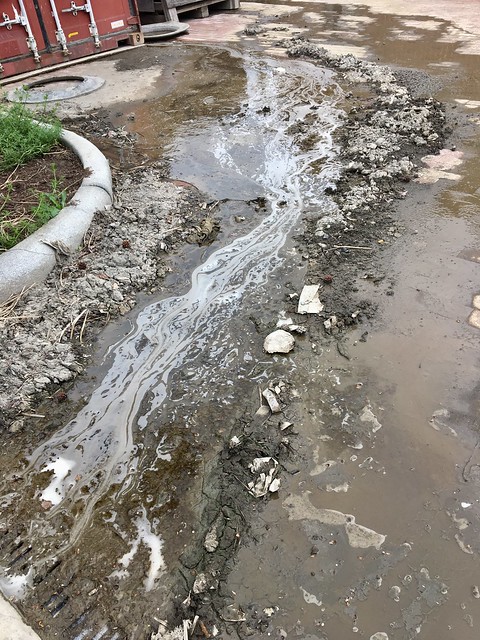
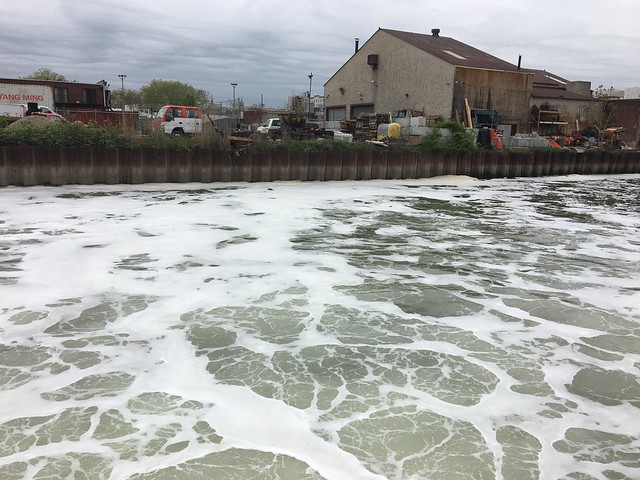
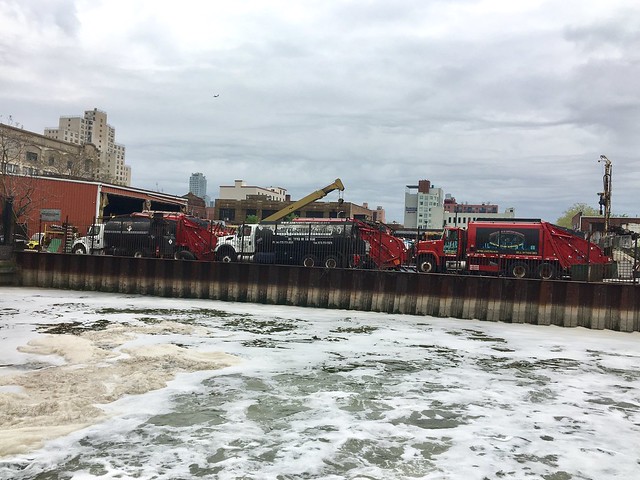
Lastly, it gives Gowanus residents a chance to ask D.E.P. about its other facility upgrade across from the canal: The Gowanus Canal Pumping Station and Flushing Tunnel that seems to be plagued by major design flaws. Since the station and the tunnel were put back into service a few years ago, massive amounts of foam has been created at the head of the canal. It is so bad, that the community has dubbed it the Gowanus"Cappuccino effect".
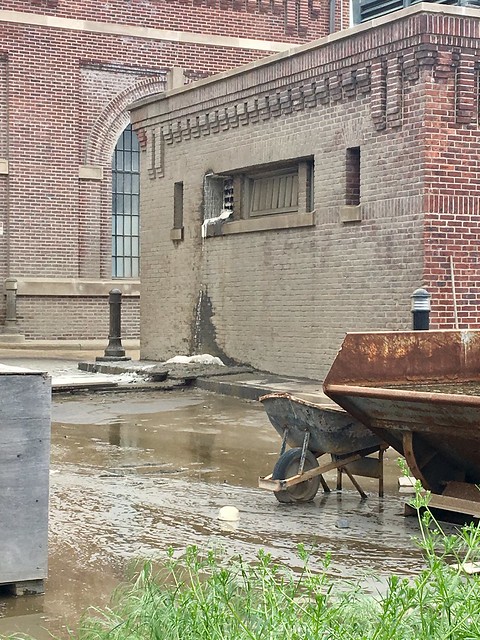
There is even foam oozing out of one of the buildings. And then there is the strange run-off that flows out of the pumping station.

Gowanus history should have taught us by now that D.E.P. has been more than negligent here in our community.  Let us ask the hard questions on Thursday's meeting. I will be there. Hope you will be there, too.

Below, a few photos of the Gowanus Cappuccino foam and strange leaks from the Gowanus Pumping Station, taken a few days ago.

Untitled
Untitled
Untitled
Untitled
Untitled
Untitled
Untitled
Untitled


Read more

Tuesday, April 10, 2018

SAVE Gowanus Station: Join Tonight's Candlelight Vigil To Preserve Iconic Neighborhood Building

IMG_1058
IMG_1055
IMG_1056
Here is a reminder to all who love Gowanus and its unique history as one of the United States first industrial neighborhoods. Please join tonight's candle light vigil and help save one of our community's most iconic buildings.
Neighborhood Candlelight Vigil Tomorrow - Save Gowanus Station - April 10th
Join a coalition of Gowanus neighborhood groups and residents as we ask public officials to avoid demolishing the iconic Gowanus Station building at 234 Butler Street. The candlelight vigil at Gowanus Station starts at 6:30 p.m. on April 10th (rain date April 12 at 6:30 p.m.).

For a bit of background:
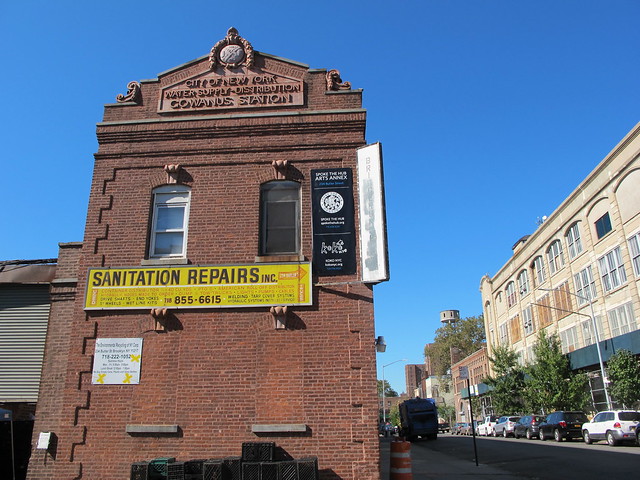
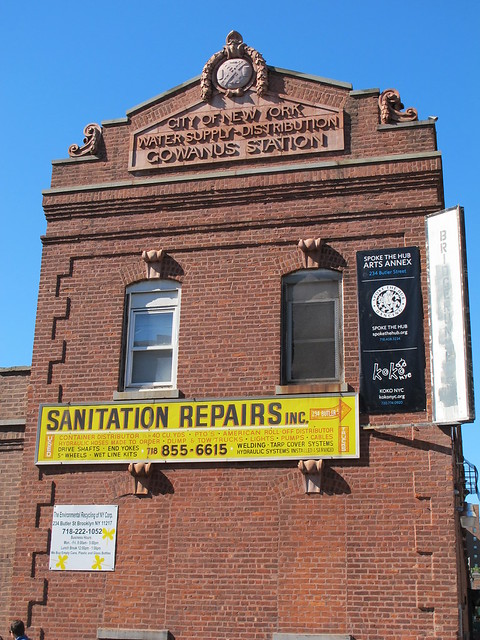
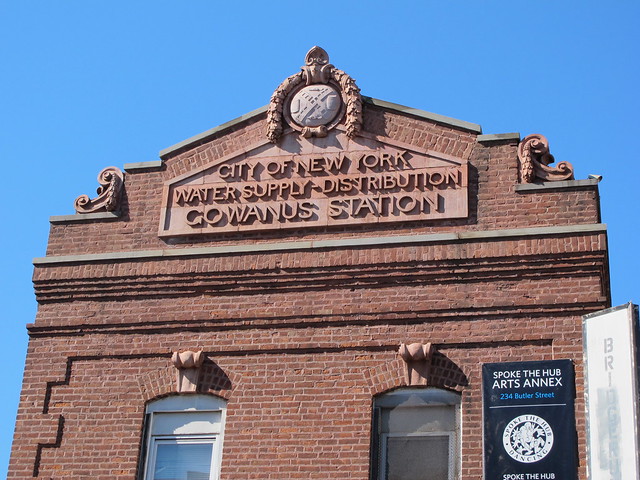
If the NYC DEP has its way, the beautiful former City of New York Water Supply Distribution Gowanus Station building at 234 Butler Street at the corner of Nevins Street will be demolished as part of the current plan to build an 8 million gallon Combined Sewer Overflow tank and facility head house on a large site that currently includes the Gowanus Station footprint.

This two-story beaux-arts style building, built in 1913 by the Department of Water Supply, Gas and Electricity, not only reflects the larger context of Gowanus as one of the earliest and busiest industrial and manufacturing centers in this country, it is also unique for being the only building that actually bears the name of the neighborhood.

The vigil is not in opposition to the CSO tank; we support construction of the tank, but there are creative design alternatives that would permit retention of the historic Gowanus Station building as a key part of neighborhood identity. For more details, please see the web link. 


For more on the Gowanus Station and what is at stake, click here:
A SAVE ME banner is a recent addition to the building


Read more