Showing posts with label Angela Licata. Show all posts

Wednesday, March 27, 2019

Same As It Ever Was In Gowanus: It Is Clear That New York City Plans To Allow New Housing First, Deal With Extra Sewage Later.

Untitled
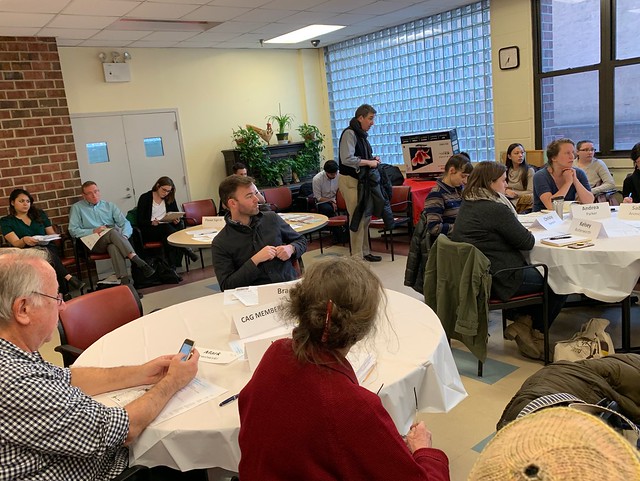
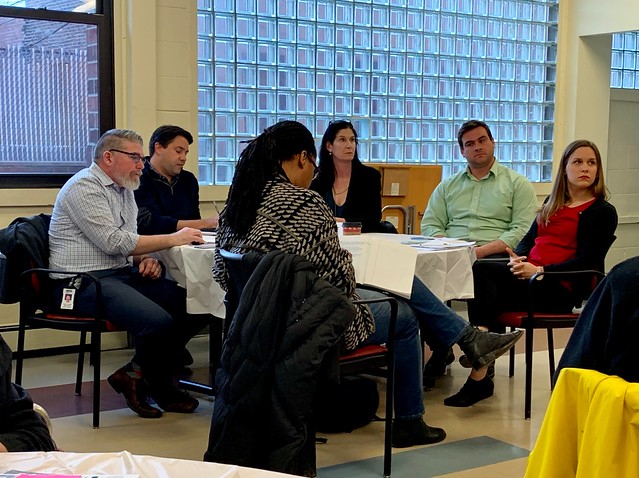
March 27 2019 meeting of the Gowanus Canal Community Advisory Group
Untitled
Untitled
Untitled
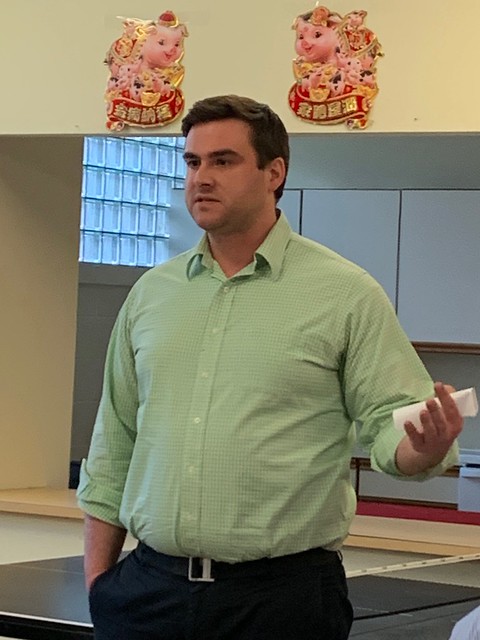
Jonathan Keller, NYC Department of City Planning
Untitled
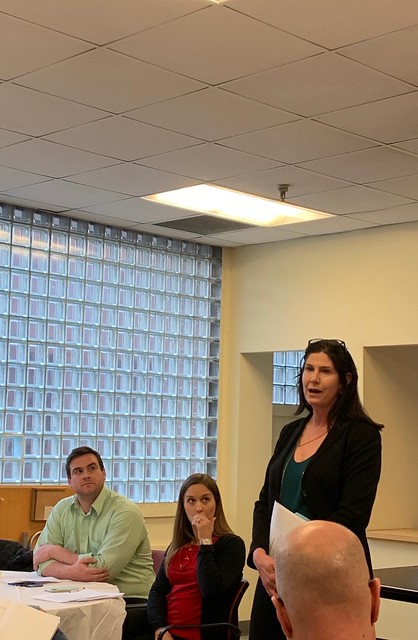
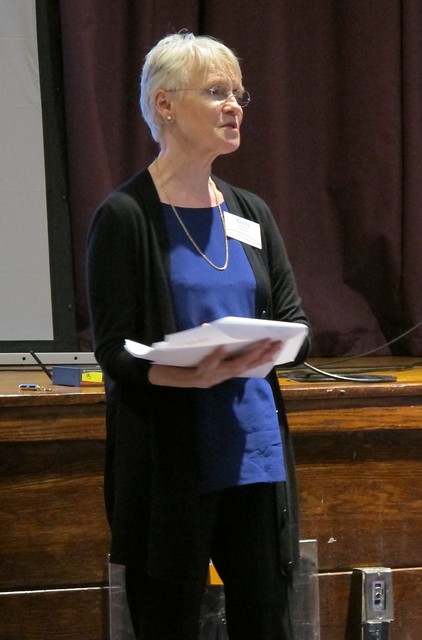
Angela Licata, NYC DEP Deputy Commissioner
Untitled
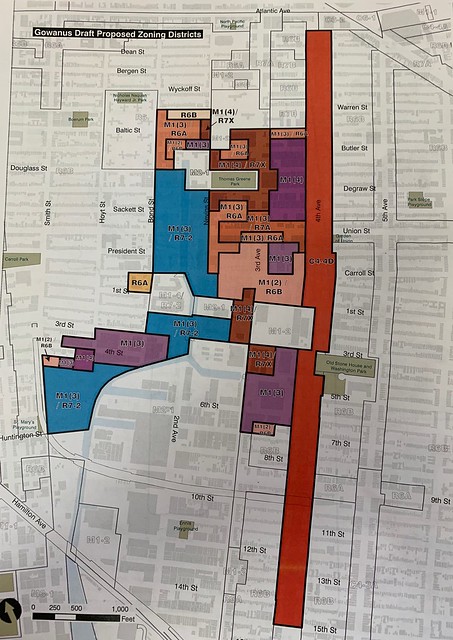
Proposed Gowanus upzoning  
Untitled
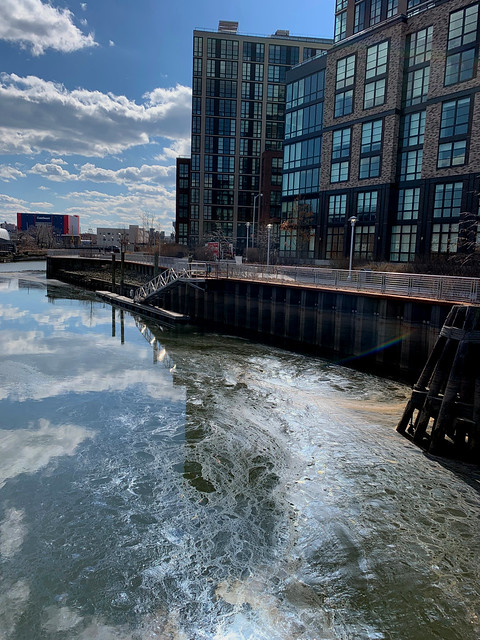
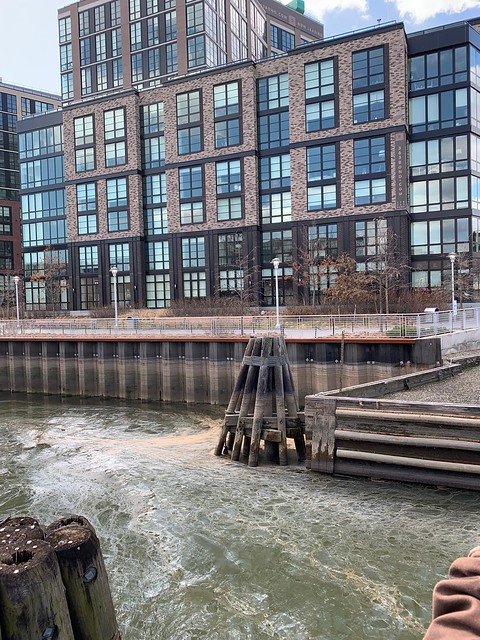
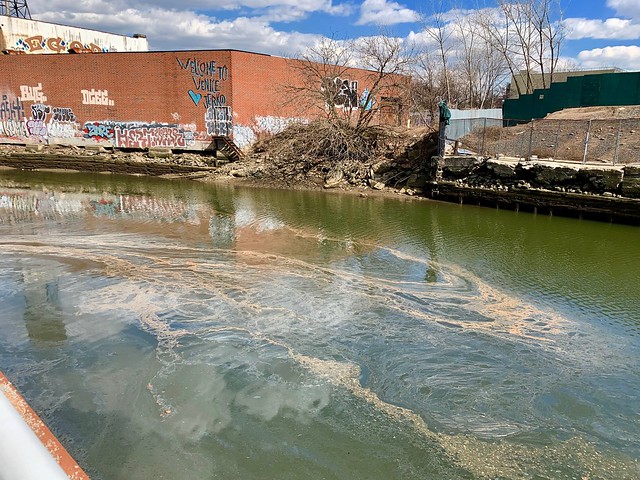
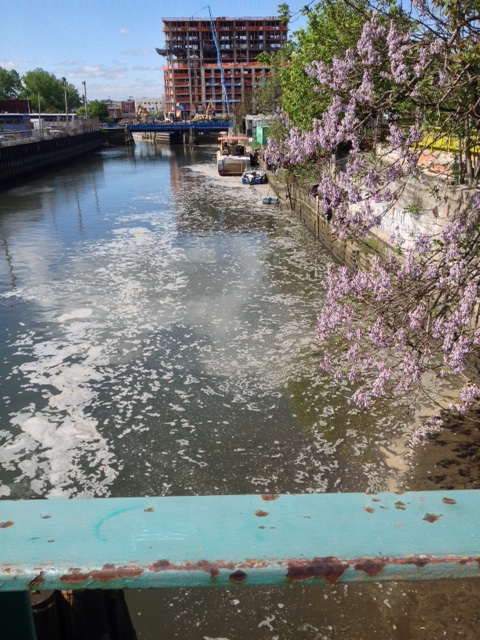
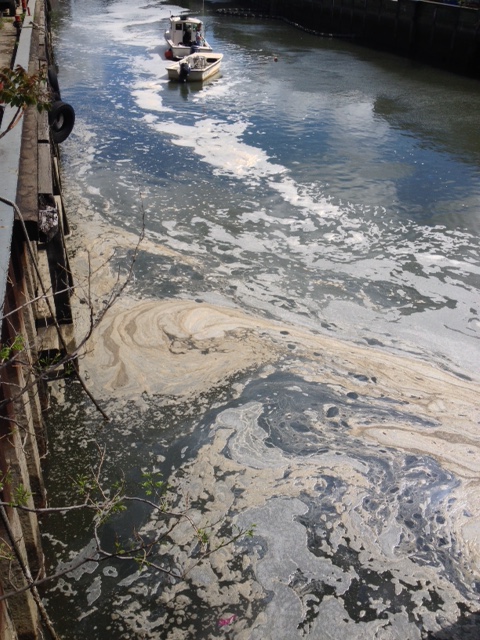
Raw Sewage and toxic discharges floating past 363 and 365 Bond Street in Gowanus
Untitled
A plume of sewage floating past 363-365 Bond Street
Untitled
How can New York City envision  an up-zoning that would bring thousands of new residents to the Gowanus Canal area when it has not yet addressed the fact that it still releases significant amounts of raw sewage into the waterway  and will continue to do so for at least another ten years?

That is the question members of the Gowanus Canal Community Advisory Group asked  representatives of both New York City Department of City Planning (DCP) and NYC's Department of Environmental Protection (DEP) at the group's general meeting last night.

Either Jonathan Keller of NYC DCP or Angela Licata of NYC DEP were unprepared to give specific answers, but it became clear throughout the conversation that the City plans to allow new buildings to go up first, and then deal with the additional sewage afterwards
And that is all backwards.

How did we get here?
The City and developers have been itching to up-zone the Gowanus neighborhood to allow more residential developments. The proposal calls for buildings that may reach 22 to 30 stories along the heavily polluted canal, which the EPA declared a Superfund in 2010.

The rezoning is slated to move through the Uniform Land Use Review Procedure (ULURP) by the end of 2019. Since ULURP takes about 9 months to 12 months to complete, developers could potentially begin building their residential towers by the end of next year.

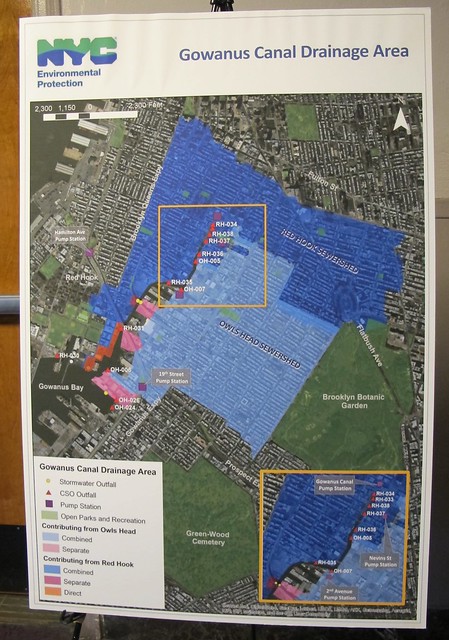
Everyone may also remember that EPA, as part of its Superfund clean-up, has mandated that NYC DEP must finally cease the practice of dumping raw sewage into the Gowanus Canal during heavy rain events. The Federal Government has ordered New York City to build two Combined Sewer Overflow tanks to remedy the situation and to protect its Superfund clean-up, once it is completed. The larger of the two tanks, is planned for the head of the Canal, next to the largest CSO outfall.

Instead of swiftly moving ahead with fulfilling its obligation in light of the City's rezoning efforts, DEP has managed to delay the completion date for the head of Canal tank, by first insisting on building it on land that needed to be taken by eminent domain instead of placing it under a City-owned park. Recently, the City has switched course entirely by proposing a tunnel under the canal, in place of the tank.

The community is looking at a scenario in which thousands more residents may be living next to an open sewer by 2020, while DEP is pushing the completion date for a CSO tunnel or tank  to 2030 and probably beyond.

Though Angela Licata last night told the Gowanus community that DEP had already invested significantly to reduce Combined Sewer Overflows (sewage) into the canal, with projects like a sponge park, rain gardens, high level storm sewers, investments on the Gowanus Pumping Station and controls of "floatables."

However, Licata revealed that even with the construction of the two EPA mandated CSO tanks, the City is dealing strictly with current CSO conditions, and is not addressing any additional measures to offset new development.
In other words, the current CSO remedy will be outdated the moment the up-zoning goes through and new high-rises get built.

Members of the CAG urged both DEP and City Planning to plan ahead and to think outside of the box. One of the  CAG suggestions was to write into the proposed rezoning that new buildings should be required to separate gray and black water to reduce the burden on our sewers.
Neither agencies seemed eager to push that idea forward.

In the absence of logical thinking by the City of New York, it is reassuring to know that the EPA, at least is planning for the future. The 2013 Gowanus Canal Superfund Record of Decision, the legal blueprint for the clean-up of the polluted canal, specifically requires that "the capacity of the retention tanks will need to accommodate the projected additional loads  to the combined sewer system as a result of current and future residential development, including future rainfall increases that may result from climate change."

DEP and DCP better figure out what more housing, more residents, and more poop would mean to a neighborhood that has literally been dumped on for decades.
Otherwise, we as a community, have a right to tell the City that no rezoning should be allowed to go forward before adequately sized CSO tanks are completed.


Read more

Saturday, May 16, 2015

NYC DEP Willing To Depend On Eminent Domain To Solve Gowanus Drainage Problems

IMG_4002
IMG_3995
IMG_4001
New York City Department of Environmental Protection Commissioner Emily Lloyd
IMG_4017 1
NYC DEP Deputy Commissioner Angela Licata
IMG_3996
IMG_4018 1
IMG_3998
IMG_4020 1
NYC DEP  assistant Commissioner Jim Mueller
Screen Shot 2015-05-16 at 6.34.37 PM
DEP short list for RH-034 CSO Tank siting
IMG_4023 1
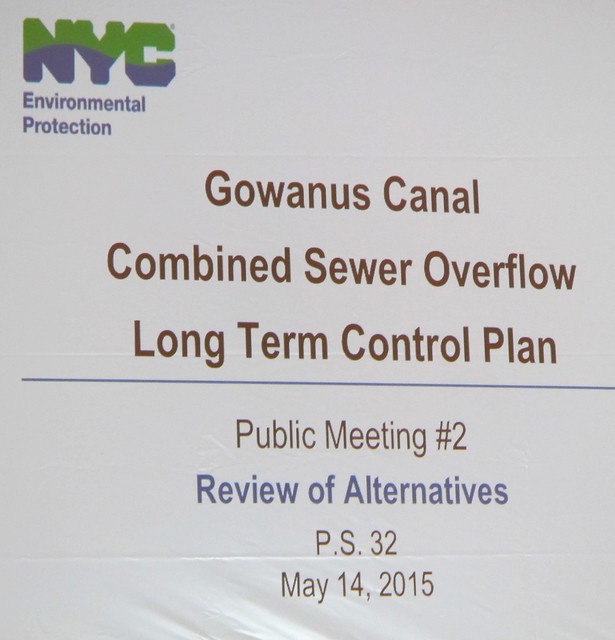
New York City Department Of Environmental Protection (DEP) Commissioner Emily Lloyd came to PS 32 on Hoyt Street on Thursday evening to present the second in a series of meetings related to the Combined Sewer Overflow Long Term Control Plan for the Gowanus Canal.

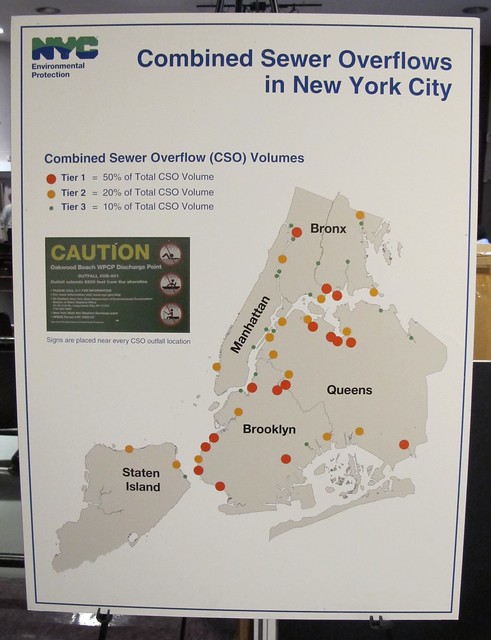
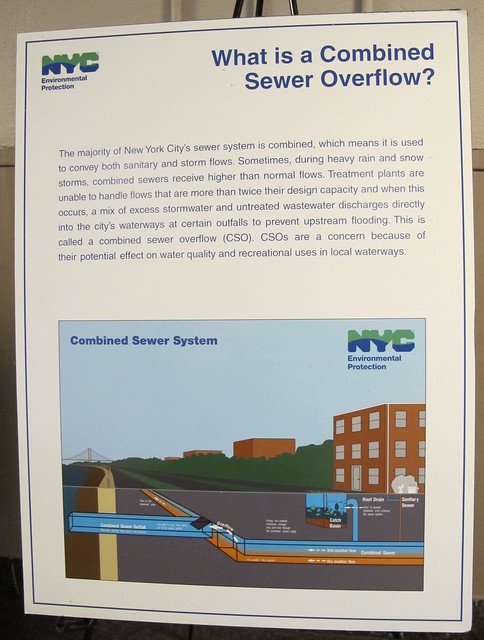
As you may know, the City diverts raw sewage mixed with rainwater directly into the Gowanus Canal and other water bodies during rain events, when our sewage treatment facility is overburdened. This violates the Clean Water Act of 1972.

In addition, the Environmental Protection Agency, as part of its Superfund investigation of the Gowanus Canal, has identified the City as the second largest Potentially Responsible Party (PRP) for discharging "hazardous substance-contaminated untreated sewage" into the canal.

Thursday night's presentation by Commissioner Lloyd focused on the work the City has already completed to address the CSOs and what measures it will implement in the future.

The Gowanus gray infrastructure improvements that have already been undertaken include upgrades to the  Gowanus Pumping Station and  to the Flushing Tunnel.
The Gowanus Pumping Station was put back into operation in June 2014. According to DEP,  the upgrades have increased pumping capacity from 20 to 30 million gallons per day.
Since May 2014, the three pumps at the Flushing Tunnel are operating, which has increased the flow through the tunnel, and improved dissolved oxygen in the water.

Further, the DEP is investing in green infrastructure in Gowanus. So far the agency has built 18 bioswales, has installed porous pavement installation at 4th Street and 5th Avenue, installed a porous playground surface at PS 261.  The Agency has provided a grant towards the Gil Hodges Community Garden's storm water management system.  90 more bioswales and 2 storm water green streets are currently under construction. 

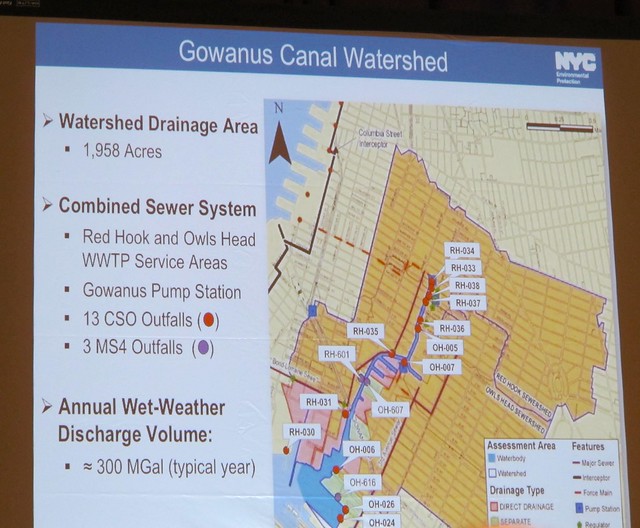
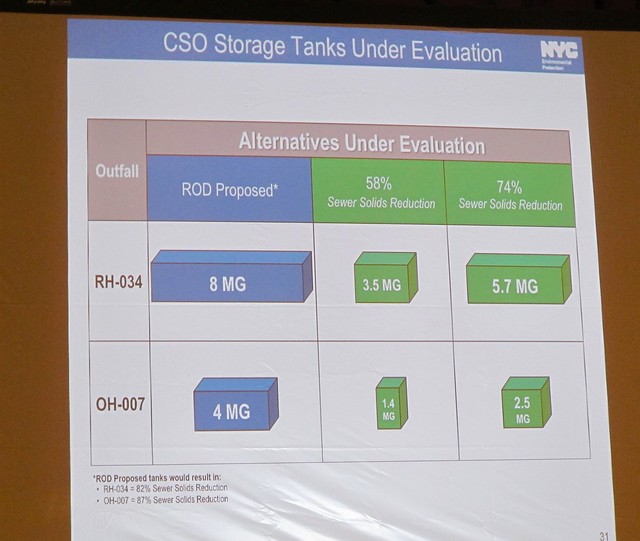
Commissioner Lloyd also spoke about the location of two CSO retention tanks that the EPA is requiring the City to construct in order to protect its remedy for the Gowanus Canal. Construction of these retention tanks is an important part of the remedial design. As per the EPA, the tanks are "combined sewer overflow (CSO) control measures for the upper reach of the Canal to significantly reduce overall contaminated solid discharges to the Canal." The retention tanks will retain discharges from two of the largest outfalls in the canal, RH-034 and OH-007 and will reduce the CSO in the canal by 58% to 74%. 
According to the Federal Agency,"it is estimated that an 8-million gallon tank and a 4-million gallon tank shall be required to address CSOs from outfalls RH-034 and OH-007, respectively."

Though the EPA had suggested two sites for the retention tanks, the agency was willing to discuss alternative locations.  The City has until June 30 to make a final site decision.
Commissioner Lloyd explained: "There are two things the EPA told us we could evaluate: one is the locations for those two tanks, and the other was that we could look at alternative sizes for the tanks if we thought we could achieve the 58% to 74% reduction goal with some alternatives other than the tanks.  So we have been looking at those. We are not complete with our evaluation, but we think we are getting close."

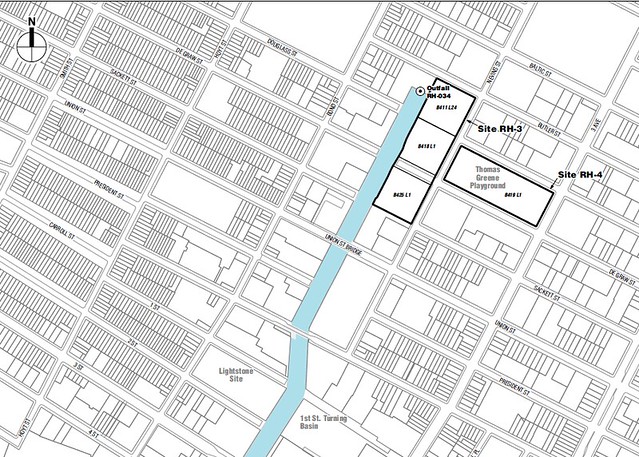
DEP is considering two sites for the retention tank for outfall RH-034. The first site are two privately owned lots directly adjacent to the canal between Douglass Street and DeGraw Street.  The second location is directly across the street at Thomas Greene Park.
"Between those two sites, we think we are likely to recommend the first site," Commissioner Lloyd told the community. "The reasons for that are emerging. First,  because of its proximity to the rest of our infrastructure, it will be more efficient to construct and operate.  The second reason is that if we go to the park site, we will need a surface building to manage the mechanics and because of potential storm surges, it can't be low. So we have to go up and we are concerned that it will cover significant portions of the park. This means that during construction of the tank, we would disrupt most of the park."
She added:"We and the Parks Department are extremely concerned and very reluctant to lose that piece of parkland."
Lloyd indicated that even with the cost of acquiring the privately owned sites, it still would be cost effective.

The DEP also looked at two sites for outflow OH-007 in the middle of the canal.  The agency seems to have settled on the site known as the 'Salt Lot' near the 5th Street turning basin, which is owned by the Department of Sanitation.  "It is likely that  that is the one we will recommend to the EPA, unless something turn up in our analysis from now till the end of June that surprises us," Lloyd said.
She added: "There is one other alternative that we are looking at concerning the OH-007 outflow. There is some excess capacity in the sewer system going to Owl's Head [sewer treatment plant], beyond the canal.  We are looking if we can divert flow from OH-007 into the sewer lines to Owl's Head."

Mysteriously, the DEP seems to have found so many ways to capture rainwater in and around the Gowanus watershed, that the agency is now trying to reduce the size of the EPA-mandated tanks from
an 8 million gallon tank to a 3.5 or 5.7 million gallon tank at RH-034, and from a 4 million gallon tank at OH-007 to a 1.4 or 2.5 million gallon tank. (see chart above).
Lloyd explained that the smaller tanks, according to DEP calculations would achieve the 58% to 74% CSO reduction mandated by the EPA.  "An 8 million gallon tank would achieve 82% reduction, which is above what EPA set as as a goal. We are always looking to see if we can meet targets in the canal at a less costly level."

After the presentation, the community had a chance to ask questions.

Asked if DEP is looking at population projections and the effect of new development on the retention tanks and sewage capacity,  Lloyd simply replied: "yes, we are doing population projections in the area."

My question related to the siting of the larger tank at the head of the canal and DEP's preference to locate it on private property instead of placing it on park land that it already owns.
"Have you talked to the owners of the property? Have you negotiated a price? Are they willing to sell?  If they do not want to sell, does that mean you need to take the land by eminent domain, which is going to take a long, long time?  Is that a delaying tactic by the City?" I asked.
Her answer:
"Yes, we have spoken to them.  We know what the fair market value of the land is.  Yes, if they are unwilling to sell and that is the selected site, we will proceed to eminent domain. We actually think that this can be expedited and we think that we can accomplish that much quicker than doing the work on the [Thomas Greene] park site."

It will be interesting to see what calculations DEP is using to make the argument that using eminent domain to site the tank at RH-034 is as cost effective and timely as placing it on parkland that it already owns.

One can only imagine what the EPA will think of DEP's  suggestion.
The Federal Agency, in its Record of Decision, which represents a blueprint for the cleanup of the Gowanus Canal,  had suggested Douglas Greene Park and the pool as the preferred site for the tank.
The EPA reasoned that:
- the park is one of the only open pieces of land in this densely populated area. 
-the land is already owned by New York City.
-Thomas Greene Park was constructed over the former Fulton Municipal Works Manufacturing Plant (MGP), which operated on the site from 1879 to 1929. Today, the land underneath the park is still heavily contaminated with coal tar. Since some of this free liquid tar is moving towards the canal, National, Grid, which bought Brooklyn Union Gas/National Grid in 2006, needs to address the problem. The work will be done under NYS Department of Environmental Conservation supervision.

The EPA logically concluded that constructing the tank under the swimming pool area of the park could be combined with the remediation work.

Recently, the DEC released its proposed Environmental Remediation plan. The primary components of the remedy "are the construction of a sealed wall along the western shoreline of the Gowanus Canal and the removal of any coal tar that accumulates behind it." 
They appear to be willing to let National Grid off the hook to clean up the former Fulton site until "an opportunity presents itself".  Many wonder if we are missing an opportunity right now, with EPA in charge of a massive remediation.  We should be outraged that once again this can is kicked down the road for our children and grandchildren to clean up.

So, there you have it reader, we await the final decision of our city and state and hope that they are fully seizing this opportunity to finally clean up our polluted neighborhood and to cooperate with the EPA.  We will know for sure in less than two months.


PS:
I also mentioned the suds that have been covering the Gowanus Canal lately. The problem seems to originate at the top of the canal near the flushing tunnel at Douglass Street. It would appear that the three new pumps which the DEP has installed introduce massive amounts of air and movement into the water, which could be stirring up household soaps and fats, which end up in the Gowanus by way of the CSO outflow right next to the flushing tunnel. The effect has become known to many in the Gowanus community as the 'milkshake' effect.
Since we have mostly had dry weather this spring, I asked Emily Lloyd if that was an indication that sewage was flowing into the canal even when there were no rain events."Not to give a definitive answer tonight, but we don't think this is from the CSO," Commissioner Lloyd answered. "We really think that it is the aeration coming from Buttermilk Channel. That's a very aerated flow that is coming in, and we think that as it comes in, it churns up. That is our preliminary thought at this point."


Photos illustrating the 'Gowanus milk shake effect" taken a few days ago by Reader Andrew
IMG_3446
IMG_3450-2


Read more

Tuesday, April 03, 2012

Members Of Gowanus Canal CAG Sit Down With DEP Representatives And Ask Agency To Do More

IMG_7250
IMG_7247
IMG_8520
IMG_6963
IMG_6962
IMG_6965
IMG_6969
Jim Mueller, Assistant Commissioner DEP,  Angela Licata, Deputy Commissioner,  Kevin Clarke,  environmental engineer.

Testimony of Carter Strickland,Commissioner, New York City Department of Environmental Protection (DEP), March 27, 2012
"At the moment DEP is concerned that EPA is considering a complete cessation of CSOs into the Gowanus Canal as part of the Superfund cleanup, even though the site was put on the National Priorities List because of contaminated sediment from historic industrial processes unconnected to the sewer system. Under the Clean Water Act and the CSO program administered by the State, DEP has considered whether CSOs could be reduced to near zero and concluded that it would be infeasible and that tanks or tunnels could cost billions without a substantial increase in water quality. Needless to say, a billion-dollar construction project in this area of Brooklyn would also create daunting traffic and construction-related impacts for well over a decade. Accordingly, DEP selected our current $136 million Gowanus Facilities Plan, which will reduce CSOs by 34% plus another 10% from High-Level Storm Sewers and green infrastructure. We are in active discussions with the EPA right now, and strongly disagree with the position that an enormous City-funded construction project is a necessary prerequisite to an EPA-led Superfund cleanup."
Last night, members of the EPA Gowanus Canal Superfund Community Advisory Group's Water Quality and Technical Committee met with representatives of the City's Department Of Environmental Protection to engage in a more meaningful dialog with the agency and to advocate for the elimination of Combined Sewer Overflow Discharges that result in the presence of pathogens in the waterway, including coliform and enterococci.
These pathogens present unacceptable health risks from contact with the water and sediments of the Canal.  As long as New York City, which has been named a Potencially Responsible Party (PRP) for its role in contributing to the toxins, allows CSOs to continue to discharge into the Gowanus, there will be ongoing environmental and potential human health risks, as well as a high chance of recontamination even after the Superfund clean-up.

Representing the DEP last night were Angela Licata, Deputy Commissioner, Jim Mueller, Assistant Commissioner, Planning and Capital Projects, Kevin Clarke and Julie Stein.   Members of the CAG did not lose any time to let DEP know that the Community expected the agency to work together with EPA to get the most comprehensive, effective clean-up within the timeframe of the Superfund. "This is great opportunity to kill two birds with one stone by investing the necessary money to have the water that goes into the canal be as clean as it can be," stated one CAG member. "Get it done right. Get it done once. Get it done now," another member told the DEP representatives. Yet another added: "We would like to see the same level of engagement from DEP as we see from EPA."
Yes, New York City is currently in the process of implementing upgrades to the Gowanus Canal facilities, which it claims will reduce CSO discharges by about 34% and another 10% from newly installed High-Level Storm Sewers and green infrastructure. That, however, simply is not good enough for many members in the community. "We have a pretty good understanding of what the City is proposing, but frankly, more needs to be done. We want more," member Steven Miller stated.

"We see this as a very opportune time for us to begin anew and to think of the long-term planning for the canal," Angela Licata told the CAG. She was quick to point out that the City's combined sewer system is a legacy system. "When it rains, you are not going to engineer your way out of that. If you never want to have sewer in the canal again, we will have to separate the system." Indeed, the gray infrastructure in the Gowanus area is underserving the community on all fronts even with the current upgrades. In addition, no real planning seems to have gone into providing new infrastructure for all the additional housing that is likely to be built along the canal in the near future.

Licata also spoke of the consent order just negotiated between NYC and Albany. "Our commitments and requirements persuent to that, require that we build out green infrastructure to a certain extend. We have to get 1" of rain over 10% of the impervious areas in the CSO watersheds of the City. And we need to develop these so-called long-term control plans. Those should envision a path forward that will carry us for the next 10 to 20 years."
(This sounds more impressive than it is. Basically, it means that New York State's Department Of Environmental Conservation has once again allowed the City to not meet the Federal clean water standards set decades ago.)

"We have to develop a plan for that waterbody," Licata continued. "We think it is quite appropriate that we start to envision this with you. What we will be looking at is a combination of solutions where we want to evaluate all the possible alternatives We need to do that in a way that achieves certain goals. We have to be able to move some of the dials on water quality and we also have to look at what is going to be cost effective."

CAG member Rita Miller mentioned that the EPA has suggested that a retention basin would solve the problem of toxins being emitted into the Gowanus.  Miller added "At the same time, it would do wonders for the pathogens flowing into the canal and perhaps satisfy some of the Clean Water Act requirements as well. Why does there seem to be resistance to that suggestion?" she asked Licata. "It seems perfectly reasonable to us. It seems like a perfectly do-able plan. You have done it in other places."

Licata's answered: "We have done retention tanks. Its a no-brainer. We have done it at Paerdegat Basin, Alley Creek and Flushing. So why not do it here? One of the things is that at those locations, you had a tremendous amount of volume that was all located at one point, so that the economy of scale was tremendous." She added: "I just want to be clear. Its not that we are discounting it here. I think it's a fair question. We should take another look at it. But I think the cost benefit on that is going to be really, really tough."

Rita Miller responded: "I would like to remind you that this is a very densely populated area. City Planning has a framework that makes it even denser. I don't see any reason why the kind of attention that has been given to other neighborhoods would not be given here, given the fact that this canal is so tiny, so narrow, that the concentration of toxins is just tremendous."


I can only speak for myself, but as a CAG member and a long time resident, I have the feeling that the City is trying to shirk its responsibility towards the Gowanus Canal Community for as long as it can. Rather than to work with the EPA to find a real solution that would address the CSOs in conjunction with the Superfund clean-up, it is trying to stall and kick the problem down the road.

Shame on Mayor Bloomberg, Deputy Mayor Caswell Halloway and DEP Commissioner Carter Strickland for continuing to ignore the community and for proposing a sorely inadequate plan to deal with a real health problem.
Stop lobbying and do what's right, already!


Read more