Showing posts with label CAG. Show all posts

Friday, May 29, 2015

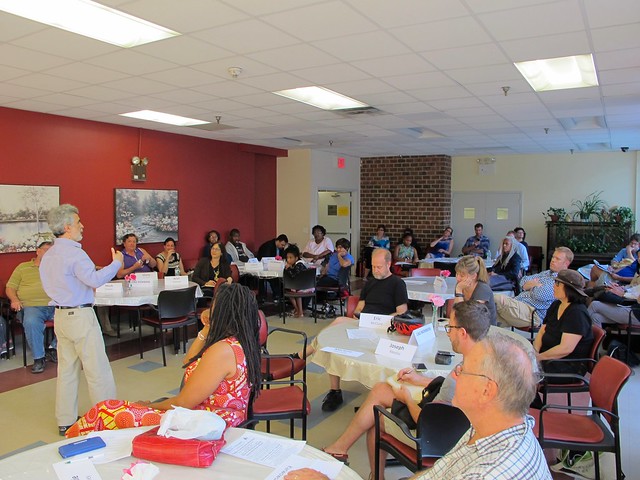
Why Can't DEP Be More Like EPA? Notes From May's Gowanus Canal Superfund CAG Meeting

IMG_4274
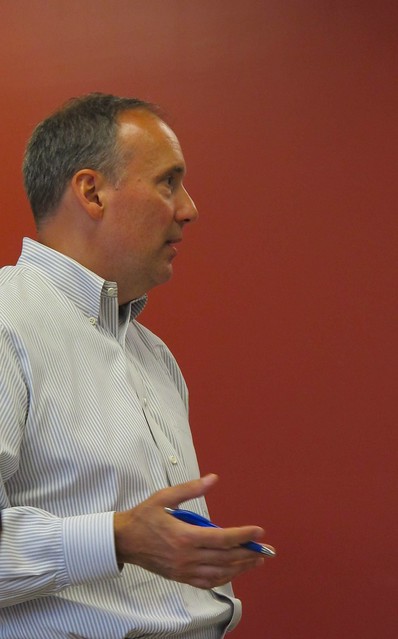
Christos Tsiamis, EPA Remedial Project Manager for the Gowanus Canal Superfund
IMG_4272
IMG_4277
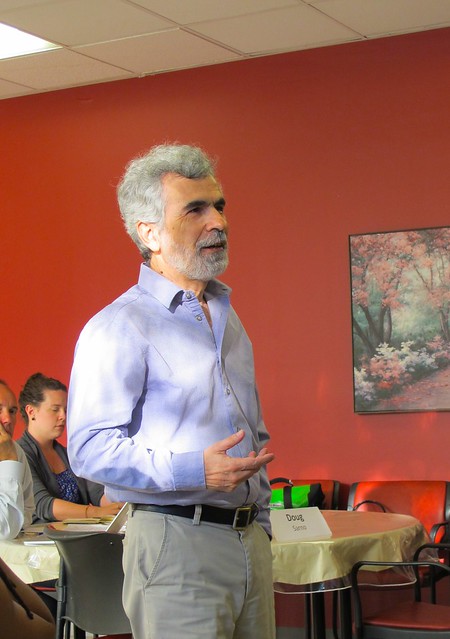
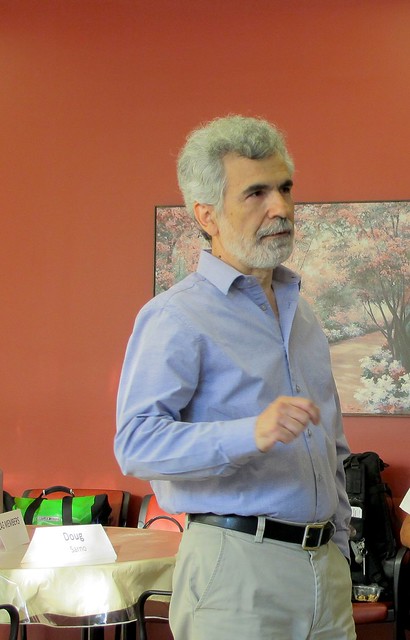
Doug Sarno, facilitator for Gowanus Canal Superfund Community Advisory Group

Christos Tsiamis, Environmental Protection Agency Remedial Project Manager for the Gowanus Canal Superfund clean-up, attended Tuesday night's meeting of the Gowanus Canal Community Advisory Group (CAG) to provide the public with a brief update. Most importantly, he wanted to clarify EPA's position on placement and size of the Combined Sewer Overflow retention tanks that his agency requires New York City to construct under the Record of Decision, which was signed back in September 2013.
"Some things have crossed my desk that I felt needed clarification", he told members of the CAG.

Tsiamis was referring to a public meeting held by New York City Department Of Environmental Protection (DEP) on May 14, 2015 on its Combined Sewer Overflow Long Term Control Plan for the Gowanus Canal, which the City is obligated to prepare under an order from New York State.

Though the Long Term Control plan has nothings to do with the EPA, DEP Commissioner Emily Lloyd at that meeting spoke at length about work that has to do with the EPA Superfund clean-up. In particular, the Commission discussed the potential location and the sizes of the two retention tanks mandated by the EPA as control measures to significantly reduce the combined sewer overflow (CSO) discharges to the Canal. 
The EPA estimates that an 8-million gallon tank and a 4-million gallon tank will be required to address CSOs from the two largest outfalls, RH-034 and OH-007. Together, they will reduce the CSO in the canal by 58% to 74%.
At the May 14th meeting,  DEP talked about reducing the sizes of the tanks from an 8 million gallon tank to a 3.5 or 5.7 million gallon tank at RH-034, and from a 4 million gallon tank at OH-007 to a 1.4 or 2.5 million gallon tank.
According to DEP calculations , the smaller sized tanks would be enough to achieve the 58% to 74% CSO reduction mandated by the EPA.

Commissioner Lloyd also indicated at the meeting that DEP is considering two sites for the  retention tank for outfall RH-034. The first site is comprised of two privately owned lots directly adjacent to the canal between Douglass Street and DeGraw Street. The second location is Thomas Greene Park, which is on land already owned by the City. Lloyd told the public that her agency will be 'likely to recommend' to EPA the privately owned lots, primarily "because of its proximity to the rest of our infrastructure, it will be more efficient to construct and operate."
Even with the cost of acquiring the privately owned sites it would still  be cost effective, Lloyd claimed. When asked what would happen if the owners of the private land were unwilling to sell, she explained that if "that is the selected site, we will proceed to eminent domain." 

Obviously, some of what DEP presented to the public regarding sizes and preferred locations for the tanks is still very much under discussion with EPA.
At Tuesday's CAG meeting, Tsiamis wanted to make this very clear:
"I am here to say that the City can discuss that, but it so happened that a week before they presented that information to the public, I personally sent comments to New York City on exactly those two issues.  On May 7th, I had commented on what the City presented to you on May 14th."
He continued:
"We took an exception to the suggested sizes of the tanks by New York City.  The EPA made comments regarding the reduced sizes  to the City. We do not agree and in our comments, we lay out the reasons why we do not agree, why we think the sizes need to be bigger than what New York City presented at that meeting.  In other words, we told DEP that this is unacceptable and we are moving towards defining what is acceptable.  And we expect a response.
I wanted to be clear that what the City presented to the public was not what will be constructed."

Regarding the DEP's preferred location of the tanks, Tsiamis had this to say:
"New York City has submitted to EPA an evaluation of two locations for each of the two CSO tanks.
We reviewed what New York City gave us and again, we had significant disagreements in the way the evaluations were conducted.  Our disagreement was regarding the cost acquisition element and its weighting factor in the evaluation. In other words, it would cost the City much more to acquire land than the cost associated with siting the tank further from the canal.
We put this in writing, sent it to them and we are still waiting for their responses.
He added:They don't make the decision. We make the decision. The City is under a unilateral order: That is a one way street."

Despite the complexity of these projections, reports, and comments, it is clear that the EPA continues to steadfastly work towards our long awaited comprehensive cleanup while our local government drags its feet and undermines the process.
I guess it is too much to ask for DEP to step up its game and be more like the EPA.
On the other hand, as a community, we have the perfect right to demand just that.
And we should.


The correspondence from  EPA to DEP was made available by Christos Tsiamis upon request

EPA COMMENTS ON NEW YORK CITY DEP’S “GOWANUS CANAL CSO TANK SITING” MEMO 
(sent to Kevin Clarke, Project Engineer for NYC DEP on May 7, 2015)

General Comment:

There are several critical omissions and unrealistic assumptions that were utilized in assigning the weighing factors to the ranking elements listed in Attachment A, which ranks potential sites for the location of the retention tanks in the vicinity of tank location RH-34 as specified in EPA’s Record of Decision.

For example, the “Land Use and Environmental” criterion for “Known contamination/hazardous materials” has been given a weighting factor of 15. The description of the scaling factors does not include the assumption that the site will be remediated by others, namely National Grid, if excavation for the construction of a retention tank takes place and, therefore, would not be the responsibility of New York City (NYC). In addition, tank locations RH-3 and RH-4 have been given different ratings, although both of the sites are known to have significant contamination and RH-4 is also known to have large underground structures that will have to be removed. In addition, as mentioned above, these locations will not be remediated by NYC. Therefore, the ratings for this criterion should be at least the same and they should have a much higher rating than the one assigned because NYC would not be responsible for their remediation. This ranking criterion should be redefined and the scaling factor should be applied properly taking into account the above considerations.

Another criterion that is improperly assessed is the “Land Use and Environmental” criterion for “Property Acquisition.” This criterion is given a weighting factor of only 10%, which is much less than the 30% weighting factor assigned to the “proximity to existing infrastructure” criterion and two other criteria. NYC’s ability to build on property that it already owns, so that it does not have to acquire property that currently is at a premium in the Gowanus area, should have a much higher weighting factor than the one assigned. In our estimate, the weighing factor for this criterion should be at least 20%, if not 30%.

A weighting of 30% would be in line with the NYCDEP Commissioner’s statement at the 2014 Wyckoff Gardens public meeting that cost would be very important in considering the tank locations. It would also take into account the rapidly increasing costs for land acquisition in the area and the loss of tax revenue in perpetuity for at least two parcels that comprise tank location RH-3, the sum of which would be presumably much higher than the additional construction and operational costs that might be associated with tank location RH-4. NYC should also assume that any costs associated with the temporary relocation of the pool and services and their eventual restoration in tank location RH-4 would be at least shared with other parties.

For similar reasons, unless the costs associated with the “Proximity to Existing Infrastructure” criterion (i.e., the approximate costs of additional conveyance pipes) are comparable with the “Property Acquisition” costs, which is unlikely, as acquisition costs are in the tens of millions of dollars, the weighting factor assigned to the “Proximity to Existing Infrastructure” criterion should be reduced.


Please revise the rankings taking into account the above considerations.


EPA COMMENTS ON NYC’S “GOWANUS CANAL BASELINE CSO VOLUME MODELING AND CSO TANK SIZING”
(sent to Kevin Clarke, Project Engineer for NYC DEP on May 7, 2015)

General Comment:

While the overall baseline scenario is better defined in this document than in prior documents, there are no details for the projected future dry weather sewage flows.  It is simply stated in the document that these new projections were “updated from 2045 projection to 2040 projection and include water conservation.”  What other assumptions were made for projected dry weather flows?  Do the flows account for ongoing and future redevelopment activities in the sewer drainage area that will increase dry weather flows in the future?  Also, a detailed description of the flow projections for the Red Hook and Owls Head WWTP service areas that were used were not provided.  Because EPA intends to review the underlying data and assumptions utilized throughout the tank design process, adequate supporting information should be included in future reports.

The tank size calculations indicate that smaller tank sizes may be sufficient to achieve the reduction goals.  The report, however, does not describe how the tanks were modeled or where they were modeled in the combined sewer systems.  In addition, the report does not describe the potential uncertainty in the model calculations themselves and the uncertainty of the eventual location of the tanks, the capacity of the infrastructure to convey flows to the tanks and their final design volume for a given site.  A description of these factors is necessary for this analysis and should be included in the eventual recommendations for tank sizes.

The report states that the tide/boundary condition downstream of the RH-034 outfall was corrected.  What provisions has New York City made in its combined sewer hydraulic and discharge calculations and plans for sea level rise and changes in rainfall that are described in older and more recent New York City Reports on Climate Change?  

Given that there are several uncertainties associated with future conditions, as described above, a conservative approach would have to be taken in designing the retention tanks called for in EPA’s Record of Decision.  Accordingly, consistent with such an approach, the tank sizes cited in Table 2 of the document under the “2014 LTCP Model 74% [solids reduction]” should be used to design the tanks rather than the volumes recommended in the report’s “Summary and Conclusions” section.   This percent reduction represents reductions estimated on the basis of the upper confidence limit of the data for PAHs.  Finally, owing to the uncertainties associated with potentially significant future development in the area and with climate change, an engineering error factor should be applied to calculate the final recommended volumes of the retention tanks.  Appropriate adjustments can be made to these preliminary assumptions as the remedial design progresses and further data and analysis are developed.


Read more

Tuesday, October 22, 2013

EPA Gowanus Canal Community Advisory Group Will Meet Tonight

IMG_6449
The Environmental Protection Agency's Community Advisory Group for the Gowanus Canal (CAG) will be holding its monthly meeting tonight, Tuesday, October 22 at 6:30 PM. The meeting will take place at Mary Star of the Sea Senior Center, 41 First Street between Hoyt and Bond Street.

Since this is the first gathering of the CAG since the release of EPA's Record Of Decision, which was signed in late September,  the agenda includes a discussion on the RoD.

The meeting is open to all in the community.


Read more

Monday, August 26, 2013

Gowanus Canal Superfund Community Advisory Group Holding General Meeting This Tuesday

IMG_3914
The Gowanus Canal Superfund Community Advisory Group (CAG) will be holding its general meeting on Tuesday, 6:30 PM at Mary Star of the Sea Senior Apartments, 41 First Street.
Two important items will be on the agenda:
-The Environmental Protection Agency will update the community on the status of the Gowanus Superfund Record of Decision (ROD), which is expected to be released this fall.
The ROD contains the final remedy for the clean-up chosen by the Agency and is a very important step towards beginning the actual remediation of the polluted waterway.

-Representatives of National Grid will give an update on a Pilot Study at Citizens Gas Works. National Grid has been named a Potential Responsible Party (PRP) and will have to remedy three former gas manufacturing sites along the Gowanus Canal. One of these sites is the five acre track of land, located between Smith Street and the Gowanus Canal, was once the site of a Citizens Gas Light Company's 12th Ward Gas Work plant, where coal and petroleum products into flammable gas for surrounding neighborhoods. Citizen later sold to Brooklyn Union Gas, which became Keyspan, which is now National Grid.The plant was decommissioned in the early 1960's.

The CAG meeting is open to the public.


Read more

Tuesday, April 02, 2013

Gowanus Canal Community Advisory Group General Meeting Tonight

IMG_3008
The Gowanus Canal Superfund Community Advisory Group (CAG) will be holding its general meeting tonight, April 2nd, 6:30 pm at Mary Star of the Sea Senior Housing at 41 1st Street.
The CAG will continue its discussion on the EPA Region 2 Proposed Plan for the Superfund clean-up of the Gowanus Canal.

As a reminder, the EPA will accept comments from the community on the Proposed Plan till the end of April.   To read the plan for the Gowanus Canal or for more information on the canal, visit http://www.epa.gov/region02/superfund/npl/gowanus or visit the EPA’s document repositories at the Carroll Gardens Library at 396 Clinton St. in Brooklyn or the Joseph Miccio Community Center, 110 West 9th Street, Brooklyn.

Written comments on the proposed plan should be addressed to:
Christos Tsiamis
Project Manager
Central New York Remediation Section
U.S. Environmental Protection Agency
290 Broadway, 20th Floor
New York, New York 10007-1866
e-mail: GowanusCanalComments.Region2@epa.gov


Read more

Monday, February 25, 2013

Upcoming Meeting Of EPA Gowanus Canal Superfund Community Advisory Group

IMG_1813
The EPA Gowanus Canal Superfund Community Advisory Group (CAG) will be meeting on Tuesday
Feb. 26 at 6:30 PM at Mary Star of the Sea Senior Housing, 41 1St Street.
The meeting will focus on the Proposed Remedial Action Plan (PRAP), which was released in late 2012.

Just a reminder: the EPA will be accepting public comments on the PRAP till the end of April 2013.
Written comments on the proposed plan should be addressed to:

Christos Tsiamis
Project Manager
Central New York Remediation Section
U.S. Environmental Protection Agency
290 Broadway, 20th Floor
New York, New York 10007-1866
e-mail: GowanusCanalComments.Region2@epa.gov
OR, contact Natalie Loney, Community Involvement Coordinator, at 212-637-3639,

Also, for those interested, the CAG Archaeology Committee will meet on February 27th, 6:30 pm at Proteus Gowanus, 543 Union Street, Brooklyn
On the agenda: Review of PRAP and EPA archaeology documents.
All CAG meetings are open to the community.


Read more

Wednesday, October 03, 2012

Full Report On Tuesday Night's EPA Gowanus Canal Superfund CAG Meeting

IMG_9699
IMG_9701
Jeff Edelstein, CAG Facilitator
IMG_9700
Christos Tsiamis, EPA Region 2 project manager for the Gowanus Canal  with Brian Carr, EPA Region 2 Legal Council
IMG_9704
Christos Tsiamis

The Environmental Protection Agency's Gowanus Canal Superfund Community Advisory Group (CAG) held its general meeting at Mary Star Of The Sea housing on First Street last night.

Superfund progress report

Both Christos Tsiamis, EPA Region 2 project manager for the Gowanus Canal,  and Brian Carr, EPA Region 2 Legal Council, were in attendance and gave a Superfund progress report.

Tsiamis explained that the Remedial Investigation and the Feasibility study have been completed. Based on all the collected data and discussions with various parties, namely National Grid and New York City as well as members of the community,  Region 2 has prepared a plan for the clean-up of the polluted waterway. A prototype plan was submitted to EPA's National Review Board at the agency's headquarter in Washington.  "We are right now at the stage of putting together the Plan for presentation to the public and are hoping to put it out for comment to the community by the end of this year," Tsiamis stated.

The formal review process generally lasts about 30 days, but because of the size of the community and the anticipated number of comments, the period will most likely be extended.

At that point, Region 2 has to look at all the comments that have been submitted and consider them. After the plan has been refined, a final document called a Record of Decision will be prepared.

Tsiamis concluded: "We are right on schedule.


IMG_9703
Polytechnic Institute of New York University Professor Maurizio Porfiri
IMG_9713
IMG_9716

Brooklyn Atlantis

Also on the agenda last night was a presentation of 'Brooklyn Atlantis', a project led by Polytechnic Institute of New York University Professors Maurizio Porfiri and Oded Nov. A team of graduate students in Mechanical Engineering and Computer Science has been working on a system of mobile instrumented buoys with wireless capabilities for data collection and environmental monitoring. As Professor Porfiri explained last night, the buoys would move about on the Gowanus Canal, powered by rechargeable batteries that use solar energy. Cameras mounted on the buoys will be taking photos above and below the water's surface.   Sensors will monitor water quality by checking temperature, dissolved oxygen levels, ph levels (and perhaps salinity and water flow.)   Photos and data will be downloaded to a website.

An important component of Brooklyn Atlantis is the participation of citizen scientists who will be able to access images on the computer, classify wildlife on photos as well as earn points for correctly identifying objects, access sensor data for different canal locations and compare results.

The project has been funded by the National Science Foundation. Professor Porfiri expects Brooklyn Atlantis to run simultaneously to the EPA clean-up of the canal.

More information about Brooklyn Atlantis can be found at www.brooklynatlantis.poly.edu


IMG_9726
Leah Graziano of the Agency for Toxic Substances and Disease Registry
IMG_9735
Chris Dorsoki of the NYS Department of Health

Public Health Assessment Of the Gowanus Superfund area

Chris Dorsoki of the New York State Department of Health and Leah Graziano of the Agency for Toxic Substances and Disease Registry (ATSDR) gave an overview of the role of their agencies and how they support the EPA and the Gowanus Canal Superfund site community.

Dorsoki and Graziano shared information about the Public Health Assessment that was prepared and the conclusions drawn from the Assessment.
Regarding the Gowanus Canal, it was found that swimming in the canal would harm people's health because of exposure to bacteria. Eating fish and crabs from the Gowanus was also a health hazard.

Dorsoki explained that a Public Health Assessment is not the same as a health study.  A few CAG members asked why such study has never been done in Gowanus, especially in light of the fact that the canal has been declared a Superfund.  Dorsoki said that a health study can take decades to complete.

After a brief discussion, Jim Vogel, representing NY State Senator Velmanette Montgomery, declared that the senator's office would formally request a study.


Read more

Tuesday, October 02, 2012

Gowanus Canal Superfund Community Advisory Group Meeting Tonight

IMG_9129
The Gowanus Canal Superfund Community Advisory Group (CAG) will be holding its general meeting tonight, October 2nd, 6:30 pm at Mary Star of the Sea Senior Housing at 41 1st Street.
On the agenda:
*Christos Tsiamis and Brian Carr of EPA Region 2 will attend to give a brief update on Superfund progress and to introduce Dr. Maurizio Porfiri of the Polytechnic Institute of New York University who will make a short presentation about his National Science Foundation funded project "Brooklyn Atlantis." The project, which will be launched in the coming weeks, involves the collection of data and environmental monitoring at the Gowanus Canal with citizen participation.

*Reminder that NYS Dept. of Health will be giving an update and taking questions about their Public Health Assessment, which has not yet been completed.


Read more

Monday, July 02, 2012

Tonight, General Meeting Of EPA Community Advisory Group For Gowanus Canal Superfund

IMG_7986
The Gowanus Canal Superfund Community Advisory Group (CAG) will be meeting tonight at Mary Star of the Sea Senior Housing, 41 1st Street,  from 6:30 pm to 9:00 pm.
Everyone in the community is welcome.
The agenda includes updates from  the US Environmental Protection Agency, New York State Department Of Environmental Conservation and New York City Department Of Environmental Protection as well as  CAG Committee reports.


Read more

Wednesday, May 30, 2012

At Tuesday Night's Gowanus Canal Community Advisory Group Meeting

IMG_6449
IMG_7809
Jeff Edelstein, Gowanus CAG Facilitator
IMG_7804
IMG_7807
IMG_7808
Tracy Bell And Terry Thompson representing National Grid

The Environmental Protection Agency's  Community Advisory Group for the Gowanus Canal met on Tuesday night at the Brooklyn Historical Society.
Natalie Loney, EPA's Community Involvement Co-Ordinator gave a brief overview of the Superfund schedule. She explained that Christos Tsiamis, Remedial Project Manager for the Gowanus Canal,
and Walter Mugdan, EPA District 2 Director,  will be presenting the Proposed Remedy for the Gowanus Canal Clean-Up to the National Remedy Review Board in Washington, D.C. the week of June 18th.

The National Remedy Review Board is "a peer review group that understands both the EPA regional and headquarters perspectives in the remedy selection process."
Generally, the Board reviews Superfund remedies that meet a certain financial threshold.  Natalie Loney explained:  "The Board wants to insure that there is consistency throughout the region.  They are looking at this project because of its size and its scope. They may ask questions or clarification, but they will not approve or disapprove the remedy.  That is not their function."   
She added: "The remedy that Region Two is presenting is technically sound.  We are very comfortable with it.  We are fully behind this proposed plan."
After the presentation to the Board, Christos Tsiamis, will have time to respond in writing to any questions raised during the meeting. Once this process is completed, Region 2 will be able to move forward with putting out the Gowanus Superfund  Remediation Plan and will most likely present it to the community at a public meeting by September.


The CAG has written its own letter to the National Review Boards.  It reads:

Dear Mr. Tsiamis and Members of the National Remedy Review Board,
A. BackgroundThe Gowanus Canal is located approximately 2 miles from Manhattan. Its watershed covers approximately 1700 acres (2.65 square miles). Based on the 2010 census, almost 150,000 people of all levels of economic stature live within the watershed. Of these, an estimated 44,000 people live within a 10 minute walk of the Canal. Further, there are many underserved families living in close proximity to the Gowanus Canal. Recent planning initiatives, including the City’s New Waterfront Revitalization Program and the Hudson-Raritan Estuary Restoration Plan support the community’s vision for increased public access, ecological restoration, and recreational use of the public waterways.
The Gowanus Canal community uses this waterway for many recreational, commercial, industrial, artistic, educational, and scientific purposes. These activities may result in ingestion of Canal water and direct and indirect contact with Canal water and sediments by adults, children, and pets. Existing on-water recreational uses such as sustenance-based fishing, canoeing, kayaking, boating, and diving may result in primary and secondary contact. There are 2 public access points located along the Gowanus Canal and Bay and a total of 19 locations at which public streets either cross or terminate at the canal. These street-ends are routinely flooded by canal water during rain showers under high-tide conditions. Commercial activities including barging and scientific research may also result in secondary contact.
Gowanus is emerging as a creative district that is home to many artists and artisans and is a cultural and entertainment destination for City and non-City residents and tourists. The Gowanus landscape attracts artists from around the world to use as subject matter. It is because the canal is so intensely used in such a variety of ways that it is important to ensure that public health be protected under these circumstances. As awareness is raised about the Canal, public access both to, and into, the Canal improves, and redevelopment pressures increase, more and more people will continue to take advantage of the unique on-water recreational and explorational opportunities it presents.
B. Comments
The CAG supports the selection of a comprehensive remedy that protects human and ecological health and improves water quality consistent with the current and projected future use of the Gowanus Canal. To that end, the CAG has passed the following resolution:April 2012 Sediment Resolution to EPA
The Gowanus Superfund Community Advisory Group fully supports the U.S. Environmental Protection Agency in its finding that New York City’s Combined Sewer Overflows are a significant contributor of harmful sediment and Superfund regulated PAHs and metals to the canal. The CAG takes the position that the total elimination of CSOs into the Gowanus Canal is the only acceptable solution to the problem.
The CAG asks that the EPA, under their Superfund authority, take the necessary measures that will ensure protection of the proposed remedy from ongoing CSO sediment solids deposits and the release of PAHs and other toxins.
In summary, the CAG believes that the Superfund cleanup represents a unique opportunity to conduct a comprehensive cleanup of the Gowanus Canal and that it would be a waste of time, money, and energy to select a remedy that does not completely prevent recontamination by CSOs.
Thank you for the opportunity to submit these comments.
Sincerely,The Gowanus Canal Superfund Site Community Advisory Group

On Tuesday night, the CAG also passed the following resolution:

"The Gowanus CAG asks that the cleanup of the Canal, including the Superfund Remedy, should be consistent with and advance current and future possibilities for ecological restoration, shoreline softening, riparian buffers, expanded wetlands, habitat restoration, and public access pursuant to the goals of the Hudson-Raritan Estuary Restoration Plan and the community's emerging vision for the waterway.We understand that some steel bulkheads may be necessary but that contiguous steel or new wooden bulkheads would not be compatible with the above stated goal."

Finally, the CAG voted and welcomed Rich Kampf and Jennivere Kenlon as full members.


Read more

Tuesday, May 29, 2012

EPA Gowanus Canal Community Advisory Group Will Meet Tonight

IMG_7338
The Environmental Protection Agency's Gowanus Canal Community Advisory Group is holding its monthly general meeting on Tuesday, May 29th between 6:30 PM to 9 PM at the Brooklyn Historical Society, 128 Pierrepont Street.
Members of the community are invited.


Read more

Wednesday, April 25, 2012

Gowanus Canal Community Advisory Group Takes Position That Total Elimination Of CSOs In Gowanus Canal Is Only Acceptable Solution To Problem. Passes Resolution.

IMG_7315
IMG_7314
IMG_3538
IMG_7218
IMG_7220
At last night's US Environmental Protection Agency's Gowanus Canal Superfund Community Advisory Group's (GAG) general meeting,  members voted to adopt a resolution that asks for a total elimination of New York City's Combined Sewer Overflows (CSOs) into the waterway.
The resolution was drafted by the CAG's Water Quality/Technical Committee after an informational meeting with NYC Department Of Environmental Protection on April 3rd, 2012.  At that meeting, DEP, which has been names a Potentially Responsible Party (PRP) by the EPA for its role in contributing hazardous toxins to the canal and for allowing CSOs to continue to discharge into the Gowanus,  had refuted EPA's findings.
Despite DEP's best effort, the agency failed to convince the Committee members that more testing was necessary and that it had not yet been proven that the CSOs are contributing chemicals to the canal at levels that constitute unacceptable human risks under Superfund.

So last night, the Water Quality/Technical Committee put forth the following resolution:
The Gowanus Superfund Community Advisory Group fully supports the United States Environmental Protection Agency in its finding that New York City's Combines Sewer Overflows are a significant contributor of harmful sediment and Superfund regulated PAHs and metals to the canal. The CAG takes the position that the total elimination of the CSOs in the Gowanus Canal is the only acceptable solution to the problem.     The CAG asks that the EPA, under their Superfund authority, take the necessary measures that will insure protection of the proposed remedy from ongoing CSO sediment solids deposits and the release of PAHs and other toxics.
However, before a discussion or a vote on the resolution could take place, Jeff Edelstein, the CAG's facilitator, informed its members that DEP, represented by Jim Mueller, would like to present its position on the CSO resolution and wanted the opportunity to give members of the CAG a presentation.

Many CAG members strongly opposed.  Though some wanted to hear what the DEP had to say, the  prevailing sentiment, especially amongst members of the Water Quality/Technical Committee, was that this was neither the time, nor the place for DEP to argue its, as one member put it, its "PRPness"
CAG member 
Marlene Donnelly,  representing F.R.O.G.G. argued:
"The DEP did just have a lengthy meeting with the community. There was no representative from the EPA there to present an alternate perspective at that meeting. If we give DEP five minutes for a presentation tonight, we also need  to give EPA five minutes to present their perspective. Since they are not here to present. I think that it is inappropriate at this time to allow DEP time to present just their perspective without a counter- perspective."
Josh Verlun,  Riverkeeper's representative, agreed:
"I believe that it is inappropriate for DEP to impose their perspective on the resolution at this time unless we have representatives from both EPA and from all the other PRPs give their perspective as well. At last count, that number was 30 or so. It is not appropriate for one PRP to voice their opinion, when there are other agencies and stakeholders that are nor represented here tonight. "
Rita Miller, C.O.R.D. representative added:
"The DEP came before the Water Quality/Technical committee, and out of that discussion, I think it is fair to say that this resolution was born.  I think that our committee should be able to present the resolution to our fellow CAG members. We have the interest of our community at heart. There is no further presentation by the DEP necessary."
And Steven Miller, member-at-large concluded:
"I want to remind everyone here tonight that the City of New York is a PRP and that their interaction with us should be held within this context."

At the end, the CAG voted to not allow DEP to give its presentation and to move forward with the vote on the resolution.
The resolution passed easily.

It was so transparent that the DEP wanted to influence members of the CAG last night and was trying to prevent this resolution from passing.  Pretty low, I say.


Read more

Tuesday, April 03, 2012

Members Of Gowanus Canal CAG Sit Down With DEP Representatives And Ask Agency To Do More

IMG_7250
IMG_7247
IMG_8520
IMG_6963
IMG_6962
IMG_6965
IMG_6969
Jim Mueller, Assistant Commissioner DEP,  Angela Licata, Deputy Commissioner,  Kevin Clarke,  environmental engineer.

Testimony of Carter Strickland,Commissioner, New York City Department of Environmental Protection (DEP), March 27, 2012
"At the moment DEP is concerned that EPA is considering a complete cessation of CSOs into the Gowanus Canal as part of the Superfund cleanup, even though the site was put on the National Priorities List because of contaminated sediment from historic industrial processes unconnected to the sewer system. Under the Clean Water Act and the CSO program administered by the State, DEP has considered whether CSOs could be reduced to near zero and concluded that it would be infeasible and that tanks or tunnels could cost billions without a substantial increase in water quality. Needless to say, a billion-dollar construction project in this area of Brooklyn would also create daunting traffic and construction-related impacts for well over a decade. Accordingly, DEP selected our current $136 million Gowanus Facilities Plan, which will reduce CSOs by 34% plus another 10% from High-Level Storm Sewers and green infrastructure. We are in active discussions with the EPA right now, and strongly disagree with the position that an enormous City-funded construction project is a necessary prerequisite to an EPA-led Superfund cleanup."
Last night, members of the EPA Gowanus Canal Superfund Community Advisory Group's Water Quality and Technical Committee met with representatives of the City's Department Of Environmental Protection to engage in a more meaningful dialog with the agency and to advocate for the elimination of Combined Sewer Overflow Discharges that result in the presence of pathogens in the waterway, including coliform and enterococci.
These pathogens present unacceptable health risks from contact with the water and sediments of the Canal.  As long as New York City, which has been named a Potencially Responsible Party (PRP) for its role in contributing to the toxins, allows CSOs to continue to discharge into the Gowanus, there will be ongoing environmental and potential human health risks, as well as a high chance of recontamination even after the Superfund clean-up.

Representing the DEP last night were Angela Licata, Deputy Commissioner, Jim Mueller, Assistant Commissioner, Planning and Capital Projects, Kevin Clarke and Julie Stein.   Members of the CAG did not lose any time to let DEP know that the Community expected the agency to work together with EPA to get the most comprehensive, effective clean-up within the timeframe of the Superfund. "This is great opportunity to kill two birds with one stone by investing the necessary money to have the water that goes into the canal be as clean as it can be," stated one CAG member. "Get it done right. Get it done once. Get it done now," another member told the DEP representatives. Yet another added: "We would like to see the same level of engagement from DEP as we see from EPA."
Yes, New York City is currently in the process of implementing upgrades to the Gowanus Canal facilities, which it claims will reduce CSO discharges by about 34% and another 10% from newly installed High-Level Storm Sewers and green infrastructure. That, however, simply is not good enough for many members in the community. "We have a pretty good understanding of what the City is proposing, but frankly, more needs to be done. We want more," member Steven Miller stated.

"We see this as a very opportune time for us to begin anew and to think of the long-term planning for the canal," Angela Licata told the CAG. She was quick to point out that the City's combined sewer system is a legacy system. "When it rains, you are not going to engineer your way out of that. If you never want to have sewer in the canal again, we will have to separate the system." Indeed, the gray infrastructure in the Gowanus area is underserving the community on all fronts even with the current upgrades. In addition, no real planning seems to have gone into providing new infrastructure for all the additional housing that is likely to be built along the canal in the near future.

Licata also spoke of the consent order just negotiated between NYC and Albany. "Our commitments and requirements persuent to that, require that we build out green infrastructure to a certain extend. We have to get 1" of rain over 10% of the impervious areas in the CSO watersheds of the City. And we need to develop these so-called long-term control plans. Those should envision a path forward that will carry us for the next 10 to 20 years."
(This sounds more impressive than it is. Basically, it means that New York State's Department Of Environmental Conservation has once again allowed the City to not meet the Federal clean water standards set decades ago.)

"We have to develop a plan for that waterbody," Licata continued. "We think it is quite appropriate that we start to envision this with you. What we will be looking at is a combination of solutions where we want to evaluate all the possible alternatives We need to do that in a way that achieves certain goals. We have to be able to move some of the dials on water quality and we also have to look at what is going to be cost effective."

CAG member Rita Miller mentioned that the EPA has suggested that a retention basin would solve the problem of toxins being emitted into the Gowanus.  Miller added "At the same time, it would do wonders for the pathogens flowing into the canal and perhaps satisfy some of the Clean Water Act requirements as well. Why does there seem to be resistance to that suggestion?" she asked Licata. "It seems perfectly reasonable to us. It seems like a perfectly do-able plan. You have done it in other places."

Licata's answered: "We have done retention tanks. Its a no-brainer. We have done it at Paerdegat Basin, Alley Creek and Flushing. So why not do it here? One of the things is that at those locations, you had a tremendous amount of volume that was all located at one point, so that the economy of scale was tremendous." She added: "I just want to be clear. Its not that we are discounting it here. I think it's a fair question. We should take another look at it. But I think the cost benefit on that is going to be really, really tough."

Rita Miller responded: "I would like to remind you that this is a very densely populated area. City Planning has a framework that makes it even denser. I don't see any reason why the kind of attention that has been given to other neighborhoods would not be given here, given the fact that this canal is so tiny, so narrow, that the concentration of toxins is just tremendous."


I can only speak for myself, but as a CAG member and a long time resident, I have the feeling that the City is trying to shirk its responsibility towards the Gowanus Canal Community for as long as it can. Rather than to work with the EPA to find a real solution that would address the CSOs in conjunction with the Superfund clean-up, it is trying to stall and kick the problem down the road.

Shame on Mayor Bloomberg, Deputy Mayor Caswell Halloway and DEP Commissioner Carter Strickland for continuing to ignore the community and for proposing a sorely inadequate plan to deal with a real health problem.
Stop lobbying and do what's right, already!


Read more

Wednesday, February 01, 2012

Notes On EPA's Presentation Of Gowanus Canal Feasibility Study To Members Of Community Advisory Group

IMG_5902
IMG_5905
IMG_5910
Christos Tsiamis, EPA Region 2 project manager for the Gowanus Canal
IMG_5904
Jeff Edelstein, Gowanus CAG facilitator
IMG_5917
Brian Carr, EPA Region 2 lawyer
IMG_5918
Victoria Hagman(l) and Natalie Loney,
EPA Region 2 Community Involvement Coordinator
IMG_5916
Hans Hasselein, Gowanus Canal Conservancy
IMG_5913
Eymund Diegel, Proteus Gowanus
IMG_5919
Michelle De La Uz (l), Fifth Avenue Committee and Ludger Balan, Urban Divers


Christos Tsiamis, Environmental Protection Agency's site manager for the Gowanus Canal Superfund, presented the just-released Feasibility Study to the Community Advsiory Group (CAG) at a meeting on Monday night.
Many CAG members had also attended the EPA's presentation on the FS to the general public at PS 58 last week, so they were already quite familiar with the options available for cleaning and containing the highly toxic sludge that has been accumulating on top of the native sediment at the bottom of the canal. This allowed Tsiamis to take more time to take questions and to explain specifics, especially addressing the issue of re-contamination after the clean-up.
As Tsiamis pointed out, the Gowanus Canal cannot be cleaned effectively without eliminating the Combined Sewer Overflow (CSO) discharges from New York City's sewer system as well as the coal tar oozing from National Grid's three  MGP sites lining the canal. This, of course, involves a tremendous amount of co-ordinate with New York City's Department of Environmental Protection (DEP), which is responsible for the CSOs and with NYS Department Of Environmental Conservation (DEC)  under whose supervision National Grid will clean up the MGP sites.
"This is an issue that has to be addressed. We need to curtail those sources of contamination," Tsiamis stated.
Quite a few CAG members seemed concerned that NYC DEP has, until now, not shown a willingness to take responsibility for their part in the clean-up. After all, Farrell Sklerov, a spokesperson for DEP told the Brooklyn Paper: “The evidence clearly indicates that the primary sources [of contamination] are the former industrial plants on the canal, and not ongoing sewer overflows.”

That seems laughable since most residents of the Gowanus area have witnessed CSO events such as this one.
"The CS0s have to be dealt with so that we have a sustainable remedy. That's a statement in the Feasibility Study." Tsiamis told the CAG. "We have been in talks [with the City] about ways that can be implemented to address this particular matter." 
A meeting has been scheduled between the EPA and DEP for February 2 to discuss specific technical possibilities.
One way to control CSOs within the framework of the Superfund would be to construct a retention basin 
to retain discharges after heavy rains, much like the facility completed by DEP in Perdegat Basin,


As a community, we should let the City know that its denial and delay mechanisms are not going to fly in this community.
Perhaps a letter writing campaign to Mayor Bloomberg and to our own city representatives, Councilmen Brad Lander and Steven Levin, is in order?
Read more

Monday, January 30, 2012

Tonight, General Meeting Of EPA's Gowanus Canal CAG

IMG_5710
The EPA's Gowanus Canal Community Advisory Group is holding its general meeting tonight.  If you missed EPA's presentation on the Feasibility Study last week,  this is is your opportunity to hear  Christos Tsiamis, the project manager for the Canal, explain the different clean-up options for the polluted waterway. 
EPA Gowanus Canal CAG Meeting
Monday, January 30
at Borough Hall from 6 pm – 9 pm
 Agenda includes:
· Discussion of Feasibility Study
· WQ/Technical Committee report-out
· Technical Assistance (TAG and TASC)· Other business
Read more

Monday, December 05, 2011

EPA Gowanus Superfund CAG Holding General Meeting Tonight

IMG_3181
The Environmental Protection Agency's Gowanus Superfund Community Advisory Group (CAG) is holding its general meeting tonight, December 5, from 6:30 p.m. to 8:30 p.m. at the Brooklyn Historical Society, 128 Pierrepont Street.  On the agenda is a question and answer session with Christos Tsiamis, EPA Region 2 project manager for the Gowanus Canal.
There will also be updates from the various committees. 
The meeting is open to all. Read more

Wednesday, October 26, 2011

Last Night At The Gowanus Canal CAG General Meeting

IMG_4079
Gowanus Canal CAG Facilitator Jeff Edelstein
IMG_4083
 Gardiner Cross of NYS Department Of  Environmental Conservation (DEC) 
IMG_4086
New York State Senator Velmanette Montgomery
IMG_4087
Councilman Steven Levin

Last night's Environmental Protection Agency's Gowanus Canal Community Advisory Group (CAG) gathered at the Brooklyn Historical Society for its monthly meeting. The evening's agenda included updates on the ongoing work done by the various CAG committees. 
-The Archeology Committee is planning a historic walking tour of the Gowanus Canal with EPA's Archeologist John Vetter this Friday. The tour will include such historically significant structures as the Coignet Stone building, the Carroll Street bridge, and the former site of Brouwer's Mill built in 1652. (I am taking part in the tour and will post about it afterwards.)
-The Water Quality and Technical Committees reported on a meeting they held recently with EPA's engineer for the Gowanus Canal, Christos Tsiamis.  The agency is planning to release its Feasibility study for the Gowanus Canal clean-up in December.
-Water Quality and Technical also reported about the presentation National Grid and NYS Department of Environmental Conservation gave to them last month regarding the proposed remediation at the heavily polluted former Citizens Gas Works MGP site on Smith Street between 5th Street and Huntington Street. 
At last night's meeting,  DEC's Gardiner Cross was asked to clarify some aspects of the clean-up plan. In particular, there was a concern about why the High Density Polyethylene (HDPE) liner, which is meant to help manage storm water, is supposedly going to be installed 2 feet below grade on the site.  Surely, some CAG members argued, it would make more sense to install the liner deeper, especially if the City plans to build on the site. It would seem that the liner could easily be compromised by any digging on the site .  Cross promised that he will look into the possibility and will get back to the CAG with an answer. 
For further information on the remediation of the site, go to www.citizensmgpsite.com.

Read more