Showing posts with label Christos Tsiamis. Show all posts

Monday, November 16, 2020

A Momentous Occasion: Dredging Of Toxic Material Begins In Upper Portion Of The Gowanus Canal Today

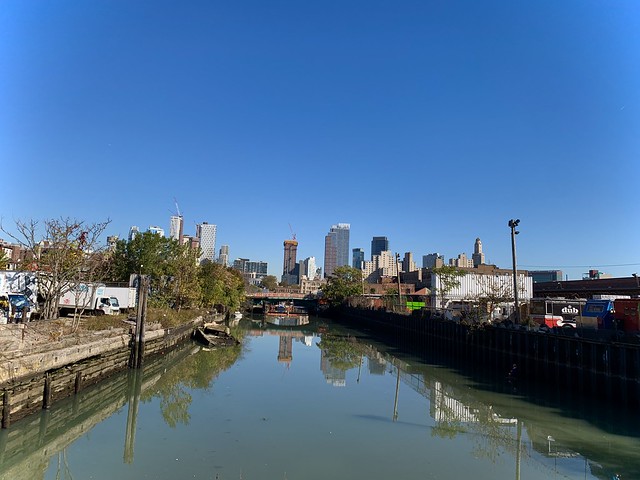
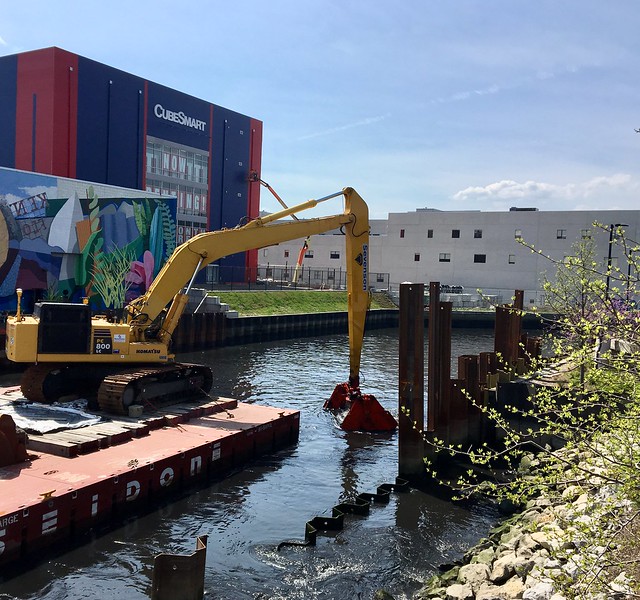
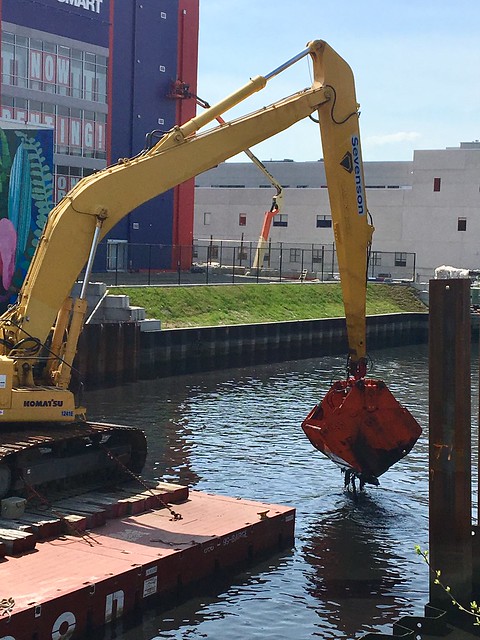
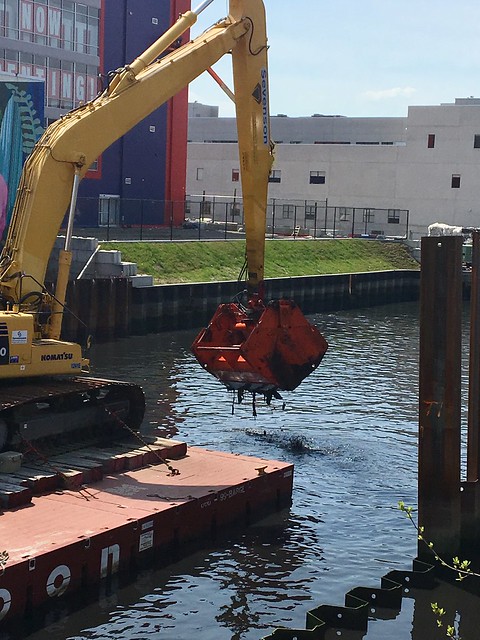
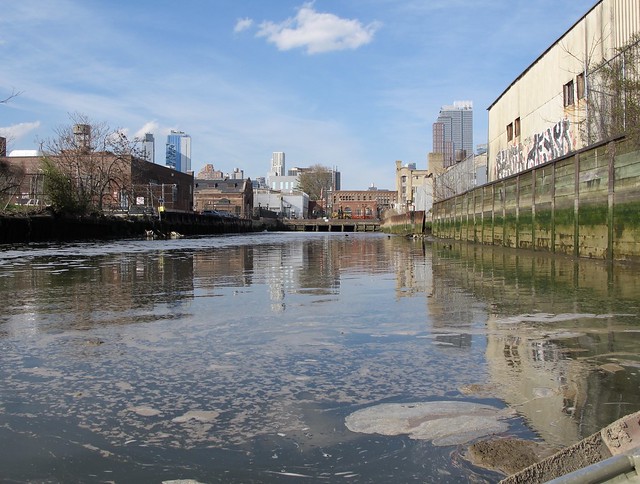
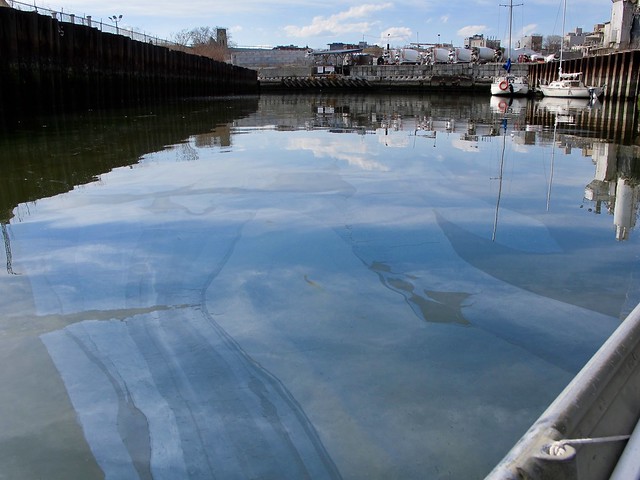
Today marks a momentous occasion for the Gowanus Canal and the Gowanus community in Brooklyn. The Environmental Protection Agency's Superfund Cleanup of the Canal is about to begin in earnest this morning, with the dredging of the toxic sludge at the bottom of our waterway.
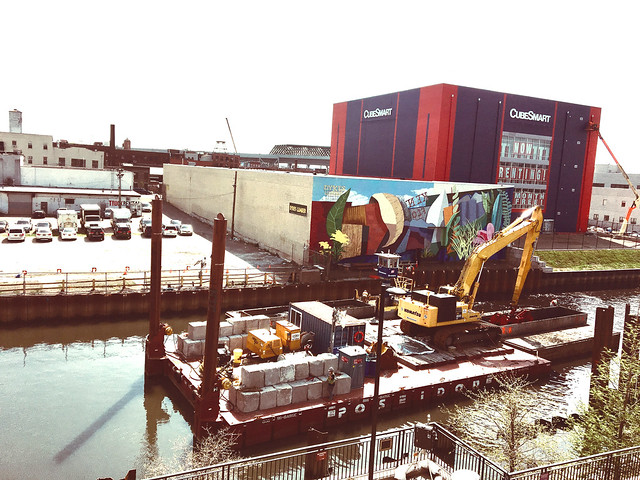
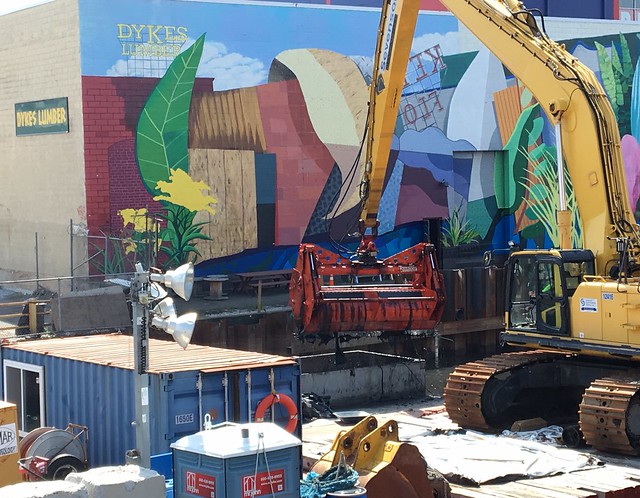
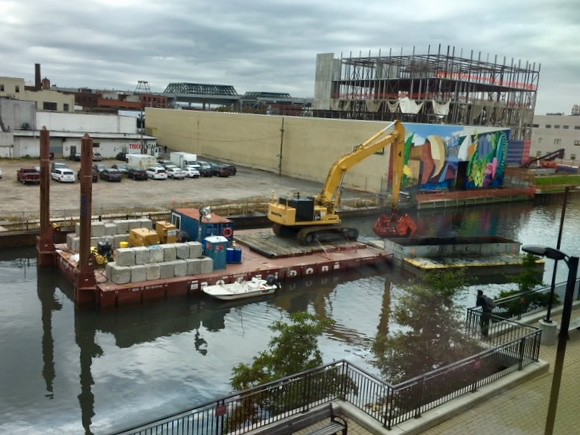
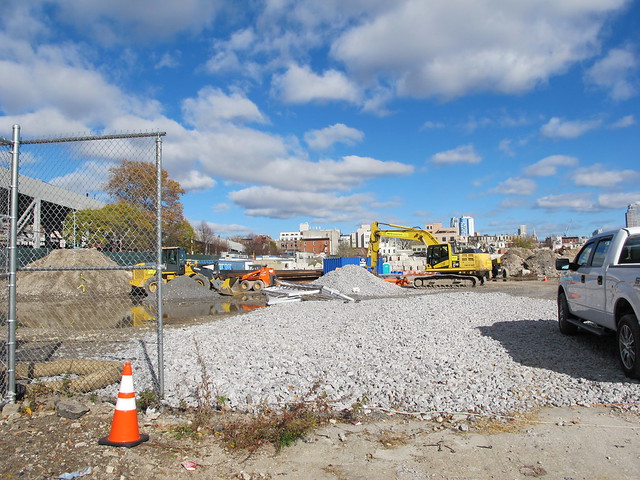
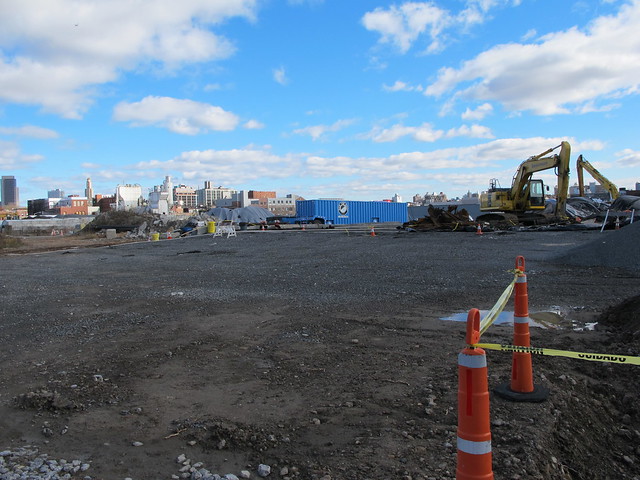
Heavy equipment and barges have been moved into place over the past few days. The first phase of this work will begin in the upper portion of the Canal, from Butler Street to the Carroll Street Bridge.
In two subsequent phases, the middle and lower parts of the canal will be dredged.

To mark the important occasion, EPA Regional Administrator Pete Lopez, Congresswoman Nydia Velazquez and other elected officials will hold a press conference at the esplanade at 363 Bond Street to celebrate the commencement of the clean-up of one of the most polluted sites in the United States.

On a personal note, I would like to thank Christos Tsiamis, the EPA Project Manager and Brian Carr, EPA Legal Council for all of their hard work on behalf of the Gowanus Community.
Both worked against tremendous odds to devise the most comprehensive, well-engineered clean-up plan for the Gowanus Canal. Without them, we would not have gotten this far.

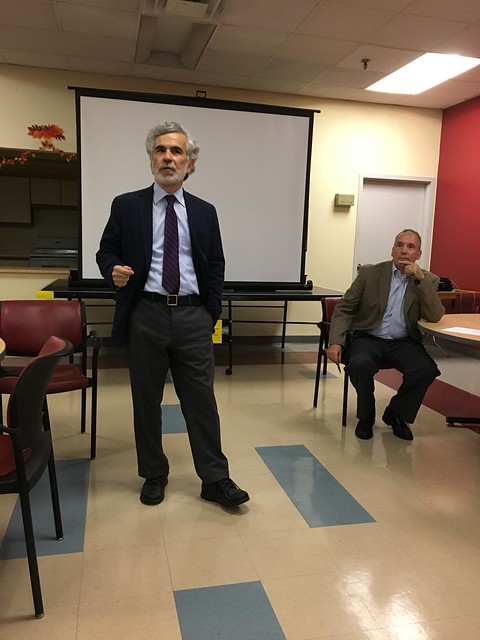
At a recent community meeting, Tsiamis said:
"I want everyone to know that this was not always in the cards that this was the kind of clean-up that we were going to get.
What others had proposed when we were starting was a perfunctory dredging of a couple of feet, followed by a sprinkling of a sand cover on top of the remaining contaminated sediment. That was all and nothing more! 
Instead, our plan included first the removal of all the contaminated sediment that had been accumulating in the canal for a century and a half. 
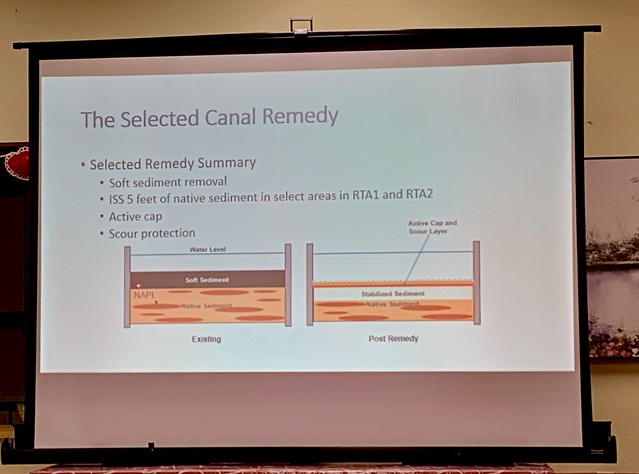
Secondly, our plan included the stabilization of all native sediment in the areas where the coal tar that had gotten in there would percolate upward into the canal and recontaminate the water. 
Thirdly, our plan had a multilayer cover that included layers that have the capacity to absorb contaminants as they move upwards. This cap will offer a clean bottom of the canal. 
Equally important in our plans is that we included measures for preventing sewer and storm water from recontaminating the canal.
Over the past ten years, it was not always easy to implement this plan. We had to fight some gargantuan battles with several entities just to ensure that the interest of the citizens were well served. In the end, we prevailed," said Tsiamis

Natalie Loney, Brian Carr and Christos Tsiamis at today's ceremony
Photo credit: Marlene Donnelly

More in depth information about what will happen in the upper portion 
of the canal over the next few months.

With the lessons learned during the Pilot Study in the Fourth Street Basin near Whole Foods in 2018, the EPA has made some adjustments to the original clean-up plan and estimates that the work on Remediation Target Area 1.

The work needs to be carefully choreographed. Before the toxic material at the bottom of the canal can be removed, new bulkheads needed to be installed to provide structural support to the shore. 
Also, work on the Fulton Bulkhead Barrier Wall Construction at the head of the canal had to be completed. The sealed wall will serve as an environmental barrier, preventing liquid coal tar from the former Fulton Manufactured Gas Plant from recontaminating the canal after the Superfund clean-up is completed.

In addition, the Union Street Bridge and the landmarked Carroll Street Bridge need to be stabilized with pipe piles in order to not compromise them during dredging. The Carroll Street Bridge will most likely stay in an open position for three to four months and will be closed to traffic. The Union Street Bridge, however, will be passable.

Once the dredging of the toxic material is completed, the bottom of the canal will be capped o keep toxins deep in the native soil from percolating back up into the water after the dredging. 
To prevent recontamination, the contractor doing the work will:
-inject a cement layer into the most contaminated pockets of native sediment to stabilize these areas
-add an oleophilic clay layer
-add granular activated carbon (to absorb any chemical pushed up from below) and a sand layer. The thickness and content will vary to match the expected dissolve phase flux through the cap and to provide an even surface for the top.
-finish with an articulated concrete armor top

Most of the toxic dredged material will be transported out of the community by barge on the Gowanus to New Jersey where there is sufficient space to separate and treat it before disposal.

Read more

Wednesday, February 26, 2020

EPA Explains Superfund Clean-Up Sequence For The Upper Gowanus Canal. Work To Begin This Fall

Untitled
Untitled
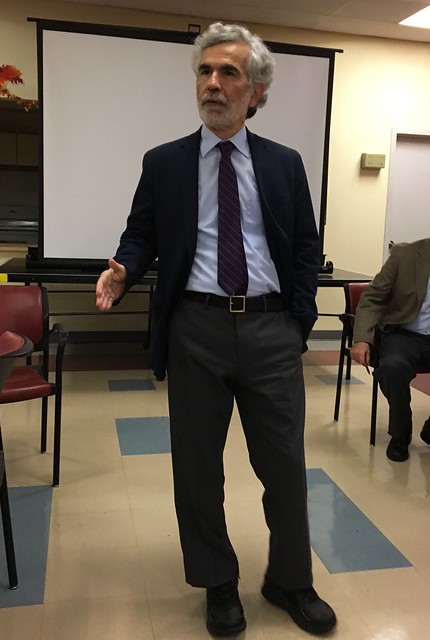
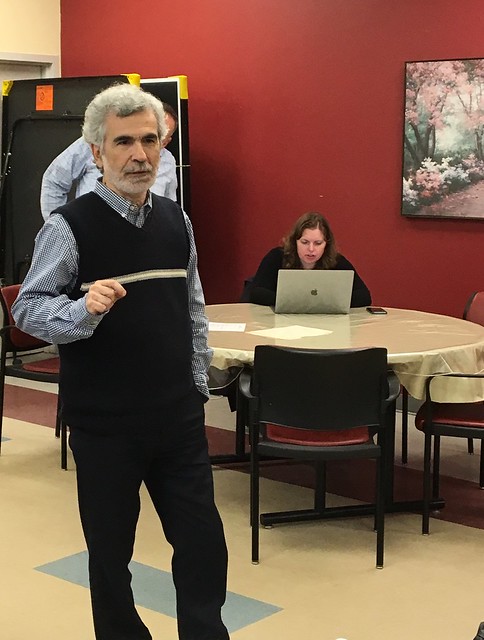
Christos Tsiamis, EPA's Gowanus Canal project manager
Untitled
Untitled
Untitled
Untitled
Untitled
Untitled
Untitled
Untitled
Untitled
Untitled
On Tuesday, January 28, the Environmental Protection Agency (EPA) issued a Unilateral Administrative Order to the six major corporations that bear the most significant responsibility for the canal's pollution. The order compels these Responsible Parties to begin the important work of dredging and capping of the upper portion of the Gowanus Canal and to restore the First Street Basin, which was illegally filled a few decades ago.

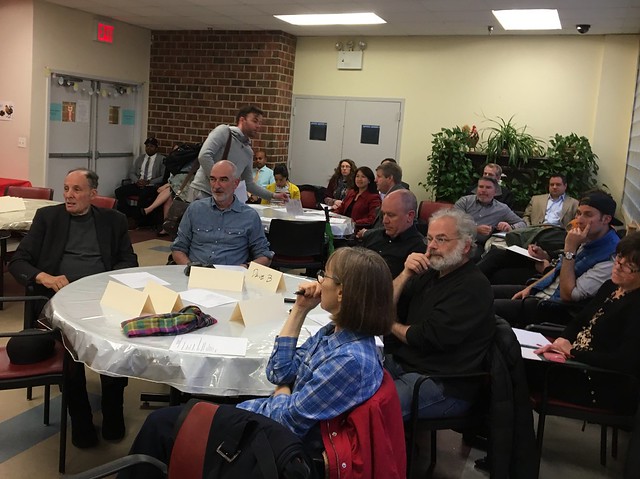
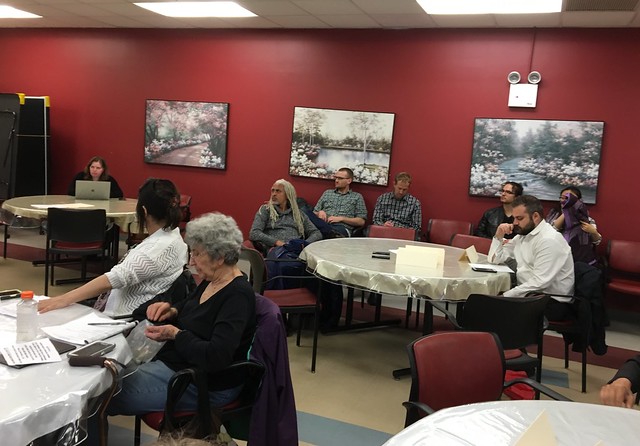
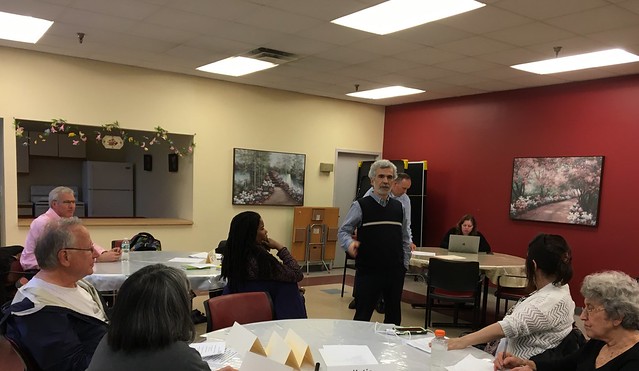
At last night's Gowanus Canal Community Advisory Group's meeting held at Mary Star of the Sea Senior Home on First Place, the EPA gave the community a one-and-a half-hour presentation on the actual clean-up sequence for this upper portion of the Gowanus Canal.

Christos Tsiamis, the EPA project manager, began the lengthy and detailed presentation by saying:
"It has been a long time coming for me and for you, this moment when I stand here in front of you to discuss specific steps that we will take for cleaning up the canal in a timeframe that is within sight. So I am very happy to be here tonight."

Indeed, it felt like a huge milestone to finally be talking about dredging the main canal after so may years of planning.

With the lessons learned during the Pilot Study in the Fourth Street Basin near Whole Foods in 2018, the EPA has made some adjustments to the original clean-up plan and estimates that the work on Remediation Target Area 1, which covers the top of the canal from Butler Street to the Carroll Street Bridge, will begin sometime in late August/ September of 2020.

The work, as Tsiamis explained yesterday, needs to be carefully choreographed. Before the toxic material at the bottom of the canal can be removed, new bulkheads need to be installed to provide structural support to the shore. Also, work on the Fulton Bulkhead Barrier Wall Construction at the head of the canal is still ongoing. The sealed wall will serve as an environmental barrier, preventing liquid coal tar from the former Fulton Manufactured Gas Plant from recontaminating the canal after the Superfund clean-up is completed.

In addition, the Union Street Bridge and the landmarked Carroll Street Bridge need to be stabilized with pipe piles in order to not compromise them during dredging.  The Carroll Street bridge will most likely stay in an open position for three to four months and will be closed to traffic. The Union Street Bridge, however, will be passable.

Once all the support work has been completed, dredging of the soft, toxic sediment at the bottom of the canal will begin between the two bridges.

One major change in the clean-up plan has to do with the capping, which serves to keep toxins deep in the native soil from percolating back up into the water after the dredging. As Tsiamis observed as part of his work on the canal, there is a significant amount of upwelling of ground water.  In order to deal with this, the contractor will:
-first dredge most of the contaminated soft sediment and debris
-inject a cement layer into the most contaminated pockets of native sediment to stabilize these areas
-add an oleophilic clay layer 
-add granular activated carbon (to absorb any chemical pushed up from below) and a sand layer. The thickness and content will vary to match the expected dissolve phase flux through the cap and to provide an even surface for the top.
-finish with an articulated concrete armor top

Most of the toxic dredged material will be transported out of the community by barge on the Gowanus to New Jersey where there is sufficient space to separate and treat it before disposal.

The work on this upper portion is expected to take about 30 months and is estimated to cost $125 million. Upon its completion, the clean-up will continue on the middle and lower parts of the canal. 
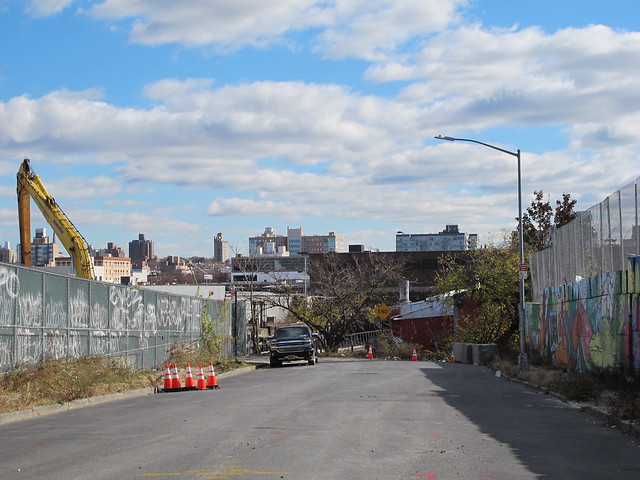
Tsiamis told the CAG that work on the design for RTA2, the most polluted part of the canal, is already underway.

This big step signals the true beginning of the clean-up of this long neglected waterway. It will be a pretty momentous occasion for Gowanus and for this community.


Read more

Monday, May 07, 2018

It's Quite A Sight: The Dredging Of Toxic "Black Mayonnaise" At Gowanus Canal's 4th Street Turning Basin Now In Full Swing

Untitled
Untitled
Untitled
Untitled
Untitled
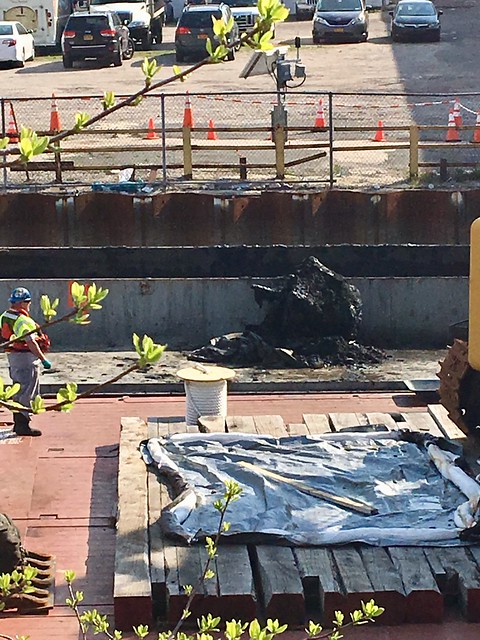
A big coal tar-covered object that was dredged out of the canal on Friday.
Untitled
Untitled
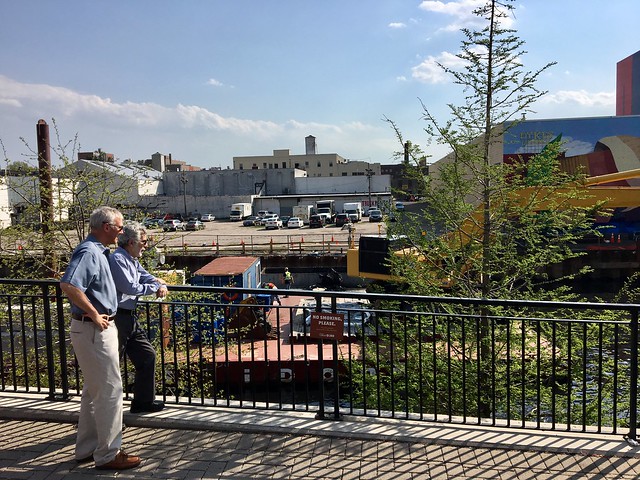
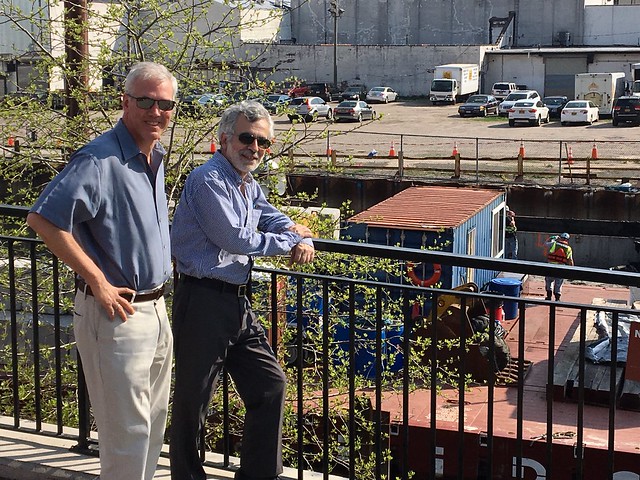
Brian Carr, EPA Region 2 lawyer , and Christos Tsiamis EPA Senior Project Manager for the Gowanus Superfund at the 4th Street Basin checking out the work being performed this past Friday.

Something quite extraordinary is happening at the 4th Street Turning Basin of the Gowanus Canal. Currently, The Environmental Protection Agency's Dredging And Capping Pilot Study at the basin near Whole Foods is in full swing.
The work consists of dredging the contaminated sediment at the bottom of the basin and capping it to prevent recontamination. The results of this work will inform EPA and help fine-tune different techniques that will eventually be applied to the entire canal.

It is quite fascinating and satisfying to see the toxic 'black mayonnaise' being lifted out of the canal after so many decades.  The crew performing the work uses a G.P.S. system to map and to keep track of where dredging has been performed.  The material is placed into barges, then de-watered at a staging area at the Public Place site at Huntington Street,  before it is sent to a licensed disposal facility.

Though there were some initial delays due to problems associated with  the installation of bulkheads to provide structural support to the shore, the dredging and, subsequently, the capping work will now continue in full swing. The work is estimated to be completed by the end of the summer.  E.P.A.'s goal is still to begin the dredging of the main canal sometime in late 2020.

Christos Tsiamis, EPA Senior Project Manager for the Gowanus Superfund and  Brian Carr, EPA Region 2 lawyer, visited the worksite this past Friday and seemed pleased with the progress being made.


For Tsiamis and Carr, as well as for the community, the completion of the 4th Street Basin Pilot study in just a few months will represent a huge milestone. It means that for the first time in over a century, there will be a clean portion of the canal.  And that is something to celebrate.


Read more

Wednesday, October 25, 2017

Spring For Gowanus Canal: By May 2018, For The First Time In Over A Century, A Section Of The Waterway With Be Clean.

Untitled
Work currently going on in the 4th Street Turning Basin
Christos Tsiamis
EPA Senior Project Manager for the Gowanus Superfund
Tsiamis with Doug Sarno, Gowanus Canal CAG facilitator

Christos Tsiamis, the Environmental Projection Agency's Senior Project Manager for the Gowanus Superfund attended last night's Gowanus Canal Community Advisory Group's meeting to give an update on the clean-up of our polluted canal.

As you might have noticed, there has been quite a bit of activity on the Gowanus Canal at the 4th Street Basin (TB4), located at the intersection of 4th Street and 3rd Avenue next to the Gowanus Whole Foods. As of the beginning of October, heavy equipment and barges have been moved into the basin to perform preparatory work ahead of Phase Two of the Dredging and Capping Pilot Study, which will begin in a little over a month from now.

The preparatory work consists of dredging an 'access channel' to allow larger vessels to work in TB4, and to install bulkhead support to strengthen the existing bulkheads during the excavation of soft sediment during the pilot study.

The second phase* of the Pilot Study will take place roughly from December 2017 to May 2018. It will consist of dredging the contaminated material at the bottom of the Turning Basin, to screen the material, to remove debris, to stabilize the sediment to render it harmless, and to barge the stabilized material to an off-site facility by barge.
Finally, a multi-layer  protective cover will be placed on the bottom of the canal to prevent re-contamination.  The study will take place roughly from December 2017 To May 2018.

Once the pilot study is completed, all information gathered will be analyzed and incorporated into the design for the entire environmental remediation of the canal from top to bottom. "Then we are, so to speak, off to the races. From then on, it will be a continuous process" according to Tsiamis.

"I don't know if you have realized it, folks, but this is the real deal! Pay attention to this. By the time we finish the pilot study at the end of spring 2018, for the first time in over a century, there will be a clean portion of the canal. It will be spring, and spring for the Gowanus Canal, also," Christos told members of the CAG, who applauded the news loudly.
"You dreamt about a clean Gowanus, we dreamt of a clean Gowanus. We would like for the community to pass around the news."

*The first phase of the Pilot Study was carried out in October 2016 and consisted of clearing debris from the basin which obstructed navigational access. (for photos of the intriguing objects and material dredged up can be found here.)


Read more

Thursday, April 27, 2017

Forget Clean Gowanus Canal By 2022: Schedule Proposed By Potentially Responsible Parties Adds Six To Seven Years To Completion Date

IMG_0476
IMG_0470
Untitled
Doug Sarno facilitator for the Gowanus Canal Superfund Community Advisory Group
Untitled
At the CAG's April General meeting this past Tuesday.
Untitled
Untitled
Christos Tsiamis of EPA addressing the Gowanus Canal Superfund CAG this past Tuesday
 Untitled
EPA timeline for the clean-up of the Gowanus Canal

National Grid, New York City, Honeywell, Amerada Hess, Con Edison and other Potentially Responsible Parties (PRPs) seem to be dragging their feet in regards to the Environmental Protection Agency's  Gowanus Canal Superfund Cleanup.
At last night's Gowanus Superfund Community Advisory Committee (CAG) meeting, Christos Tsiamis, the EPA project manager for the canal, told local residents that certain differences of opinion have arisen fairly recently between his agency and the PRPs.

The differences relate to the schedule of the work that the group of 28 PRPs has been directed to perform in the canal by the EPA.

Following the selection of the environmental remedy for the site in September 2013, the EPA had issued orders to the PRPs to design the selected remedy on a specific timetable. The remedial design work is supposed to be done in stages in three remedial target areas along the canal.
Roughly,
-remedial Target Area #1 includes the upper canal area from Butler Street to the 4th Street Basin
-remedial Target Area #2 includes the middle canal area from the 4th Street Basin to 9th Street
-remedial Target Area #3 includes the lower canal area from 9th Street to the Erie Basin at 21st Street
According to EPA's timetable , the design for Target Area #1 of the Canal was anticipated to be completed by the end of  2017. However, a schedule submitted by the PRPs to EPA indicates a completion date of February 2019. That is a significant change, especially because work for the entire canal is estimated by EPA to be completed by 2022.

The delays could be magnified during the design phase of the other two target areas.  EPA has "reasonably assumed" that the work will therefore be delayed by six to seven years.
"If the PRPs have the same approach as they have now, we conservatively estimate going to 2028-2030 for the completion of the canal, not 2022," Tsiamis explained.

The timeline discrepancy is related to the difference of approach. "One is the 'organizing principle' of the work, the second is the sequencing", according to Tsiamis.  "Our agency's organizing principle from the time that we came to Gowanus to do the investigation, was to build on past work that already existed from the Corps Of Engineers and others.   Then we added what was needed and excercised good engineering judgement to make decisions. We are not trying to reinventing the wheel."

The group of PRPs, however, is insisting on repeating many elements of the work rather than to rely on information that already exists. This is not only a waste of time, it is also a waste of money, according to the EPA.

Sequencing refers to how the actual work is done and how one deals with sub-contractors.  "One of the important aspects of the clean-up is fixing the bulkheads," said Tsiamis. "From our perspective, it makes sense while we are doing other investigations in the canal, to start fixing them."
For the past few years, the EPA has been speaking with property owners, have prepared orders and have been successful in completing a number of bulkheads with others being completed in the near future.  Tsiamis stated that 'one can de-couple the bulkhead work from the rest of the work that is happening in the canal. 
The PRPs are taking the opposite approach, trying to lump all work together.

"I am doing everything in my power to push the work forward. I have issued a number of directives in the last month. I am not sure how successful I will be in compressing the schedule that they have presented." Tsiamis told the CAG. "What you need is willingness on the part of the PRPs."

Obviously the PRPs are taking full advantage of the Trump administration's gutting of the EPA. The Gowanus community should be outraged by any possible delays in the clean-up of our toxic waterways and should voice its protest loudly and clearly.
Enough is enough!


Read more

Wednesday, November 23, 2016

It Came From The Gowanus: Viewing Debris Recently Removed From 4th Street Basin

IMG_9562
IMG_9554
IMG_9560
Representative of contractor Stevenson going over some safety points before entering site
IMG_9563
Christos Tsiamis,
EPA Senior Project Manager for the Gowanus Superfund, (right) speaking to members of the EPA Community Advisory Group's Archaeology Committee
IMG_9561
IMG_9566
IMG_9567
IMG_9575
IMG_9568
IMG_9570
IMG_9583
IMG_9569
IMG_9572
IMG_9573
IMG_9577
IMG_9574
IMG_9585
IMG_9591
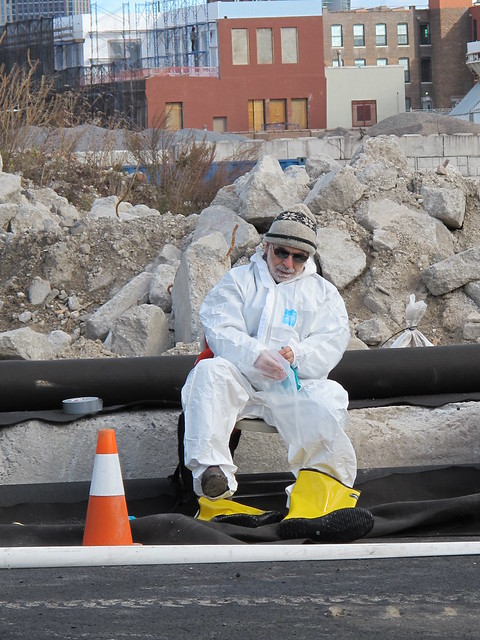
EPA's Christos Tsiamis,
suiting up to handle some of the material recently removed fro the Gowanus Canal 

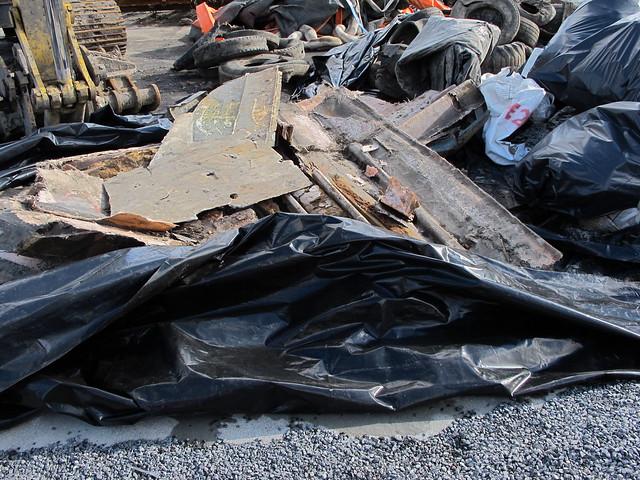
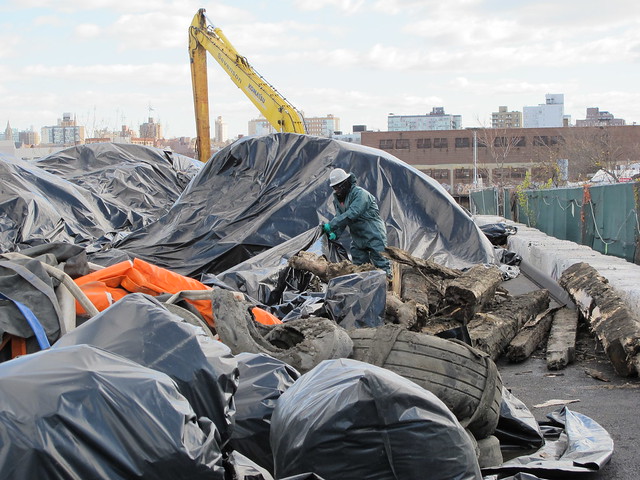
As an important step in the environmental clean-up of the highly toxic Gowanus Canal, the U.S. Environmental Protection Agency began a debris removal Pilot Project at the 4th Street Turning Basin next to the Gowanus Whole Foods this past October. This first phase of the pilot program consisted of clearing obstructions from the basin that prevented navigational access.

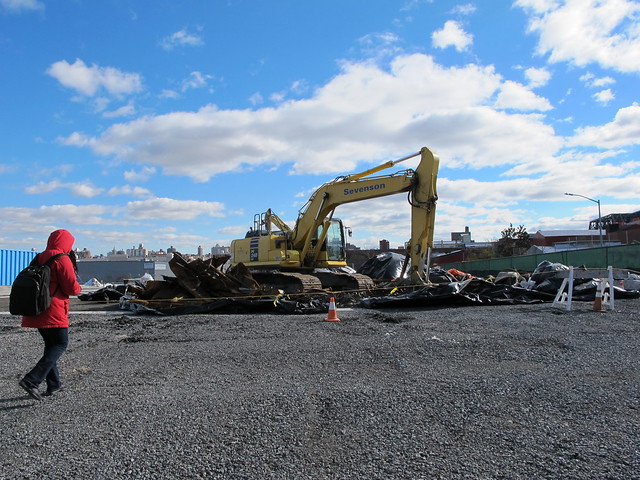
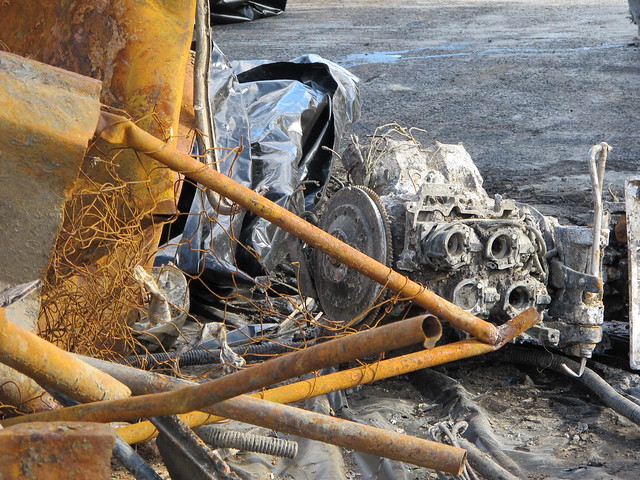
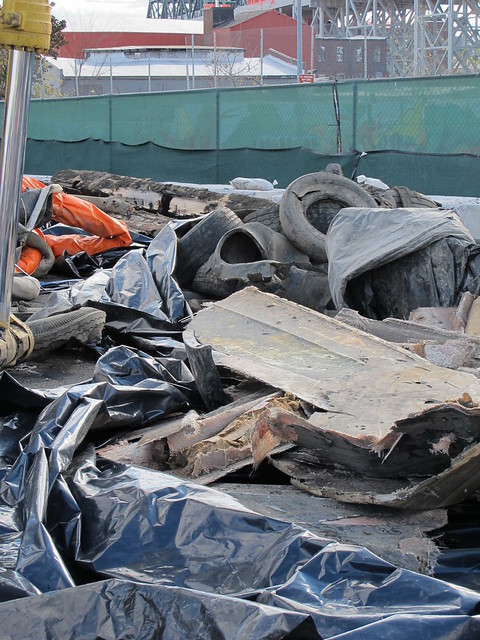
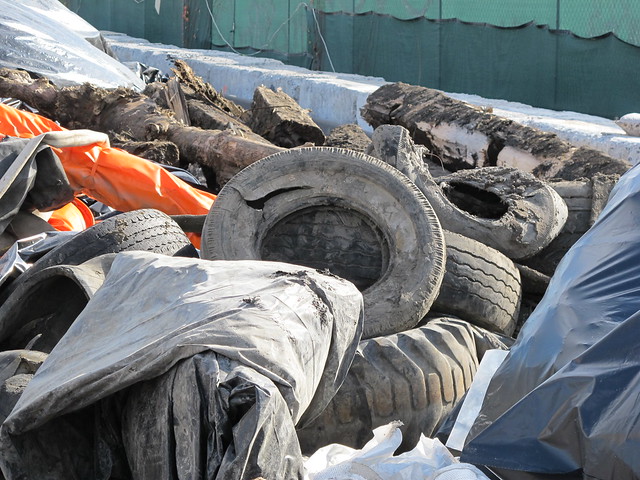
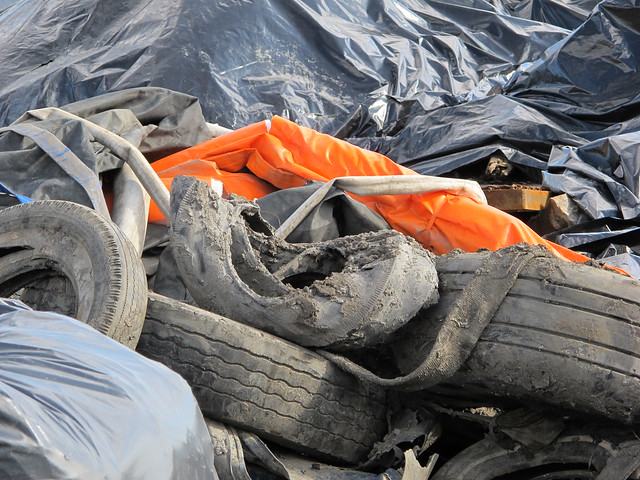
For about two weeks, environmental remediation and dredging contractor Sevenson removed all sorts of urban debris that included a sunken boat hull, a smaller fiber glass boat and countless tires. 

The debris was transported by barge to a staging area to the Public Place site at Smith Street and Huntington Street.  Eventually, it will be transported out of the area via barge to appropriate recycling or waste facilities.

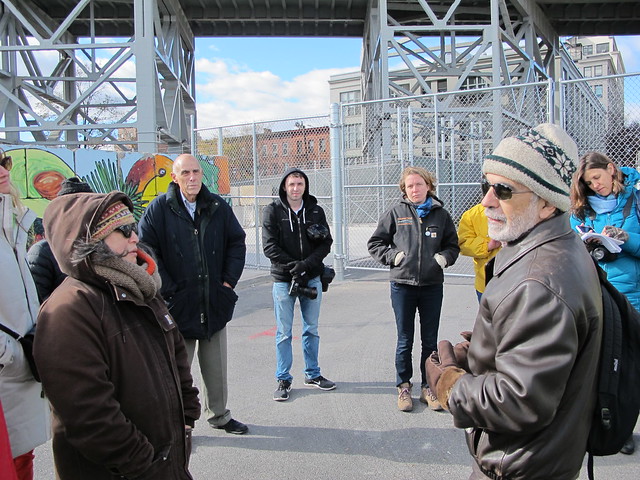
Before shipping the debris off-site, Christos Tsiamis,  EPA Senior Project Manager for the Gowanus Superfund, organized a viewing this past Tuesday for members of the press and for the Archaeology Committee of the Gowanus Canal Community Advisory Group.
Accompanied by Natalie Loney, EPA Community Involvement Coordinator, Tsiamis explained to the group that the debris had been neutralized and  assessed by an archaeologist, who found that it held "no archeological importance." A full report will be available at the beginning of December.
 
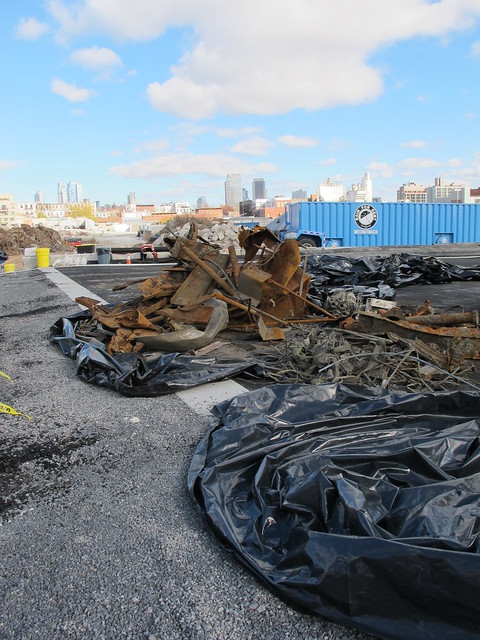
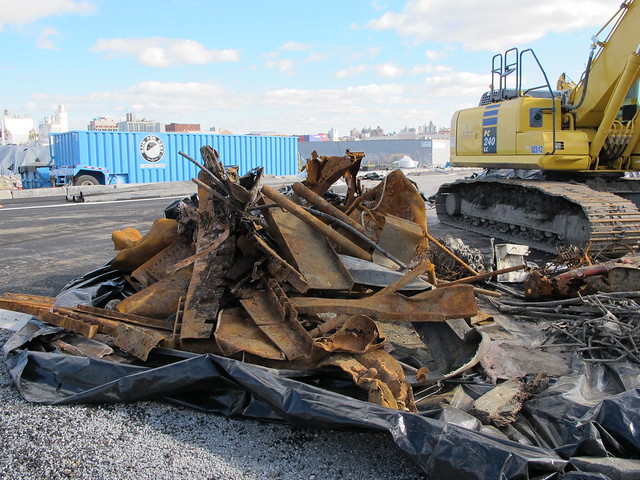
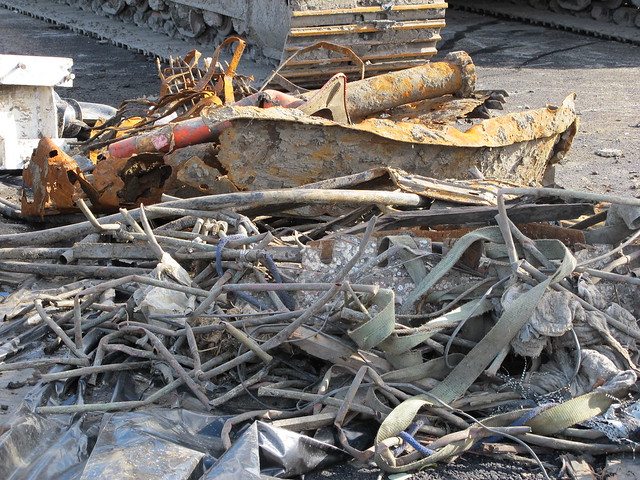
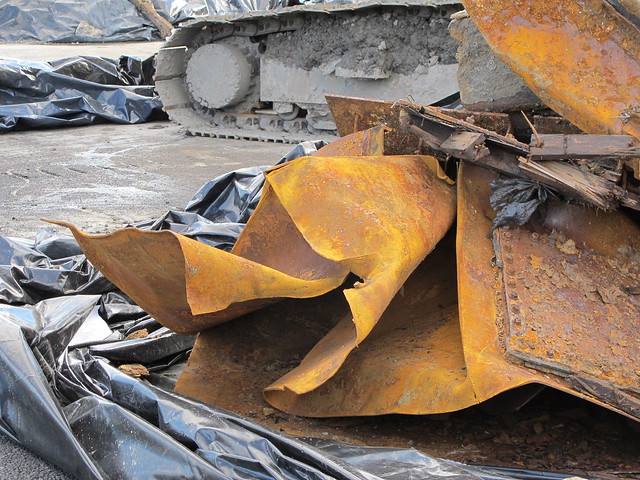
Since most of the larger items removed from the 4th Street basin broke apart when lifted out of the water, the debris currently stored on Public Place consists of twisted metal and wood. The only recognizable items are an engine and tires.

According to Tsiamis, there really were no big surprises when the material was lifted out of the water, 
The larger items had previously been identified and mapped using sonar technology. 
"There may be more interesting targets when we come to dredge deeper into the soft material at the bottom of the canal," Tsiamis said.

Indeed, the second phase of the 4th Street Basin pilot study will continue at the end of the summer in 2017. It will consist of dredging the toxic black sediment at the bottom of the canal and capping to prevent recontamination. The results of that work will inform the EPA on how best to dredge the entire length of the canal at a later time.

So there is still a chance that the Gowanus Canal will give up some of its darker secrets and live up to its infamous reputation as the resting place of the Maryland 400, as a notorious mafia dumping ground  and home of a revengeful toxic sludge monster.


Read more