Showing posts with label EPA Gowanus Canal Community Advisory Group. Show all posts

Monday, March 29, 2021

National Grid's Own Documents Prove That Contaminants From Public Place In Gowanus Migrated Off-Site


Public Place, the large empty swath of land between Smith Street and the Gowanus Canal in Carroll Gardens, may be one of the most contaminated sites in New York State and there are grave concerns that it may never be fully cleaned up despite current remediation efforts.  How did Public Place get so contaminated?
This is the site of the former Citizens Gas Company's Manufacturing Gas Plant, one of three such MGPs that once operated along the Gowanus Canal.

The Citizens Gas Company began operations in the late 1860's and then passed into the ownership of Brooklyn Union Gas (BUG) in 1895, which demolished the plant in the 1960's, when the MGP ceased operation. In subsequent years, BUG was merged with Keyspan, which was then acquired by National Grid in 2007.

What has been left behind is poisoned land. Coal tar, a highly toxic and carcinogenic by-product of the gas manufacturing process, has been allowed to migrate freely throughout the site and into the Gowanus Canal.  On Public Place, the deepest tar observed extended to approximately 153 feet below the ground surface.

Finally, after decades of exposing local residents to this toxicity, three of the four parcels that made up the former MGP site are currently being remediated by National Grid under the supervision of New York State's Department Of Environmental Conservation (DEC) through the state's Brownfield program.

However, the remediation can hardly be called a clean-up. It would be more appropriate to call it a containment, since most of the coal tar will remain in the soil forever.
Just recently, the Carroll Gardens / Gowanus community learned that DEC had allowed National Grid to significantly alter and degrade the remediation, sparking concerns that future residents would be exposed to the remaining contamination.

A look at National Grid's online repository for the Citizen's Gas Site documents reveals exactly how dangerously contaminated the site is.
According to a Remediation Investigation Report from 2005 by environmental consultant firm GEI, "groundwater moving through the areas of tar-saturated soil and residual tar will dissolve the BTEX components and light molecular weight PAHs (e.g., naphthalene). The resultant groundwater plume will migrate in the direction of groundwater flow. "
The study also revealed that in some spots, soil vapor contained elevated levels of benzene, toluene, and xylenes.

The most concerning information, however, can be found in a document entitled 2005 Final Remedial Investigation for Public Place, which can also be found in National Grid's online repository.
The community has known for a while that coal tar from Public Place has migrated into the adjacent Gowanus Canal. Local residents therefore asked if the contamination could have found its way past the other three boundaries of the site.
If one studies the report carefully, the answer, alarmingly, seems to be "YES".

The 2005 report clearly shows that pockets of coal tar have oozed underneath Smith Street, Huntington Street, as well as 4th Street at Hoyt Street, where it was detected underneath a row of buildings.
Yet, neither National Grid, nor NYC DEC admitted this important fact to local residents, though they were asked at numerous occasions at public meetings.

Below, we will guide you through the documents from the 2005 Final Remedial Investigation to reveal that contamination from the former MGP site at Public Place is no longer confined to its boundaries.
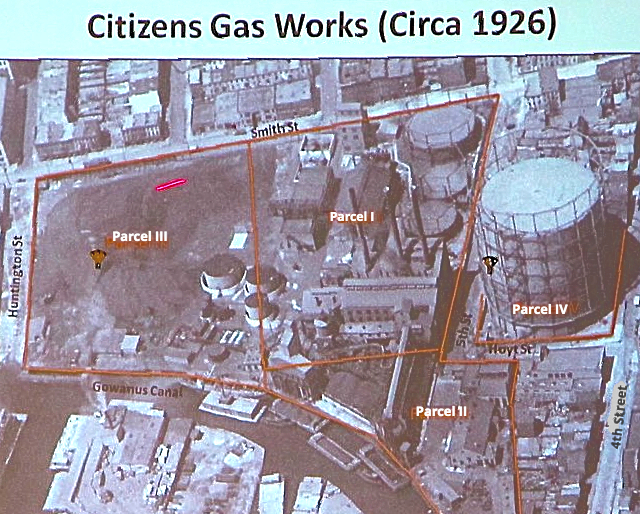
The four parcels that make up the former Citizens Gas Site
Arial view of the MGP site  in 1926, showing the various round gas holders. Parcel I with the three 
holders near Smith and 5th Street apparently holds the most pollution.
This diagram is from page 290 Of the 2005 GEI report
This particular map shows the survey of the site boundaries, as well as the cross sections (A-A' to G-G') along which soil borings were taken and ground water monitoring wells were installed by GEI. 
This is page 306 from the report. It shows the results of the soil samplings and ground water analysis from cross sections A-A'  and B-B'. The best way of visualizing this is by imaging cutting a straight line into a cake. The cut piece would reveal the different layers of the cake. In this instance, it shows the soils and contamination found in this cross section.
This speaks for itself, obviously, but notice that the dark blues indicate presence of coal tar.
Let us take a closer look at section B-B', which starts at Smith Street on Parcel I and ends at 6th Street on the other side of the Gowanus Canal.
Here is the level of pollution found deep in the ground on Parcel I along the B-B' section.
Corner of 5th Street and Smith Street, which according to cross section diagram,
 indicates a pocket of contaminated ground water.

This is where it gets interesting. This is the beginning of that B cross section of Parcel 1 at the corner of Smith Street and 5th Street, where the three gas holders that can be seen in the 1929 photo were once located.
If you look at the left hand side of the diagram, you will see a turquoise section in the 'shallow zone' that indicates that "coal tar staining, sheen and odors" were observed in the groundwater at this spot. The upper blue number in the little white box shows that at this spot, the groundwater concentration of BTEX, which refers to the chemicals benzene, toluene, ethylbenzene and xylene, is 13,300 μg/mL (parts per billion). The lower number indicates PHA (Polycyclic Aromatic Hydrocarbon) at concentration of 7670 parts per billion.)

NY State regulations state that BTEX should not exceed 5 parts per billion for drinking water but there are no limits for the PHA. While nobody will be drinking the groundwater containing these chemicals, there is continuing exposure through contact with the soil and breathing the air.

Now look up at the upper left hand side and notice that the contamination at this spot actually starts past the Public Place fence line. This diagram from the 2005 report indicates clearly that the groundwater barely 30 feet (NDA) below the surface has been heavily contaminated and actually extends onto Smith Street.
Now let us look at cross section I-I', which crosses Parcel 3 and Huntington Street, and ends across the Gowanus Canal towards 9th Street.
This is slide 310 of the GEI report from 2005.
Analysis of soil borings taken at this location also indicates the presence of coal tar staining, sheen and odors. The BTEX soil concentration here is 79 parts per million, the PHA concentration is 482 per million.
Once again, notice on the top part of this diagram, that the toxins have been found outside of Parcel 3, underneath Smith Street.
Approximate spot where evidence of coal tar was present on Smith Street on the I-I' cross section 
Mary Star Of The Sea Playground just steps away
The most interesting part of the report concerns cross section G-G', 
which starts on Parcel IV along 4th Street.

It is not currently being remediated by National Grid, though it is part of the former MGP site and is also contaminated. The parcel is occupied by a bus depot at the moment, and the community has been told it will be cleaned at a later time.
However, if you follow the G-G' cross section, you notice that there are actually pockets of toxic material right underneath the buildings between Hoyt Street and Bond Street.
Cross section G-G'. Slide 309 of the 2005 report.
One can clearly see the pockets of contamination in the soil and ground water underneath those buildings, especially the brick building on 4th Street nearest to Bond Street.
Buildings on south side of 4th Street between Hoyt and Bond Street, which show 
evidence of contamination along the G-G' cross section

The 2005 Final Remedial Report for Public Place indicates widespread pockets of coal tar on all four parcels. The remedial work currently being done on Parcel I, II and III by National Grid under NYS DEC supervision only removes 2 feet of soil across those parcels, and only digs down to a maximum depth of 22 feet on Parcel 1, where the remaining subsurface structures of the former gas holders need to be removed anyway.
The report also shows that the contamination has migrated outside the boundaries of all four parcels.

It is important here to indicate that the beginning and the end of each cross section along which the soil and the ground water was tested, was strictly arbitrary. If, for example, line I-I' had extended further across Smith Street and testing had been done closer to Nelson Street, it may have shown contamination under St. Mary's Playground or, one shudders to think, under some of the homes, perhaps.

It may not have been in the interest of National Grid to find out if that is the case. However, as the lead agency overseeing the Public Place remediation, one wonders why NYS DEC did not insist on more testing, more mitigation and more barriers to prevent the contaminants from migrating outside of the site.. After all, the documents referred to above have been available since 2005.

Why is all of this so relevant?
The pollution at Public Place and the gasses they emit are dangerous to human health. Despite this knowledge, Mayor de Blasio and Councilmember Brad Lander envision Gowanus Green, a 29 story development project with 950 affordable housing units and a school on a section of Public Place that is City owned (Parcels 1 and 2). More housing is planned on the privately owned parcel 3.

As a community, we need to insist that independent testing along a wider radius of Public Place is performed. We must insure that the coal tar is not present under other adjacent buildings.
At the very least, we need to insist that no housing be built right on top of the source of the contamination on Public Place.


We are dealing with people's lives and cannot have National Grid nor NYS DEC take any shortcuts. This community has already been exposed to the harmful effects of this contamination for more than a century.
Let's organize and fight together to get the environmental clean-up we deserve and are entitled to by law.


Related reading:
National Grid's online repository for the Citizen's Gas Site documents.


Read more

Monday, March 01, 2021

False Claims And Questionable Oversight: Why NY State DEC Cannot Be Trusted To Supervise National Grid's Clean-Up At Public Place

Public Place, the almost 11 acre swath of land bordered by the canal and Smith Street and 5th Street and Huntington Street in Carroll Gardens has been mentioned frequently in the news of late and for good reasons.
Public Place may be one of the most polluted sites in New York State and there are grave concerns that it may never be fully cleaned up despite current remediation efforts.

Despite these circumstances, Mayor de Blasio and Councilmember Brad Lander envision Gowanus Green, a 29 story development project with 950 affordable housing  units and a school on a section of Public Place that is City owned (Parcels 1 and 2).  More housing is planned on the privately owned parcel 3.

Public Place site in Carroll Gardens

How did Public Place get so polluted? It is the site of the former Citizens Gas Company's Manufacturing Gas Plant,  one of three such MGPs that once operated along the Gowanus Canal.

The Citizens Gas Company began operations in the late 1860's and then passed into the ownership of Brooklyn Union Gas (BUG) in 1895, which demolished the plant in the 1960's, when the MGP ceased operation.  In subsequent years, BUG was merged with Keyspan, which was then acquired by National Grid in 2007.
An arial view of the Citizens Gas Work site in 1926

What is left behind 160 years later is poisoned land. Coal tar, a highly toxic and carcinogenic by-product of the gasification process, has been allowed to migrate freely through the site and into the Gowanus Canal.   On Public Place, the deepest tar observed extended to approximately 153 feet below the ground surface.

According to a Remediation Investigation Report from 2005 by environmental consultant firm GEI,  "groundwater moving through the areas of tar-saturated soil and residual tar will dissolve the BTEX components and light molecular weight PAHs (e.g., naphthalene). The resultant groundwater plume will migrate in the direction of groundwater flow. "
The study also revealed that in some spots, soil vapor contained elevated levels of benzene, toluene, and xylenes. 

Finally, after decades of exposing local residents to this toxicity, the site is currently being remediated by National Grid under the supervision of New York State's Department Of Environmental Conservation through the state's Brownfield program.
However, the remediation can hardly be called a clean-up. It would be more appropriate to call it a containment, since most of the coal tar will forever remain deep in the native soil.ƒ

Just recently, the Carroll Gardens/ Gowanus community learned that DEC had allowed National Grid to significantly alter and degrade the remediation, sparking concerns that future residents would be exposed to the remaining contamination.

At a December 2020, Gowanus Superfund Community Advisory Committee meeting, members addressed this issue and proposed a resolution asking the Environmental Protection Agency (EPA) to review and comment on DEC's changes to the remediation of Public Place. The resolution passed overwhelmingly.

Christos Tsiamis, EPA's project manager for the Gowanus Canal Superfund, was in attendance at the December meeting.  Tsiamis, who holds a master's degree in chemical engineering from Columbia University, is very familiar with the issues at Public Place, since coal tar from the site is a major source of pollution in the Gowanus Canal. 
The EPA is very protective of their Superfund clean-ups, so that any site, like Public Place, which has the potential of recontaminating the canal, is rigorously scrutinized.

Christos Tsiamis, the EPA Senior Project Manager for the Gowanus Canal Superfund
(on right)

Since Tsiamis has been studying the contamination of the canal and the uplands since 2009,  he is in a unique position to compare the original mandated clean-up plan to the new downgraded one. 

He expressed concerns that the current DEC supervised remediation actions will not be sufficient. In particular, he mentioned three key aspects that were included in a 2007 design report, but subsequently eliminated when the plan was finalized in 2017-2018.

- the installation of a High Density, heavy plastic liner 2 feet below grade throughout the site as storm water management to prevent rain water absorption, which could dislodge the deeper, remaining pockets of coal tar.  

- two water treatment systems to clean the rainwater from the site so it can can be discharged back directly into the Gowanus Canal

-two 'wings' or wall extensions along 5th Street and Huntington Street to prevent coal tar from oozing out of the site onto nearby sites.

Though members of the Gowanus Superfund CAG appreciated and thanked Tsiamis for his honesty and for sharing his expertise, NYS DEC demanded a retraction from EPA.
Mere days after the CAG meeting, DEC director Michael J. Ryan called Tsiamis' comments "flippant, unsubstantiated statements" and "not only inappropriate but dangerous" in a letter sent to EPA

Ryan claimed that Tsiamis:
• Incorrectly stated that the 2007 remedy required an impermeable cover two feet below grade to prevent infiltration;
• Incorrectly stated that the 2007 remedy required two water treatment systems to treat rainwater;
• Incorrectly stated that the 2007 remedy required “wing walls” along 5th Street and Huntington Street to prevent coal tar migration.

Luckily, one does not have to look far to prove Tsiamis right and the DEC wrong.
A deep dive into National Grid's online documents repository and into PMFA's own reporting revealed these facts:

-In August 2011,  a National Grid team presented their remedial design for the MGP site to Community Board 6. The team stated:
“The proposed remediation calls for the removal of the top 8 feet of soil throughout the site, which will be backfilled with clean soil to street level.
"As part of storm water management and to prevent ground water from leaking into the canal, a High Density Polyethylene (HDPE) liner will be installed 2 feet below grade throughout.”
Portions of the meeting were videotaped by PMFA and can be seen here.

slide from a 2011 National Grid presentation to Community Board 6

-The need for water treatment systems was incorporated in a 2007 National Grid Final Remedial Design Work Plan, which NYS DEC signed off on as part of the 50 % Remedial Design Approval.
In-Situ Groundwater Treatment (Section 5.4.3)
Based on the results of the hydrologic model and the final subsurface containment barrier wall configuration, groundwater treatment may be required to address shallow dissolved phased contamination at the site boundaries. As described in Section 5.2.2 above, in the shallow zone, installation of a barrier wall could exacerbate the natural mounding that occurs between Parcels I and II. If the configuration of the barrier wall cannot be adjusted to mitigate these effects then the mounded groundwater will have to be allowed to migrate through or around the containment barrier via perforated sections or treatment windows. In the event that this is necessary, various groundwater treatment technologies will be evaluated and an applicable technology selected. The results of this evaluation will be presented to NYSDEC for review and approval. If bench scale or pilot testing of the groundwater treatment technology is necessary, then an additional work plan will be developed and submitted to NYSDEC for review and approval. 

Since the EPA had observed that coal tar had migrated off the site on Huntington Street, the 2007 plan did call for “Wing walls” along 5th Street and Huntington Street to prevent further migration.  The wings were still part of the plan in this July 2011 work plan document which National Grid submitted to DEC for review and approval to perform a remedial design pilot test program "to demonstrate the application and effectiveness of barrier wall technologies at the site."

As can be clearly seen in the red outline in Figure 1 included in the report, the barrier wall was designed to partially extend along 5th Street and halfway along Huntington Street. 

2011 National Grid document showing 'wing walls' along 5th Street and Huntington Street 
to prevent coal tar from migrating off site

When it comes to the environmental clean-up of our community after more than a century and a half of exposure to carcinogens, we need to make sure that it is done to the highest remediation standards we are entitled to by law.
It seems, by its actions and false claims, New York State intends to be more protective of National Grid, the polluter, than of the interests of local residents.
The State agency has not only allowed National Grid to reduce the level of remediation on Public Place, it has also covered up the fact that it helped remove some key aspects of the clean-up such as a vapor barrier and wing walls, specifically put in place to reduce the likelihood that coal tar will migrate out of the site.

NYS DEC is trying to rewrite its own documented history and is playing politics when it asks for Christos Tsiamis of EPA to retract his statements.  It is displaying contempt for public safety when it disparaged his concerns about the remediation.
Facts and science are the only things that should matter when it comes to public health.  


Read more

Monday, November 16, 2020

A Momentous Occasion: Dredging Of Toxic Material Begins In Upper Portion Of The Gowanus Canal Today

Today marks a momentous occasion for the Gowanus Canal and the Gowanus community in Brooklyn. The Environmental Protection Agency's Superfund Cleanup of the Canal is about to begin in earnest this morning, with the dredging of the toxic sludge at the bottom of our waterway.
Heavy equipment and barges have been moved into place over the past few days. The first phase of this work will begin in the upper portion of the Canal, from Butler Street to the Carroll Street Bridge.
In two subsequent phases, the middle and lower parts of the canal will be dredged.

To mark the important occasion, EPA Regional Administrator Pete Lopez, Congresswoman Nydia Velazquez and other elected officials will hold a press conference at the esplanade at 363 Bond Street to celebrate the commencement of the clean-up of one of the most polluted sites in the United States.

On a personal note, I would like to thank Christos Tsiamis, the EPA Project Manager and Brian Carr, EPA Legal Council for all of their hard work on behalf of the Gowanus Community.
Both worked against tremendous odds to devise the most comprehensive, well-engineered clean-up plan for the Gowanus Canal. Without them, we would not have gotten this far.

At a recent community meeting, Tsiamis said:
"I want everyone to know that this was not always in the cards that this was the kind of clean-up that we were going to get.
What others had proposed when we were starting was a perfunctory dredging of a couple of feet, followed by a sprinkling of a sand cover on top of the remaining contaminated sediment. That was all and nothing more! 
Instead, our plan included first the removal of all the contaminated sediment that had been accumulating in the canal for a century and a half. 
Secondly, our plan included the stabilization of all native sediment in the areas where the coal tar that had gotten in there would percolate upward into the canal and recontaminate the water. 
Thirdly, our plan had a multilayer cover that included layers that have the capacity to absorb contaminants as they move upwards. This cap will offer a clean bottom of the canal. 
Equally important in our plans is that we included measures for preventing sewer and storm water from recontaminating the canal.
Over the past ten years, it was not always easy to implement this plan. We had to fight some gargantuan battles with several entities just to ensure that the interest of the citizens were well served. In the end, we prevailed," said Tsiamis

Natalie Loney, Brian Carr and Christos Tsiamis at today's ceremony
Photo credit: Marlene Donnelly

More in depth information about what will happen in the upper portion 
of the canal over the next few months.

With the lessons learned during the Pilot Study in the Fourth Street Basin near Whole Foods in 2018, the EPA has made some adjustments to the original clean-up plan and estimates that the work on Remediation Target Area 1.

The work needs to be carefully choreographed. Before the toxic material at the bottom of the canal can be removed, new bulkheads needed to be installed to provide structural support to the shore. 
Also, work on the Fulton Bulkhead Barrier Wall Construction at the head of the canal had to be completed. The sealed wall will serve as an environmental barrier, preventing liquid coal tar from the former Fulton Manufactured Gas Plant from recontaminating the canal after the Superfund clean-up is completed.

In addition, the Union Street Bridge and the landmarked Carroll Street Bridge need to be stabilized with pipe piles in order to not compromise them during dredging. The Carroll Street Bridge will most likely stay in an open position for three to four months and will be closed to traffic. The Union Street Bridge, however, will be passable.

Once the dredging of the toxic material is completed, the bottom of the canal will be capped o keep toxins deep in the native soil from percolating back up into the water after the dredging. 
To prevent recontamination, the contractor doing the work will:
-inject a cement layer into the most contaminated pockets of native sediment to stabilize these areas
-add an oleophilic clay layer
-add granular activated carbon (to absorb any chemical pushed up from below) and a sand layer. The thickness and content will vary to match the expected dissolve phase flux through the cap and to provide an even surface for the top.
-finish with an articulated concrete armor top

Most of the toxic dredged material will be transported out of the community by barge on the Gowanus to New Jersey where there is sufficient space to separate and treat it before disposal.

Read more

Thursday, October 03, 2019

Don't Eat The Fish! Man Seen Fishing In Gowanus Canal

Untitled
Untitled
Untitled
Untitled
Untitled
Untitled
(photos by Linda Mariano)

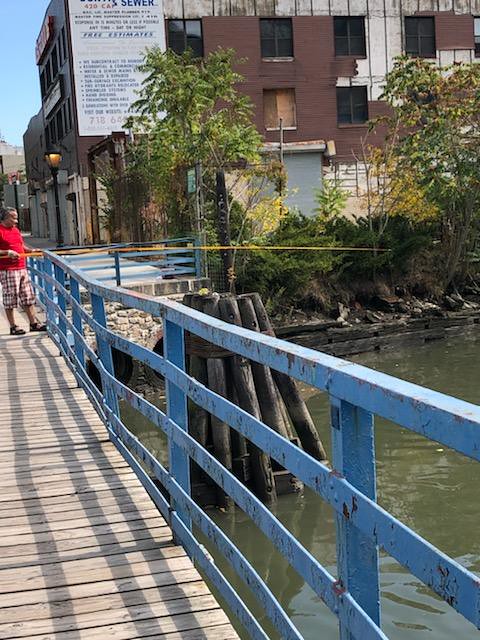
A few days ago, Gowanus resident and activist Linda Mariano came across a man fishing in the Gowanus Canal off the Carroll Street Bridge. He had caught several small fishes, which he had placed in a bucket. She tried to explain to him that the Gowanus Canal is an EPA Superfund site and that it was NOT a good idea to consume the fish. The man did not seem to speak English very well and perhaps did not understand her warning. However, a 'No Fishing' sign with graphics warn people  just a few feet away from where he was standing.
Apparently, this is not the first time he has been seen with his fishing rod and others have apparently warned him as well.

The Federal Environmental  Protection Agency declared the Gowanus Canal a Superfund Site in 2010 because it is one of the most polluted waterbodies in the nation. Once a thriving industrial transportation route, it was contaminated by the Manufactured Gas Plants (MGP), paper mills, tanneries and chemical plants that once operated along the Canal and discharged toxins into it.  To this day, contaminants mixed with raw sewage find their way into the Gowanus through Combined Sewer Overflow points along the canal.

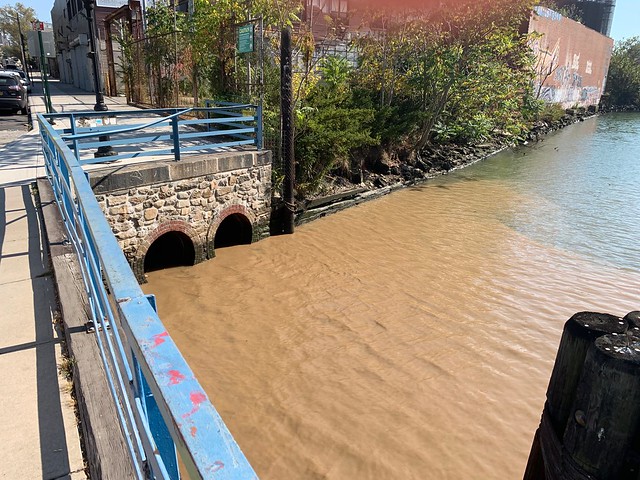
One of the largest sewer overflow pipes happens to be right next to the Carroll Street Bridge at the spot were the man was fishing.

Ironically, one of the factors (besides its toxicity) that earned the Gowanus Canal a spot on the EPA Superfund List was the fact that people were fishing and consuming fish caught in the waterway, especially when the anglers told EPA that they sold the extra catch to local restaurants.

Members of the  Gowanus Canal Community Advisory Group (CAG) have been urging  the New York State Department of Environmental Conservation to put up clearer and more urgent No Fishing, No Crabbing and No Swimming signs along the Gowanus. With the CAG's input, NYSDEC has finalized a new version of the signs. which will be put up shortly.

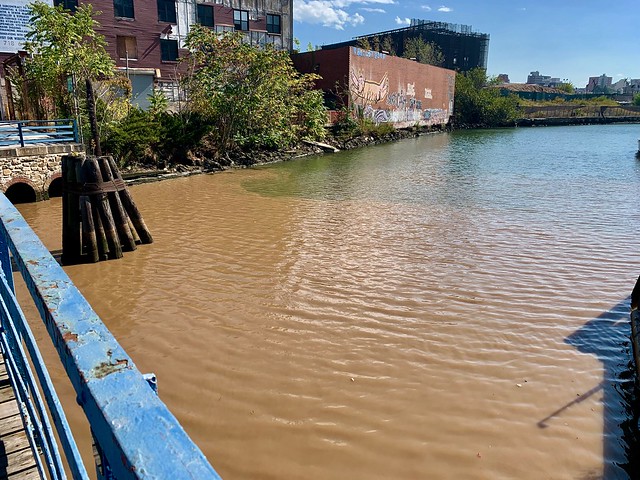
Just yesterday, we walked across the Carroll Street Bridge ourselves and witnessed a huge plume of dirt being discharged from the CSO outfall into the canal. The dirt most probably cane from a construction site on the Par Slope side of the Gowanus.

There was also a plume of raw sewage right next to the Lightstone residential buildings just adjacent to the outflow.

So, please folks, don't eat fish caught in the canal.

Untitled
Gowanus Canal at the Carroll Street bridge yesterday at 2 pm.
Untitled
Untitled
Read more

Monday, November 27, 2017

Gowanus Canal Superfund Clean-Up: Community Advisory Group To Meet This Tuesday, November 28

IMG_1236
The Gowanus Canal Community Advisory Group will be hosting its November general meeting on Tuesday, November 28h, 2017.  Find out the latest about the clean-up of our polluted waterway.
The Environmental Protection Agency Region 2 team responsible for overseeing the environmental remediation will be on hand to update the community on the latest.
New York City Department of Environmental Protection will also attend to address the two Combined Sewer Overflow Tanks and to give an update on the design for the 1st Street Turning Basin.
The meeting open to everyone.

Gowanus Canal CAG Meeting
Tuesday, November 28, 2017 @6:30pm
Mary Star of the Sea Senior Apartments, 41 1st Street, Brooklyn


Read more

Monday, September 25, 2017

What's Happening With Our EPA Superfund? Gowanus Canal Community Advisory Group To Meet Tomorrow

IMG_0986
IMG_0988
Perhaps fall has motivated you to get involved with your community? Maybe you want to be better informed about neighborhood issues? As PMFA resumes posting after a long, lazy summer, we will let you know about all the important meetings and events that are coming up.

The most important issue in the neighborhood remains the U.S. Environmental Protection Agency's clean-up of the Gowanus Canal, a Superfund site.
The Gowanus Canal Community Advisory Group will hold its general meeting tomorrow, Tuesday, September 26, 2017, 6:30 PM,  at Mary Star of the Sea Senior Apartments, 41 1st Street, Brooklyn.
The EPA will be on hand to give a project update to the community and will answer questions regarding the canal.

So please make time to attend. The meetings are open to everyone.


Read more

Monday, November 28, 2016

Gowanus Canal Superfund Clean-Up: Community Advisory Group To Meet This Tuesday

IMG_9365
The Gowanus Canal Community Advisory Group will be hosting its November general meeting on Tuesday, November 29th at 6:30PM. Find out the latest from the EPA Region 2 team responsible for the clean-up of our polluted waterway and connect with members of the CAG.
The meeting is held at Mary Star of the Sea, 41 1st Street. The meeting open to everyone.


Read more

Thursday, May 26, 2016

"Stop Eminent Domain from Closing our Studio!": Eastern Effects Asks Community For Help In Fighting City's Plan To Seize 270 Nevins Street

12
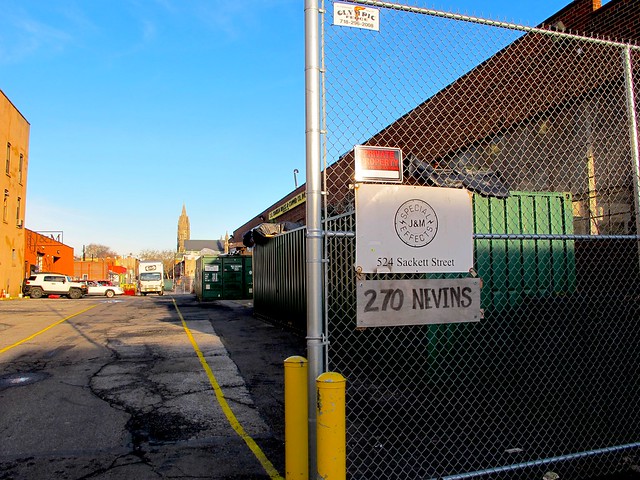
Eastern Effect's Movie and TV studios at 270 Nevins Street, Gowanus
IMG_7909
IMG_8222
Philip Warren and Scott Levy of  Eastern Effects at  Tuesday's Gowanus Canal Community Advisory Group meeting.
As part of the Gowanus Canal Superfund clean-up, the City of New York and EPA have negotiated a
proposed agreement to situate one of the two retention tanks mandated in the Record of Decision at the head of the Canal rather than at the EPA suggested site which is under the pool in Thomas Greene Park.

The City's plan relies on the taking of two privately owned sites, 234 Butler Street and 242 Nevins Street, by eminent domain. A third site, 270 Nevins Street will most likely also be seized by the City, which plans to use it for staging purposes during the construction project.

This would displace Eastern Effects, a successful film and television studio, where many commercials, movies and television shows like  FX's "The Americans" are filmed.

Eastern Effects' founder and president Scott Levy and the studio's general manager Philip Warren attended last Tuesday's Gowanus Canal Community Advisory Group's general meeting to make sure the community knew that the closing would mean a 50% loss of business and therefore real hardship. It would also represent  a loss of about 200 union jobs during filming and 31 full-time jobs.
In addition, the company contributes, by their estimate, approximately four million dollars ($4,000,000) per year to the local economy.

Levy argued that it makes little sense for the City to seize the site for temporary use, when Eastern Effects has plowed millions into the building to meet all stage 2 requirements and can support New York City's booming film and movie industry.
"I have invested millions of dollars and have spent three of the most grueling years of my life building this studio," Levy told members of the CAG.  "We did everything we needed to do."
He talked about receives calls every day for studio space, but has to turn production companies down because his are fully booked. Apparently, 46 television productions are currently filming in New York City and are competing for space.
The City of New York has recently notified Eastern Effect that it would be forced to cease operations at 270 Nevins Street.   "The City did not come to us to talk about any of this,' Levy said.  "It was news to us and was announced as 'an agreement between the EPA and the City'.  We were shocked and upset because no one came to us. Only one person from the City came to do a walk through of the building. So it was time for us to do something to protect ourselves."

Eastern Effects is asking the community's help in saving the 270 Nevis Street building, their studios, their investment and local jobs.
"We have no issue with the building of the tank. We understand that the tank is part of the clean-up that is needed for the City and for this local area," said Levy. "We are not here to debate that, but we think we are an afterthought when it comes to where to put a staging site to support that tank."
Rather, Levy makes the point that there are alternatives to the City's proposed plan. Currently, there are several building  located directly adjacent to the lots the City plans to seize by eminent domain, which are currently empty and/or for sale.
That includes 537 Sackett Street, which is located directly across the street from Eastern Effects and is currently empty.

Levy and Warren provided the community with the map pictured above, which shows some alternative sites that could be used by the City.
Eastern Effects also issued the following statement:

Keep Jobs in Gowanus – Stop Eminent Domain from Closing our Studio!
Background:
Eastern Effects, Inc. a film and television production studio adjacent to the Gowanus Canal, was recently notified by the City that it would be forced to cease operations and close in order for the property to be used as a temporary staging area for the construction of two combined sewage overflow (CSO) tanks required to clean up the canal. The Gowanus Canal was designated as a Superfund site by the EPA in 2010.

Eastern Effects leases property at 270 Nevins Street (between Sackett and Degraw Street). The studio is in the 5th year of a 20-year lease. The studio hosts over 230 well-paying jobs, utilizes local vendors, and is the setting for the hit television series The Americans.

There are underutilized and vacant properties surrounding the area that are viable alternatives for this temporary staging location. We propose that the City evaluate such sites, saving the studio from closure and maintaining New York City’s position as a leader in the film and television production industry.

Reasons to Support an Alternate Staging Site:
*Eastern Effects invested over $5 million and three years of exhaustive work in the building at 270 Nevins Street to create a state-of-the-art facility that meets the City’s stringent Level 2 stage requirements to accommodate large scale shows —the type of soundstage that productions are actively seeking in New York City. This is the company’s Flagship Studio.

*Eastern Effects is committed to Brooklyn: all five of the company’s buildings are located in the borough—four buildings are located in Gowanus and one building is currently under construction in East New York.

*Since 2009, Eastern Effects has partnered with Brooklyn Workforce Initiative to provide training and job opportunities in the film industry through the Made in NY PA Training Program. Graduates of the program are currently working on the set of The Americans. Eastern Effects also hires graduates of BWI’s CDL driver training, Red Hook on the Road.

*The site supports over 230 jobs, most of which are union. These union employees are represented by: IATSE Locals 600, 5, 817, 700, 161, 829, 764, 798, WGA, DGA, and SAG/AFTRA. Eastern Effects has 31 direct full-time employees, 3 part-time employees, and is planning an expansion this summer.

*Soundstages are unique facilities that require large, open floor plates, high ceilings, and costly specialized infrastructure. There are no viable alternatives to move the stage in Gowanus. The loss of the Flagship Studio will impact Eastern Effects’ nearby production offices, editing suites, writer’s offices, and support spaces.

*The film and television industry wants to be in New York City. A 2015 report showed that the industry brings $8.7 billion into the local economy, with 46 series produced in the five boroughs during the 2014-2015 season. The spending on production creates a ripple effect in the city’s economy, indirectly supporting an additional 20,000 full-time jobs.

*Production companies currently report difficulty in finding adequate studio space in New York City. If they cannot find space, these productions will turn to other cities, costing New York State jobs and valuable tax revenue.


Meanwhile, our elected officials already threw their support behind the agreement between EPA and the City Of New York, in which the City proposes the taking by eminent domain of 234 Butler Street, 242 Nevins Street, as well as 270 Nevins Street.
New York City Council Member Brad Lander, New York City Council Member Stephen Levin, Brooklyn Borough President Eric L. Adams, and New York State Assembly Member Jo Anne Simon, issued a statement "supportive of the approach described in the proposed agreement"

New York City has already signed the agreement, but the Gowanus Canal Community Advisory Group has asked the EPA for a public comment period before the Federal Government signs it.
Members of the community can send their own comments on the agreement and I strongly encourage you to do so. Please mail to :

Walter Mugdan,
U.S. EPA Superfund Director 290 Broadway, Floor 19, New York, N.Y., 10007 mugdan
or email to : mugdan.walter@epa.gov

To read the agreement between the EPA and New York City, please visit:
https://semspub.epa.gov/work/02/395808.pdf

Click here to write a letter of support for Eastern Effects


Read more