Showing posts with label FROGG. Show all posts

Friday, April 02, 2021

On The Passing Of Gowanus Activist And Historic Preservationist Linda Mariano

Linda Mariano at Yesterday's News 2018

Dear Readers,

The news that Gowanus resident Linda Mariano has passed last night after a brief illness was shared amongst those who knew her with infinite sorrow.  This morning, it feels as if a huge empty space has opened up in the neighborhood, which she called home and loved so dearly.

To have known Linda will forever be one of the greatest privileges of my life. She could brighten the cloudiest day with her huge smile and laugh. She was a fearless activist, and passionate advocate for Gowanus. She always spoke truth to power and taught many that one never gives up fighting for what is right.  Over the years, she became a mentor to many of us and we all aspired to become just like her. She was fiercely loyal to her friends and her house was always open for a glass of wine, some food and stimulating discussions. 

Most neighborhood residents might remember her from Yesterday's News, the Court Street vintage store, where she worked on week-ends for many years.

Linda moved to Gowanus with her husband Joseph Mariano and daughter Rachel over 40 years ago from Manhattan. They bought a dilapidated house on President Street in the 1970's, which they lovingly restored into a welcoming home. They displayed a black and white photo of what the building had looked like when they first laid eyes on it, as a reminder of how they had saved this piece of neighborhood history.  In the spring, Linda would plant her window boxes with the brightest fuchsia geraniums, making the house the prettiest on the block.

Linda was one of the founding members of Friends Of Greater Gowanus (F.R.O.G.G.), a group that was founded in 2002 to safe the Green Building on Union Street near the canal when the old brick building was slated for demolition to make way for a high rise.
Together with F.R.O.G.G., Linda became a very vocal supporter of the Environmental Protection Agency's Superfund designation of the Gowanus Canal and was a founding member of the Gowanus Superfund Community Advisory Group after the designation in 2010.

However, as passionate as she was about the environment, it was preservation of the neighborhood that was always her main focus. She tirelessly worked with the NYC Landmarks Preservation Commission (LPC), the Historic Districts Council (HDC), and the NYS Historic Preservation Office (SHPO), to pursue historic designation of the Gowanus Corridor as an Urban Industrial District.
In 2019, because of her perseverance, five important Gowanus buildings were landmarked by New York City.  But of course, she wanted to save many more. It comes at no surprise that she vehemently opposed the massive rezoning for Gowanus which is currently being discussed.

On a personal note, I cannot express the deep sadness I feel at knowing that I will never sit around her kitchen table with other members of FROGG again,  envisioning a better and more sustainable future for the neighborhood than the plan cooked up by developers.  
She will forever be my role model, and I will try, in my way, to continue to make her Gowanus dreams a reality.

My deepest sympathy goes to her daughter, son-in-law and granddaughters, whom she loved passionately.
We share your sorrow.

To hear Linda tell her own story, please visit the Preservation Archive Project

Joseph and Linda Mariano at their home in 2009
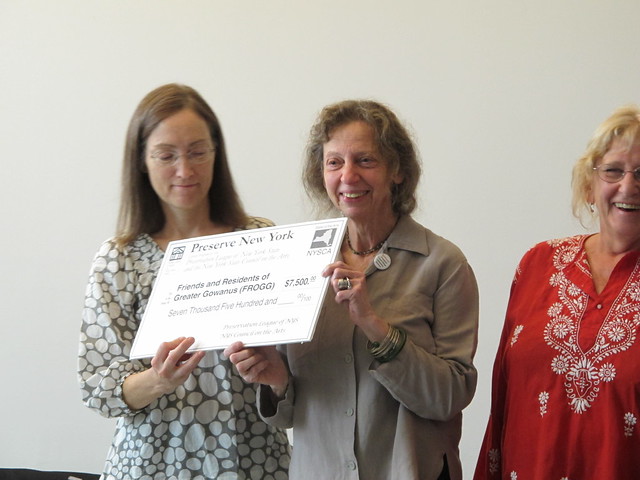
With Marlene Donnelly and Bette Stoltz, receiving a Preservation League grant
A very happy moment with FROGGS in 2019.
from left to right, Margaret Maugenest,  Marlene Donnelly, Linda Mariano and me.


Read more

Wednesday, February 06, 2019

Prior To Neighborhood Rezoning, Gowanus Landmarking Coalition Seeks City Landmark Designation For Key Historical, Architectural, And Cultural Sites In Gowanus

IMG_5109
Gowanus 2007
IMG_4236
Gowanus 2008
IMG_0415
Gowanus 2007
IMG_8041
Gowanus 2007

As mentioned previously, the New York City Department of City Planning (DCP) has just released the long awaited Gowanus Draft Zoning Proposal.  Many in the community are trying to understand and to envision what Gowanus will look like in the future, if the proposed rezoning, which calls for  22 to 30-story buildings, does go through as proposed.  Others are looking to the past, cognizant of the fact that much of the neighborhood's history could easily be erased forever as a result of the rezoning.

The Gowanus Landmarking Coalition was formed in the summer of 2017 to seek New York City landmark designation for key historical, architectural, and cultural sites in Gowanus prior to the neighborhood rezoning.
The coalition is made up of Gowanus residents, local businesses,  and the following organizations. Park Slope Civic CouncilThe Old Stone HouseHistoric Districts CouncilFriends and Residents of Greater Gowanus (FROGG).
It's mission is "to ensure that Gowanus retains an authentic sense of place - and remains capable of telling its own many-layered story."

The Gowanus Landmarking Coalition has just issued the press release below. Please support its mission and sign the petition to protect Gowanus' built environment prior to the City Planning Commission's rezoning.

Gowanus Landmarking Coalition Launches Website Ahead of Rezoning

GOWANUS - The Gowanus Landmarking Coalition unveiled its new website today in advance of tonight’s public meeting regarding the city’s Gowanus rezoning plan.
The website can be found at: www.gowanuslandmarks.org

The new site highlights the Coalition’s priority list of fifteen sites and small districts in Gowanus that warrant official designation by the City of New York. 


Having waited more than two years for the city’s Landmarks Preservation Commission to conclude its study of potential Gowanus landmarks for designation, the Coalition continues to press public officials to designate and protect critical sites before rezoning arrives in the neighborhood.


“We’ve seen this before in recent city-led neighborhood rezonings,” said Coalition member and Gowanus resident Brad Vogel, “Landmarking has been left as something of an afterthought in places like East Harlem, Inwood, and East New York when it needs to happen prior to the major changes that come with city-led rezonings. We hope the city will take a better course here in Gowanus.”

Some groups in the Coalition have been advocating for landmark designation in Gowanus for more than a decade. And during that time, several quintessentially Gowanus sites, like the Burns Brothers Coal Pockets, have been lost to demolition.

“We invite community members to sign our petition found at the new Coalition website,” said Kelly Carroll of the Historic Districts Council. “Gowanus should not be left with a paltry 3 or 4 designated landmarks when the rezoning dust settles. Telling the full story of this neighborhood’s industrial and maritime heritage requires more than a dozen sites. Our Coalition priority list is a good start.”


The Coalition, comprised of city-wide, neighborhood, and historical groups, continues to meet with elected officials and city agencies to advocate for landmark designation.

“Historic interpretation signage in the neighborhood as proposed by the city sounds nice. But first we need to save the buildings that still exist and give Gowanus a real sense of place,” said Linda Mariano of Friends and Residents of Greater Gowanus. “We ask our public officials to do right by Gowanus and landmark the important buildings shown on our website as soon as possible.”

Here is a list of sites identified by the Gowanus Landmarking Coalition as landmark worthy.

Gowanus Flushing Tunnel Pumping Station, 209 Douglass Street
ASPCA Memorial Building, 238 Butler Street
Gowanus Station, 234 Butler Street
BRT Powerhouse, 322 Third Avenue
National Packing Box Factory, 280 Nevins Street
T.H. Roulston Inc., 70-124 9th Street
American Can Factory, 232 3rd Street
“The Green Building”, 460 Union Street
Ice House & Brewing Complex, 401-421 Bond Street
Union Street Bridge Control Tower
R.J. Dun & Company, 237-257 Butler Street
Norge Sailmakers Building, 170 Second Avenue
Bowne Grain Storage, 398 Smith Street
2nd Street Historic District (between Bond & Hoyt Streets)
Head of Canal District

Read more

Wednesday, October 30, 2013

No Gowanus Planning Without Meaningful Representation: Let's Demand A Truly Democratic Process

IMG_6015
IMG_8530
IMG_4030
From 2008's City Planning Gowanus Draft Rezoning Proposal
Pratt Center's Draft Timeline For "Gowanus Community Planning"

Proposed Gowanus Zoning study area


No Gowanus Planning Without Meaningful Representation:
A rather long post about a terribly important issue

With the Brooklyn real estate market soaring in the last decade, developers have been salivating over the mostly-industrial Gowanus Canal area.  However, their dreams of luxury glass-clad high-rises clashes with the popular vision of Gowanus as an incubator for small businesses, light manufacturing and the arts.
Local residents have been debating the merits of one over the other with much fervor. The conversation became more divisive when, in November 2008, New York City Department of Planning Commissioner Amanda Burden came to the community to introduce her agency's Draft Rezoning Proposal for 25 blocks along the Gowanus Canal. The land use framework put forth by City Planning addressed issues like land use, density, bulk and waterfront access.
Though the rezoning proposal sought to maintain areas for continued industrial and commercial use,
it also allowing for a mix of uses, including residential, in certain areas currently zoned for manufacturing.  According to the timeline presented by City Planning at the time, the Uniform Land Use Review Process (ULURP), the public review process of a rezoning, was due to begin in early 2009.

What City Planning was envisioning for those mixed-use areas would soon become clear.  In February 2009, after a contentious ULURP process and much community opposition, City Planning granted Toll Brothers, a national developer, a rezoning from manufacturing to mixed use, allowing Toll to build 470 residential condo units at the edge of the canal.
At the time, City Planning justified their decision to allow Toll Brothers to move ahead of the City's over-all rezoning by saying that the project was essentially based on their own plans for Gowanus.

But just two months later, in April 2009,  the Environmental Protection Agency (EPA) proposed the 1.8 mile long Gowanus Canal to the Agency’s Superfund National Priorities List, a list reserved for the country's most polluted sites.  Toll Brothers bailed on their project, and City Planning shelved their rezoning.

By the following year, the EPA had formally designated the Gowanus a Superfund site.  The agency made it clear that they would not get involved in land-use issues, but suggested that it would be helpful to the agency to know the end use of the uplands.

Then in 2011, Hurricane Sandy slammed into the area, and caused serious flooding to homes and businesses in Gowanus.  City Planning made clear that the agency had no plans to resume its rezoning effort until Federal Emergency Management Agency (FEMA) had released its redrawn post-Sandy draft flood maps.

After the hurricane, many of our local elected officials addressed this 'new reality.' Congresswoman Velázquez spoke of the need to set public policy and of a revision of the type of development allowed along the coastline. Councilman Brad Lander felt that this was a very important time, one which offered a re-set button in regards to development on the shores of the Gowanus Canal.

The Superfund nomination of the canal and the hurricane only offered a short reprieve from a rezoning. By this spring, Councilman Lander was ready to resume the conversation about 'planning for Gowanus'. However, at several meetings, he hinted that a rezoning should be moved forward under a new administration,  and that "the upcoming transition at City Hall – with a new Mayor and City Planning Commission – presents an opportunity for a better outcome."

On August 5, 2013, State Senator Velmanette Montgomery, Congresswoman Nydia Velazquez, State Assemblywoman Joan Millman,  Councilmember Steven Levin and Councilmember Lander convened  a Gowanus Planning Kick-Off meeting. On the list of invited stakeholders were representatives from local organizations and neighborhood associations.***
This first step in what Councilman Brad Lander called "inclusive community planning" didn't seem so inclusive to some.  The meeting was not announced, not posted in any way on the internet,  not open to the general public and was closed to the press.

Pratt Center for Community Development (not to be confused with the Pratt Institute) has been hired by the elected officials as the consultant that is running the planning process.
According to an overview  prepared by Pratt, the goal of these planning meetings is to:
*Develop the outlines of a comprehensive, community‐based infrastructure and land‐use plan for a safe, vibrant, and sustainable Gowanus area
*Bring community stakeholders together to build as much consensus as we can around a long‐term vision for the Gowanus Canal area
*Shape the next NYC mayoral administration’s thinking about the Gowanus Canal
*Create a space for honest conversation about different viewpoints

Just recently, Pratt has held a series of small group interviews with the stakeholders who were invited to the first meeting.  I was asked to participate in the group that apparently "cared deeply about the environment."  The interview, held on Monday evening, was led by Elena Conte and Paula Crespo of Pratt.  The questions were rather basic and covered such topics as what makes Gowanus special, what should be preserved, and what are some of the infrastructure issues.  

My group included members from CORDSave Gowanus, and South Brooklyn Local Development.
(FROGG, though invited, did not send a representative because the group put into question the validity of the process.)
The group quickly seemed to reach consensus that before moving ahead with any re-zoning, a health study and a hydrological study were needed to investigate the health effects of exposure to the environmental hazards in Gowanus, and to evaluate the effect of new development in this flood prone area. We also felt that we first need assurances that the City Of New York will pay and follow through  on the EPA-mandated retention basins that will help reduce the Combined Sewer Overflows and improve water quality in the canal.  Without these studies and without the retention basins, planning more housing in Gowanus seemed "recklessly premature."

In the coming weeks, Pratt Center will compile the information from these interviews and will then host a series of three public meetings.  The first one is scheduled for Thursday, November 14th.  (The time and place has not yet been determined.  As soon as I find out, I will post the information.)

Personally, I remain very skeptical of this entire 'Gowanus planning' process and doubt that the community will have a true say or vote in the outcome.  Though I appreciate the opportunity to weigh in on the area's future,  I can't shake the suspicion that my participation in these meetings only serves to rubber-stamp a re-zoning plan that has already been chosen by our politicians and by developers.

As far as Brad's suggestion that planning under a new city administration presents the opportunity for a better outcome, he may be mistaken.
As the latest numbers indicate, Bill deBlasio will most likely be our next mayor.  DeBlasio not only supported the Toll Brothers spot-rezoning back in '08, he fought hard to drive away the EPA when the agency proposed to list the Gowanus as a Superfund.
If DeBlasio wins , we can be sure that he will hand over the Gowanus Canal to developers on a silver platter, no matter what we say.
"I give Mayor Bloomberg tremendous credit for fighting [the EPA] tooth and nail, and I was proud to stand with him. We tried every play in the book to save the [Toll Brothers'] development deal.
In the end, the EPA won out, the development stalled and every time I drive past that site I see derelict lots where we should now have hundreds of new homes and jobs.


I couldn't disagree more. Today, the Gowanus Canal area is slowly healing after years of neglect. Small businesses and a vibrant artist community are thriving there.  Jobs are being created.  Yes, the area has some serious environmental problems, but thanks to the EPA, they are being addressed.  What seems to be holding back Gowanus is the threat of a zoning change that will most likely drive away many businesses, and the speculation by developers that a re-zoning will reward them for holding on to their 'derelict lots'.

We owe it to ourselves and to all who will come after us to take our seat at the table, and to push for a true, transparent, democratic process.  We need to tell our politicians that before any new development is envisioned, we need to first find out what the Gowanus can sustain.  We need to first invest in infrastructure to strengthen the businesses and the residential areas that are already there, and we need to demand new tools in City Planning's tool box.  Because Gowanus is unique and deserves solutions that are just as unique.

***I was invited to the August meeting but was out of the country and could not attend.


IMG_7065


Read more

Wednesday, August 07, 2013

'Save Gowanus' Planning Community Rally To Voice Concerns About Lightstone Group Project On Thursday Evening

rendering by Lightstone Group

Meanwhile, back in Brooklyn....
'Save Gowanus' is planning a rally on Thursday night at the Carroll Street bridge to protest the Lightstone Group's 12 story, 700 unit project at 363-365 Bond Street on the shores of the Gowanus Canal.

Save Gowanus is composed of Gowanus residents and home-owners living near the site on Bond Street between Carroll Street and 2nd Street, as well as members of civic groups Friends of Bond (FOB) and Friends and Residents of Greater Gowanus (FROGG)

Mayoral candidate Bill Thompson is scheduled to attend and will be speaking with concerned community members about the impact the Lightstone apartment complex will have on the community and on the Gowanus flood zone.

From a FROGG press release:
"This is not a rally to endorse Thompson's mayoral candidacy; instead, it is a chance "to bring broader attention to the issue of irresponsible development (which endangers scale, zoning, schools, transit and health and safety) in the context of the mayoral race.
It is extremely urgent that as many of you attend as possible. Please invite your neighbors as well. We need to show all our elected representatives how important this issue is to our community. They've already heard from the developers and their lobbyists; now it's our turn to be heard. This is the protest that will hopefully help bring attention to our issue in the media and the mayoral race."

***UPDATE  From Save Gowanus

Tonite's rally, which will be attended both by the media and by Mayoral candidate Bill Thompson, is still scheduled to happen at the Carroll Street Bridge.

However, in chance of rain, we'll be moving indoors to the community room of Mary Star of the Sea, 41 1st Street.

Keep your eyes peeled to the website, savegowanus.org, to find out if the rally has been moved to that indoor location.


Read more

Monday, November 12, 2012

Friends And Residents Of Greater Gowanus (FROGG) To City Planning: After Sandy, How Can Department Consider 700-Unit Apartment Complex In Gowanus?

IMG_8977
IMG_8996
Proposed Lightstone Development next to the Gowanus Canal (credit: Lightstone Group)
IMG_9006
IMG_9002
IMG_9000
Untitled
Lightstone Development site, Canal at Carroll Street during Sandy  (photo credit: Margaret Maugenest)
Second and Bond Streets during storm (photo credit: Triada Samaras)
Sandy flooding at First and Bond Streets near Canal (photo credit: Carl Teitelbaum)

On November 13th***, NYC's Department Of City Planning will be reviewing The Lightstone Group's application for "minor modifications" to the previously approved land use actions at 363-365 Bond Street on two blocks right next to the Gowanus Canal. One of those minor modifications is to increase the number of units from 447 to 700, which doesn't seem so very minor at all.

In 2009, after a Uniform Land Use Review Process (ULURP) that was set in motion by Toll Brothers, a national development company, the property was spot re-zoned by City Planning from manufacturing to special mixed-use, which allows housing.
After the Gowanus Canal was declared a Superfund Site by the US Environmental Protection Agency in 2010, Toll Brothers decided to abandon plans for their proposed condo development.

Lightstone revived the project and is planning a 700-unit rental complex. In order to proceed, they just need City Planning's approval.  (It is important to note that Lightstone could start construction on the previously approved 447 unit building immediately.)

Many Gowanus residents have warned that the building site is in a flood zone A and that the infrastructure, especially the sewer system in the Gowanus area is dreadfully antiquated.  
After Hurricane Sandy and the ensuing flooding, these concerns are well founded.

The group Friends And Residents Of Greater Gowanus (FROGG) just released the  statement below aimed at NYC Planning and Chairperson Amanda Burden to address the 'new reality' about the vulnerability of our shoreline and the risks of bringing more residents to a flood plain.

BROOKLYN RESIDENTS, SMALL BUSINESSES BLAST NY CITY PLANNING’S DECISION TO CONSIDER A NEW 700-UNIT APARTMENT COMPLEX IN CONTAMINATED ZONE A
Development would be the first approved since Superstorm Sandy despite being in a flood-prone, mandatory evacuation zone along a hazardous Superfund site; Brooklyners upset at the prospective rise in insurance costs from the eventual bail out of this building in the next storm; City Planning to discuss approval November 13.***
Brooklyn residents and small businesses are outraged that the New York City Planning Commission will consider a proposal to build a gigantic 8 to 12 story apartment complex to house over 1400 residents on the banks of the Gowanus Canal, which is a hazardous federal Superfund site. Their proposed site was under more than 10 feet of toxic, sewage- contaminated water during Hurricane Sandy.
After the mandatory evacuation order for Zone A and the continuing devastation from the hurricane, many Gowanus residents have still not been allowed to return to their damaged buildings. Other high rises in the neighborhood, such as the Gowanus Houses, are still without power and heat a week after the storm. The EPA is currently conducting street-level site sampling to determie whether the cancer-causing contaminants from the canal’s toxic sediments linger and are harmful to citizens. It’s in this dystopian environment that the Lightstone Group is applying
to build an apartment complex. “It is lunacy for the city to consider this project in light of the damage from the hurricane,” says Linda Mariano, co-chair of the community advisory group Friends and Residents of the Greater Gowanus (FROGG). “We are calling for a full moratorium on development and all up-scale zoning changes in any waterfront district.”
A 2010 State Sea-Level Task Force Report recommends " restriction of new development and redevelopment in high- risk areas”. That’s because the costs of dealing with a storm’s aftermath is too costly to New York taxpayers. The dollars to bail out residents during future storm surges raises everyone’s taxes as well as insurance rates.
The NY City Planning Commission will discuss this project at a November 13 meeting at which the public is not allowed to speak. Unlike other proposals for new developments, the Lightstone project is slipping backdoor through a loophole in the city planning process. The proposal will not go through a city ULURP hearing or have to file and environmental impact statement because of
an earlier area spot zoning in 2009. However, given the federal government’s designation of the Gowanus Canal as a Superfund site in 2010 and the incredible damage and displacement
from Hurricane Sandy, it is irresponsible for the City Planning Commission to greenlight such a development at this time.
Lightstone has said that despite the storm, it will proceed with building, claiming that they plan to raise the grade of their development to offer protection to the new residents. However, the surge brought in by Sandy exceeded their proposed elevation changes. And even if their buildings are above the flood plain,  all their of nearly 1400 residents will still need to be evacuated in the next storm– a task made more complicated by the city’s evacuation route also being underwater for high tides during the storm. Furthermore, in Sandy’s wake, new developments can’t only seek to impede a flood by trapping storm water, but also need to be evaluated as to whether they can assist in the speedy drainage of future storm surges, something Lightstone’s proposal does not include.
“Flood water would not only find another path, it would go further up each side of the Canal to find open or other accessible space,” says Diane Buxbaum, a neighborhood resident and environmentalist “It makes no sense to continue building on our shore areas. Creating open areas and trying to restore some link to wetlands is the better choice.”
More than 500 Brooklyn residents and small businesses have signed a petition decrying the development, and it is also opposed by a large number of community groups incluing FROGG (Friends and Residents of Greater Gowanus), CORD (Coalition for Responsible Development) and the Central Brooklyn Independent Democrats, among others.
These allies call upon Governor Cuomo, Mayor Bloomberg, Congresswoman Nydia Velasquez and Councilman Brad Lander and other elected officials, acting under the power of the current “State of Emergency,” to take the first steps in addressing the effects of hurricane and storm surge catastrophes by calling for a moratorium on development and all up-scale zoning changes in any waterfront district that was affected by the storm surge of hurricane Sandy. They call for Amanda Burden and the NY City Planning to put an immediate moratorium on the review or approval of any pending projects planned for Zone A, including that of the Lightstone Group, until new guidelines for such development have been created. To do otherwise would not only be foolish, but irresponsible and costly to the community as well. As Governor Andrew Cuomo recently stated, “We have a 100-year flood every two years now.” The NY City Department of Planning must acknowledge this fact, and act accordingly.
We must rebuild following Sandy – but not at the water’s edge. Let’s not create new and costly regional flood control problems.

*** The hearing on this development was delayed. The date apeared on NYC Department of City Planning's online calendar prior to Hurricane Sandy, but was removed after the storm. No word yet on when it will be rescheduled.


Read more

Wednesday, April 25, 2012

Gowanus Canal Community Advisory Group Takes Position That Total Elimination Of CSOs In Gowanus Canal Is Only Acceptable Solution To Problem. Passes Resolution.

IMG_7315
IMG_7314
IMG_3538
IMG_7218
IMG_7220
At last night's US Environmental Protection Agency's Gowanus Canal Superfund Community Advisory Group's (GAG) general meeting,  members voted to adopt a resolution that asks for a total elimination of New York City's Combined Sewer Overflows (CSOs) into the waterway.
The resolution was drafted by the CAG's Water Quality/Technical Committee after an informational meeting with NYC Department Of Environmental Protection on April 3rd, 2012.  At that meeting, DEP, which has been names a Potentially Responsible Party (PRP) by the EPA for its role in contributing hazardous toxins to the canal and for allowing CSOs to continue to discharge into the Gowanus,  had refuted EPA's findings.
Despite DEP's best effort, the agency failed to convince the Committee members that more testing was necessary and that it had not yet been proven that the CSOs are contributing chemicals to the canal at levels that constitute unacceptable human risks under Superfund.

So last night, the Water Quality/Technical Committee put forth the following resolution:
The Gowanus Superfund Community Advisory Group fully supports the United States Environmental Protection Agency in its finding that New York City's Combines Sewer Overflows are a significant contributor of harmful sediment and Superfund regulated PAHs and metals to the canal. The CAG takes the position that the total elimination of the CSOs in the Gowanus Canal is the only acceptable solution to the problem.     The CAG asks that the EPA, under their Superfund authority, take the necessary measures that will insure protection of the proposed remedy from ongoing CSO sediment solids deposits and the release of PAHs and other toxics.
However, before a discussion or a vote on the resolution could take place, Jeff Edelstein, the CAG's facilitator, informed its members that DEP, represented by Jim Mueller, would like to present its position on the CSO resolution and wanted the opportunity to give members of the CAG a presentation.

Many CAG members strongly opposed.  Though some wanted to hear what the DEP had to say, the  prevailing sentiment, especially amongst members of the Water Quality/Technical Committee, was that this was neither the time, nor the place for DEP to argue its, as one member put it, its "PRPness"
CAG member 
Marlene Donnelly,  representing F.R.O.G.G. argued:
"The DEP did just have a lengthy meeting with the community. There was no representative from the EPA there to present an alternate perspective at that meeting. If we give DEP five minutes for a presentation tonight, we also need  to give EPA five minutes to present their perspective. Since they are not here to present. I think that it is inappropriate at this time to allow DEP time to present just their perspective without a counter- perspective."
Josh Verlun,  Riverkeeper's representative, agreed:
"I believe that it is inappropriate for DEP to impose their perspective on the resolution at this time unless we have representatives from both EPA and from all the other PRPs give their perspective as well. At last count, that number was 30 or so. It is not appropriate for one PRP to voice their opinion, when there are other agencies and stakeholders that are nor represented here tonight. "
Rita Miller, C.O.R.D. representative added:
"The DEP came before the Water Quality/Technical committee, and out of that discussion, I think it is fair to say that this resolution was born.  I think that our committee should be able to present the resolution to our fellow CAG members. We have the interest of our community at heart. There is no further presentation by the DEP necessary."
And Steven Miller, member-at-large concluded:
"I want to remind everyone here tonight that the City of New York is a PRP and that their interaction with us should be held within this context."

At the end, the CAG voted to not allow DEP to give its presentation and to move forward with the vote on the resolution.
The resolution passed easily.

It was so transparent that the DEP wanted to influence members of the CAG last night and was trying to prevent this resolution from passing.  Pretty low, I say.


Read more

Wednesday, December 14, 2011

At Yesterday's BSA Hearing On Gowanus Whole Foods Variance

IMG_1825
IMG_2735
IMG_5043
IMG_5042
IMG_5071
IMG_5083
IMG_5073
IMG_5076
Meenakshi Srinivasan, Chair Of NYC Board Of Standards And Appeals
More than twenty people showed up to testify yesterday afternoon at the hearing in front of the NYC Board Of Standards And Appeals regarding Whole Foods Market's request for a use variance (§72-21) to permit a food store (UG6), contrary to use regulations in an M2-1 zoning district, at the corner of Third Avenue and Third Street on the Gowanus Canal.
Currently, New York City's Zoning Resolution only allows Whole Foods to build a 10,000s.f. store on the site, which is located in an M2-1 zoning district. The proposed Gowanus food store would be 58,000 s.f., have a 20,000 sf rooftop greenhouse, parking for 248 vehicles, and a public walkway along the Gowanus Canal.
Whole Foods is claiming that full compliance with zoning regulations is not possible in order to realize a reasonable economic return on their property.
At the hearing, lawyers for the food retailer gave a brief presentation on the project, then argued the following reasons for hardships associated with developing the site:
*Unsuitable soil conditions on the property require extensive pile foundations. Special drilled piles are also near needed near the the landmarked Coignet building on the site.
*the property is in a Flood Zone A and has a high water table. Extensive waterproofing and additional measures to resist hydrostatic pressure will be required.
* The property is adjacent to two bridges
*Has varying street elevations and a grade change of 12 feet,
*And is subject to the Brownfields Cleanup Program which entails environmental remediation costs.

During the public testimony session of the hearing, representatives of Community Board 6, the Brooklyn Chamber Of Commerce and the Gowanus Canal Coomunity Development Corporation all read statements in support of the project. (Borough President Marty Markowitz has also endorsed it.)
A representative from the Al-Madinah School, which is located on 3rd Avenue, across the site, spoke in favor.
Hans Hesselein of the Gowanus Canal Conservancy testified that the Conservancy welcomes many aspects of the plan, but requests that any approval by the BSA "be conditioned upon Whole Foods Market's commitment to provide the community with adequate natural and open space resources."
In particular, the Conservancy suggests that WF increase the public esplanade along the Gowanus Canal on the West side of the site from the proposed 20' width to a minimum of 40' on all sides bordering the canal "consistent with the goals of the NYC Department of City Planning DRAFT Zoning Proposal for the Gowanus Canal as well as the Sponge Park master plan."
However, many organizations and individuals spoke against the project.
The Gowanus Canal Community Advisory Group submitted a letter asking the BSA to postpone its decision on the Whole Food Market's variance application until the US Environmental Protection Agency releases its Record of Decision for the Gowanus Canal Clean-up plan. (See letter below.)
Marlene Donnelly, representing Friends And Residents of Greater Gowanus (FROGG), pointed out that the BSA has, in recent history, rejected non-conforming uses along the Gowanus Canal, most notably in the case of 130 Third Street, in which the Board found that the applicant "failed to provide substantial evidence that the subject lot possessed unique physical conditions that create practical difficulties and unnecessary hardships in developing the site in strict conformity with current zoning."
The Gowanus Institute, an independent think tank, urged the BSA to reject the variance, arguing that "the WFM application is flawed, and the proposed development will have a lasting negative impact on the manufacturing community of Gowanus and the surrounding neighborhoods." (see their testimony below)
Nathan Elbogen director of XØ Projects and The Old American Can Factory (OACF) pointed out that the large site could be developed 'as-of-right' with up to 370,000 SF for small to medium-scale manufacturing and referred to the success of the Old American Can Factory, a multi-story light-industrial complex fully occupied by industrial and commercial tenants.

Quite an impressive number of Gowanus artists, musicians, film makers, lighting designers, jewelers and non-profits, many OACF tenants, testified against the WFM project as well. They argued that there are few industrial manufacturing zones left in the city and those that remain need to be protected. They pointed out that the Gowanus area is not the waste-land Whole Foods depicts it as. Rather it is a vibrant manufacturing and cultural zone that permits growth that can not be sustained anywhere else. As an industrial zone, they pointed out, the Gowanus area is vital for the economic recovery of the city.

The next hearing on this matter has been scheduled for January 24th, 2012


December 9, 2011
Hon. Meenakshi Srinivasan, Chair
New York City Board of Standards and Appeals
40 Rector Street, 9th Floor
New York, NY 10006

Dear Chair Srinivasan
The Gowanus Canal Community Advisory Group (CAG), at its December 5, 2011 general meeting, passed the following resolution directed to the NYC Board of Standards and Appeals:

The Gowanus Canal Community Advisory Group requests that the NYC Board of Standards and Appeals postpone its decision on Whole Foods Market’s Variance Application until the US Environmental Protection Agency releases its Record of Decision for the Gowanus Canal cleanup plan.
In addition, for your information, the CAG passed the following resolution directed to Whole Foods Markets:
The Gowanus Canal Superfund Community Advisory Group requests that Whole Foods Market present to the CAG their general sitework and bulkhead plan for review and discussion.
The following describes the background discussion that took place at the Gowanus Canal CAG meeting on December 5, 2011 prior to the vote on the two resolutions above:
Whole Foods Market (WFM) is scheduled for a New York City Board of Standards and Appeals (BSA) public hearing on 12/13/11 to review its use variance application to construct a 78,000 GSF food market at the southwest corner of Third Street and Third Avenue, which is not permitted in M2-1 zone.  WFM's proposed development is the largest new building development on the canal in generations, and is set on the single largest zoning lot along the Gowanus Canal, with 892 linear feet of canal frontage, the most frontage of any property along the canal.
Members of the Gowanus Canal CAG want assurance that the WFM development is done in a manner that is compatible with the USEPA Superfund cleanup process, which is still in the planning phase.  The CAG’s understanding is that USEPA will be releasing its Feasibility Study by the end of 2011, announcing its selection of the clean-up remedy by June of 2012, and after a public comment period will be finalizing the selection of the clean-up remedy by the end of 2012 in a Record of Decision.  Members of the Gowanus Canal CAG are concerned that the WFM development may adversely impact the EPA Superfund cleanup process, given the issues outlined below:
ISSUES & CONCERNS WITH WFM PROPOSED DEVELOPMENT
1.  WFM's application does not thoroughly discuss its relationship to the EPA Superfund designation and cleanup plan, and makes a single reference to it saying "...our project proposes splash pads within the canal to handle stormwater runoff in compliance with and pursuant to NYSDEC's approval which will require notification of the EPA when installation is to happen. In addition, the EPA has two monitoring wells that may need to be preserved."  
2.  The CAG has requested technical assistance from the EPA regarding maintenance, repair and/or replacement of canal bulkheads which are historical, in poor condition and may further deteriorate with dredging;
3.  WFM's development site includes three parcels with contaminated soil that are have not yet been remediated as well as four parcels with severely contaminated soil and underground storage tanks that have been remediated but that have not yet received final approval from NYSDEC;
4.  WFM's development plan includes major sitework including:  changes to grade and storm drainage as well as driving piles and other foundation work that could disturb contaminants below the level of remediated portions of the site and below the base of the bulkheads
5.  WFM's development site was suggested as an ideal staging and production area for EPA Superfund cleanup-related activities;
6.  EPA's cleanup process will include soil dredging that will omit noxious odors, be unsightly, and noisy, and incompatible with a food store;
7.  A proposal to process the dredged sludge from the Gowanus Canal includes a suggestion by the US Army Corp of Engineers to vitrify and bury the sludge under the Fourth Avenue Basin which abuts the WFM site;
8.  A proposal was made as part of the stormwater and CSO control plan for the area, to submerge a stormwater holding tank under the Fourth Basin which abuts the WFM site.
9.  Failure to ensure compatibility between the WFM development and the USEPA cleanup process could prolong the impact of the clean-up on existing businesses and neighbors.
Sincerely,
Jeff Edelstein, P.E.
Facilitator
On Behalf of the Gowanus Canal Community Advisory Committee


Testimony Give By The Gowanus Institute
Whole Foods Market (WFM) is proposing a development of 78,000 SF facility, including a 248 vehicle surface parking lot and a 58,000 SF retail food market in an M2 zoning district, nearly six times the allowable area of a maximum of 10,000 SF

WFM is requesting to modify a land use requirement that currently protects a scarce and diminishing resource:  a property zoned for medium manufacturing, on an active industrial canal. If built, the proposed development would substantially alter the essential manufacturing character of the Gowanus neighborhood, and contradict  NYC's long-range goals to diversify its economy and increase higher paying jobs.

Over the past 10 years, the Gowanus neighborhood has become a haven for light and medium manufacturing as other manufacturing districts throughout NYC have been rezoned. The site is at the heart of a thriving industrial community that includes maritime uses, and is within the Southwest Brooklyn Industrial Business Zone, which the Mayor's policy has committed to preserving for manufacturing or related uses.

The large manufacturing site could be developed genuinely "as-of-right" with up to 370,000 SF for small to medium-scale manufacturing and could yield up to three times as many jobs with considerably higher pay than the proposed retail use. In fact, directly across the subject site on Third Avenue, is a multi-story light-industrial complex of 130,000 GSF that is fully occupied with approximately 80 industrial and commercial tenants employing more than 300 people.

In recent years, numerous studies, including NYC Dept of City Planning's Gowanus Canal Corridor Study (2008) and the Gowanus Canal Community Development Corporation's Comprehensive Community Plan (2006), have encouraged growing the manufacturing activity in the Gowanus area, particularly on the south side of the canal, which includes the WFM site. In October 2011, NYS Dept of Environmental Conservation awarded a $200,000+ Brownfield Opportunity Area (BOA) grant to Friends of Community Board 6, specifically to study the growing industrial activity along the Gowanus Canal and to help them map a sustainable, economically viable industrial future for the area dedicated to 'green' manufacturing. The WFM site is at the nexus of this BOA study area.

Further, in light of NYC Dept of City Planning's Vision 2020 Working Waterfront Policy,  this site, with its extensive canal frontage, would be ideal for uses that utilize barging as its primary mode of transport, reducing substantially the truck traffic throughout the city, as several businesses are currently doing directly adjacent to the site.

To receive a variance, the applicant must prove five findings showing why they are in need of relief from the existing zoning regulations.  First, WFM claims that the site is “burdened by unique conditions”when the site is typical of most sites along the Canal, and had active industrial uses on each of the parcels prior to WFM assembling its site. WFM's second claim of “economic hardship” is based an untenable "as-of-right" scheme that submerged all of the retail area well below grade where it is considered a ‘cellar’ and not counted as floor area. As for “not altering the essential character of the neighborhood,” an upscale food store would certainly be incompatible with the surrounding uses that include two large concrete producers, a large metal and car recycling facility and a paper/cardboard recycler, all of which are fundamentally different in use, noise, odor, and access requirements.  Fourth, given that the site has accommodated a variety of conforming uses in the past, it is only reasonable that this is in fact a “self-created hardship.”  The fifth point, the “minimum variance required”, is therefore irrelevant.

Increase in traffic is another major concern. WFM presents a traffic study which projects only into the year 2012, barely the year it would open, without taking into account any new major developments currently planned in the area, such as the Barclays Stadium, Atlantic Yards  or the numerous high-rise residential buildings planned on Fourth Ave. As the store is clearly intended to serve the broader region of the borough of Brooklyn, not a local one, its (modest) projections of thousands of car trips per day to the site (just one way!) would certainly add a huge amount of traffic on Third Avenue (a narrow, two-lane truck route) and on Third Street (one of only two two-way bridges crossing the Gowanus Canal). Further, the WFM site is located on the evacuation route for Carroll Gardens and Red Hook, hardly a prudent place for additional daily traffic.

Environmental concerns with the WFM site include: its location on former wetlands; it is within FEMA's Flood Zone A; and, it abuts the Gowanus Canal, recently designated an EPA Superfund Site.  There is real concern among the EPA's Community Advisory Group (CAG) that the development  might disrupt the cleanup effort given potentially incompatible work plans. On 12/5/11, the CAG formally requested that BSA postpone its decision on the WFM variance application until the EPA releases its cleanup plan.

The residential neighborhoods nearby are well served by multiple, large organic and natural food stores. If WFM aims to serve the Park Slope neighborhood, it could locate just one block east on Fourth Avenue as part of an urban, mixed-use development, similar to WFM's Manhattan stores. Or, if a 'regional' Brooklyn store is WFM's objective, then an appropriate location could be near an exit ramp, as other large retailers have done. The subject site is a mile or more from any highway.
In conclusion, WFM's project would be the first development on the Gowanus Canal in generations, set on the single largest private zoning lot. If this variance were granted and the WFM plan developed, it would set back decades of hard work to get the canal area growing as a fresh and thriving manufacturing community focusing on maritime uses, green manufacturing and the creative industries.
Read more