Showing posts with label Gowanus Canal Community Advisory Group. Show all posts

Wednesday, May 29, 2019

REMINDER! Gowanus Canal CAG To Host Superfund Town Hall With Congresswoman Nydia Velázquez Tonight

Untitled
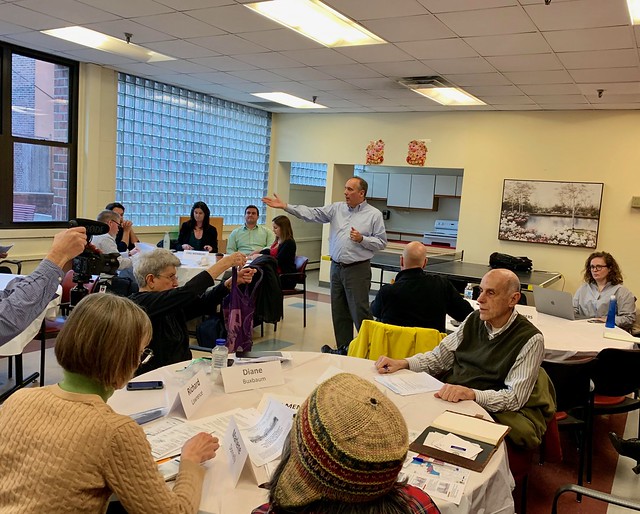
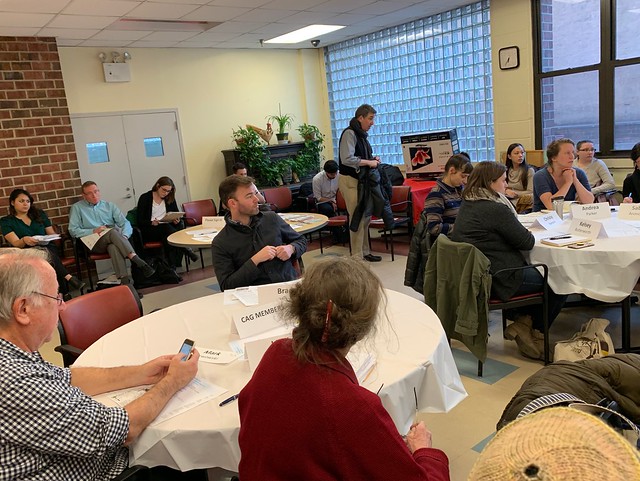
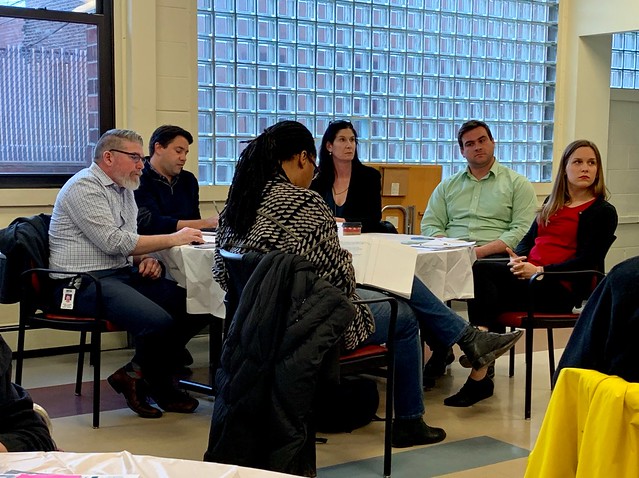
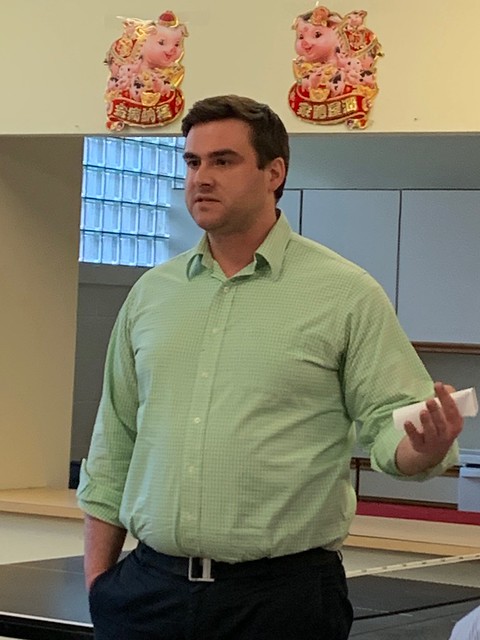
On Wednesday, May 29, 6:30 – 8:30 p.m., the Gowanus Canal Community Advisory Group (CAG) will be hosting a Gowanus Superfund Town Hall at  PS 133,  610 Baltic Street at 4th Avenue, in Brooklyn.  This is your chance to catch up on everything related to the clean-up of the canal,  to ask questions and, perhaps, to get involved.

From the Gowanus Canal CAG:
"The Gowanus Canal was designated a federal Superfund site in 2010, initiating a complex, multi-year clean-up of more than a century’s worth of toxins and other contaminants.

The US Environmental Protection Agency (EPA) has completed a successful pilot dredging and capping of the 4th Street turning basin, and is now turning its sights on the process of cleaning the entirety of the canal, beginning at the head-end near Butler Street, in 2020.

Please join us at a public town hall meeting on May 29 for an important update on the canal clean-up, the future timeline, and an idea of what to expect as the work progresses. Congresswoman Nydia Velázquez will give a keynote, and representatives from the EPA will present a project overview and look-ahead. The public will have an opportunity to ask questions following the presentation."


Please RSVP via Eventbrite. The event is FREE.

Read more

Monday, May 20, 2019

Gowanus Canal CAG To Host Superfund Town Hall With Congresswoman Nydia Velázquez

Untitled
On Wednesday, May 29, 6:30 – 8:30 p.m., the Gowanus Canal Community Advisory Group (CAG) will be hosting a Gowanus Superfund Town Hall at  PS 133,  610 Baltic Street at 4th Avenue, in Brooklyn.  This is your chance to catch up on everything related to the clean-up of the canal,  to ask questions and, perhaps, to get involved.

From the Gowanus Canal CAG:
"The Gowanus Canal was designated a federal Superfund site in 2010, initiating a complex, multi-year clean-up of more than a century’s worth of toxins and other contaminants.

The US Environmental Protection Agency (EPA) has completed a successful pilot dredging and capping of the 4th Street turning basin, and is now turning its sights on the process of cleaning the entirety of the canal, beginning at the head-end near Butler Street, in 2020.

Please join us at a public town hall meeting on May 29 for an important update on the canal clean-up, the future timeline, and an idea of what to expect as the work progresses. Congresswoman Nydia Velázquez will give a keynote, and representatives from the EPA will present a project overview and look-ahead. The public will have an opportunity to ask questions following the presentation."


Please RSVP via Eventbrite. The event is FREE.


Read more

Wednesday, March 27, 2019

Same As It Ever Was In Gowanus: It Is Clear That New York City Plans To Allow New Housing First, Deal With Extra Sewage Later.

Untitled
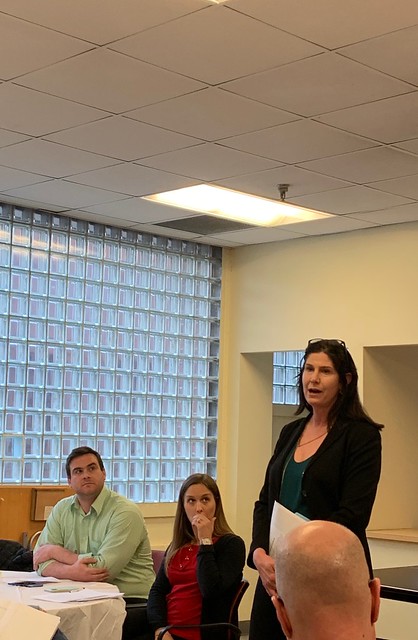
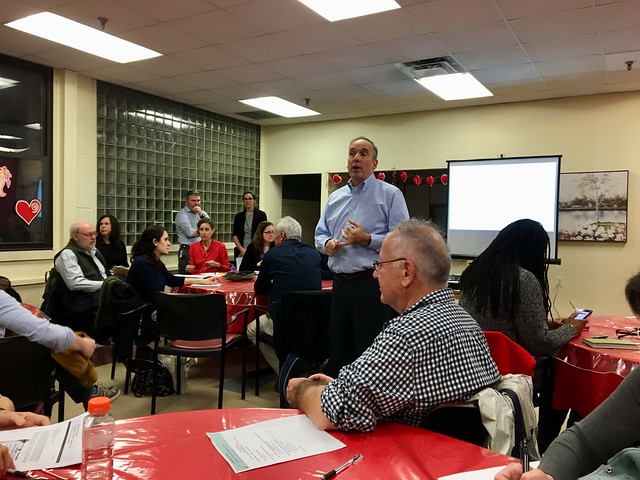
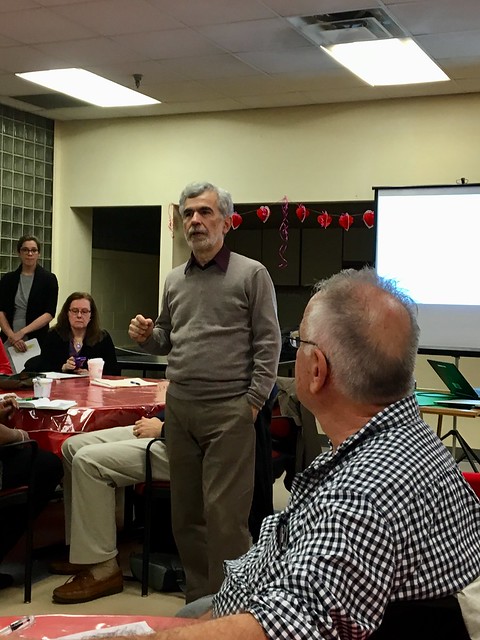
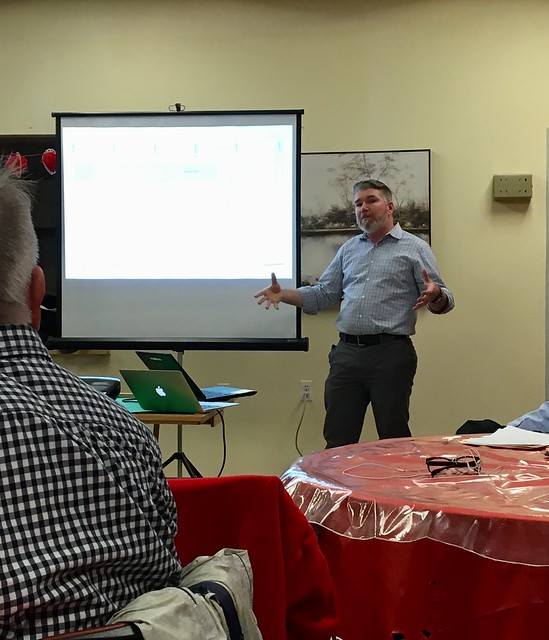
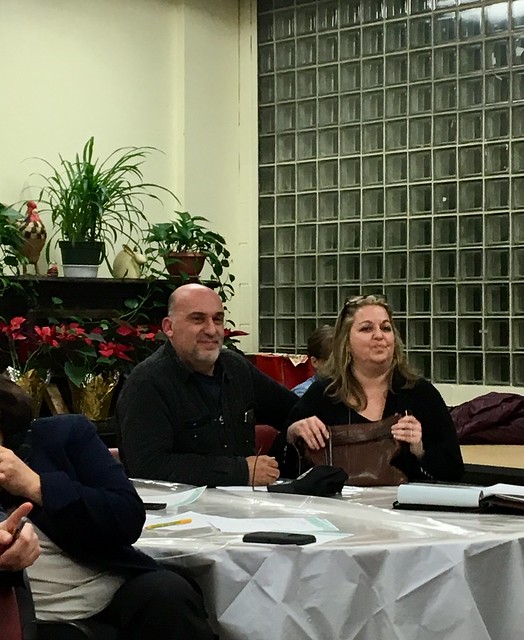
March 27 2019 meeting of the Gowanus Canal Community Advisory Group
Untitled
Untitled
Untitled
Jonathan Keller, NYC Department of City Planning
Untitled
Angela Licata, NYC DEP Deputy Commissioner
Untitled
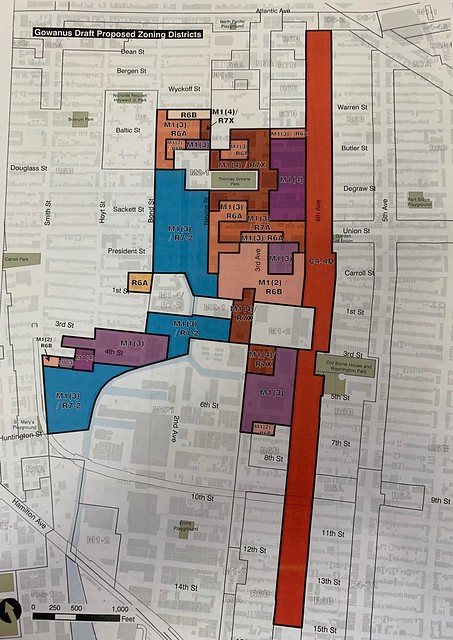
Proposed Gowanus upzoning  
Untitled
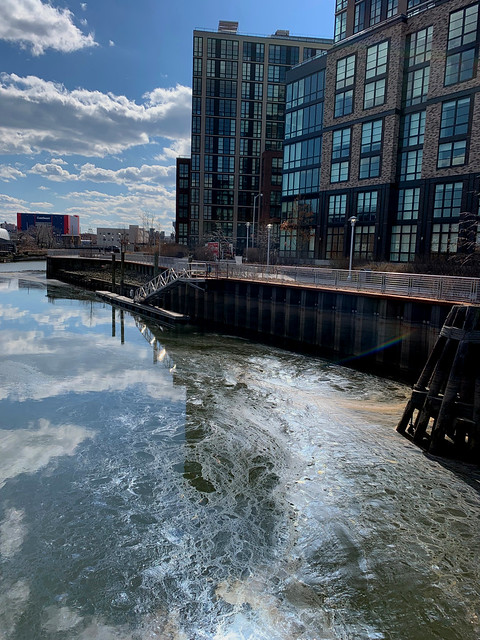
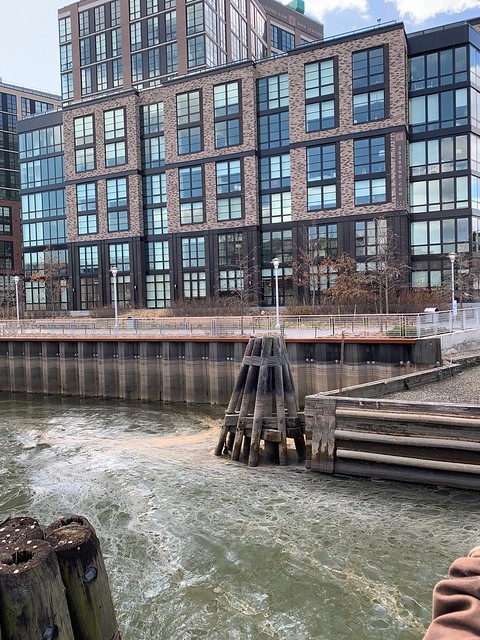
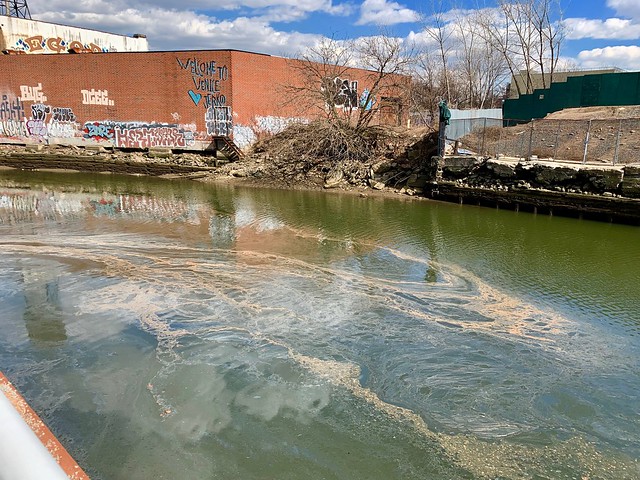
Raw Sewage and toxic discharges floating past 363 and 365 Bond Street in Gowanus
Untitled
A plume of sewage floating past 363-365 Bond Street
Untitled
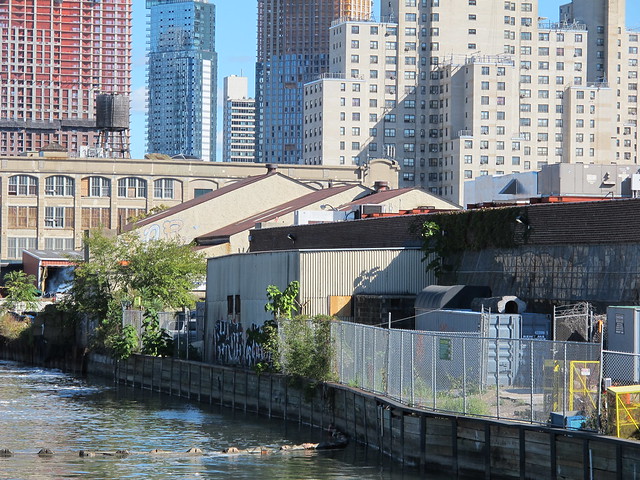
How can New York City envision  an up-zoning that would bring thousands of new residents to the Gowanus Canal area when it has not yet addressed the fact that it still releases significant amounts of raw sewage into the waterway  and will continue to do so for at least another ten years?

That is the question members of the Gowanus Canal Community Advisory Group asked  representatives of both New York City Department of City Planning (DCP) and NYC's Department of Environmental Protection (DEP) at the group's general meeting last night.

Either Jonathan Keller of NYC DCP or Angela Licata of NYC DEP were unprepared to give specific answers, but it became clear throughout the conversation that the City plans to allow new buildings to go up first, and then deal with the additional sewage afterwards
And that is all backwards.

How did we get here?
The City and developers have been itching to up-zone the Gowanus neighborhood to allow more residential developments. The proposal calls for buildings that may reach 22 to 30 stories along the heavily polluted canal, which the EPA declared a Superfund in 2010.

The rezoning is slated to move through the Uniform Land Use Review Procedure (ULURP) by the end of 2019. Since ULURP takes about 9 months to 12 months to complete, developers could potentially begin building their residential towers by the end of next year.

Everyone may also remember that EPA, as part of its Superfund clean-up, has mandated that NYC DEP must finally cease the practice of dumping raw sewage into the Gowanus Canal during heavy rain events. The Federal Government has ordered New York City to build two Combined Sewer Overflow tanks to remedy the situation and to protect its Superfund clean-up, once it is completed. The larger of the two tanks, is planned for the head of the Canal, next to the largest CSO outfall.

Instead of swiftly moving ahead with fulfilling its obligation in light of the City's rezoning efforts, DEP has managed to delay the completion date for the head of Canal tank, by first insisting on building it on land that needed to be taken by eminent domain instead of placing it under a City-owned park. Recently, the City has switched course entirely by proposing a tunnel under the canal, in place of the tank.

The community is looking at a scenario in which thousands more residents may be living next to an open sewer by 2020, while DEP is pushing the completion date for a CSO tunnel or tank  to 2030 and probably beyond.

Though Angela Licata last night told the Gowanus community that DEP had already invested significantly to reduce Combined Sewer Overflows (sewage) into the canal, with projects like a sponge park, rain gardens, high level storm sewers, investments on the Gowanus Pumping Station and controls of "floatables."

However, Licata revealed that even with the construction of the two EPA mandated CSO tanks, the City is dealing strictly with current CSO conditions, and is not addressing any additional measures to offset new development.
In other words, the current CSO remedy will be outdated the moment the up-zoning goes through and new high-rises get built.

Members of the CAG urged both DEP and City Planning to plan ahead and to think outside of the box. One of the  CAG suggestions was to write into the proposed rezoning that new buildings should be required to separate gray and black water to reduce the burden on our sewers.
Neither agencies seemed eager to push that idea forward.

In the absence of logical thinking by the City of New York, it is reassuring to know that the EPA, at least is planning for the future. The 2013 Gowanus Canal Superfund Record of Decision, the legal blueprint for the clean-up of the polluted canal, specifically requires that "the capacity of the retention tanks will need to accommodate the projected additional loads  to the combined sewer system as a result of current and future residential development, including future rainfall increases that may result from climate change."

DEP and DCP better figure out what more housing, more residents, and more poop would mean to a neighborhood that has literally been dumped on for decades.
Otherwise, we as a community, have a right to tell the City that no rezoning should be allowed to go forward before adequately sized CSO tanks are completed.


Read more

Friday, March 23, 2018

Community Activists Planning Candle Light Vigil To Save Iconic Gowanus Station

IMG_1058
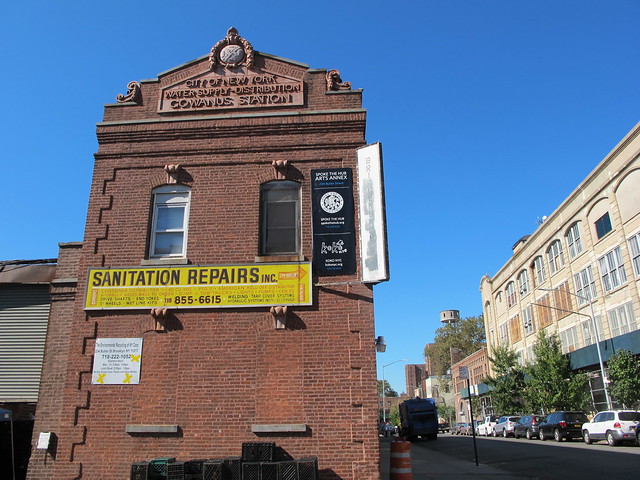
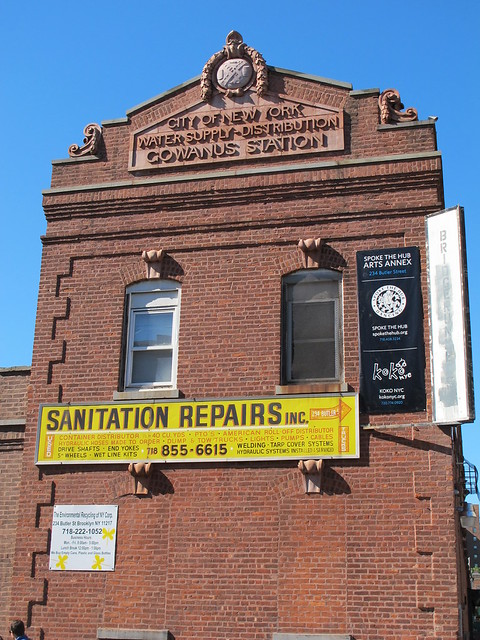
The Gowanus Station Building at 234 Butler Street is at risk.
IMG_1055
IMG_1056 

Candle Light Vigil To Save Iconic Gowanus Station will be held on April 10 from 6:30 to 7:30 at the building site, 234 Butler Street, corner of Nevins Street. 
(Rain Date is April 12 at 6:30-7:30).

Community activists are continuing to speak out  against a plan by the New York City Department of Environmental Protection Agency to demolish the iconic Gowanus Station building on Butler Street.
To have their voices heard, they will be holding a Candle Light Vigil at the building and are encouraging others to join. 

For a bit of background on the building and how we got here:
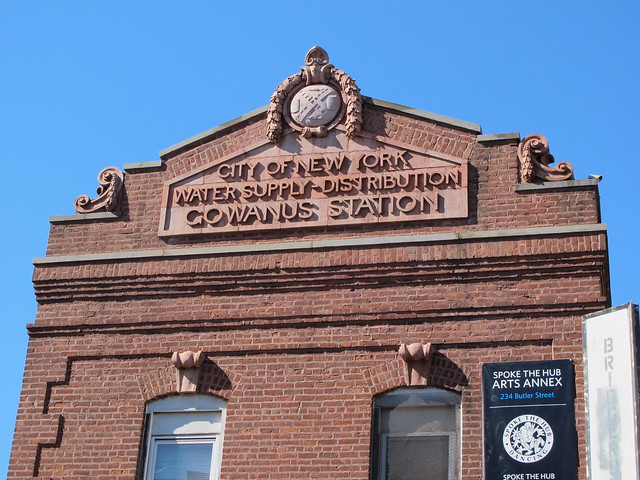
If the New York City Department of Environmental Protection Agency has its way, the beautiful former City of New York Water Supply Distribution Gowanus Station building at 234 Butler Street at the corner of Nevins Street will be demolished as part of the current plan to build an 8 million gallon Combined Sewer Overflow tank and facility head house on the site it occupies,

This two-story beaux-arts building, built in 1913 by the Department of Water Supply, Gas and Electricity, not only reflects the larger context of Gowanus as one of the earliest and busiest industrial and manufacturing centers in this country, it is also unique for being the only building that actually bears the name of the neighborhood.

There has been much advocacy from members of the community to save the building, or at the very least, incorporate its facade into D.E.P.'s design for the C.S.O. facility.

Support came from the New York State Historic Preservation Office (SHPO), which wrote in October 2017: "Based on our review of the project details to date, it appears feasible to retain and incorporate the historic former Gowanus Station Building (234) Butler Street into the project. This building which has a prominent street presence on the corner and the very edge of the city’s preferred site, has overreaching significance on the National Register eligible Gowanus Historic District. Its demolition would adversely affect both the building and the National Register eligible Gowanus Canal Historic District. To destroy this intact, architecturally distinctive example of Brooklyn’s civic and industrial heritage would be a disservice to the Gowanus neighborhood and to the city as a whole.”

Borough President Eric Adams also noted that the entire building is valued as a local resource and has been found to be significant by SHPO as part of the National Register Gowanus Historic District. "Given the building's significance to members of the community, if additional testing determines that the building's walls are structurally sound, it would be worthwhile to consider retaining the walls using creative architectural and engineering solutions, integrated into the facility's design."

Community Board 6 acknowledged the importance of the building to the community and asked DEP to "consider an alternative design to save the historic structure." 

Yet, New York City D.E.P. seems determined to take a wrecking ball to 234 Butler Street. Why wouldn't the agency attempt to take the wishes of the community into consideration, you ask? Many would say that the City has never been very transparent or trustworthy when it comes to Gowanus.

To better understand the matter regarding the Gowanus Station building and how it relates to the planned C.S.O facility, let us rewind a bit.

You may remember that in June of 2016, the US Environmental Protection Agency (EPA) finalized an agreement with the City of New York that secures the design of the larger of two combined sewage and storm water overflow (CSO) retention tanks, mandated by the Federal Agency as part of Gowanus Canal Superfund cleanup.

The agreement allows New York City to locate an 8 million gallon retention tank in New York City’s preferred location, known as the “Head-of-Canal” location. It also stipulates that the EPA can require New York City to place the tank at the EPA-suggested Thomas Greene Park location instead "if certain activities do not occur on schedule, including if New York City is not able to acquire the land at the Head-of-Canal location within approximately four years."

The City's plan relies on the taking of two privately owned sites, 234 Butler Street and 242 Nevins Street, by eminent domain. A third site, 270 Nevins Street, which currently houses a film production studio, will be seized and then leased by the City for temporary staging purposes.

An application submitted by New York City Department of Environmental Protection (DEP) and the New York City Department of Citywide Administrative Services (DCAS) for the acquisition of these three privately-owned parcels needed for the Gowanus CSO Facility is currently moving through the Uniform Land Use Review Procedure (ULURP). DEP expects the ULURP to be completed by April 2018, when the NYC Council will cast a final vote.

In the meantime, D.E.P. is designing the C.S.O. facility, which includes a huge head house (for maintenance and odor control). According to the agency's plans, that head house will be located in the footprint of the Gowanus Station building at 234 Butler Street.
                                                                                                                 
Kevin Clarke, the DEP Project Coordinator, told the community that his agency had determined that it was "not technically feasible" to keep the building, nor its façade, since the excavation for the retention tank would seriously undermine the structure. 

According to Clarke, the Gowanus Station is too brittle, had been altered too many times over its lifetime, and did not meet code anymore. Besides, DEP feels that saving the building would 'not be a prudent expenditure."

Instead, DEP would salvage the building's parapet and other exterior elements and display them in the publicly accessible areas of the completed C.S.O. facility.   

That is not enough for those who want to keep this piece of Gowanus history.
Please join the candle light vigil and make your voice heard.
                                                  
Read more

Friday, March 02, 2018

Despite Overwhelming Community Advocacy To Save The Iconic Gowanus Station Building On Butler Street, New York City Determined To Demolish It

IMG_1058
The Gowanus Station Building at 234 Butler Street is at risk.
IMG_1055
IMG_1056
Untitled
At Tuesday night's meeting of the Gowanus Canal Community Advisory Group 
Untitled
Christos Tsiami, US EPA Region 2's Project Manager for the Gowanus Canal Superfund Site
Untitled
Kevin Clarke, the NYC DEP Project Coordinator
Untitled
Salvatore Tagliavia and his wive Lena, owners of 234 Butler Street
at Tuesday's meeting

If the New York City Department of Environmental Protection Agency has its way, the beautiful former City of New York Water Supply Distribution Gowanus Station building at 234 Butler Street at the corner of Nevins Street will be demolished as part of the current plan to build an 8 million gallon Combined Sewer Overflow tank and facility head house on the site it occupies,

This two-story beaux-arts building, built in 1913 by the Department of Water Supply, Gas and Electricity, not only reflects the larger context of Gowanus as one of the earliest and busiest industrial and manufacturing centers in this country, it is also unique for being the only building that actually bears the name of the neighborhood.

There has been much advocacy from members of the community to save the building, or at the very least, incorporate its facade into D.E.P.'s design for the C.S.O. facility.

Support came from the New York State Historic Preservation Office (SHPO), which wrote in October 2017: "Based on our review of the project details to date, it appears feasible to retain and incorporate the historic former Gowanus Station Building (234) Butler Street into the project. This building which has a prominent street presence on the corner and the very edge of the city’s preferred site, has overreaching significance on the National Register eligible Gowanus Historic District. Its demolition would adversely affect both the building and the National Register eligible Gowanus Canal Historic District. To destroy this intact, architecturally distinctive example of Brooklyn’s civic and industrial heritage would be a disservice to the Gowanus neighborhood and to the city as a whole.”

Borough President Eric Adams also noted that the entire building is valued as a local resource and has been found to be significant by SHPO as part of the National Register Gowanus Historic District. "Given the building's significance to members of the community, if additional testing determines that the building's walls are structurally sound, it would be worthwhile to consider retaining the walls using creative architectural and engineering solutions, integrated into the facility's design."

Community Board 6 acknowledged the importance of the building to the community and asked DEP to "consider an alternative design to save the historic structure." 

Yet, New York City D.E.P. seems determined to take a wrecking ball to 234 Butler Street. Why wouldn't the agency attempt to take the wishes of the community into consideration, you ask? Many would say that the City has never been very transparent or trustworthy when it comes to Gowanus.

To better understand the matter regarding the Gowanus Station building and how it relates to the planned C.S.O facility, let us rewind a bit.

You may remember that in June of 2016, the US Environmental Protection Agency (EPA) finalized an agreement with the City of New York that secures the design of the larger of two combined sewage and storm water overflow (CSO) retention tanks, mandated by the Federal Agency as part of Gowanus Canal Superfund cleanup.

The agreement allows New York City to locate an 8 million gallon retention tank in New York City’s preferred location, known as the “Head-of-Canal” location. It also stipulates that the EPA can require New York City to place the tank at the EPA-suggested Thomas Greene Park location instead "if certain activities do not occur on schedule, including if New York City is not able to acquire the land at the Head-of-Canal location within approximately four years."

The City's plan relies on the taking of two privately owned sites, 234 Butler Street and 242 Nevins Street, by eminent domain. A third site, 270 Nevins Street, which currently houses a film production studio, will be seized and then leased by the City for temporary staging purposes.

An application submitted by New York City Department of Environmental Protection (DEP) and the New York City Department of Citywide Administrative Services (DCAS) for the acquisition of these three privately-owned parcels needed for the Gowanus CSO Facility is currently moving through the Uniform Land Use Review Procedure (ULURP). DEP expects the ULURP to be completed by April 2018, when the NYC Council will cast a final vote.

In the meantime, D.E.P. is designing the C.S.O. facility, which includes a huge head house (for maintenance and odor control). According to the agency's plans, that head house will be located in the footprint of the Gowanus Station building at 234 Butler Street.

At the February general meeting of the Gowanus Canal Community Advisory Group (CAG), attended by representatives from EPA, DEP, New York's State Historic Preservation Office (SHPO), and by New York City Landmarks Preservation Commission, the entire meeting was set aside to discuss the Gowanus Station.

Kevin Clarke, the DEP Project Coordinator, told the community that his agency had determined that it was "not technically feasible" to keep the building, nor its façade, since the excavation for the retention tank would seriously undermine the structure. 

According to Clarke, the Gowanus Station was too brittle, had been altered too many times over its lifetime, and did not meet code anymore. Besides, DEP felt that saving the building would 'not be a prudent expenditure."

Instead, DEP would salvage the building's parapet and other exterior elements and display them in the publicly accessible areas of the completed C.S.O. facility.

Conveniently, the New York City Landmarks Preservation Commission (LPC) has supported DEP's assertions and has "deemed the Gowanus Station too altered to grant it individual landmark status."
This prompted Salvatore Tagliavia and his wife Lena, the current owners of the 234 Butler Street to raise skepticism at Tuesday's CAG meeting. 
Not only is New York City planning to acquire their property by eminent domain, but NYC LPC is making recommendations on a building that the City plans on demolishing.

Ideally, LPC would make recommendations solely on the historic worthiness of a structure.
In this case, one could make the case that there is a clear conflict of interest and that the lines are sufficiently blurred to be skeptical of LPC's determination.

SHPO also seems to have toed the line, changing its overwhelming support to incorporate the Gowanus Station building into the overall design of the CSO facility in late 2017, to accepting "the project alternatives as presented" and concurring with DEP that "there appear to be no prudent and feasible alternatives to demolition of 234 Butler and 242-244 Nevins Street" by early February 2018.

It is important to know that on June 30th, 2017, DEP filed documents with EPA for the first phase of the tank design, which pertain to "site preparation and demolition". Apparently, the City has been working on a contract to demolish the building, making clear that it never earnestly looked into saving it.
It is also important to remember that the EPA will have final say on the City's CSO facility design and what happens on the site. 

Stay tuned! As always, things in Gowanus are interesting, never simple, and often perplexing.


Read more

Friday, November 10, 2017

EPA And Congresswoman Nydia Velázquez To Attend Gowanus Superfund Town Hall

IMG_9365
On Thursday, November 16, 2017 at 6:30 pm, the Gowanus Canal Community Advisory Group (CAG) will be hosting a Gowanus Superfund Town Hall. In attendance will be representatives of the U.S. Environmental Protection Agency and Congresswoman Nydia Velázquez will be the keynote speaker.
This is YOUR opportunity to get an overview and timeline of the environmental clean-up of everyone's favorite polluted canal. There will be a question and answer period after the presentation.As a Gowanus Canal CAG member, I will be on hand with my fellow members after the meeting to give out information on how to join the group.
The meeting will be held at the Wyckoff Gardens Community Center, 272 Wyckoff Street.
Don't miss this! It is important for all of us to stay involved and to be up to date on this important neighborhood issue.


Read more

Wednesday, November 23, 2016

It Came From The Gowanus: Viewing Debris Recently Removed From 4th Street Basin

IMG_9562
IMG_9554
IMG_9560
Representative of contractor Stevenson going over some safety points before entering site
IMG_9563
Christos Tsiamis,
EPA Senior Project Manager for the Gowanus Superfund, (right) speaking to members of the EPA Community Advisory Group's Archaeology Committee
IMG_9561
IMG_9566
IMG_9567
IMG_9575
IMG_9568
IMG_9570
IMG_9583
IMG_9569
IMG_9572
IMG_9573
IMG_9577
IMG_9574
IMG_9585
IMG_9591
EPA's Christos Tsiamis,
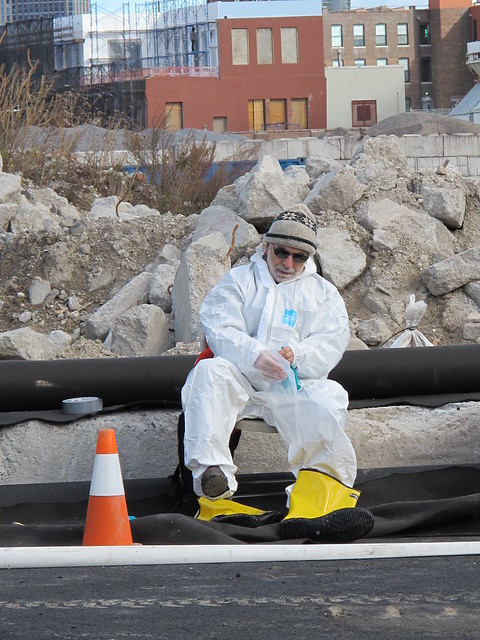
suiting up to handle some of the material recently removed fro the Gowanus Canal 

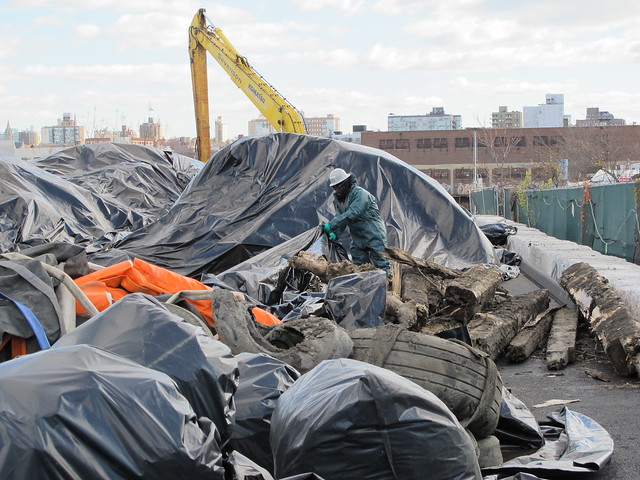
As an important step in the environmental clean-up of the highly toxic Gowanus Canal, the U.S. Environmental Protection Agency began a debris removal Pilot Project at the 4th Street Turning Basin next to the Gowanus Whole Foods this past October. This first phase of the pilot program consisted of clearing obstructions from the basin that prevented navigational access.

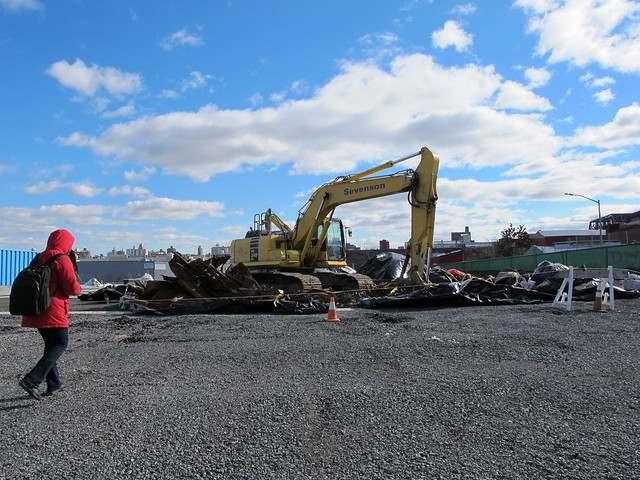
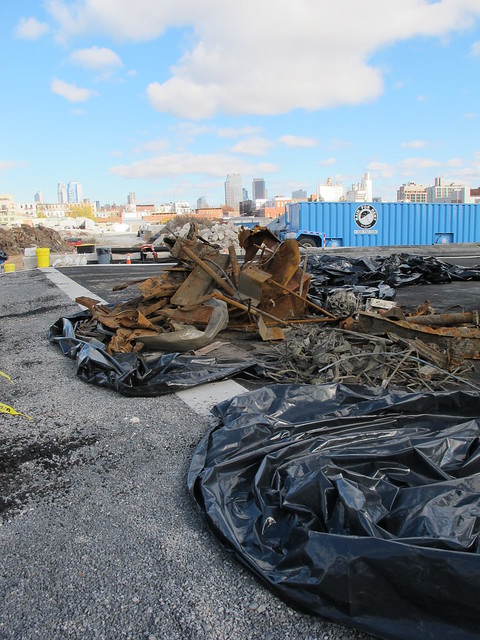
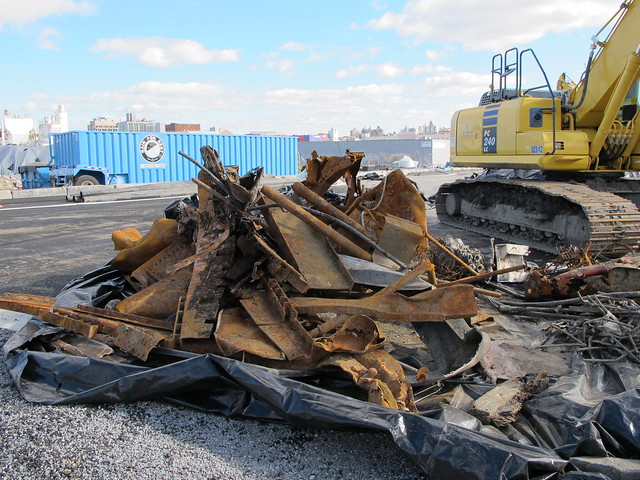
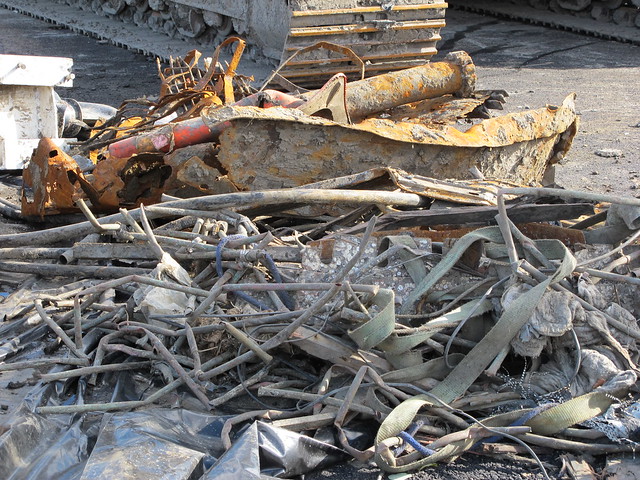
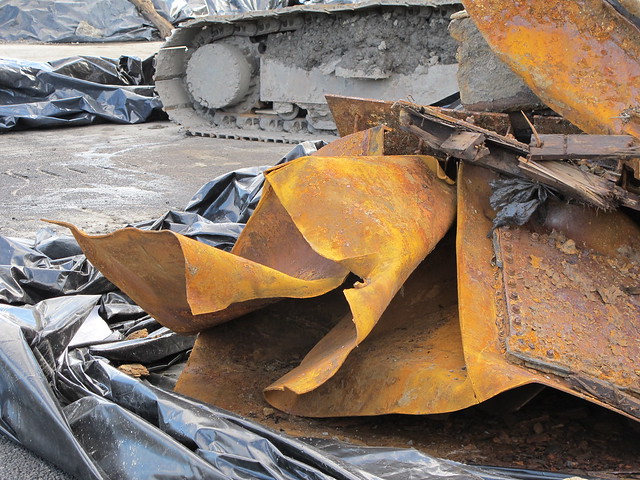
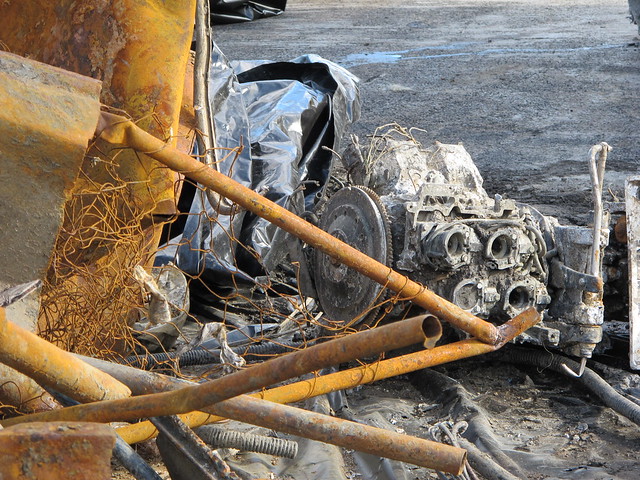
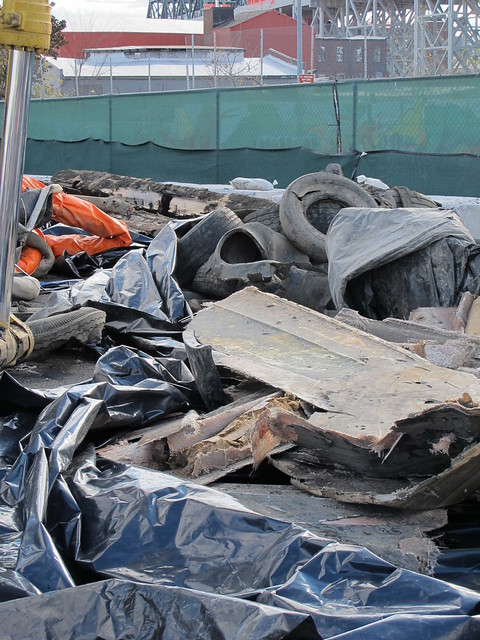
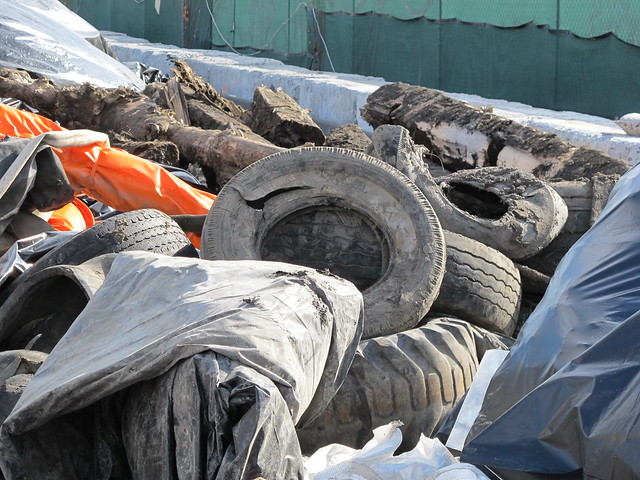
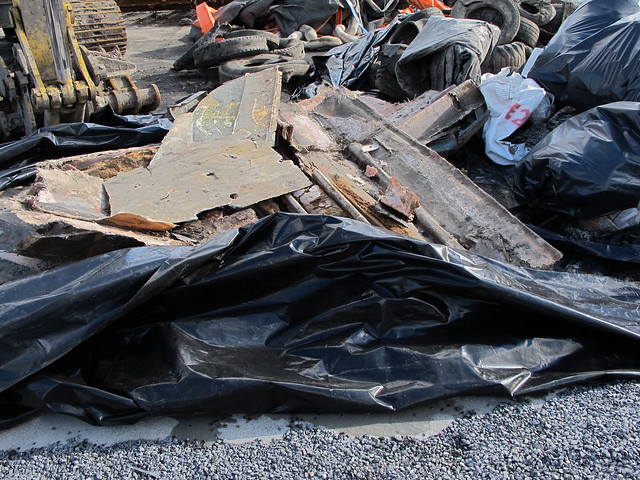
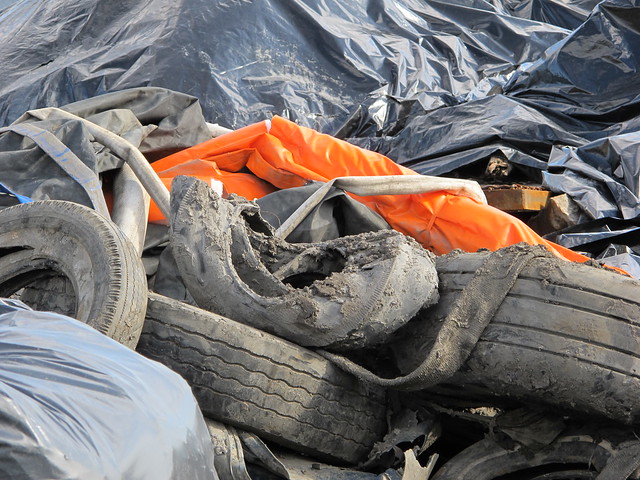
For about two weeks, environmental remediation and dredging contractor Sevenson removed all sorts of urban debris that included a sunken boat hull, a smaller fiber glass boat and countless tires. 

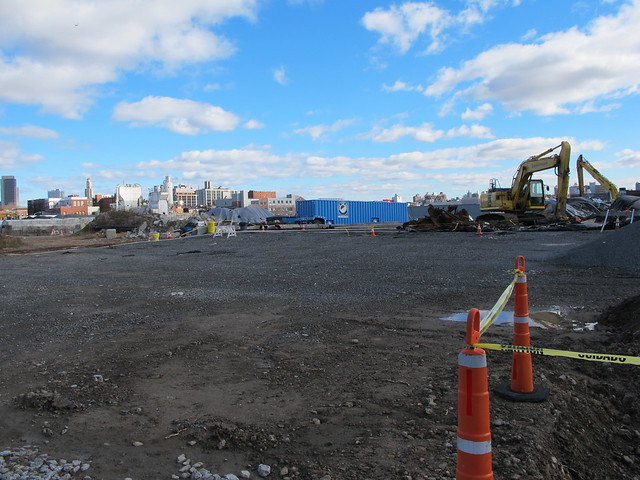
The debris was transported by barge to a staging area to the Public Place site at Smith Street and Huntington Street.  Eventually, it will be transported out of the area via barge to appropriate recycling or waste facilities.

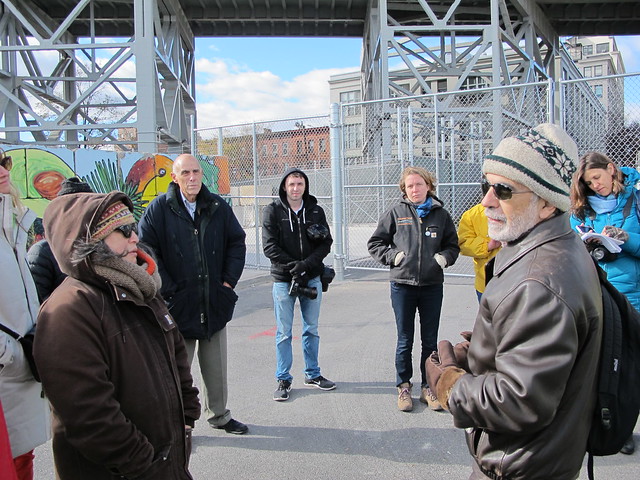
Before shipping the debris off-site, Christos Tsiamis,  EPA Senior Project Manager for the Gowanus Superfund, organized a viewing this past Tuesday for members of the press and for the Archaeology Committee of the Gowanus Canal Community Advisory Group.
Accompanied by Natalie Loney, EPA Community Involvement Coordinator, Tsiamis explained to the group that the debris had been neutralized and  assessed by an archaeologist, who found that it held "no archeological importance." A full report will be available at the beginning of December.
 
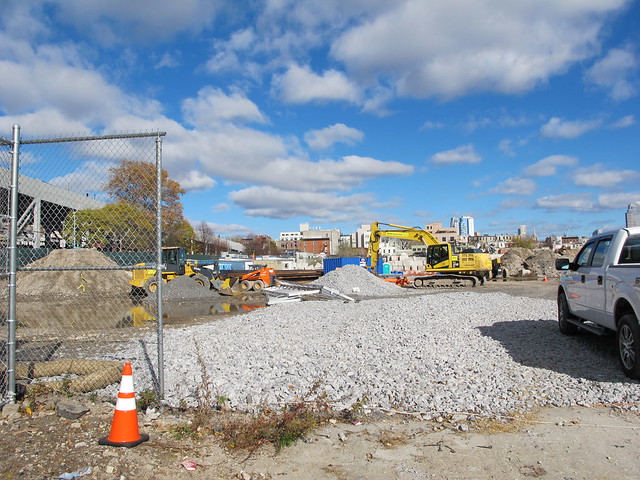
Since most of the larger items removed from the 4th Street basin broke apart when lifted out of the water, the debris currently stored on Public Place consists of twisted metal and wood. The only recognizable items are an engine and tires.

According to Tsiamis, there really were no big surprises when the material was lifted out of the water, 
The larger items had previously been identified and mapped using sonar technology. 
"There may be more interesting targets when we come to dredge deeper into the soft material at the bottom of the canal," Tsiamis said.

Indeed, the second phase of the 4th Street Basin pilot study will continue at the end of the summer in 2017. It will consist of dredging the toxic black sediment at the bottom of the canal and capping to prevent recontamination. The results of that work will inform the EPA on how best to dredge the entire length of the canal at a later time.

So there is still a chance that the Gowanus Canal will give up some of its darker secrets and live up to its infamous reputation as the resting place of the Maryland 400, as a notorious mafia dumping ground  and home of a revengeful toxic sludge monster.


Read more

Wednesday, January 13, 2016

EPA Believes Proposal By Developer Alloy Creates New Possibilities For Moving On With Design Of Gowanus Retention Tank

IMG_6723
Christopher Swain Gowanus Swim
IMG_1723
IMG_1724
The first  2016 meeting of the US Environmental Protection Agency's  Gowanus Canal Superfund Community Advisory Group  will take place on January 19th at 6:30 pm at P.S. 58, 330 Smith Street.

Perhaps this is a perfect time to review what has been happening with the Gowanus Superfund in the past few months and to focus on what is likely to be the major discussion related to the environmental clean-up of  our waterway in this coming year: the siting of an 8 million gallon Combined Sewer Overflow retention tank at the head of the canal.

The Federal Agency and New York City has hinted that it will soon announce its decision regarding  the siting of the larger of two Combined Sewer Overflow (CSO) retention tanks that EPA has ordered New York City Department Of Environmental Protection (DEP) to construct in Gowanus. The tanks are needed to capture raw sewage currently being discharged into the canal and to protect the environmental remedy outlined in the Record of Decision  in 2013.

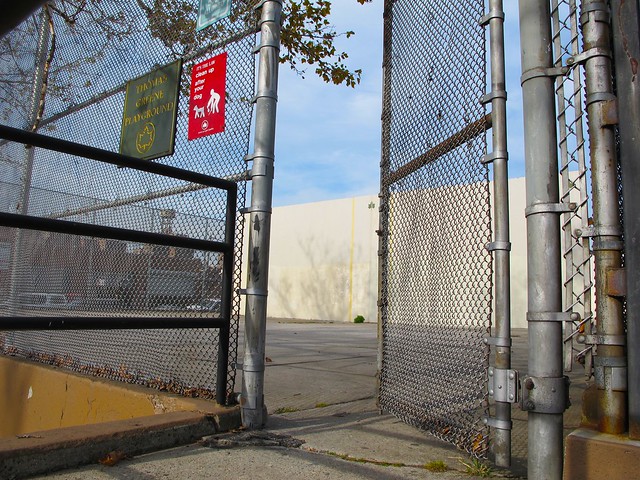
In the Record of Decision, EPA's Region 2, responsible for overseeing the Gowanus Superfund clean-up, has suggested placing the 8-million gallon tank underneath the Double D pool at Thomas Greene Park. The Agency reasoned that the site is already owned by the City, which would save the cost of acquiring land. 
In addition, the park sits on top of the former Brooklyn Union Gas Fulton Municipal Manufactured Gas Plant (MGP) which was in operation at this location from 1879 to the early 1930s. Since coal tar is currently oozing under the pool area and flows towards the Gowanus Canal, National Grid, the party responsible for the environmental clean-up, has been asked by EPA to dig up the pool so that the source contamination can be removed. By working in tandem with National Grid, DEP would save money and time.

The NYC DEP, on the other hand, would prefer to site the 8-million gallon tank on privately-owned land along the canal, adjacent to the park. The sites in question are 234 Butler Street and 242 Nevins Street. In addition, the City wants to acquire 270 Nevins Street, which is currently occupied by Eastern Effects Studios, as a staging area. The City is willing to make use of Eminent Domain to acquire the three properties if the private owners are unwilling to sell. The necessary legal proceedings involved in making this happen will take time and millions of dollars.

The City wants to place the tank and a 50 feet high head house for the mechanical elements needed for the tank at 234 Butler and 242 Nevins partly because of the proximity to the rest of its Gowanus infrastructure at the head of the canal, and partly to "protect Thomas Greene Park" since the nearby community is underserved when it comes to open space and recreational facilities.

The problem with the City's eminent domain plan is that it will delay the environmental clean up of the Gowanus Canal by about 3 to 5 years, which EPA is very concerned about.

Pretty confusing, right?

In late 2015, things got even more complicated.
Alloy, a real estate development firm based in Dumbo, has proposed an alternative solution that may reduce or eliminate the clean-up delay as well as offset the loss of parkland.

Alloy is proposing to build an as-of-right commercial development with a 2.0 Floor Area Ratio (FAR) that will provide much needed creative office space in Gowanus. Distributing the allowable square footage into two four-story buildings instead of one large two-story structure would allow Alloy and the owners of the sites to donate a sizable piece of land to the City. 
According to Jared Della Valle, Alloy's president, the donation would create additional permanent park land that would exceed the land lost to the head house in the park, if it were placed there.
It would also preserve the properties' tax base and create jobs in the area.

"We believe that our proposal could save the unnecessary time of pursuing eminent domain" Jared Della Valle, Alloy's president, told the Community Advisory Group. "It would also save the City up to a hundred million dollars."
What do Alloy and the owners get out of it? "No eminent domain. It's that simple," Della Valle explained.

After the December 2 , 2015 meeting, I reached out to Christos Tsiamis, EPA Region 2 Senior Project Manager for the Gowanus Superfund.

I asked him if the EPA would have a conflict with the plan Alloy presented to the CAG and if it would support EPA's proposed technology related to the siting of the tank.

Here is Mr. Tsiamis' response:

"EPA is aware of Alloy’s proposal to New York City (NYC). Alloy met with EPA to explain the proposal and they also submitted to us the presentation they made to the CAG earlier this month. It is evident that under their proposal NYC is expected not to condemn the two northern-most parcels on the east side of the Gowanus Canal for the purpose of building the retention tank there. In return NYC would receive from Alloy, as a permanent donation, a portion of those two parcels (over 50,000 square feet) to be eventually developed as parkland.

To answer your question, Alloy’s proposal is not in conflict with EPA’s plans. On the contrary, it is in accord with EPA’s Record of Decision (ROD). The ROD assumed that the retention tank would be placed in NYC-owned land thus reducing the cost of the project (by eliminating land acquisition costs for NYC) and creating cost and schedule synergies out of the simultaneous cleanup of the tar source at the Thomas Greene Park and the construction of the underground retention tank.

EPA believes that the Alloy proposal creates new possibilities for moving on with the design of the retention tank. It addresses EPA’s concern for disruptions in the Canal cleanup schedule by avoiding the lengthy delays associated with the taking of land through eminent domain. It also addresses the community’s need for maintaining the present park and even gaining additional parkland through the donation of private land. Finally, it offers significant cost savings to the City as the ROD had  envisioned."

(You can access Alloy's complete proposal here.)

The EPA will be updating the community at the next Gowanus Canal Superfund Community Advisory Group meeting on January 19th.  The meetings are open to the public.  I urge everyone to attend.
2016 should be an interesting year for Gowanus.


Read more

Monday, February 23, 2015

Councilman Lander To Present "Bridging Gowanus" Planning Framework At Gowanus Canal Superfund CAG Meeting

IMG_2745
Councilmember Brad Lander will be attending this Tuesday's Gowanus Canal Superfund Community Advisory Group (CAG) meeting to present the result of Bridging Gowanus, his initiative to "develop a neighborhood framework for the infrastructure and land use plan needed for a safe, vibrant and sustainable Gowanus".

Though the Councilmember had met with many community groups to share the final "Draft Bridging Gowanus Community Planning Framework" in the weeks prior to its November 2014 release, he had somehow failed to meet with the CAG.

At its December 2014 general meeting, the CAG, which has been working closely with the Environmental Protection Agency to keep the community information on issues relating to the canal's Superfund clean-up, asked for the Councilman to come present the framework to its members. It also asked that the Bridging Gowanus comment period be extended so that the CAG has time to formulate a response.

Tuesday's CAG meeting is open to the community. I urge everyone to attend.
Since the 'shared values' reflected in the Bridging Gowanus framework are meant to guide New York City Planning and the De Blasio Administration when a re-zoning plan for Gowanus will be put worth, it will have a huge impact on the future of the community.

Gowanus Canal CAG Meeting
Tuesday, February 24, 2015 at 6:30 PM
Mary Star of The Sea Senior Apartments, 41 1st Street, Brooklyn


Read more