Showing posts with label US Environmental Protection Agency. Show all posts

Monday, March 29, 2021

National Grid's Own Documents Prove That Contaminants From Public Place In Gowanus Migrated Off-Site


Public Place, the large empty swath of land between Smith Street and the Gowanus Canal in Carroll Gardens, may be one of the most contaminated sites in New York State and there are grave concerns that it may never be fully cleaned up despite current remediation efforts.  How did Public Place get so contaminated?
This is the site of the former Citizens Gas Company's Manufacturing Gas Plant, one of three such MGPs that once operated along the Gowanus Canal.

The Citizens Gas Company began operations in the late 1860's and then passed into the ownership of Brooklyn Union Gas (BUG) in 1895, which demolished the plant in the 1960's, when the MGP ceased operation. In subsequent years, BUG was merged with Keyspan, which was then acquired by National Grid in 2007.

What has been left behind is poisoned land. Coal tar, a highly toxic and carcinogenic by-product of the gas manufacturing process, has been allowed to migrate freely throughout the site and into the Gowanus Canal.  On Public Place, the deepest tar observed extended to approximately 153 feet below the ground surface.

Finally, after decades of exposing local residents to this toxicity, three of the four parcels that made up the former MGP site are currently being remediated by National Grid under the supervision of New York State's Department Of Environmental Conservation (DEC) through the state's Brownfield program.

However, the remediation can hardly be called a clean-up. It would be more appropriate to call it a containment, since most of the coal tar will remain in the soil forever.
Just recently, the Carroll Gardens / Gowanus community learned that DEC had allowed National Grid to significantly alter and degrade the remediation, sparking concerns that future residents would be exposed to the remaining contamination.

A look at National Grid's online repository for the Citizen's Gas Site documents reveals exactly how dangerously contaminated the site is.
According to a Remediation Investigation Report from 2005 by environmental consultant firm GEI, "groundwater moving through the areas of tar-saturated soil and residual tar will dissolve the BTEX components and light molecular weight PAHs (e.g., naphthalene). The resultant groundwater plume will migrate in the direction of groundwater flow. "
The study also revealed that in some spots, soil vapor contained elevated levels of benzene, toluene, and xylenes.

The most concerning information, however, can be found in a document entitled 2005 Final Remedial Investigation for Public Place, which can also be found in National Grid's online repository.
The community has known for a while that coal tar from Public Place has migrated into the adjacent Gowanus Canal. Local residents therefore asked if the contamination could have found its way past the other three boundaries of the site.
If one studies the report carefully, the answer, alarmingly, seems to be "YES".

The 2005 report clearly shows that pockets of coal tar have oozed underneath Smith Street, Huntington Street, as well as 4th Street at Hoyt Street, where it was detected underneath a row of buildings.
Yet, neither National Grid, nor NYC DEC admitted this important fact to local residents, though they were asked at numerous occasions at public meetings.

Below, we will guide you through the documents from the 2005 Final Remedial Investigation to reveal that contamination from the former MGP site at Public Place is no longer confined to its boundaries.
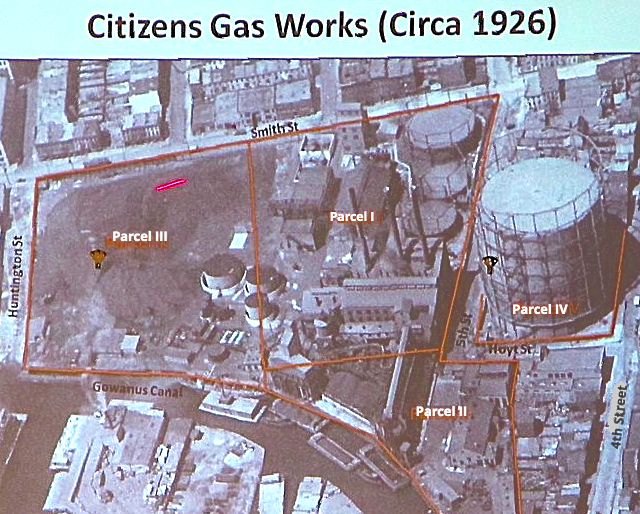
The four parcels that make up the former Citizens Gas Site
Arial view of the MGP site  in 1926, showing the various round gas holders. Parcel I with the three 
holders near Smith and 5th Street apparently holds the most pollution.
This diagram is from page 290 Of the 2005 GEI report
This particular map shows the survey of the site boundaries, as well as the cross sections (A-A' to G-G') along which soil borings were taken and ground water monitoring wells were installed by GEI. 
This is page 306 from the report. It shows the results of the soil samplings and ground water analysis from cross sections A-A'  and B-B'. The best way of visualizing this is by imaging cutting a straight line into a cake. The cut piece would reveal the different layers of the cake. In this instance, it shows the soils and contamination found in this cross section.
This speaks for itself, obviously, but notice that the dark blues indicate presence of coal tar.
Let us take a closer look at section B-B', which starts at Smith Street on Parcel I and ends at 6th Street on the other side of the Gowanus Canal.
Here is the level of pollution found deep in the ground on Parcel I along the B-B' section.
Corner of 5th Street and Smith Street, which according to cross section diagram,
 indicates a pocket of contaminated ground water.

This is where it gets interesting. This is the beginning of that B cross section of Parcel 1 at the corner of Smith Street and 5th Street, where the three gas holders that can be seen in the 1929 photo were once located.
If you look at the left hand side of the diagram, you will see a turquoise section in the 'shallow zone' that indicates that "coal tar staining, sheen and odors" were observed in the groundwater at this spot. The upper blue number in the little white box shows that at this spot, the groundwater concentration of BTEX, which refers to the chemicals benzene, toluene, ethylbenzene and xylene, is 13,300 μg/mL (parts per billion). The lower number indicates PHA (Polycyclic Aromatic Hydrocarbon) at concentration of 7670 parts per billion.)

NY State regulations state that BTEX should not exceed 5 parts per billion for drinking water but there are no limits for the PHA. While nobody will be drinking the groundwater containing these chemicals, there is continuing exposure through contact with the soil and breathing the air.

Now look up at the upper left hand side and notice that the contamination at this spot actually starts past the Public Place fence line. This diagram from the 2005 report indicates clearly that the groundwater barely 30 feet (NDA) below the surface has been heavily contaminated and actually extends onto Smith Street.
Now let us look at cross section I-I', which crosses Parcel 3 and Huntington Street, and ends across the Gowanus Canal towards 9th Street.
This is slide 310 of the GEI report from 2005.
Analysis of soil borings taken at this location also indicates the presence of coal tar staining, sheen and odors. The BTEX soil concentration here is 79 parts per million, the PHA concentration is 482 per million.
Once again, notice on the top part of this diagram, that the toxins have been found outside of Parcel 3, underneath Smith Street.
Approximate spot where evidence of coal tar was present on Smith Street on the I-I' cross section 
Mary Star Of The Sea Playground just steps away
The most interesting part of the report concerns cross section G-G', 
which starts on Parcel IV along 4th Street.

It is not currently being remediated by National Grid, though it is part of the former MGP site and is also contaminated. The parcel is occupied by a bus depot at the moment, and the community has been told it will be cleaned at a later time.
However, if you follow the G-G' cross section, you notice that there are actually pockets of toxic material right underneath the buildings between Hoyt Street and Bond Street.
Cross section G-G'. Slide 309 of the 2005 report.
One can clearly see the pockets of contamination in the soil and ground water underneath those buildings, especially the brick building on 4th Street nearest to Bond Street.
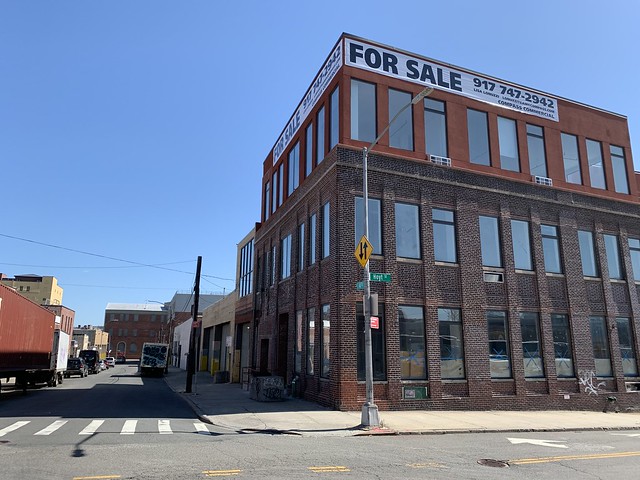
Buildings on south side of 4th Street between Hoyt and Bond Street, which show 
evidence of contamination along the G-G' cross section

The 2005 Final Remedial Report for Public Place indicates widespread pockets of coal tar on all four parcels. The remedial work currently being done on Parcel I, II and III by National Grid under NYS DEC supervision only removes 2 feet of soil across those parcels, and only digs down to a maximum depth of 22 feet on Parcel 1, where the remaining subsurface structures of the former gas holders need to be removed anyway.
The report also shows that the contamination has migrated outside the boundaries of all four parcels.

It is important here to indicate that the beginning and the end of each cross section along which the soil and the ground water was tested, was strictly arbitrary. If, for example, line I-I' had extended further across Smith Street and testing had been done closer to Nelson Street, it may have shown contamination under St. Mary's Playground or, one shudders to think, under some of the homes, perhaps.

It may not have been in the interest of National Grid to find out if that is the case. However, as the lead agency overseeing the Public Place remediation, one wonders why NYS DEC did not insist on more testing, more mitigation and more barriers to prevent the contaminants from migrating outside of the site.. After all, the documents referred to above have been available since 2005.

Why is all of this so relevant?
The pollution at Public Place and the gasses they emit are dangerous to human health. Despite this knowledge, Mayor de Blasio and Councilmember Brad Lander envision Gowanus Green, a 29 story development project with 950 affordable housing units and a school on a section of Public Place that is City owned (Parcels 1 and 2). More housing is planned on the privately owned parcel 3.

As a community, we need to insist that independent testing along a wider radius of Public Place is performed. We must insure that the coal tar is not present under other adjacent buildings.
At the very least, we need to insist that no housing be built right on top of the source of the contamination on Public Place.


We are dealing with people's lives and cannot have National Grid nor NYS DEC take any shortcuts. This community has already been exposed to the harmful effects of this contamination for more than a century.
Let's organize and fight together to get the environmental clean-up we deserve and are entitled to by law.


Related reading:
National Grid's online repository for the Citizen's Gas Site documents.


Read more

Monday, March 01, 2021

False Claims And Questionable Oversight: Why NY State DEC Cannot Be Trusted To Supervise National Grid's Clean-Up At Public Place

Public Place, the almost 11 acre swath of land bordered by the canal and Smith Street and 5th Street and Huntington Street in Carroll Gardens has been mentioned frequently in the news of late and for good reasons.
Public Place may be one of the most polluted sites in New York State and there are grave concerns that it may never be fully cleaned up despite current remediation efforts.

Despite these circumstances, Mayor de Blasio and Councilmember Brad Lander envision Gowanus Green, a 29 story development project with 950 affordable housing  units and a school on a section of Public Place that is City owned (Parcels 1 and 2).  More housing is planned on the privately owned parcel 3.

Public Place site in Carroll Gardens

How did Public Place get so polluted? It is the site of the former Citizens Gas Company's Manufacturing Gas Plant,  one of three such MGPs that once operated along the Gowanus Canal.

The Citizens Gas Company began operations in the late 1860's and then passed into the ownership of Brooklyn Union Gas (BUG) in 1895, which demolished the plant in the 1960's, when the MGP ceased operation.  In subsequent years, BUG was merged with Keyspan, which was then acquired by National Grid in 2007.
An arial view of the Citizens Gas Work site in 1926

What is left behind 160 years later is poisoned land. Coal tar, a highly toxic and carcinogenic by-product of the gasification process, has been allowed to migrate freely through the site and into the Gowanus Canal.   On Public Place, the deepest tar observed extended to approximately 153 feet below the ground surface.

According to a Remediation Investigation Report from 2005 by environmental consultant firm GEI,  "groundwater moving through the areas of tar-saturated soil and residual tar will dissolve the BTEX components and light molecular weight PAHs (e.g., naphthalene). The resultant groundwater plume will migrate in the direction of groundwater flow. "
The study also revealed that in some spots, soil vapor contained elevated levels of benzene, toluene, and xylenes. 

Finally, after decades of exposing local residents to this toxicity, the site is currently being remediated by National Grid under the supervision of New York State's Department Of Environmental Conservation through the state's Brownfield program.
However, the remediation can hardly be called a clean-up. It would be more appropriate to call it a containment, since most of the coal tar will forever remain deep in the native soil.ƒ

Just recently, the Carroll Gardens/ Gowanus community learned that DEC had allowed National Grid to significantly alter and degrade the remediation, sparking concerns that future residents would be exposed to the remaining contamination.

At a December 2020, Gowanus Superfund Community Advisory Committee meeting, members addressed this issue and proposed a resolution asking the Environmental Protection Agency (EPA) to review and comment on DEC's changes to the remediation of Public Place. The resolution passed overwhelmingly.

Christos Tsiamis, EPA's project manager for the Gowanus Canal Superfund, was in attendance at the December meeting.  Tsiamis, who holds a master's degree in chemical engineering from Columbia University, is very familiar with the issues at Public Place, since coal tar from the site is a major source of pollution in the Gowanus Canal. 
The EPA is very protective of their Superfund clean-ups, so that any site, like Public Place, which has the potential of recontaminating the canal, is rigorously scrutinized.

Christos Tsiamis, the EPA Senior Project Manager for the Gowanus Canal Superfund
(on right)

Since Tsiamis has been studying the contamination of the canal and the uplands since 2009,  he is in a unique position to compare the original mandated clean-up plan to the new downgraded one. 

He expressed concerns that the current DEC supervised remediation actions will not be sufficient. In particular, he mentioned three key aspects that were included in a 2007 design report, but subsequently eliminated when the plan was finalized in 2017-2018.

- the installation of a High Density, heavy plastic liner 2 feet below grade throughout the site as storm water management to prevent rain water absorption, which could dislodge the deeper, remaining pockets of coal tar.  

- two water treatment systems to clean the rainwater from the site so it can can be discharged back directly into the Gowanus Canal

-two 'wings' or wall extensions along 5th Street and Huntington Street to prevent coal tar from oozing out of the site onto nearby sites.

Though members of the Gowanus Superfund CAG appreciated and thanked Tsiamis for his honesty and for sharing his expertise, NYS DEC demanded a retraction from EPA.
Mere days after the CAG meeting, DEC director Michael J. Ryan called Tsiamis' comments "flippant, unsubstantiated statements" and "not only inappropriate but dangerous" in a letter sent to EPA

Ryan claimed that Tsiamis:
• Incorrectly stated that the 2007 remedy required an impermeable cover two feet below grade to prevent infiltration;
• Incorrectly stated that the 2007 remedy required two water treatment systems to treat rainwater;
• Incorrectly stated that the 2007 remedy required “wing walls” along 5th Street and Huntington Street to prevent coal tar migration.

Luckily, one does not have to look far to prove Tsiamis right and the DEC wrong.
A deep dive into National Grid's online documents repository and into PMFA's own reporting revealed these facts:

-In August 2011,  a National Grid team presented their remedial design for the MGP site to Community Board 6. The team stated:
“The proposed remediation calls for the removal of the top 8 feet of soil throughout the site, which will be backfilled with clean soil to street level.
"As part of storm water management and to prevent ground water from leaking into the canal, a High Density Polyethylene (HDPE) liner will be installed 2 feet below grade throughout.”
Portions of the meeting were videotaped by PMFA and can be seen here.

slide from a 2011 National Grid presentation to Community Board 6

-The need for water treatment systems was incorporated in a 2007 National Grid Final Remedial Design Work Plan, which NYS DEC signed off on as part of the 50 % Remedial Design Approval.
In-Situ Groundwater Treatment (Section 5.4.3)
Based on the results of the hydrologic model and the final subsurface containment barrier wall configuration, groundwater treatment may be required to address shallow dissolved phased contamination at the site boundaries. As described in Section 5.2.2 above, in the shallow zone, installation of a barrier wall could exacerbate the natural mounding that occurs between Parcels I and II. If the configuration of the barrier wall cannot be adjusted to mitigate these effects then the mounded groundwater will have to be allowed to migrate through or around the containment barrier via perforated sections or treatment windows. In the event that this is necessary, various groundwater treatment technologies will be evaluated and an applicable technology selected. The results of this evaluation will be presented to NYSDEC for review and approval. If bench scale or pilot testing of the groundwater treatment technology is necessary, then an additional work plan will be developed and submitted to NYSDEC for review and approval. 

Since the EPA had observed that coal tar had migrated off the site on Huntington Street, the 2007 plan did call for “Wing walls” along 5th Street and Huntington Street to prevent further migration.  The wings were still part of the plan in this July 2011 work plan document which National Grid submitted to DEC for review and approval to perform a remedial design pilot test program "to demonstrate the application and effectiveness of barrier wall technologies at the site."

As can be clearly seen in the red outline in Figure 1 included in the report, the barrier wall was designed to partially extend along 5th Street and halfway along Huntington Street. 

2011 National Grid document showing 'wing walls' along 5th Street and Huntington Street 
to prevent coal tar from migrating off site

When it comes to the environmental clean-up of our community after more than a century and a half of exposure to carcinogens, we need to make sure that it is done to the highest remediation standards we are entitled to by law.
It seems, by its actions and false claims, New York State intends to be more protective of National Grid, the polluter, than of the interests of local residents.
The State agency has not only allowed National Grid to reduce the level of remediation on Public Place, it has also covered up the fact that it helped remove some key aspects of the clean-up such as a vapor barrier and wing walls, specifically put in place to reduce the likelihood that coal tar will migrate out of the site.

NYS DEC is trying to rewrite its own documented history and is playing politics when it asks for Christos Tsiamis of EPA to retract his statements.  It is displaying contempt for public safety when it disparaged his concerns about the remediation.
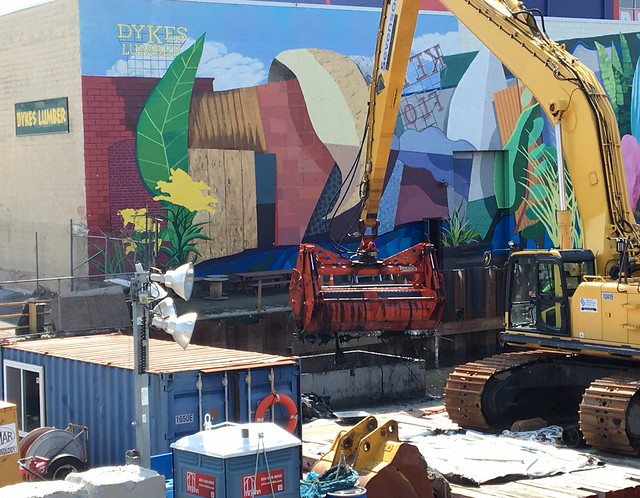
Facts and science are the only things that should matter when it comes to public health.  


Read more

Monday, January 11, 2021

A Reminder To All That We Need To Continue Fighting For The "Most Stringent, Future-Thinking Mitigation Measures" For Gowanus

It is hard to believe that 2021 is only a few days old, what with all the events of the past week. When the country seems out of control and many feel powerless, it may make sense to remind ourselves that we can still help bring about  significant change and a better outcome for our communities through old-fashioned  peaceful activism.  

In 2009 and 2010, I was a member of the largest coalition of South Brooklyn civic groups from both sides of the canal ever assembled to fight for the Environmental Protection Agency (EPA) placing the Gowanus Canal on its list of Superfunds.  
The common mission of all those in the coalition was to demonstrate that our community stood united and firmly behind the Superfund designation for the heavily polluted canal, because we had come to understand that only the Federal Government has the science, know-how and the best array of tools at their disposal to clean the canal to the highest level. Nothing else would do.

It was a hard fight.  Many may remember that then-Mayor Michael Bloomberg set in motion a shameless lobbying campaign to derail the Superfund designation. He was supported in his efforts by our then-Councilmember Bill de Blasio.
Their reasons for blocking the nomination became clear quite quickly: 
the EPA identified New York City as the second largest polluter of the Gowanus for allowing untreated sewage to discharge into the canal during heavy rain events. At the same time, Bloomberg and De Blasio were pushing a rezoning of the Gowanus area from manufacturing to mostly residential.
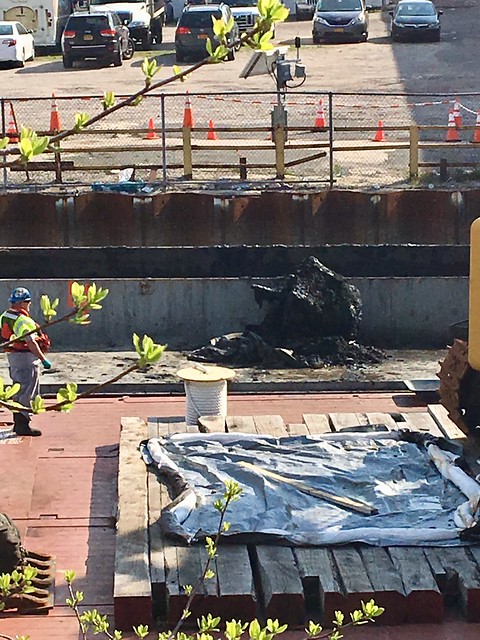
Developers, who had already speculated and secured their plot of land in Gowanus, were not happy about the EPA designation. They were lobbying our elected officials themselves and donated generously to deBlasio's  own Mayoral  Campaign.

Of course, the community and science prevailed and the EPA placed the Gowanus Canal on its list of most polluted sites in 2010.  Just this past November, the long awaited dredging of toxic material at the bottom of the waterway began. It was a proud moment for those who had fought so hard for it.

My friend and long-time Cobble Hill resident Roy Sloane, who represented the Cobble Hill Association in our coalition, recently reminded me of this important win for the community.
In his letter below, he encourages us all to continuing to advocate for the most thorough environmental clean-up and for the future of Gowanus.
Thank you for allowing me to share your words of caution with the community, Roy.
Hi Katia,

I wanted to write to congratulate you, all of the community associations and all of the individuals who were part of the coalition that fought to have the Gowanus Canal designated as a Superfund site. The start of the dredging that began on November 19th is the direct result of this community-initiated effort and truly marks the beginning of an exciting new era for the Gowanus Canal and it’s surrounding community. I am proud to have been a part of the grand alliance of civic organizations we assembled for the fight to clean up the Love Canal in our midst and want to thank all of the individuals and civic associations who helped make this incredible, positive transformation possible!

The clean-up of the Gowanus Canal should be added to the list of major citizen-initiated movements that have helped transform Brooklyn into one of the most exciting, vibrant urban communities in the world: the brownstone revival movement that took root here in the 50’s and 60’s, the citizen-led effort that led to the creation of Brooklyn Bridge Park and even the creation of the Brooklyn Heights Promenade. These all began as individual efforts and civic initiatives. The canal clean-up will rank high as one more example of the community-powered, community-led movements that have contributed so much to improving the quality of life in Brooklyn.

I do urge all to continue the fight to guarantee that all contaminants and toxic materials are safely removed and to insist on the most stringent, future-thinking mitigation measures be required to completely protect any future residents. For all of us, the battle was not to re-build or re-develop the Gowanus neighborhood, it was to protect all our current and future residents. Personally, I do also hope that a slower pace of development post-COVID might allow for the preservation and protection of more of the historic architectural and industrial character of the Gowanus.
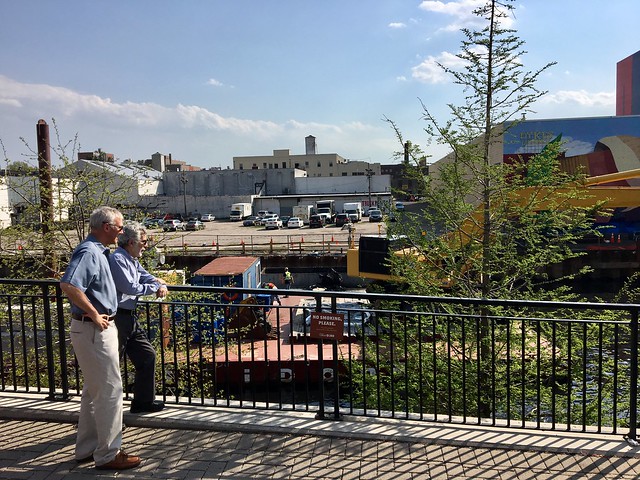
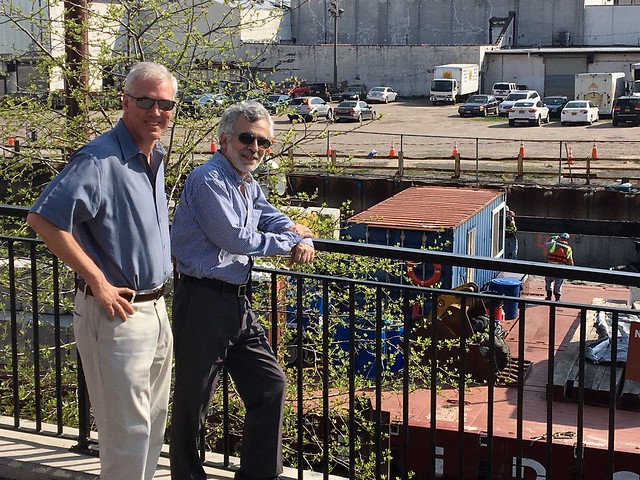
Again, thank you to the great coalition of organizations that united to fight for the Superfund designation just a few years ago — Friends And Residents Of Greater Gowanus , Carroll Gardens Coalition for Respectful Development , Carroll Gardens Neighborhood Association, Gowanus Houses, Cobble Hill Association and Riverkeeper and especially all the individuals who participated in the lobbying effort should take deep pride that this major milestone has been achieved: dredging has actually begun!

All the best, Roy Sloane

Roy Sloane, long time Cobble Hill resident and former Cobble Hill Association president


Read more

Friday, July 03, 2020

Large Amount Of Coal Tar And CSO Pollution Flowing Into The Already Remediated Gowanus Canal 4th Street Basin

IMG_1166
The Gowanus Canal's 4th Street Basin near Whole Foods earlier this year
Untitled
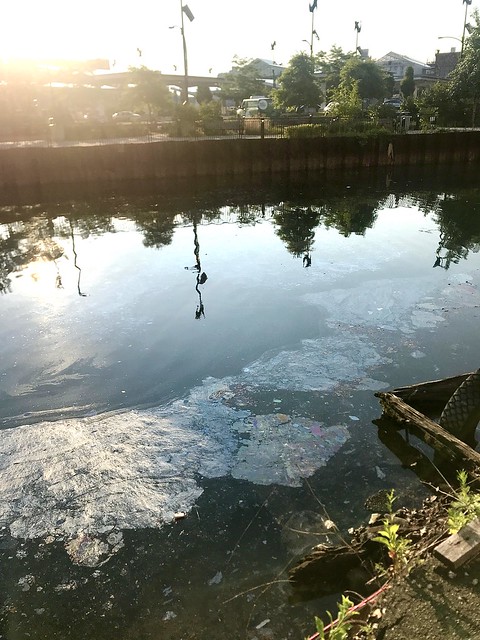
Coal Tar sheen clearly visible on the surface of the water at Gowanus' 4th Street Basin
Looking Towards Whole Food's parking lot
Untitled
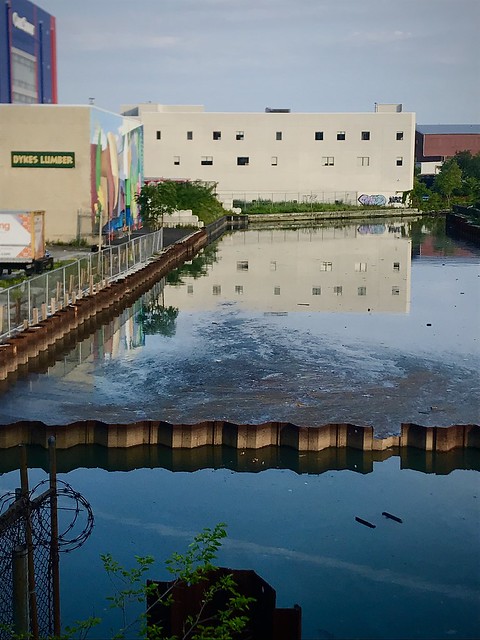
CSO and Coal tar visible from Third Avenue, looking at the 4th Street Basin
Untitled
Untitled
From Whole Food's Esplanade.
Untitled
Untitled
106666647_10111123739264227_6494654045970112114_n


The photos and videos above were taken early this morning in Gowanus.  They were taken byBrad Vogel of the Gowanus Dredgers and clearly show a large amount of Coal Tar and Combined Sewer Overflow at the Gowanus Canal's 4th Street Turning Basin near Whole Foods and 3rd Avenue.
The Environmental Protection Agency was immediately notified of today's condition.

The sight is heartbreaking. Why? Because the 4th Street Turning Basin was the first portion of the canal to be cleaned and capped as part of the EPA's Superfund remediation of the polluted canal.  The basin had been chosen for a  Dredging and Capping Pilot Study, the results of which informed and helped EPA fine-tune different techniques that will  be applied to the entire canal.
E.P.A.'s plans to begin the dredging of the main canal sometime in late 2020.

The pilot study was completed in late 2018 and represented a huge milestone. The work consisted of dredging the contaminated sediment at the bottom of the basin and capping it to prevent recontamination.  It was the first time in over 100 years that a section of the Gowanus was clean of debris and toxic 'black mayonnaise', the thick coal tar sediment at the bottom of the canal, which is a result of heavy industrial use in and around the Gowanus over centuries.

This is why the sight of new coal tar and CSO floating on this remediated section this morning is so upsetting. The pollution was flowing into the Basin from the main canal.  Perhaps Wednesday's heavy rains are to blame for the current conditions?

This illustrates the complexity of remediating such a polluted body of water . It also demonstrates  the fragility of the environment after decades of abuse.
Surely, the sight of little ducklings swimming around on the polluted water in Vogel's video above is just so sad.


Read more

Friday, May 18, 2018

'Not Gowanusy Enough' And "Save The Gowanus Station Building": Local Residents React To DEP's Proposed Gowanus Canal Combined Sewer Overflow Facility Design

Untitled
Untitled
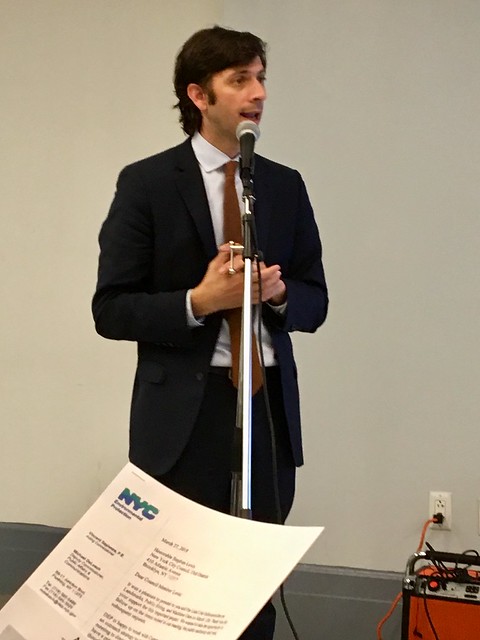
Council Member Stephen Levin, in whose district the facility will be built.
Untitled
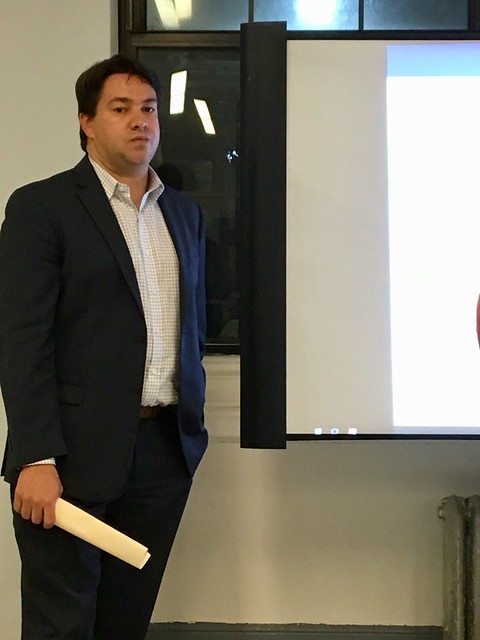
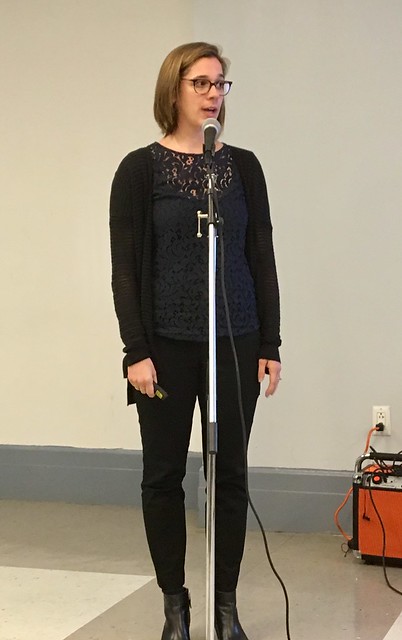
Michael DeLoach, DEP Deputy Commissioner of Public Affairs and Communications
Untitled
Alicia West, DEP Director of Public Design Outreach
Untitled
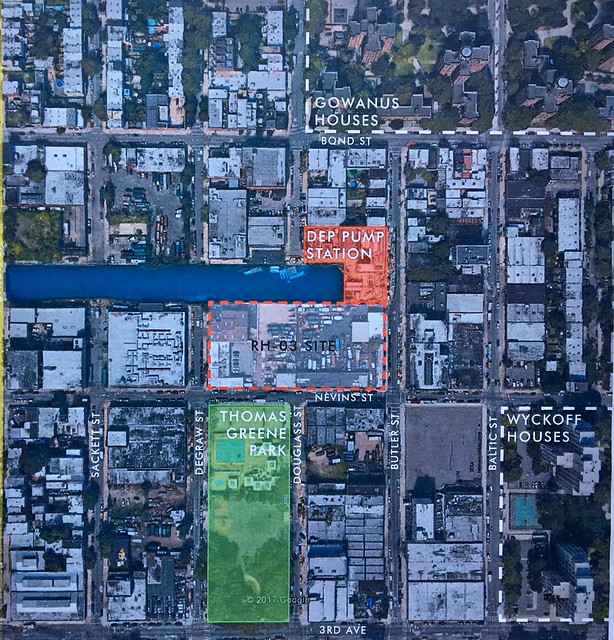
RH-03, the 2.4 acre site in Gowanus, where DEP is planning on building the facility.
Untitled
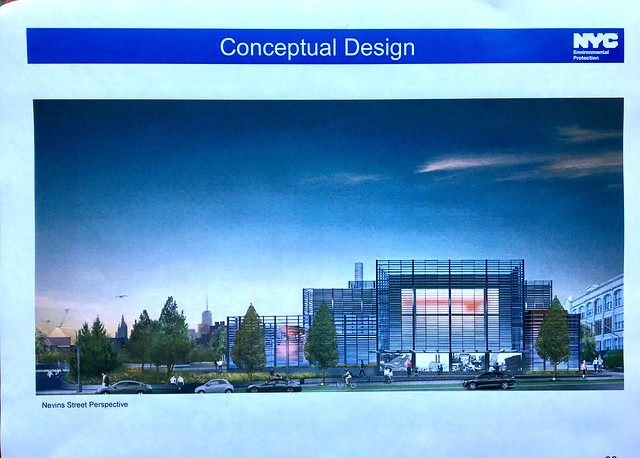
Conceptual Design for proposed Gowanus Canal CSO Facility at head of Canal
Conceptual design for the open public space planned over the retention tank.

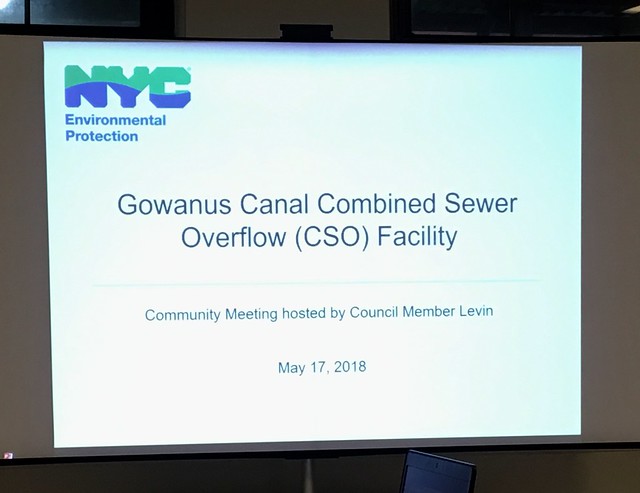
Last night, New York City Department of Environmental Protection and Council Member Stephen Levin held a joint public meeting to give the community a preview of the proposed design for the Gowanus Canal Combined Sewage Overflow facility at the head of the canal at Butler Street.

You may remember that D.E.P. is required by the U.S. Environmental Protection Agency to build an 8-million gallon sewage retention tank at the head-end of the Gowanus Canal to reduce the volume of untreated wastewater entering the waterway as part of the Superfund clean-up.

D.E.P. has taken the requirement for a simple tank to a whole new level by insisting that the C.S.O. tank will also need a massive head house. The building will hold screens, a de-gritter and odor control equipment, as well as an electric room, boiler and other mechanical spaces.

Because of D.E.P.'s insistence that the 8-million gallon CSO Facility be constructed on two privately owned properties at Butler Street between Nevins and DeGraw Street instead of using City-owned parkland across the street as E.P.A. had suggested, the price tag has mushroomed. D.E.P. has estimated the cost for land acquisition of the two lots at $90 million alone, with an additional $400 million for the construction of the facility.

At a City Council hearing in March 2018, Kevin Clarke of D.E.P. spoke of a combined cost of $1.2 billion for both the 8-million gallon tank and a 4-million gallon tank in the middle portion of the canal  that the City is also required to build.
(It is important to note that the E.P.A. had estimated the cost for both the 8-million gallon AND the smaller 4-million gallon Canal at $77 million for both.)

At last night's meeting Council Member Stephen Levin, in whose district the head-of-the-canal facility will be constructed, defended this large expenditure and this financial burden to New York City taxpayers.

"The cost for both of these tanks is likely to be over $1 billion, which is massive. It deserves a long conversation and a real discussion on why that is. I think when you see [DEP's] presentation tonight, you'll get a sense of the scale of this project and why it could possibly cost that much. I just want to say, as an overall perspective, capital projects in New York City always cost much more than we think that they should. Whether it is a park, or a school, or a massive infrastructure project like this one, it is always, always more expensive," he explained." So when that price tag comes up, don't be shocked."

The City also hired Selldorf Architects and DLandStudios, the landscape firm currently positioning itself to make the most of the upcoming Gowanus Canal corridor re-zoning with their Gowanus Canal Sponge Park Masterplan.

Alicia West, DEP Director of Public Design Outreach gave the public its first real look at the proposed design of the massive head house at the northern end of the 2.4 acre site, and the public accessible open space over the tank itself.
To camouflage much of the more unsightly air intakes and outflows  required for the head house Selldorf Architects is proposing a 'breathable cloak" made of terra cotta louvers, like a 'Venetian blind.'
The architectural goal, according to D.E.P. was to establish a 'thoughtful architectural design that respects the character and feel of the neighborhood", by employing "materials that are evocative" of Gowanus.

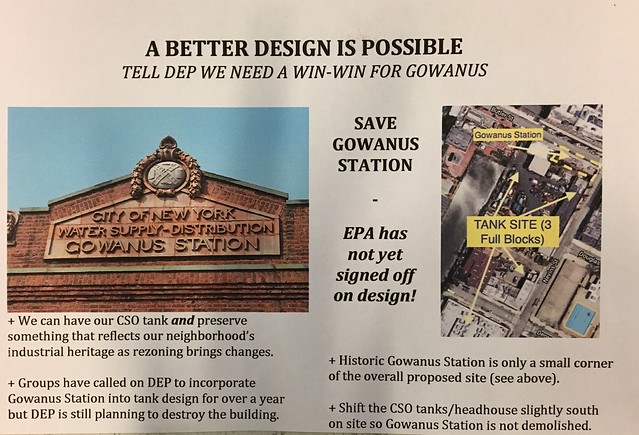
Michael DeLoach, DEP Deputy Commissioner of Public Affairs and Communications, left no doubt that his agency plans on demolishing the iconic and historic beaux-arts Gowanus Station building on the site, despite repeated calls from the community that is should be saved and incorporated into the overall facility. Instead, D.E.P. maintains that the building is in deplorable shape and can not be saved.
DeLoach explained that 'significant architectural elements' from the building will be saved and integrated on the site.

Most of the residents present seemed unconvinced that D.E.P. was really trying to save the building.
Gowanus resident Brad Vogel felt that D.E.P.'s design for the facility had "not started from a place where the Gowanus Station building would be preserved." He argued that saving 'tidbits' of the building was just not good enough and that pieces of a building, once stored in a warehouse, have a tendency to get lost.

The main goal for many who spoke up last night was to save the entire building, and to perhaps, use it as a community space.

As for the design of the head house and its Venetian-blind cladding, there was little enthusiasm.
People felt that is really did no truly reflect the neighborhood's character, as D.E.P. was claiming.
It was not "Gowanusy" enough, as one resident pointed out.

Suggestions for the 1.6 acres of proposed open space above the tank included a more active use, water access for boaters, indoor community spaces, and  covered areas for a makers market.
The community also urged D.E.P. to consider New York City's 2050 projections for sea level rise and to incorporate resiliency standards.

The most important aspect of all of this is that E.P.A. has yet to approve of D.E.P. 's engineering plans for the facility. It is also significant that E.P.A. will make the final determination whether the Gowanus Station will be saved or not.


Below is a flier handed out by a member of the community in regards to saving the Gowanus Station.
Untitled

Read more

Monday, May 07, 2018

It's Quite A Sight: The Dredging Of Toxic "Black Mayonnaise" At Gowanus Canal's 4th Street Turning Basin Now In Full Swing

Untitled
Untitled
Untitled
Untitled
Untitled
A big coal tar-covered object that was dredged out of the canal on Friday.
Untitled
Untitled
Brian Carr, EPA Region 2 lawyer , and Christos Tsiamis EPA Senior Project Manager for the Gowanus Superfund at the 4th Street Basin checking out the work being performed this past Friday.

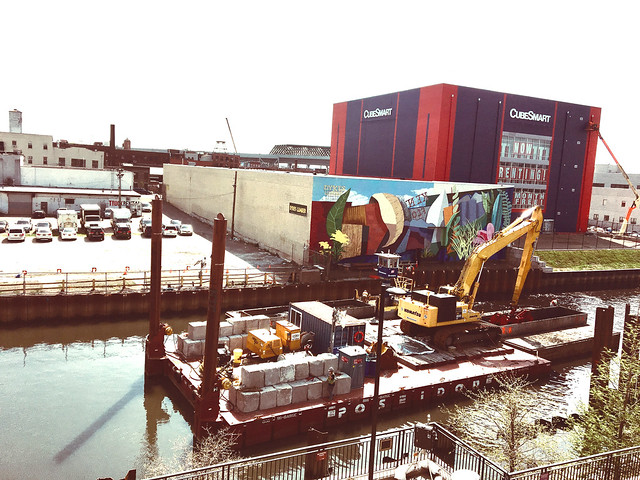
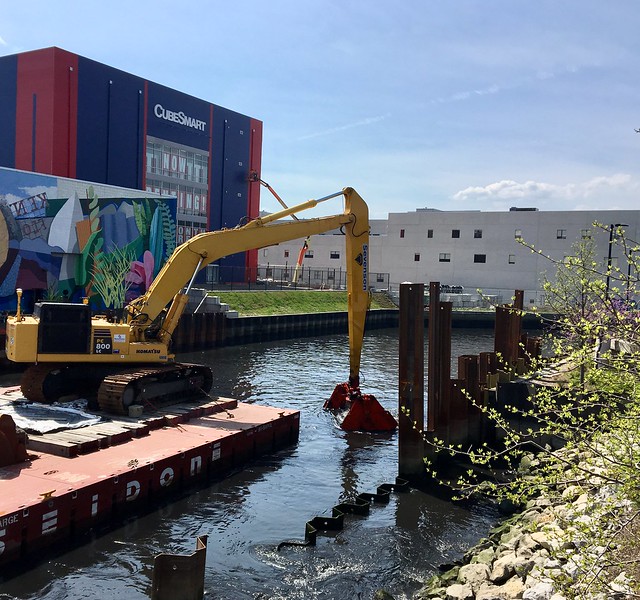
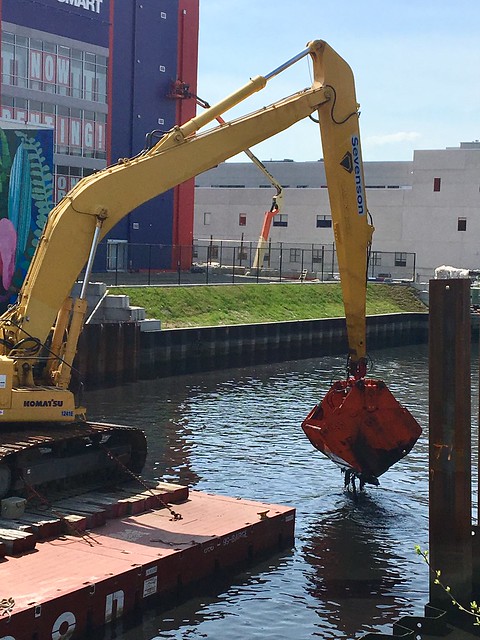
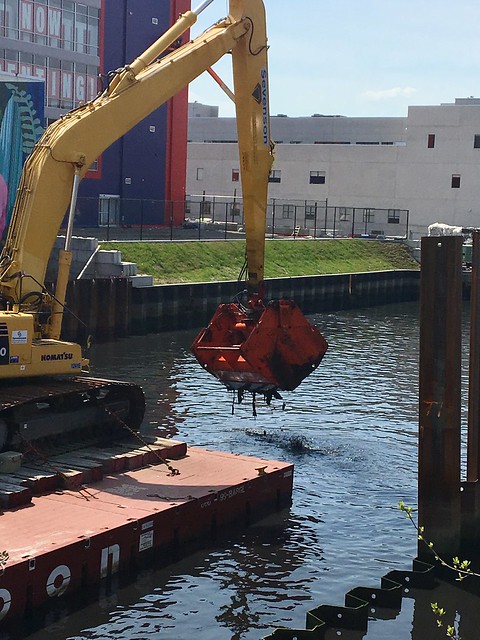
Something quite extraordinary is happening at the 4th Street Turning Basin of the Gowanus Canal. Currently, The Environmental Protection Agency's Dredging And Capping Pilot Study at the basin near Whole Foods is in full swing.
The work consists of dredging the contaminated sediment at the bottom of the basin and capping it to prevent recontamination. The results of this work will inform EPA and help fine-tune different techniques that will eventually be applied to the entire canal.

It is quite fascinating and satisfying to see the toxic 'black mayonnaise' being lifted out of the canal after so many decades.  The crew performing the work uses a G.P.S. system to map and to keep track of where dredging has been performed.  The material is placed into barges, then de-watered at a staging area at the Public Place site at Huntington Street,  before it is sent to a licensed disposal facility.

Though there were some initial delays due to problems associated with  the installation of bulkheads to provide structural support to the shore, the dredging and, subsequently, the capping work will now continue in full swing. The work is estimated to be completed by the end of the summer.  E.P.A.'s goal is still to begin the dredging of the main canal sometime in late 2020.

Christos Tsiamis, EPA Senior Project Manager for the Gowanus Superfund and  Brian Carr, EPA Region 2 lawyer, visited the worksite this past Friday and seemed pleased with the progress being made.


For Tsiamis and Carr, as well as for the community, the completion of the 4th Street Basin Pilot study in just a few months will represent a huge milestone. It means that for the first time in over a century, there will be a clean portion of the canal.  And that is something to celebrate.


Read more