Showing posts with label Bill De Blasio. Show all posts

Monday, March 29, 2021

National Grid's Own Documents Prove That Contaminants From Public Place In Gowanus Migrated Off-Site


Public Place, the large empty swath of land between Smith Street and the Gowanus Canal in Carroll Gardens, may be one of the most contaminated sites in New York State and there are grave concerns that it may never be fully cleaned up despite current remediation efforts.  How did Public Place get so contaminated?
This is the site of the former Citizens Gas Company's Manufacturing Gas Plant, one of three such MGPs that once operated along the Gowanus Canal.

The Citizens Gas Company began operations in the late 1860's and then passed into the ownership of Brooklyn Union Gas (BUG) in 1895, which demolished the plant in the 1960's, when the MGP ceased operation. In subsequent years, BUG was merged with Keyspan, which was then acquired by National Grid in 2007.

What has been left behind is poisoned land. Coal tar, a highly toxic and carcinogenic by-product of the gas manufacturing process, has been allowed to migrate freely throughout the site and into the Gowanus Canal.  On Public Place, the deepest tar observed extended to approximately 153 feet below the ground surface.

Finally, after decades of exposing local residents to this toxicity, three of the four parcels that made up the former MGP site are currently being remediated by National Grid under the supervision of New York State's Department Of Environmental Conservation (DEC) through the state's Brownfield program.

However, the remediation can hardly be called a clean-up. It would be more appropriate to call it a containment, since most of the coal tar will remain in the soil forever.
Just recently, the Carroll Gardens / Gowanus community learned that DEC had allowed National Grid to significantly alter and degrade the remediation, sparking concerns that future residents would be exposed to the remaining contamination.

A look at National Grid's online repository for the Citizen's Gas Site documents reveals exactly how dangerously contaminated the site is.
According to a Remediation Investigation Report from 2005 by environmental consultant firm GEI, "groundwater moving through the areas of tar-saturated soil and residual tar will dissolve the BTEX components and light molecular weight PAHs (e.g., naphthalene). The resultant groundwater plume will migrate in the direction of groundwater flow. "
The study also revealed that in some spots, soil vapor contained elevated levels of benzene, toluene, and xylenes.

The most concerning information, however, can be found in a document entitled 2005 Final Remedial Investigation for Public Place, which can also be found in National Grid's online repository.
The community has known for a while that coal tar from Public Place has migrated into the adjacent Gowanus Canal. Local residents therefore asked if the contamination could have found its way past the other three boundaries of the site.
If one studies the report carefully, the answer, alarmingly, seems to be "YES".

The 2005 report clearly shows that pockets of coal tar have oozed underneath Smith Street, Huntington Street, as well as 4th Street at Hoyt Street, where it was detected underneath a row of buildings.
Yet, neither National Grid, nor NYC DEC admitted this important fact to local residents, though they were asked at numerous occasions at public meetings.

Below, we will guide you through the documents from the 2005 Final Remedial Investigation to reveal that contamination from the former MGP site at Public Place is no longer confined to its boundaries.
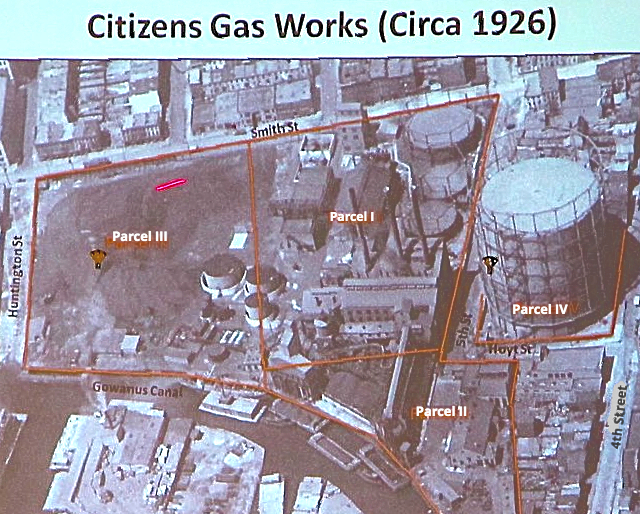
The four parcels that make up the former Citizens Gas Site
Arial view of the MGP site  in 1926, showing the various round gas holders. Parcel I with the three 
holders near Smith and 5th Street apparently holds the most pollution.
This diagram is from page 290 Of the 2005 GEI report
This particular map shows the survey of the site boundaries, as well as the cross sections (A-A' to G-G') along which soil borings were taken and ground water monitoring wells were installed by GEI. 
This is page 306 from the report. It shows the results of the soil samplings and ground water analysis from cross sections A-A'  and B-B'. The best way of visualizing this is by imaging cutting a straight line into a cake. The cut piece would reveal the different layers of the cake. In this instance, it shows the soils and contamination found in this cross section.
This speaks for itself, obviously, but notice that the dark blues indicate presence of coal tar.
Let us take a closer look at section B-B', which starts at Smith Street on Parcel I and ends at 6th Street on the other side of the Gowanus Canal.
Here is the level of pollution found deep in the ground on Parcel I along the B-B' section.
Corner of 5th Street and Smith Street, which according to cross section diagram,
 indicates a pocket of contaminated ground water.

This is where it gets interesting. This is the beginning of that B cross section of Parcel 1 at the corner of Smith Street and 5th Street, where the three gas holders that can be seen in the 1929 photo were once located.
If you look at the left hand side of the diagram, you will see a turquoise section in the 'shallow zone' that indicates that "coal tar staining, sheen and odors" were observed in the groundwater at this spot. The upper blue number in the little white box shows that at this spot, the groundwater concentration of BTEX, which refers to the chemicals benzene, toluene, ethylbenzene and xylene, is 13,300 μg/mL (parts per billion). The lower number indicates PHA (Polycyclic Aromatic Hydrocarbon) at concentration of 7670 parts per billion.)

NY State regulations state that BTEX should not exceed 5 parts per billion for drinking water but there are no limits for the PHA. While nobody will be drinking the groundwater containing these chemicals, there is continuing exposure through contact with the soil and breathing the air.

Now look up at the upper left hand side and notice that the contamination at this spot actually starts past the Public Place fence line. This diagram from the 2005 report indicates clearly that the groundwater barely 30 feet (NDA) below the surface has been heavily contaminated and actually extends onto Smith Street.
Now let us look at cross section I-I', which crosses Parcel 3 and Huntington Street, and ends across the Gowanus Canal towards 9th Street.
This is slide 310 of the GEI report from 2005.
Analysis of soil borings taken at this location also indicates the presence of coal tar staining, sheen and odors. The BTEX soil concentration here is 79 parts per million, the PHA concentration is 482 per million.
Once again, notice on the top part of this diagram, that the toxins have been found outside of Parcel 3, underneath Smith Street.
Approximate spot where evidence of coal tar was present on Smith Street on the I-I' cross section 
Mary Star Of The Sea Playground just steps away
The most interesting part of the report concerns cross section G-G', 
which starts on Parcel IV along 4th Street.

It is not currently being remediated by National Grid, though it is part of the former MGP site and is also contaminated. The parcel is occupied by a bus depot at the moment, and the community has been told it will be cleaned at a later time.
However, if you follow the G-G' cross section, you notice that there are actually pockets of toxic material right underneath the buildings between Hoyt Street and Bond Street.
Cross section G-G'. Slide 309 of the 2005 report.
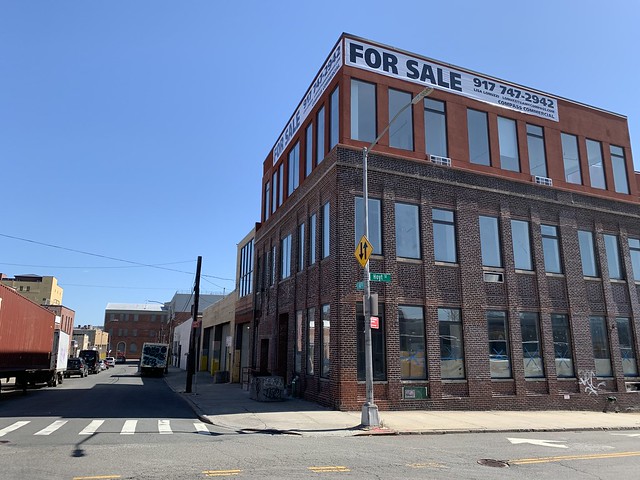
One can clearly see the pockets of contamination in the soil and ground water underneath those buildings, especially the brick building on 4th Street nearest to Bond Street.
Buildings on south side of 4th Street between Hoyt and Bond Street, which show 
evidence of contamination along the G-G' cross section

The 2005 Final Remedial Report for Public Place indicates widespread pockets of coal tar on all four parcels. The remedial work currently being done on Parcel I, II and III by National Grid under NYS DEC supervision only removes 2 feet of soil across those parcels, and only digs down to a maximum depth of 22 feet on Parcel 1, where the remaining subsurface structures of the former gas holders need to be removed anyway.
The report also shows that the contamination has migrated outside the boundaries of all four parcels.

It is important here to indicate that the beginning and the end of each cross section along which the soil and the ground water was tested, was strictly arbitrary. If, for example, line I-I' had extended further across Smith Street and testing had been done closer to Nelson Street, it may have shown contamination under St. Mary's Playground or, one shudders to think, under some of the homes, perhaps.

It may not have been in the interest of National Grid to find out if that is the case. However, as the lead agency overseeing the Public Place remediation, one wonders why NYS DEC did not insist on more testing, more mitigation and more barriers to prevent the contaminants from migrating outside of the site.. After all, the documents referred to above have been available since 2005.

Why is all of this so relevant?
The pollution at Public Place and the gasses they emit are dangerous to human health. Despite this knowledge, Mayor de Blasio and Councilmember Brad Lander envision Gowanus Green, a 29 story development project with 950 affordable housing units and a school on a section of Public Place that is City owned (Parcels 1 and 2). More housing is planned on the privately owned parcel 3.

As a community, we need to insist that independent testing along a wider radius of Public Place is performed. We must insure that the coal tar is not present under other adjacent buildings.
At the very least, we need to insist that no housing be built right on top of the source of the contamination on Public Place.


We are dealing with people's lives and cannot have National Grid nor NYS DEC take any shortcuts. This community has already been exposed to the harmful effects of this contamination for more than a century.
Let's organize and fight together to get the environmental clean-up we deserve and are entitled to by law.


Related reading:
National Grid's online repository for the Citizen's Gas Site documents.


Read more

Monday, March 01, 2021

False Claims And Questionable Oversight: Why NY State DEC Cannot Be Trusted To Supervise National Grid's Clean-Up At Public Place

Public Place, the almost 11 acre swath of land bordered by the canal and Smith Street and 5th Street and Huntington Street in Carroll Gardens has been mentioned frequently in the news of late and for good reasons.
Public Place may be one of the most polluted sites in New York State and there are grave concerns that it may never be fully cleaned up despite current remediation efforts.

Despite these circumstances, Mayor de Blasio and Councilmember Brad Lander envision Gowanus Green, a 29 story development project with 950 affordable housing  units and a school on a section of Public Place that is City owned (Parcels 1 and 2).  More housing is planned on the privately owned parcel 3.

Public Place site in Carroll Gardens

How did Public Place get so polluted? It is the site of the former Citizens Gas Company's Manufacturing Gas Plant,  one of three such MGPs that once operated along the Gowanus Canal.

The Citizens Gas Company began operations in the late 1860's and then passed into the ownership of Brooklyn Union Gas (BUG) in 1895, which demolished the plant in the 1960's, when the MGP ceased operation.  In subsequent years, BUG was merged with Keyspan, which was then acquired by National Grid in 2007.
An arial view of the Citizens Gas Work site in 1926

What is left behind 160 years later is poisoned land. Coal tar, a highly toxic and carcinogenic by-product of the gasification process, has been allowed to migrate freely through the site and into the Gowanus Canal.   On Public Place, the deepest tar observed extended to approximately 153 feet below the ground surface.

According to a Remediation Investigation Report from 2005 by environmental consultant firm GEI,  "groundwater moving through the areas of tar-saturated soil and residual tar will dissolve the BTEX components and light molecular weight PAHs (e.g., naphthalene). The resultant groundwater plume will migrate in the direction of groundwater flow. "
The study also revealed that in some spots, soil vapor contained elevated levels of benzene, toluene, and xylenes. 

Finally, after decades of exposing local residents to this toxicity, the site is currently being remediated by National Grid under the supervision of New York State's Department Of Environmental Conservation through the state's Brownfield program.
However, the remediation can hardly be called a clean-up. It would be more appropriate to call it a containment, since most of the coal tar will forever remain deep in the native soil.ƒ

Just recently, the Carroll Gardens/ Gowanus community learned that DEC had allowed National Grid to significantly alter and degrade the remediation, sparking concerns that future residents would be exposed to the remaining contamination.

At a December 2020, Gowanus Superfund Community Advisory Committee meeting, members addressed this issue and proposed a resolution asking the Environmental Protection Agency (EPA) to review and comment on DEC's changes to the remediation of Public Place. The resolution passed overwhelmingly.

Christos Tsiamis, EPA's project manager for the Gowanus Canal Superfund, was in attendance at the December meeting.  Tsiamis, who holds a master's degree in chemical engineering from Columbia University, is very familiar with the issues at Public Place, since coal tar from the site is a major source of pollution in the Gowanus Canal. 
The EPA is very protective of their Superfund clean-ups, so that any site, like Public Place, which has the potential of recontaminating the canal, is rigorously scrutinized.

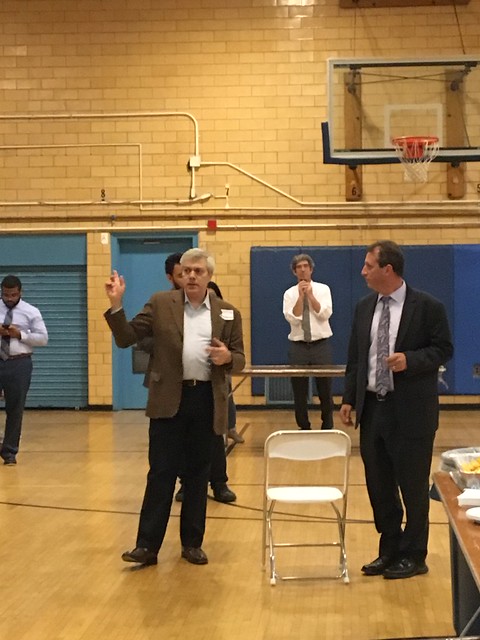
Christos Tsiamis, the EPA Senior Project Manager for the Gowanus Canal Superfund
(on right)

Since Tsiamis has been studying the contamination of the canal and the uplands since 2009,  he is in a unique position to compare the original mandated clean-up plan to the new downgraded one. 

He expressed concerns that the current DEC supervised remediation actions will not be sufficient. In particular, he mentioned three key aspects that were included in a 2007 design report, but subsequently eliminated when the plan was finalized in 2017-2018.

- the installation of a High Density, heavy plastic liner 2 feet below grade throughout the site as storm water management to prevent rain water absorption, which could dislodge the deeper, remaining pockets of coal tar.  

- two water treatment systems to clean the rainwater from the site so it can can be discharged back directly into the Gowanus Canal

-two 'wings' or wall extensions along 5th Street and Huntington Street to prevent coal tar from oozing out of the site onto nearby sites.

Though members of the Gowanus Superfund CAG appreciated and thanked Tsiamis for his honesty and for sharing his expertise, NYS DEC demanded a retraction from EPA.
Mere days after the CAG meeting, DEC director Michael J. Ryan called Tsiamis' comments "flippant, unsubstantiated statements" and "not only inappropriate but dangerous" in a letter sent to EPA

Ryan claimed that Tsiamis:
• Incorrectly stated that the 2007 remedy required an impermeable cover two feet below grade to prevent infiltration;
• Incorrectly stated that the 2007 remedy required two water treatment systems to treat rainwater;
• Incorrectly stated that the 2007 remedy required “wing walls” along 5th Street and Huntington Street to prevent coal tar migration.

Luckily, one does not have to look far to prove Tsiamis right and the DEC wrong.
A deep dive into National Grid's online documents repository and into PMFA's own reporting revealed these facts:

-In August 2011,  a National Grid team presented their remedial design for the MGP site to Community Board 6. The team stated:
“The proposed remediation calls for the removal of the top 8 feet of soil throughout the site, which will be backfilled with clean soil to street level.
"As part of storm water management and to prevent ground water from leaking into the canal, a High Density Polyethylene (HDPE) liner will be installed 2 feet below grade throughout.”
Portions of the meeting were videotaped by PMFA and can be seen here.

slide from a 2011 National Grid presentation to Community Board 6

-The need for water treatment systems was incorporated in a 2007 National Grid Final Remedial Design Work Plan, which NYS DEC signed off on as part of the 50 % Remedial Design Approval.
In-Situ Groundwater Treatment (Section 5.4.3)
Based on the results of the hydrologic model and the final subsurface containment barrier wall configuration, groundwater treatment may be required to address shallow dissolved phased contamination at the site boundaries. As described in Section 5.2.2 above, in the shallow zone, installation of a barrier wall could exacerbate the natural mounding that occurs between Parcels I and II. If the configuration of the barrier wall cannot be adjusted to mitigate these effects then the mounded groundwater will have to be allowed to migrate through or around the containment barrier via perforated sections or treatment windows. In the event that this is necessary, various groundwater treatment technologies will be evaluated and an applicable technology selected. The results of this evaluation will be presented to NYSDEC for review and approval. If bench scale or pilot testing of the groundwater treatment technology is necessary, then an additional work plan will be developed and submitted to NYSDEC for review and approval. 

Since the EPA had observed that coal tar had migrated off the site on Huntington Street, the 2007 plan did call for “Wing walls” along 5th Street and Huntington Street to prevent further migration.  The wings were still part of the plan in this July 2011 work plan document which National Grid submitted to DEC for review and approval to perform a remedial design pilot test program "to demonstrate the application and effectiveness of barrier wall technologies at the site."

As can be clearly seen in the red outline in Figure 1 included in the report, the barrier wall was designed to partially extend along 5th Street and halfway along Huntington Street. 

2011 National Grid document showing 'wing walls' along 5th Street and Huntington Street 
to prevent coal tar from migrating off site

When it comes to the environmental clean-up of our community after more than a century and a half of exposure to carcinogens, we need to make sure that it is done to the highest remediation standards we are entitled to by law.
It seems, by its actions and false claims, New York State intends to be more protective of National Grid, the polluter, than of the interests of local residents.
The State agency has not only allowed National Grid to reduce the level of remediation on Public Place, it has also covered up the fact that it helped remove some key aspects of the clean-up such as a vapor barrier and wing walls, specifically put in place to reduce the likelihood that coal tar will migrate out of the site.

NYS DEC is trying to rewrite its own documented history and is playing politics when it asks for Christos Tsiamis of EPA to retract his statements.  It is displaying contempt for public safety when it disparaged his concerns about the remediation.
Facts and science are the only things that should matter when it comes to public health.  


Read more

Wednesday, January 20, 2021

Voice Of Gowanus Had Another Win In Court Against The City In Regards To Gowanus Rezoning

All attention has been focused on Washington, DC these last few days, but here in Gowanus, there was big news.
As you might remember, the New York City Department Of City Planning was supposed to certify the massive 80 block Gowanus Rezoning yesterday. The certification would have started the 7 to 9 months-long Uniform Land Use Review process, which gives the community a way to voice their opinion on the rezoning.  Well, January 19th came and went without the certification.
As we reported late last week, attorneys for community coalition Voice of Gowanus (VOG) ​filed a legal suit​ against New York City’s Department of City Planning in State Supreme Court in Kings County this past Friday. The suit challenged the de Blasio Administration’s plan to use a so-called “virtual” land use review process for the proposed Gowanus rezoning.
On Friday afternoon, a judge imposed a temporary restraining order on the Gowanus Rezoning, which was a huge win for Voice of Gowanus.

By Monday morning, lawyers from the City's Legal team tried to overturn the court order, so that the rezoning could still be certified on January 19th.  They failed, and Voice of Gowanus won again.

The Temporary Restraining Order remains in place until a judicial hearing on January 27th, where the matter will be decided.

Voice of Gowanus is ready to keep fighting. BUT THE GROUP NEEDS YOUR HELP TO KEEP GOING! DONATE TODAY to our Gowanus Legal Defense Fund. No donation is too small to make a difference for our community.

Below is a brief statement by VoG:


January 19, 2021

VOICE OF GOWANUS WINS AGAIN

CITY FAILS IN COURT ATTEMPT TODAY TO OVERTURN ORDER 

GOWANUS REZONE CERTIFICATION: NOT HAPPENING

GOWANUS, BROOKLYN - The Gowanus rezoning will not be certified today. This development comes despite the de Blasio Administration’s last minute attempt today to overturn the temporary restraining order (TRO) that Voice of Gowanus (VOG) won in court on Friday. After arguments this morning by counsel for both VOG and the City, a justice of the Second Division Appellate Court denied the City’s application and let the TRO stand.

“This is HUGE,” said Nora Almeida of Voice of Gowanus. “We won the initial order and now we’ve beat back the City’s attempt to avoid a substantive response to our lawsuit. The Appellate Court has now affirmed that the equity, access, transparency, and rule of law issues at the heart of our legal action must have their day in court.”

The result of today’s court decision: the City may not proceed with certification of the Gowanus rezoning application or utilize virtual ULURP pending a NYS Supreme Court hearing scheduled for January 27, 2021.

“Today’s win in the Appellate Division is an important one for VOG and the community. It represents the second Court in four days to rule that the City’s ULURP application must be halted pending a hearing,” attorney Jason Zakai of Hiller, PC said. “It’s clear that the City must provide as much information, and allow for the maximum amount of public input and participation, as provided for in the City’s Charter and Rules.”

Today’s ruling against the City also drew words of solidarity from the Citywide People’s Land Use Alliance, a group of over sixty organizations from around New York City that are calling for an end to abuse of ULURP (Uniform Land-Use Review Procedure). The alliance was brought together by the de Blasio Administration’s aggressive and abusive approach to rezoning working class neighborhoods of color and industrial areas. Despite a constant parroting by developers and the city that these large-scale rezonings are really about creating affordable housing, the de Blasio Administration has failed New York on this issue. And in Gowanus, the vast majority of proposed new housing would be market rate luxury, with the one truly “affordable” housing complex located on a forever-toxic site contaminated by dangerous industrial pollution.

Alliance members issued this statement today:

“The Citywide People’s Land Use Alliance supports the legal action of Voice of Gowanus, which seeks to halt New York City’s “virtual” land use procedure (ULURP). The “virtual” version of ULURP limits civic participation, which is guaranteed by the City Charter. We need a true democracy in which all people—regardless of ability, class, race, economic power, or current housing status—have power to decide what will be built.”

Coordination with many members of the Alliance from across the city, including Chinatown Working Group, Protect Sunset Park, Flushing Anti-Displacement Alliance, Movement to Protect the People, and Inwood Legal Action, has proven that Gowanus is not alone in calling out the de Blasio Administration’s unjust and unsustainable approach to rezonings.

“This is a citywide issue because ULURP is a tilted playing field that simply does not work for communities,” said Elyse Schuk of Voice of Gowanus. “And now, in the middle of a global pandemic, the de Blasio Administration is trying to rush through a massive rezoning with a process that disenfranchises community voices. Enough is enough.”

Voice of Gowanus continues to fundraise vigorously to continue its legal efforts through the Gowanus Legal Defense Fund.


Read more

Monday, January 11, 2021

A Reminder To All That We Need To Continue Fighting For The "Most Stringent, Future-Thinking Mitigation Measures" For Gowanus

It is hard to believe that 2021 is only a few days old, what with all the events of the past week. When the country seems out of control and many feel powerless, it may make sense to remind ourselves that we can still help bring about  significant change and a better outcome for our communities through old-fashioned  peaceful activism.  

In 2009 and 2010, I was a member of the largest coalition of South Brooklyn civic groups from both sides of the canal ever assembled to fight for the Environmental Protection Agency (EPA) placing the Gowanus Canal on its list of Superfunds.  
The common mission of all those in the coalition was to demonstrate that our community stood united and firmly behind the Superfund designation for the heavily polluted canal, because we had come to understand that only the Federal Government has the science, know-how and the best array of tools at their disposal to clean the canal to the highest level. Nothing else would do.

It was a hard fight.  Many may remember that then-Mayor Michael Bloomberg set in motion a shameless lobbying campaign to derail the Superfund designation. He was supported in his efforts by our then-Councilmember Bill de Blasio.
Their reasons for blocking the nomination became clear quite quickly: 
the EPA identified New York City as the second largest polluter of the Gowanus for allowing untreated sewage to discharge into the canal during heavy rain events. At the same time, Bloomberg and De Blasio were pushing a rezoning of the Gowanus area from manufacturing to mostly residential.
Developers, who had already speculated and secured their plot of land in Gowanus, were not happy about the EPA designation. They were lobbying our elected officials themselves and donated generously to deBlasio's  own Mayoral  Campaign.

Of course, the community and science prevailed and the EPA placed the Gowanus Canal on its list of most polluted sites in 2010.  Just this past November, the long awaited dredging of toxic material at the bottom of the waterway began. It was a proud moment for those who had fought so hard for it.

My friend and long-time Cobble Hill resident Roy Sloane, who represented the Cobble Hill Association in our coalition, recently reminded me of this important win for the community.
In his letter below, he encourages us all to continuing to advocate for the most thorough environmental clean-up and for the future of Gowanus.
Thank you for allowing me to share your words of caution with the community, Roy.
Hi Katia,

I wanted to write to congratulate you, all of the community associations and all of the individuals who were part of the coalition that fought to have the Gowanus Canal designated as a Superfund site. The start of the dredging that began on November 19th is the direct result of this community-initiated effort and truly marks the beginning of an exciting new era for the Gowanus Canal and it’s surrounding community. I am proud to have been a part of the grand alliance of civic organizations we assembled for the fight to clean up the Love Canal in our midst and want to thank all of the individuals and civic associations who helped make this incredible, positive transformation possible!

The clean-up of the Gowanus Canal should be added to the list of major citizen-initiated movements that have helped transform Brooklyn into one of the most exciting, vibrant urban communities in the world: the brownstone revival movement that took root here in the 50’s and 60’s, the citizen-led effort that led to the creation of Brooklyn Bridge Park and even the creation of the Brooklyn Heights Promenade. These all began as individual efforts and civic initiatives. The canal clean-up will rank high as one more example of the community-powered, community-led movements that have contributed so much to improving the quality of life in Brooklyn.

I do urge all to continue the fight to guarantee that all contaminants and toxic materials are safely removed and to insist on the most stringent, future-thinking mitigation measures be required to completely protect any future residents. For all of us, the battle was not to re-build or re-develop the Gowanus neighborhood, it was to protect all our current and future residents. Personally, I do also hope that a slower pace of development post-COVID might allow for the preservation and protection of more of the historic architectural and industrial character of the Gowanus.
Again, thank you to the great coalition of organizations that united to fight for the Superfund designation just a few years ago — Friends And Residents Of Greater Gowanus , Carroll Gardens Coalition for Respectful Development , Carroll Gardens Neighborhood Association, Gowanus Houses, Cobble Hill Association and Riverkeeper and especially all the individuals who participated in the lobbying effort should take deep pride that this major milestone has been achieved: dredging has actually begun!

All the best, Roy Sloane

Roy Sloane, long time Cobble Hill resident and former Cobble Hill Association president


Read more

Tuesday, August 11, 2020

Yet Again, NYC DEP Wants To Delay Construction Of Two Crucial CSO Retention Tanks For The Gowanus Canal

Untitled
The head of the Gowanus Canal
Untitled
The Salt lot at 2nd Avenuel
The famous "poo-nami' video showing CSO event on Gowanus Canal

Despite a pandemic, despite an exodus out of New York City, Mayor Bill de Blasio and Councilmember Brad Lander are both still pushing for the rezoning of the Gowanus neighborhood from mostly manufacturing to residential.  It is by far the largest proposed New York City upzoning of the de Blasio administration despite the fact that the area still faces serious and dangerous environmental challenges
First, the Gowanus Canal, which runs through the area, was declared  an EPA Superfund site and has not been remediated yet.  Secondly, much of the land in Gowanus is in a FEMA Flood Zone A. Thirdly, there are three former Manufactured Gas Plant  (MGP) sites along the canal's shores that are now and will forever be laden with liquid coal tar at depths of 100 to 150 feet. And fourthly, NYC continues to use the canal as an open sewer, allowing Combined Sewer Overflow to enter the waterway during heavy rain events. That is a clear violation against the Federal Clean Water Act.

It is expected that the Department of City Planning will certify the proposed rezoning, which will trigger the Uniform Land Use Review Process (ULURP) very soon.

But....what about the pollution, you may ask? Well...
Just yesterday, PMFA wrote about the fact that shortcuts were being taken on the most polluted MGP site in Gowanus where our Councilman is envisioning 900 units of housing.

In addition, residents learned at the July 28th EPA Community Advisory Group meeting that the City of New York is yet again trying to delay the construction of two CSO control facilities meant to reduce the volume of untreated wastewater entering the Gowanus Canal.

Here is some background. As part of the EPA Superfund clean-up, the Federal Agency has ordered the City to build two retention tanks, one 8 million gallon tank at the head of the canal at Butler and Nevins Streets, and a 4 million gallon tank at the Salt Lot at 2nd Avenue, located in the middle section of the canal.

In the past few years, the NYC Department of Environmental Protection has managed to delay the construction of the tanks by several years by insisting on siting the tanks on land seized by eminent domain and by over-designing the tank facilities. The Agency also managed to more than double the construction cost. In  2018, D.E.P.'s Kevin Clarke testified that the cost for the entire 'program' that includes both tanks is estimated to reach $1.2 Billion. E.P.A. had estimated the cost at $500 million.

So, imagine the community's surprise when it heard that DEP's Commissioner Vincent Sapienza had reached out to EPA Region 2's Administrator Peter Lopez, asking for additional time due to the financial challenges the City is currently facing because of the Covid-19 pandemic.
Sapienza asked for a one year delay for the completion of the larger tank and an 18 months delay for for the smaller one.

Keep in mind that the tanks are only addressing current CSO discharges and that 0EPA expects a significant increase in CSOs into the canal as part of the area rezoning, this is bad news for current and future residents.

The news prompted Voice Of Gowanus, a coalition of civic organizations and local residents to reach out to Administrator Lopez with the following letter on August 7th:

Gowanus Canal Superfund Required Sewage Detention Tanks 
Vs. DEP Delay Request

Dear Regional Administrator Lopez,

During the recent July Gowanus CAG meeting, the community was made aware that NYC DEP has requested a substantial delay in carrying out its obligations in the EPA Superfund cleanup for the canal, which includes one sewage detention tank at the head the canal and a smaller one on the city’s 2nd Avenue Salt Lot. We have been told that the DEP cites a large coronavirus-related revenue shortfall as a reason to push back this Superfund construction work a year for the larger tank, and a year and a half for the smaller tank.

As a local Gowanus coalition of civic associations and residents, we are reaching out to you with our concerns now, given that the EPA CAG will not be meeting again till late September and we understand this is a very time-sensitive matter.

As members of the Gowanus community many of us are aware of previous times when the DEP had fully funded Gowanus infrastructure work (the 2004 Flushing Tunnel Project) only to have DEP pull the funding for years and delay Gowanus for new infrastructure projects elsewhere.

We have good reason to be concerned with this current excuse for delay especially given that the EPA has already allowed several delays on this DEP work. And that this work will now no longer be completed by the time the dredging work is finished. Further, there was an understanding in the community that funding for Gowanus CSO tanks has been in place. In March 2016, Councilman Lander TWEETED proudly that he was glad to see $510m in the updated capital plan for Gowanus CSO retention tanks.

From Councilman Brad Lander's Twitter account, March 2016

The Gowanus community prefers that you DO NOT allow the NYC DEP to delay its portion of the Superfund cleanup any further. If you are inclined to negotiate any delay, we ask that you only agree to delay the work of one tank's construction, not both, and make approval contingent upon NYCDEP agreeing to prioritize design and construction of both retention tank projects over all other new DEP infrastructure projects. We would feel deeply wronged in Gowanus if the EPA granted the requested delays to the DEP only to have the DEP fund new infrastructure works at the expense of finishing the Gowanus tank projects.

As you know, hundreds of millions of gallons of raw sewage discharging regularly into our waterway continues to be a major environmental and health concern. The problem is about to become even more acute as the City appears poised to certify the massive rezoning of the Gowanus corridor.

Our community needs a hero. Please be ours.

Respectfully,
Voice of Gowanus


If you would like to send your own email to Administrator Lopez in support of Voice Of Gowanus, click on the link below. It will open a new page with the email address and letter. So easy.
Click to Write Your Own Email To Administrator Lopez

Read more

Wednesday, August 05, 2020

Voice Of Gowanus: NYC's 'Virtual' Hearings For The Proposed Neighborhood Rezoning Will Deprive Community Of Due Process Rights And Violate City Charter Requirements For ULURP

Voice Of Gowanus, a coalition of Gowanus-area residents and  civic associations, just sent a letter to New York City Planning Commission Chair Marisa Lago regarding the proposed Gowanus rezoning.

The group has been very vocal about its concerns relating to the rezoning, the largest undertaken by the De Blasio administration so far. 

To become law, the rezoning needs to go through a months-long public Uniform Land Use Review Procedure, a process mandated by the New York City Charter.  The charter requires public hearings at several stages of the ULURP process be held in places of public assembly in a physical location. 

VoG wants to make absolutely sure that Gowanus residents will have the same opportunity as all other New York City neighborhoods that have been rezoned. In the letter to Lago, the group points out that an attempt by the city to proceed with "virtual" public hearings for the proposed Gowanus rezoning while it is not possible to hold safe, large-scale, in-person public hearings will violate the city charter's requirements for ULURP.

From VoG:
"Now is not the time to proceed with an illegitimate and diluted land use review process for a major rezoning that would dramatically impact our neighborhood.  Community members are entitled by law to a process that protects their rights to hold public officials accountable in the same room - and in the same manner as other neighborhoods that have previously faced rezonings."

Below is the letter sent by the group to Marisa Lago yesterday.


August 4, 2020

Chair Marisa Lago City Planning Commission New York City

Dear Chair Marisa Lago:

Many in our Brooklyn community are concerned that the city’s land use process is set to re-open without adequate consideration of existing land use law. Together our group of concerned independent community members calls upon the Department of City Planning and the City Planning Commission to cease any further consideration of the proposed Gowanus rezoning-and any other New York City-led neighborhood rezonings-until conditions permit holding safe, large-scale, in-person public hearings. This pause must include holding off on certifying any City-led neighborhood rezoning.

Any further actions undertaken by the Department of City Planning and the City Planning Commission to certify the proposed Gowanus rezoning this month that would lead to so-called “virtual” Uniform Land Use Review Procedure (ULURP) public hearings starting in September—a civic process that has never before been carried out “virtually” in any previous New York City-led neighborhood rezoning—would constitute a violation of ULURP.

“Virtual” ULURP hearings would not be uniform in light of what the law requires. The city charter provision regarding ULURP procedures requires that public hearings for ULURP at the community board level occur in a physical location (as does the provision about borough president hearings during ULURP):

“A community board public hearing shall be held at a convenient place of public assembly chosen by the board and located within its community district. If in the community board's judgment there is no suitable and convenient place within the community district, the hearing shall be held at a centrally located place of public assembly within the borough.”

Given the in-person civic process other communities have been afforded to date when facing neighborhood rezonings, “virtual” ULURP hearings would unfairly undercut the procedural rights of community members in greater Gowanus and any other neighborhood facing a rezoning, and would prevent them from holding their elected and appointed officials accountable.

The virtual hearings and practices recently rushed into use by other City agencies indicate that, especially in the context of ULURP for an entire neighborhood, attendees’ collective power would be severely diluted through the use of an online platform. Equitable access to technological devices and high-speed internet is simply presumed by the City but a resourced plan has not been offered or executed to ensure access for all community members. Structurally diluting a community’s ability to hold power accountable during the current Covid-19 crisis, when the future of our entire neighborhood and its interconnected communities is at stake, is unacceptable. It does not conform to the letter or the spirit of what ULURP requires; even if more individuals could theoretically participate in “virtual” hearings, community power to confront politicians collectively in a room is blunted by an internet-only process. We urge you in the strongest possible terms to abandon plans for this illegitimate and illegal “virtual” ULURP process that will effectively deprive our community members of their due process rights.

Please also find enclosed an Op-Ed co-authored by State Assemblymember Jo Anne Simon published in yesterday’s edition of City Limits that details further the widespread community concerns regarding “virtual” ULURP hearings and any certification that would lead to such hearings.

Resolutely,
Voice of Gowanus


Opinion: Fairness Requires that NYC Pause the Gowanus Rezoning


Read more

Wednesday, July 29, 2020

Voice Of Gowanus: Let's Require a Racial Impact Study BEFORE the Proposed Gowanus Rezoning

Untitled
Untitled
Untitled
Despite a pandemic, despite the fact that the economic reality for New York City looks grim, and despite the fact that residential and retail vacancy rates were increasing BEFORE the Covid-19 outbreak, Mayor Bill de Blasio and Council members Stephen Levin and Brad Lander seem intent on pushing through the proposed rezoning of  the Gowanus neighborhood.  

Let's be clear: by doing so, they are fulfilling a promise made to developers and their donors more than a decade ago. It is definitely more about greed and  less about  improving the lives of current residents who will have to live with the consequences of the largest  up-zoning undertaken by the City under de Blasio, with 8,000 new apartment units and an estimated 20,000 new residents. All these people will be living near an EPA Superfund site, in a FEMA flood zone A.

It seems likely that the Uniform Land Use Review Procedure (ULURP) needed for the rezoning will start soon.  And if it does, there is not much the community can do to try to influence its outcome or to moderate its impact on the neighborhood. As other rezonings have shown, it is already a done deal.

One way WE CAN ALL GET INVOLVED is by joining Voice Of Gowanus in asking for a RACIAL IMPACT STUDY NOW ahead of the rezoning to make sure that ALL current residents are protected from this massive land grab.

Please join Voice Of Gowanus by signing on to the statement below.

Ensuring Diversity and Preventing Displacement in Gowanus: 
Let's Require a Racial Impact Study Before the Proposed Gowanus Rezoning

The events of the first half of 2020 have made it clear that racial justice must be a prominent factor in all decisions that affect the future of New York City. From the horrific effects of the pandemic on low income and BIPOC communities to the Black Lives Matter protests, it is clear that inclusion, justice, and diversity are fundamental concerns to all New Yorkers.


Public Advocate Jumaane Williams' legislation 1572-2019 is a visionary resolution that calls for a mandated racial impact study to be undertaken for any land-use actions that require an Environmental Impact Study (EIS). We, the undersigned, are concerned about the impacts of the proposed Gowanus rezoning and support this legislation. We call for the study envisioned in this legislation to be applied prior to any decision being made on the Gowanus rezoning.


Introduced in May 2019, PA Williams' legislation would require that “all draft and final environmental impact statements prepared in connection with applications subject to review by the City Planning Commission, shall include an analysis of potential direct and indirect racial and ethnic residential impacts of the proposed action and whether the proposed action would affirmatively further fair housing within the meaning of the Fair Housing Act.”


While it has not yet passed, this legislation is co-sponsored by Councilmembers Brad Lander and Stephen Levin, whose own districts will be the most significantly impacted by the planned Gowanus rezone. We agree with their assessment of the necessity of this legislation, and call on them to have an independent body perform a Racial Impact Study to understand the effect of this enormous rezoning plan on the neighborhood’s current and future diversity.


The Gowanus rezoning, which will be the largest rezoning undertaken under the de Blasio administration, is the perfect opportunity to show the value and importance of such a study to ensure that social justice—racial, environmental, and economic—is at the center of NYC’s development.


Let us envision greater Gowanus as a truly diverse New York City neighborhood where generations to come can thrive.


We ask Public Advocate Williams and Councilmembers Lander and Levin to ensure that the Department of City Planning conducts a racial impact study prior to the certification of the proposed Gowanus rezoning.


SIGNED BY:

Churches United for Fair Housing (CUFFH)
Gowanus For Life
Save Gowanus
Voice of Gowanus
BCStudio
Friends and Residents of Greater Gowanus
Carroll Gardens Neighbors
Open Source Gallery
KoKo NY
Justice for All Coalition
Extinction Rebellion
The Coalition to Stop Sunnyside Yards
Tom Angotti, Professor Emeritus at Hunter College’s Urban Policy and Planning Center
Artist Studio Affordability Project
Housing Justice NYC
Carroll Gardens Coalition for Respectful Development
Western Queens Community Land Trust 

Gowanuslands.org 
Victoria Cambranes for NYC Council 33 
RETI  (Resilience, Education, Training and Innovation) Center

Please add your own voice to this very important ask for our community. Follow the link below and send a letter to our elected officials.
CLICK HERE:

I promise it will only take a minute. 

Read more

Monday, December 04, 2017

As The World Turns In Gowanus: A Tale Of Eminent Domain, Development Pressure, Environmental Challenges, And The Risk Of Losing A Neighborhood's Uniqueness

IMG_0986
IMG_0988
Nothing is simple in Gowanus. This small neighborhood wedged between Park Slope, Boerum Hill and Carroll Gardens has the ominous distinction of being home to an 1.8 mile man-made canal that is one of the most polluted sites in the United States, which landed it on the Federal Environmental Protection Agency's Superfund list in 2010.  Besides being polluted, New York City has been allowing raw sewage to spill into the waterway during heavy downpours for decades and continues to do so.
IMG_7706
Raw sewage floating on the Gowanus Canal

Then there is the fact that most of Gowanus has been declared a Flood Zone 'A' by the  Federal Emergency Management Agency, which means mandatory evacuation during hurricanes.  But no superstorms are needed for floods, as flooding occurs on a regular basis even during moderate downpours.
3rd Street Bridge in Gowanus after heavy rain
6090312118_33bcd2f4a7_o
Flooding is a reality for many Gowanus residents.

Lastly, Gowanus has been targeted for development. A real estate frenzy has been unleashed by Mayor deBlasio and Councilmen Lander and Levin, when they began pushing to rezone the area from mostly manufacturing to mixed-use, which would allow more residential developments similar to the recently completed Lightstone Group rental towers along the canal. This resulted in speculative investments by developers such as Jared Kushner, President Trump's son-in-law and others.  In anticipation of the rezoning, manufacturing lots in the area have significantly increased in value, which has forced many manufacturing tenants out of the area.
Lightstone Group's 700-unit high rise rental along the Gowanus Canal

This perfect storm has pitted not-for-profit organizations, which have taken money from developers and our elected officials and these same elected officials who envision a shiny new Gowanus neighborhood against true civic associations, and neighbors who want to hold on to at least part of its history and uniqueness.

As of right now, The EPA Superfund Clean-Up of the toxic Canal seems to be on track.  A dredging and capping pilot study is about to begin in the 4th Street basin. The result will enable the EPA to finalize the design for the environmental clean-up of the entire waterway. The actual clean-up is slated to start in 2020 at the head of the Canal.

The re-zoning of Gowanus has picked up momentum.  From 2013 to 2015, Councilmen Lander held "Bridging Gowanus," a series of curated community planning meetings to help "shape a sustainable, livable, and inclusive future for the Gowanus neighborhood." At one of the planning meetings, the public was given a highly slanted exercise to "weigh the hard choices of density and development."
Predictably, the resulting report claimed that "nearly three-quarters of the participants who chose this scenario expressed openness to buildings of more than 10 stories (with a distribution of opinion spread about equally from 8 to 18 stories)."
How very convenient for developers.
15607330045_2923aebe24_z
Councilman Brad Lander at one of the Bridging Gowanus meetings, 
promising an 'inclusive and transparent process"

By late 2016, the NYC Department of City Planning launched the Gowanus Neighborhood Planning Study to develop a planning and land-use framework for the Gowanus neighborhood. Here again, local residents were asked to participate through a series of workshops. Though many in the community clearly asked City Planning to consider establishing "managed retreat from the Gowanus flood zone", the recommendation never made it into the final presentation given by the Department of City Planning in October 2017.
The reason? According to DCP:
"This interest was not mutually shared among working group members. It conflicts with core objectives established within the Gowanus Study process, including promoting investment in the creation of commercial and arts uses, housing and continued industrial use on canal-side properties."
Currently, DCP is working on a Gowanus rezoning pan, which they will present to the community in  early 2018.
No doubt, new zoning will allow for lots of 18 story high-rises along the canal in a flood zone.

New York City Department Of City Planning Gowanus Neighborhood Study
Untitled
City Planning's Winston Von Engel with Brad Lander at a 
Gowanus Neighborhood meeting, October 2017

By far the most contentious issue in Gowanus right now is the placement of the larger of two Combined Sewer Overflow (CSO) and storm water retention tanks.

As part of the Gowanus Canal Superfund Record of Decision, a legally binding blueprint for the environmental clean-up of the canal, EPA has mandated that New York City construct an eight million gallon tank in the upper portion of the canal, and a four million gallon tank in the middle of the canal as a control measure meant to significantly reduce overall contaminated solid discharges to the waterway during heavy rain events.
Looking at 234 Butler Street and 242 Nevins Street from the Gowanus Canal Side
IMG_1725
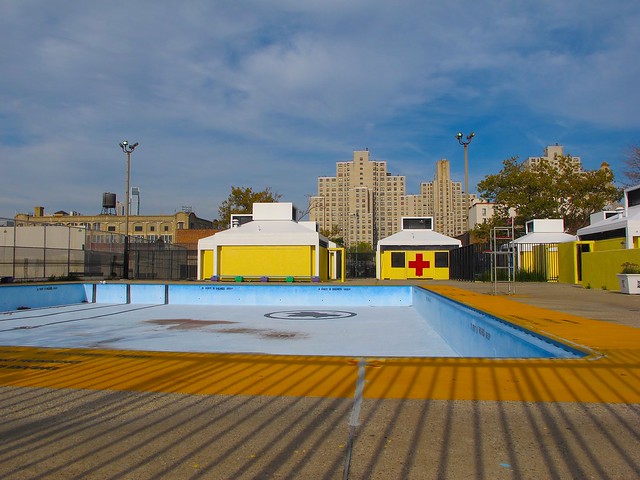
Double D Pool at Thomas Greene Park

EPA Region 2 suggested placing the 8-million gallon tank underneath the Double D pool at Thomas Greene Park near Nevins Street. The Agency reasoned that the pool needs to be removed anyway because it sits on the former  Fulton Municipal Manufactured Gas Plant which needs to be remediated. Also, the parkland is already owned by the City, which would save the acquisition cost.

The NYC Department of Environmental Protection on the other hand, prefers to site the 8-million gallon tank on three privately-owned sites along the canal, adjacent to the park. In early 2016, an Administrative Settlement Agreement between EPA and New York City grants the City the opportunity to locate the tank on its preferred 'canal side' location. However, the order comes with a strict timeline which requires that the City must acquire the three sites by 2020. EPA will force the City to pivot to the Thomas Greene site if this deadline is not met.

To avoid delays if this should occur, EPA is requiring DEP to prepare parallel tank and head house designs for both sites.

The City's plan relies on the taking of two privately owned sites, 234 Butler Street and 242 Nevins Street, by eminent domain if necessary. A third site, 270 Nevins Street will also be seized and then leased by the City for staging purposes. The taking by eminent domain will displace a fair number of businesses, including Eastern Effects Studios, where the popular "The Americans" television show is filmed. it will also displace Spoke The Hub, a popular not-for-profit, which has had a presence in Gowanus for decades.

In DEP's Capital Plan for 2016 to 2019, $510 million was added "to secure land, design two CSO tanks and construct one of the two planned CSO tanks adjacent to the Gowanus Canal." That sum rivals the estimated amount for the entire Superfund clean-up of the canal and buys the community only ONE tank.

Obviously, inflating the cost of the 8-million gallon tank at the top of the canal through needless land acquisition doesn't concern Councilman Brad Lander, who tweeted that he was "very glad to have secured the $510 million in the DEP updated capital plan."
From Councilman Brad Lander's Twitter account, March 2016

Currently, an application submitted by New York City Department of Environmental Protection (DEP) and the New York City Department of Citywide Administrative Services (DCAS) for the acquisition of these three privately-owned parcels needed for the Gowanus CSO Facility is currently moving through the Uniform Land Use Review Procedure (ULURP) process.
Community Board 6 as already held a public hearing and voted to support the eminent domain action. The next step is to get approval from Brooklyn Borough President Eric Adams. A public hearing was held at Brooklyn Borough Hall on November 27th. Adams will make a determination soon.

If the ULURP process goes according to the De Blasio administration, the city may have to fork over at least $70 million dollars for 242 Nevins Street and 234 Butler Street, according to a recent Crain's article.
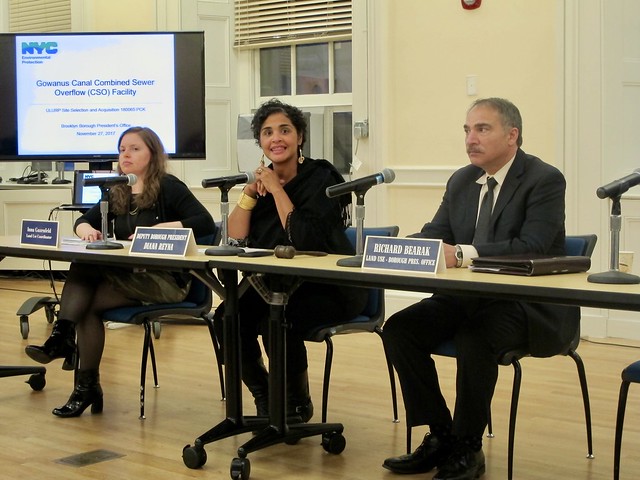
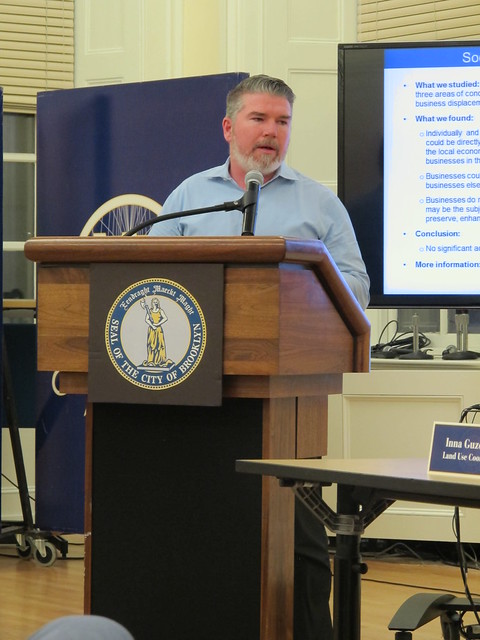
Inna Guzenfeld, Diana Reyna and Richard Bearak of the Brooklyn Borough President's office
during ULURP hearing on eminent domain action for
Combined Sewer Overflow Tank and Facility.
IMG_1406
Kevin Clarke of NYC DEP at ULURP hearing at Brooklyn Borough Hall
IMG_1399
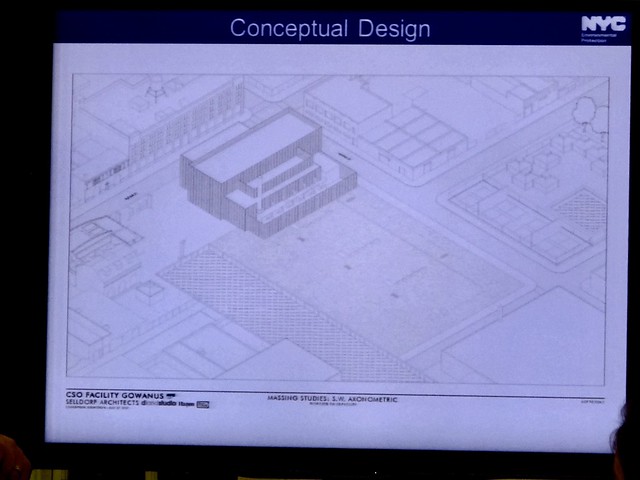
DEP's conceptual design for retention tank head house at
234 Butler Street and 242 Nevins Street

At the Brooklyn Borough President's hearing, Kevin Clarke of NYC's DEP stated that the City hopes to purchase the land as a "willing seller, willing buyer" transaction and said that the City had made the owners an offer.

"Not so," said Salvatore Tagliavia, the owner of 234 Butler Street, and of Sanitation Repairs, Inc. located on the property. At a Gowanus Canal Community Advisory meeting the very next day. Kevin Clarke again claimed that "the City has made offers to the two property owners."

"I would like to disagree," Tagliavia. "I am the owner of one of these properties. All I hear DEP say is that they want to do this and they want to do that, but I have not been approached on any level as far as relocation of my employees, my tenants and the not-for-profit, Spoke The Hub, that is located in my building." He added: "I think I speak for the other two owners. The only thing that we have received is a letter stating that they intend to make an offer and that they intend to acquire the property."

Tagliavia has made clear that he is not a willing seller. He had intended to sign a 100-year lease agreement with real estate development firm Alloy, so that his property could remain in his family for future generations.
IMG_1441
Salvatore Tagliavia and his wive Lena, owners of 234 Butler Street, 
at the November Gowanus Canal CAG meeting.

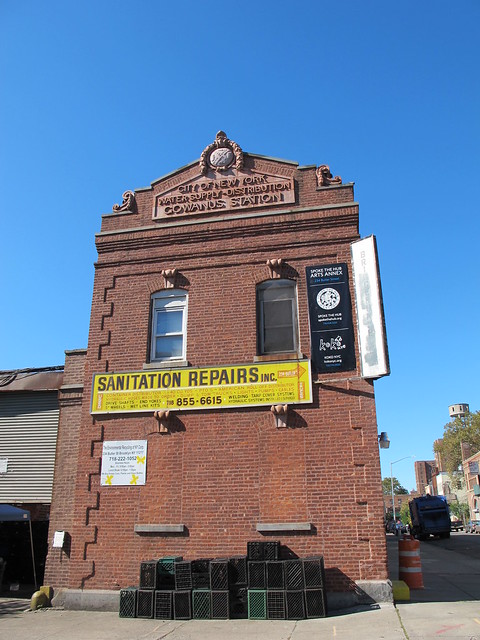
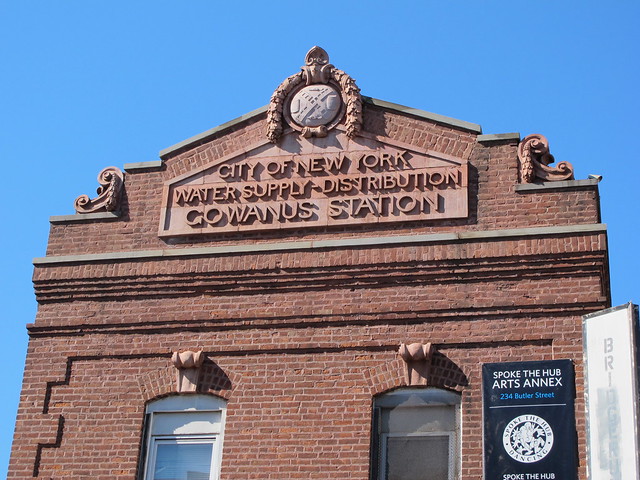
Tagliavia's property happens to also be home to the iconic 'City of New York Water Supply Gowanus Distribution Station.' The charming brick structure, which bears the neighborhood name in terra cotta and sports a medallion showing a windmill, will probably be destroyed if the City acquires the site. Yet, it is of historic significance.

Members of the community are asking DEP to incorporate the building into the CSO tank and proposed head house facility on the site.

They have been backed by Community Board 6, which asked DEP to "consider an alternative design to save the historic structure" as part of their support of the eminent domain action.

More support comes from the New York State Historic Preservation Office (SHPO), which wrote in October 2017:"Based on our review of the project details to date, it appears feasible to retain and incorporate the historic former Gowanus Station Building (234) Butler Street into the project. This building which has a prominent street presence on the corner and the very edge of the city’s preferred site, has overreaching significance on the National Register eligible Gowanus Historic District. Its demolition would adversely affect both the building and the National Register eligible Gowanus Canal Historic District. To destroy this intact, architecturally distinctive example of Brooklyn’s civic and industrial heritage would be a disservice to the Gowanus neighborhood and to the city as a whole.”
IMG_1057
IMG_1056
The Gowanus Station Building at 234 Butler at risk.

Poor Gowanus! So many pressures on such a vulnerable neighborhood. For developers, Gowanus is a dream come true: they have been able to buy low and will profit tremendously as soon as the area is rezoned.  Our politicians are willing to ignore the fact that the area is a flood plain and will always be threatened.
New York City, which has used the Gowanus Canal as an open sewer for decades and opposed the nomination of the canal as an EPA Superfund because it knew that it would be named as a major polluter, is now throwing crazy money at the problem by insisting on building the 8 million gallon CSO tank on private land, instead of City owned land.
There is a real risk of losing everything that is special about Gowanus in the rush to rezone.  The speed of change has accelerated of late and will increase in the next year or two as the rezoning gets pushed through.
When it comes time to attend the public meetings related to the rezoning, I hope you will all join me in voicing our opinions about the future of the neighborhood. If we don't collectively fight for Gowanus, the decision will be made by others.

You may want to start by sending an email to Brooklyn Borough President Eric Adams before December 15, to strongly oppose demolition of the historic Gowanus Water Supply Building at Butler and Nevins Streets.  His email address is askeric@brooklynbp.nyc.gov.


Read more