Showing posts with label NYC Department of Environmental Protection. Show all posts

Tuesday, March 30, 2021

EPA Issues Administrative Order Requiring City to Construct Sewage Retention Tanks for Gowanus Canal Superfund Site Cleanup

The Environmental Protection Agency just issued the press release below,  stating that the Federal Agency has issued an important Administrative Order requiring New York City to construct two sewage retention tanks as part of the Gowanus Canal Superfund Site Cleanup.
This is great news for the Gowanus community, which has long demanded that the City of New York cease the use of the Gowanus Canal as an open sewer.

As part of the EPA Record of Decision for the Gowanus Canal Superfund clean-up, the EPA had mandated that the NYC Department of Environmental Protection construct two retention tanks to control untreated sewage from entering the canal during heavy downpours.

NYC DEP has tried to delay the tank's construction for the past few years. Just recently,  DEP's Commissioner Vincent Sapienza told EPA Region 2 that the completion date for the larger of the two tanks at the head of the canal would have to be pushed back to 2032, citing "the impact of the Covid-19 pandemic on the city's finances and water revenues."

This EPA order legally compels the City to complete the smaller retention tank on the Salt Lot near 2nd Avenue in 2028 and the larger 8 million gallon tank by 2029.  If the City fails to comply to the order, it will face stiff fines.

It is important to note that the two tanks only address CSO discharges into the canal under current conditions. This is significant given the fact that NY City is currently pushing for a massive rezone that would bring about 20,000 new residents into the area. However, the EPA has publicly assured the community that will carefully monitor sewage discharge from any future residential development to insure that the City does not recontaminate the Gowanus Canal.


NEW YORK (March 30, 2021) 
The U.S. Environmental Protection Agency (EPA) ordered the City of New York (city) to construct and operate two Combined Sewer Overflow (CSO) retention tanks to control contaminated solids discharges at the Gowanus Canal Superfund site in Brooklyn, New York, which is a key component of the Gowanus Canal cleanup. The EPA’s order follows previous orders that EPA issued in 2014 and 2016 to require the city to find a location for and design the two tanks. Controls to reduce CSO discharges and prevent other land-based sources of pollution, such as street runoff, from compromising the cleanup are a critical part of the site’s cleanup plan.
“This order will ensure that EPA’s cleanup efforts will not be undermined by uncontrolled combined sewer overflow discharges that have contributed to the chemical contamination of this waterway and impacted this community for the past century and a half,” said EPA Acting Regional Administrator Walter Mugdan. “To ensure the integrity of the dredging work, the retention tanks will control New York City’s sewer outfalls over the long-term.”

The administrative order, issued on March 29, 2021, requires the city to construct one 8-million-gallon tank, located at the head of the canal, and one 4-million-gallon tank, located at a New York City Department of Sanitation Salt Lot near the middle of the canal.

The order also requires the city to, among other things:
• Ensure that developers comply with municipal stormwater regulations within the Gowanus area to prevent additional sewer volume from impairing the effectiveness of the CSO tanks; • Provide treatment for separated stormwater discharges;

• Perform monitoring of sewer solids discharges to ensure protection of the dredging remedy; • Perform associated maintenance dredging, if determined by EPA to be necessary; • Construct a bulkhead on City-owned property to prepare for the second phase of dredging work; and

• Adhere to an overall schedule for remaining tank design work and construction.

The 2013 cleanup plan for the Gowanus Canal Superfund site includes dredging to remove contaminated sediment from the bottom of the canal, which has accumulated because of industrial activity and CSO discharges. More than a dozen contaminants, including polycyclic aromatic hydrocarbons, polychlorinated biphenyls, and heavy metals, including mercury, lead, and copper, are present at high levels in the Gowanus Canal sediments. Dredged sediment that contains high levels of liquid tar will be thermally treated at an off-site facility and disposed. The less contaminated dredged sediment will be processed at an off-site facility to transform it into a beneficial use product, such as landfill cover. Certain areas of the native sediment, below the original canal bottom, that contain mobile liquid tar and are too deep to excavate, will be mixed with cement and solidified to prevent the migration of the tar into the water of the canal. Following dredging and solidification of areas of the native sediment, construction of a multilayer cap in dredged areas will isolate and prevent migration of any dissolved chemicals remaining in the deep native sediments.

To view EPA’s administrative order, as well as other information and documents concerning cleanup activity and EPA’s efforts at the site, please visit www.epa.gov/superfund/gowanus-canal Follow EPA Region 2 on Twitter at http://twitter.com/eparegion2 and visit our Facebook page, http://facebook.com/eparegion2
Read more

Tuesday, August 11, 2020

Yet Again, NYC DEP Wants To Delay Construction Of Two Crucial CSO Retention Tanks For The Gowanus Canal

Untitled
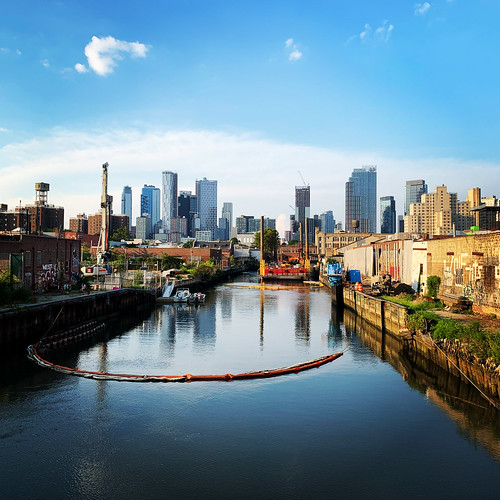
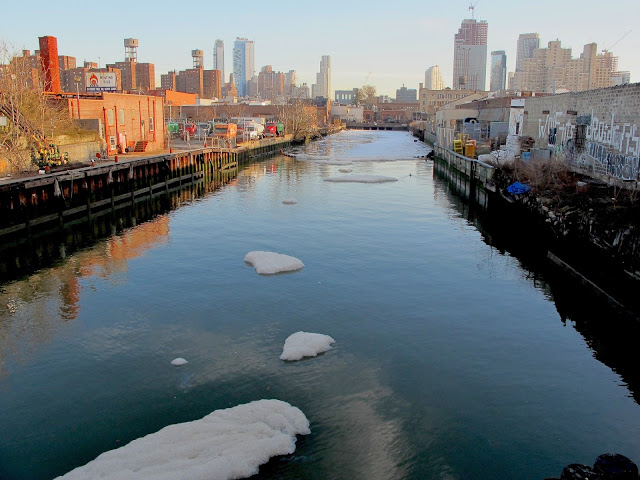
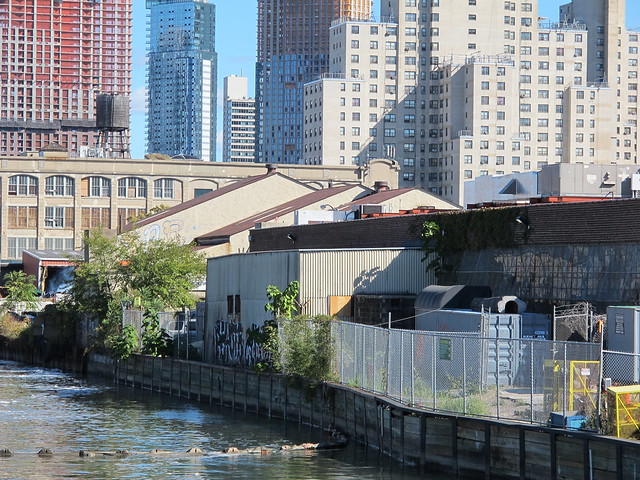
The head of the Gowanus Canal
Untitled
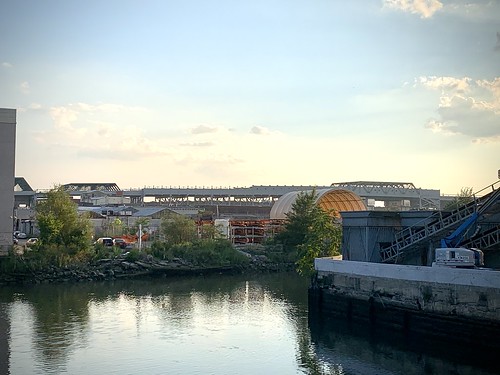
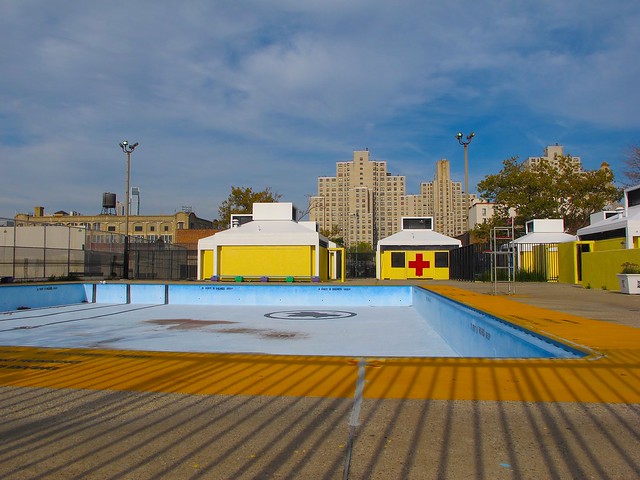
The Salt lot at 2nd Avenuel
The famous "poo-nami' video showing CSO event on Gowanus Canal

Despite a pandemic, despite an exodus out of New York City, Mayor Bill de Blasio and Councilmember Brad Lander are both still pushing for the rezoning of the Gowanus neighborhood from mostly manufacturing to residential.  It is by far the largest proposed New York City upzoning of the de Blasio administration despite the fact that the area still faces serious and dangerous environmental challenges

First, the Gowanus Canal, which runs through the area, was declared  an EPA Superfund site and has not been remediated yet.  Secondly, much of the land in Gowanus is in a FEMA Flood Zone A. Thirdly, there are three former Manufactured Gas Plant  (MGP) sites along the canal's shores that are now and will forever be laden with liquid coal tar at depths of 100 to 150 feet. And fourthly, NYC continues to use the canal as an open sewer, allowing Combined Sewer Overflow to enter the waterway during heavy rain events. That is a clear violation against the Federal Clean Water Act.

It is expected that the Department of City Planning will certify the proposed rezoning, which will trigger the Uniform Land Use Review Process (ULURP) very soon.

But....what about the pollution, you may ask? Well...
Just yesterday, PMFA wrote about the fact that shortcuts were being taken on the most polluted MGP site in Gowanus where our Councilman is envisioning 900 units of housing.

In addition, residents learned at the July 28th EPA Community Advisory Group meeting that the City of New York is yet again trying to delay the construction of two CSO control facilities meant to reduce the volume of untreated wastewater entering the Gowanus Canal.

Here is some background. As part of the EPA Superfund clean-up, the Federal Agency has ordered the City to build two retention tanks, one 8 million gallon tank at the head of the canal at Butler and Nevins Streets, and a 4 million gallon tank at the Salt Lot at 2nd Avenue, located in the middle section of the canal.

In the past few years, the NYC Department of Environmental Protection has managed to delay the construction of the tanks by several years by insisting on siting the tanks on land seized by eminent domain and by over-designing the tank facilities. The Agency also managed to more than double the construction cost. In  2018, D.E.P.'s Kevin Clarke testified that the cost for the entire 'program' that includes both tanks is estimated to reach $1.2 Billion. E.P.A. had estimated the cost at $500 million.

So, imagine the community's surprise when it heard that DEP's Commissioner Vincent Sapienza had reached out to EPA Region 2's Administrator Peter Lopez, asking for additional time due to the financial challenges the City is currently facing because of the Covid-19 pandemic.
Sapienza asked for a one year delay for the completion of the larger tank and an 18 months delay for for the smaller one.

Keep in mind that the tanks are only addressing current CSO discharges and that 0EPA expects a significant increase in CSOs into the canal as part of the area rezoning, this is bad news for current and future residents.

The news prompted Voice Of Gowanus, a coalition of civic organizations and local residents to reach out to Administrator Lopez with the following letter on August 7th:

Gowanus Canal Superfund Required Sewage Detention Tanks 
Vs. DEP Delay Request

Dear Regional Administrator Lopez,

During the recent July Gowanus CAG meeting, the community was made aware that NYC DEP has requested a substantial delay in carrying out its obligations in the EPA Superfund cleanup for the canal, which includes one sewage detention tank at the head the canal and a smaller one on the city’s 2nd Avenue Salt Lot. We have been told that the DEP cites a large coronavirus-related revenue shortfall as a reason to push back this Superfund construction work a year for the larger tank, and a year and a half for the smaller tank.

As a local Gowanus coalition of civic associations and residents, we are reaching out to you with our concerns now, given that the EPA CAG will not be meeting again till late September and we understand this is a very time-sensitive matter.

As members of the Gowanus community many of us are aware of previous times when the DEP had fully funded Gowanus infrastructure work (the 2004 Flushing Tunnel Project) only to have DEP pull the funding for years and delay Gowanus for new infrastructure projects elsewhere.

We have good reason to be concerned with this current excuse for delay especially given that the EPA has already allowed several delays on this DEP work. And that this work will now no longer be completed by the time the dredging work is finished. Further, there was an understanding in the community that funding for Gowanus CSO tanks has been in place. In March 2016, Councilman Lander TWEETED proudly that he was glad to see $510m in the updated capital plan for Gowanus CSO retention tanks.

From Councilman Brad Lander's Twitter account, March 2016

The Gowanus community prefers that you DO NOT allow the NYC DEP to delay its portion of the Superfund cleanup any further. If you are inclined to negotiate any delay, we ask that you only agree to delay the work of one tank's construction, not both, and make approval contingent upon NYCDEP agreeing to prioritize design and construction of both retention tank projects over all other new DEP infrastructure projects. We would feel deeply wronged in Gowanus if the EPA granted the requested delays to the DEP only to have the DEP fund new infrastructure works at the expense of finishing the Gowanus tank projects.

As you know, hundreds of millions of gallons of raw sewage discharging regularly into our waterway continues to be a major environmental and health concern. The problem is about to become even more acute as the City appears poised to certify the massive rezoning of the Gowanus corridor.

Our community needs a hero. Please be ours.

Respectfully,
Voice of Gowanus


If you would like to send your own email to Administrator Lopez in support of Voice Of Gowanus, click on the link below. It will open a new page with the email address and letter. So easy.
Click to Write Your Own Email To Administrator Lopez

Read more

Thursday, October 24, 2019

Latest EPA Update On Gowanus Canal Superfund: All You Need To Know

Untitled
Untitled
Untitled
Gowanus Canal Community Advisory Group
Untitled
Untitled
Christos Tsiamis
EPA Region 2 Gowanus Canal Project Manager
Untitled
EPA Fact Sheet on Fulton Bulkhead Barrier Wall

The Gowanus Canal Superfund Community Advisory Group gathered this past Tuesday for its October General Meeting to receive an update on work currently performed in and around the canal under the supervision  of the Environmental Protection Agency.

Christos Tsiamis, the EPA project manager for the Gowanus Canal Superfund gave the CAG an overview on the Fulton Bulkhead Barrier Wall Construction at the head of the canal. The sealed wall  will serve as an environmental barrier, preventing liquid coal tar from the former Fulton Manufactured Gas Plant from recontaminating the canal after the Superfund clean-up is completed. The work is being done by National Grid contractors  and consists of "880 feet of steel sheet piling to be placed in front of the bulkheads along the eastern side of the Gowanus Canal and will extend from the canal head end to the Union Street Bridge."

Work on the wall began in late August 2019 and has been progressing as planned, except for a small  delay caused by repairs to the Union Street Bridge. However, the NY City Department of Transportation has assured EPA that it will open the bridge so that barges carrying material for the wall construction can get through. EPA does not project a significant delay because of the bridge repair.
"The conclusion is that we are on track to finish that wall by August 2020," Tsiamis told the CAG.

Untitled
DoT at work on the Union Street Bridge this morning

Recently, the group of Potentially Responsible Parties (Polluters) handed EPA 90% of the design for the clean-up of the upper portion of the canal. EPA is in the process of reviewing in detail  all aspects of the canal design and will send back comments to the PRPs shortly.
"I mention this because we have had some differences with the PRPs, in particular National Grid and their contractor in regards to the approach of that particular clean-up. We had objections to the schedule that they were presenting." Tsiamis stated.
EPA believes that the dredging at the head of the canal can begin in August/ September 2020, whereas National Grid is pushing for a start date in May 2021.
"We still believe that the head of the canal clean-up can start by sometime in 2020. We are looking carefully at the design that they have submitted and we will let you know how things are going at the next CAG meeting." Tsiamis added.

Regarding the two retention tanks that NY City's Department of Environmental Protection is mandated to build to keep Combined Sewer Overflow out of the Canal during rain events  (one 8 million gallon tank at the head of the Canal and a 4 million gallon tank on the Salt Lot on Second Street), Tsiamis mentioned that the City has just provided EPA with the 90% design for the larger of the two tanks.  Again, the Agency is currently reviewing the plans.
"I am also looking forward to resuming work on the middle of the canal retention tank," he told the CAG.

When asked how DEP had reacted to a recent decision by EPA Region 2 Regional Administrator Lopez to disallow the City to shift from constructing the two CSO tanks to a tunnel,  Tsiamis answered: "That matter is finished on the part of the EPA. and we are moving forward."


"The EPA has spent nearly a year and a half and lots of resources looking at what had been presented to us. We offered our input to the Administrator. He considered everything and he made his decision.  That decision is very well summarized in the letter that was sent by him to [DEP's] Commissioner."
{see letter below}

"We now have to really focus all of our efforts on getting on with the work, finalizing the design, initiate the design, hopefully in an accelerated fashion, and cleaning up the canal, which is not a small task.," Tsiamis concluded.


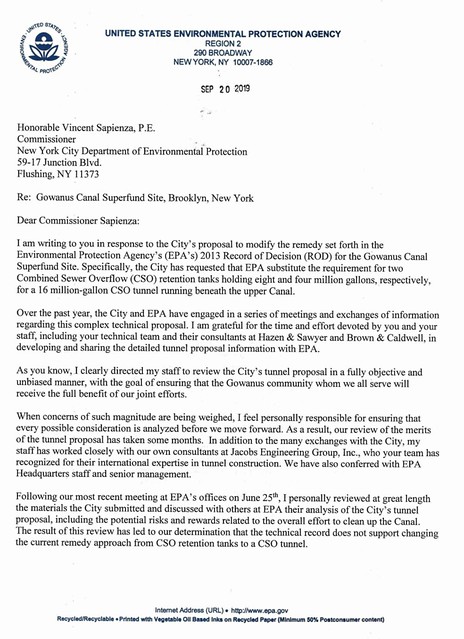
Letter from EPA Regional Administrator Lopez To DEP Commissioner Sapienza 
regarding CSO tunnel decision.


Screen Shot 2019-10-24 at 3.00.28 PM
Screen Shot 2019-10-24 at 3.00.47 PM
Screen Shot 2019-10-24 at 3.01.09 PM
Read more

Monday, January 21, 2019

EPA Gowanus Canal Community Advisory Group To Meet This Tuesday (Sans EPA Due To Shutdown)

The Gowanus Canal Community Advisory Group will host its regularly scheduled meeting regarding the Canal's Superfund clean-up this Tuesday, January 22, 6:30 pm at Mary Star of the Sea Senior Apartments, 41 1st Street, Brooklyn .
The Environmental Protection Agency, whoever, will sadly be absent from the meeting, due to the federal government shutdown.
The meeting will be self-facilitated by members of the CAG, if the federal government shutdown is not resolved by tomorrow, which is very likely.

On the agenda will be a presentation by NYC Department of Environmental Protection on the agency's surprising alternate proposal for a 16-17 million gallon Combined Sewer Overflow storage tunnel under the Canal, instead of the two CSO tanks that DEP has been advancing.
You may remember that DEP dropped the bombshell announcement at the CAG's last general meeting in November 2018. 

This is bound to be an interesting meeting for anyone living in or near Gowanus, so I urge everyone to attend. This is our opportunity to ask DEP how much more time a tunnel will take, and how much more it will cost.  More importantly, let us find out if this is yet another way for DEP to delay the City's part of the Superfund clean-up.

Read more

Thursday, October 18, 2018

D.E.P. Presents Modifications To Its Gowanus Canal CSO Facility, But For More Than Half A Billion Dollars, Don't Expect The Taj Mahal

Untitled
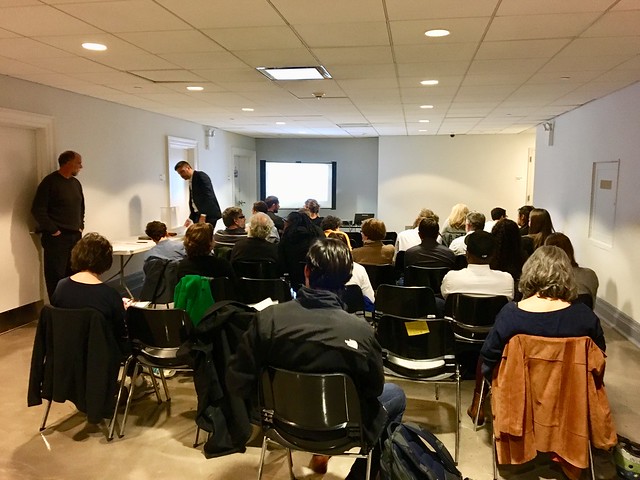
Last night's meeting at the YMCA on Third Avenue
Untitled
Alicia West, DEP Director of Public Design Outreach
Untitled
Untitled
Untitled
Untitled
Untitled
Untitled
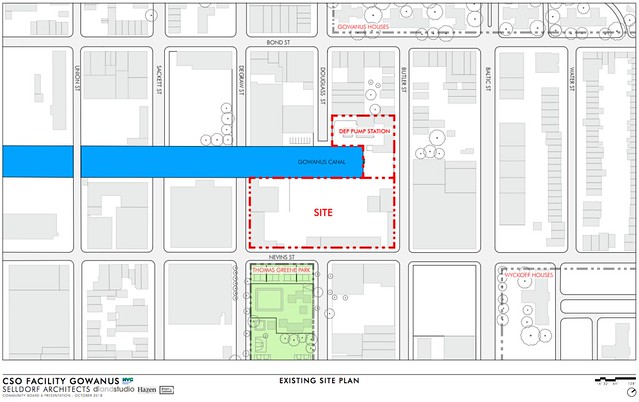
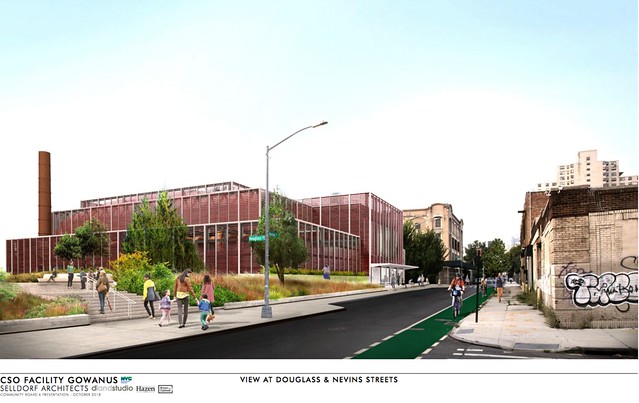
Last night, New York City's Department of Environmental Protection came in front of Community Board 6 Parks and Recreation / Environmental Protection Committee to give a presentation on the proposed design for the Gowanus Canal Combined Sewer Overflow Facility at the head of the Gowanus Canal.
The changes to the design of both the 'head house' and the 1.6 acre open space were based on public comments gathered at public meetings in May 2018 and at a North Gowanus Community Visioning session in July.

Before we delve into some of the proposed changes to the design, let us provide some background on this issue:
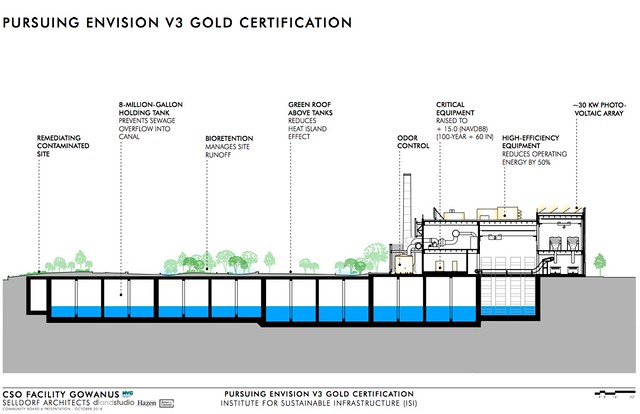
You may remember that DEP is required by the US Environmental Protection Agency to build an 8-million gallon sewage retention tank at the head-end of the Gowanus Canal to reduce the volume of untreated wastewater entering the waterway as part of the Superfund clean-up.

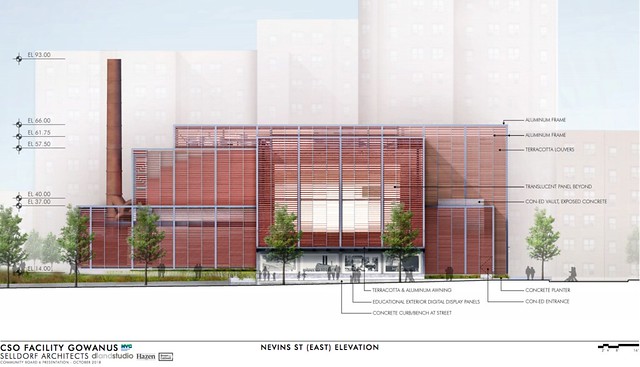
DEP has taken the requirement for a simple tank to a whole new level by insisting that the C.S.O. tank be built on two privately owned parcels that the City is currently acquiring through eminent domain, rather than to follow EPA's suggestion to site the tank on publicly-owned parkland across the street. Along with the tank, DEP is insisting that it also needs a massive head house to hold debris capture screens, a de-gritter, odor control equipment, as well as an electric room, boiler and other mechanical spaces.   
DEP admitted last night that the final cost is expected to exceed $500 million dollars.

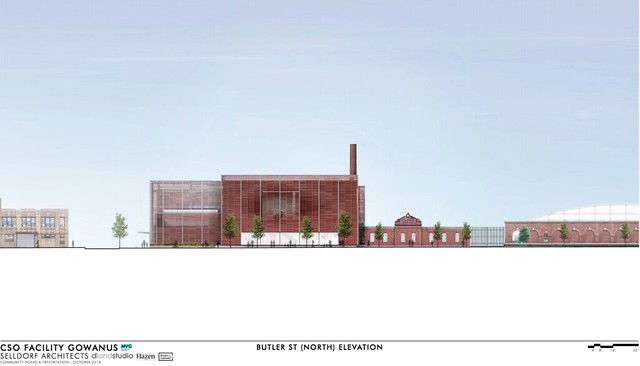
For more than half a billion dollars, the community could expect something resembling the Taj Mahal, no?  However,  the Selldorf Architects-designed building looks just like a big box, even if it will be clad in terra cotta Venetian style louvers.  As for the green space above the tank,   DLandStudios designed a pleasing passive-use space, yet it only really provides plantings, some open areas, and benches.

So what changes were made to the project?  The building's footprint has apparently been slightly reduced, it has been pulled back from the lot line at Nevins Street, and its color palette has been softened.

To some residents, the modified design was a great improvement. To others, many of the suggestions or 'asks' from the community were ignored.  The facility, for example, does not include an indoor educational center. There are no provisions for restrooms. There are no active play areas for children, water access for boaters, or covered areas for a makers market.

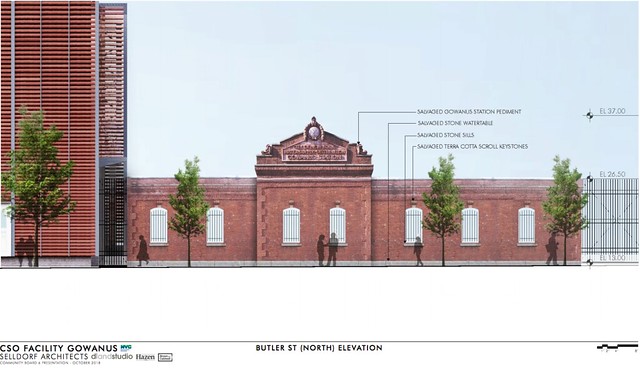
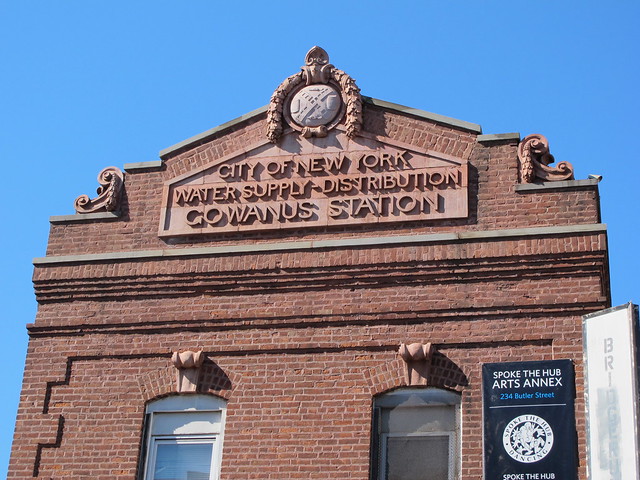
Most disturbing, many in the Gowanus Community had passionately voiced their desire to preserve the 100-year old former Gowanus Station building at 234 Butler Street and had asked DEP for over a year to incorporate this historic structure into their plan.
Instead, the new facility design calls for the demolition of the building. Only its parapet and a few other elements will be saved and incorporated into a brick wall on Butler Street, around the corner from its current location. 

D.E.P. will be presenting the design to the Public Design Commission in mid-November.
It may be a tad premature.  To date, DEP  has only submitted 30% of the CSO facility's design to EPA. The Federal Agency will have to give final approval of the mechanics and underground tank.

So, while DEP shows us pretty drawings and samples of glazed terra cotta tiles, perhaps it is more important for the agency to prove to us and to the EPA, that their costly facility will actually keep raw sewage out of the canal.

Read more

Thursday, April 12, 2018

Camouflaged With #METOO Legislation, Eminent Domain Acquisition Of Sites In Gowanus For C.S.O. Tank Easily Sails Through City Council

Untitled
Untitled
Untitled
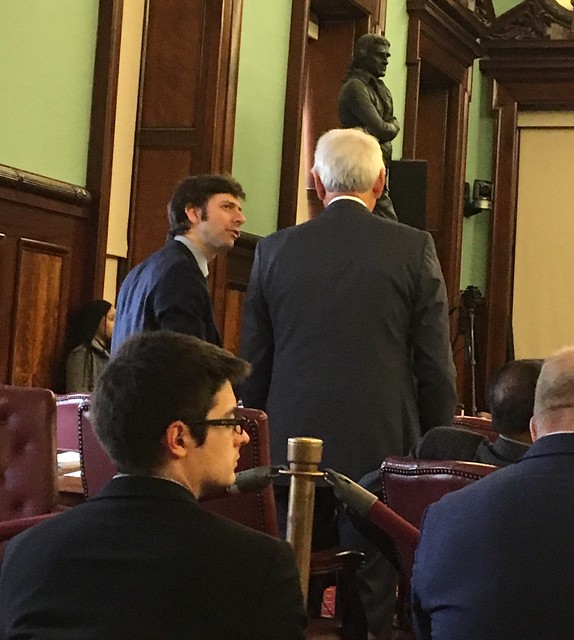
Councilman Steve Levin at yesterday's vote at City Council
Untitled
Untitled


Kevin Clarke of D.E.P. testifying in front of 
Video courtesy of New York City Council
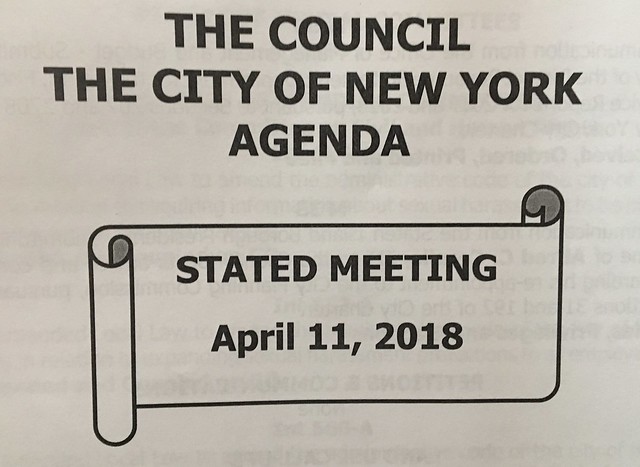
Always an engaged citizen and someone who likes to see things through, I took the time to attend
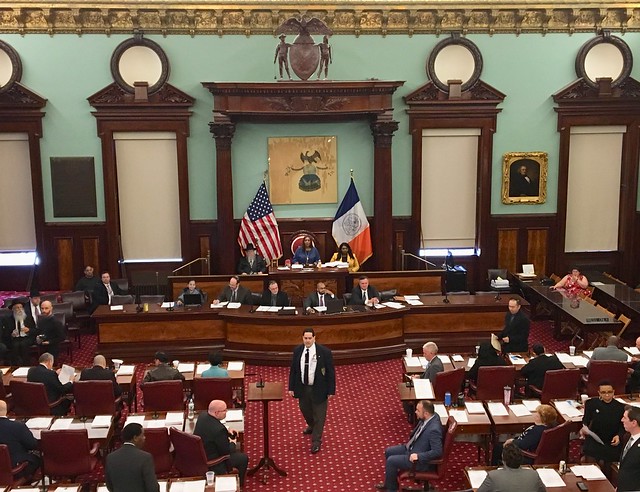
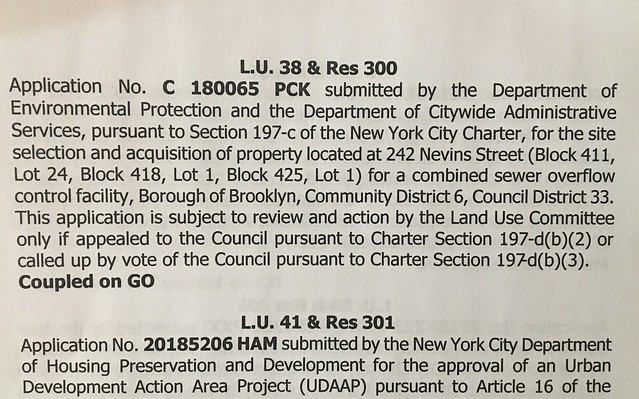
New York City Council's meeting yesterday afternoon.  On the agenda was a vote on an important Gowanus issue that I have written about on this site from the very beginning: an application by the New York City Department of Environmental Protection for the proposed site selection and acquisition of three privately owned properties at 242  Nevins Street, 270 Nevins Street, and 234 Butler Street "to facilitate the construction of the “Head End Facility” as part of the larger project to construct combined sewer overflow (“CSO”) control facilities to reduce the volume of untreated wastewater entering the Gowanus Canal."
This project is located in Council Member Stephen Levin’s district, who attended the meeting. His colleague, Councilmember Brad Lander, whose district covers a larger section of the Gowanus Canal, was absent.

This land acquisition at the head of the canal only accommodates an 8 million gallon CSO retention tank mandated by the Federal government as part of the Environmental Protection Agency's Superfund clean-up of the polluted waterway.  D.E.P. also has to construct a 4 million gallon tank in the middle portion of the canal, in Councilmember Brad Lander's district.

At a hearing of the City Council's  Subcommittee on Landmarks, Public Siting and Maritime Uses on March 12, 2018, D.E.P.'s Kevin Clarke testified that the cost for the entire 'program' that includes both tanks is estimated to reach $1.2 Billion.  That is more than twice the entire cost of the Superfund Clean-Up, which E.P.A. estimates at $500 million.
The estimated cost for the acquisition of the sites at the head of the canal is $90 million, according to Clarke, with an additional $400 million for the construction of the 8 million gallon tank.
(I am really, really not good at math, but that would mean that the smaller tank will cost $700 million? How is that possible?)
Please keep in mind that the EPA estimated the cost at $77 million for both tanks, suggesting that they be build on land already owned by the City to keep cost down.

Given what amounts to a "remarkably expensive endeavor" (Councilman Levin's words),
I had hoped for an animated discussion on the item from his fellow Councilmembers.
After all, it is not every day that the City proposes to spend such a huge amount of money in two Councilmen's districts.

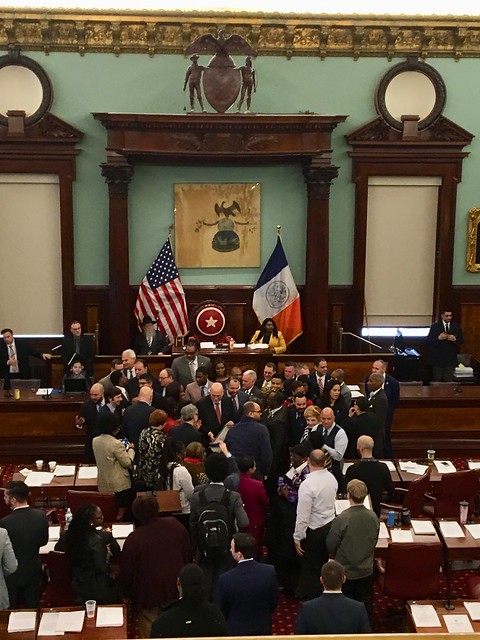
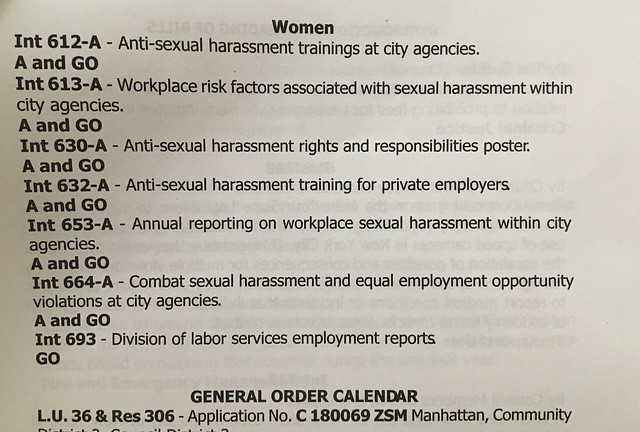
Imagine my surprise when I realized yesterday that application # C 180065 PCK for the site acquisition at the head of the canal was bundled together with at least 25 other items, safely camouflaged with several items pertaining to the “Stop Sexual Harassment in NYC Act".

Now, I applaud all the Councilmembers who voted overwhelmingly to support the #MeToo movement and secure protection from sexual harassment, yet one wonders if they were even aware that they were also voting for such a huge ticket item.
On the other hand, I may just be naïve. After all, such items are regularly slipped into bills and votes in Washington and Albany.

Please don't misunderstand me. I support the construction of both C.S.O. retention tanks. The City has to stop using the Gowanus Canal as an open sewer.  But the City which has ignored the pleas of the community to stop dumping raw sewage into our canal for decades now seems to want to line these tanks in gold.

Indeed, with a massive re-zoning of the Gowanus corridor that would allow the construction of residential buildings in this once vibrant industrial neighborhood, one has to wonder if the City  is instead planning what one Gowanus resident recently called "the Taj Mahal of sewer treatment facilities" to accommodate developers and their planned condos instead of two simple tanks as mandated by the E.P.A.

Read more

Monday, December 04, 2017

As The World Turns In Gowanus: A Tale Of Eminent Domain, Development Pressure, Environmental Challenges, And The Risk Of Losing A Neighborhood's Uniqueness

IMG_0986
IMG_0988
Nothing is simple in Gowanus. This small neighborhood wedged between Park Slope, Boerum Hill and Carroll Gardens has the ominous distinction of being home to an 1.8 mile man-made canal that is one of the most polluted sites in the United States, which landed it on the Federal Environmental Protection Agency's Superfund list in 2010.  Besides being polluted, New York City has been allowing raw sewage to spill into the waterway during heavy downpours for decades and continues to do so.
IMG_7706
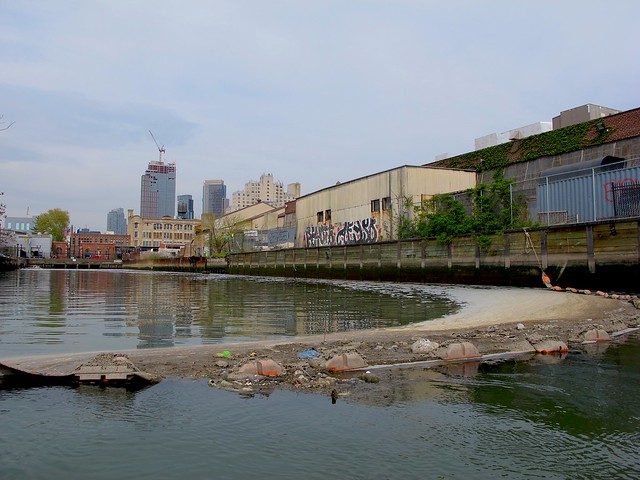
Raw sewage floating on the Gowanus Canal

Then there is the fact that most of Gowanus has been declared a Flood Zone 'A' by the  Federal Emergency Management Agency, which means mandatory evacuation during hurricanes.  But no superstorms are needed for floods, as flooding occurs on a regular basis even during moderate downpours.
3rd Street Bridge in Gowanus after heavy rain
6090312118_33bcd2f4a7_o
Flooding is a reality for many Gowanus residents.

Lastly, Gowanus has been targeted for development. A real estate frenzy has been unleashed by Mayor deBlasio and Councilmen Lander and Levin, when they began pushing to rezone the area from mostly manufacturing to mixed-use, which would allow more residential developments similar to the recently completed Lightstone Group rental towers along the canal. This resulted in speculative investments by developers such as Jared Kushner, President Trump's son-in-law and others.  In anticipation of the rezoning, manufacturing lots in the area have significantly increased in value, which has forced many manufacturing tenants out of the area.
Lightstone Group's 700-unit high rise rental along the Gowanus Canal

This perfect storm has pitted not-for-profit organizations, which have taken money from developers and our elected officials and these same elected officials who envision a shiny new Gowanus neighborhood against true civic associations, and neighbors who want to hold on to at least part of its history and uniqueness.

As of right now, The EPA Superfund Clean-Up of the toxic Canal seems to be on track.  A dredging and capping pilot study is about to begin in the 4th Street basin. The result will enable the EPA to finalize the design for the environmental clean-up of the entire waterway. The actual clean-up is slated to start in 2020 at the head of the Canal.

The re-zoning of Gowanus has picked up momentum.  From 2013 to 2015, Councilmen Lander held "Bridging Gowanus," a series of curated community planning meetings to help "shape a sustainable, livable, and inclusive future for the Gowanus neighborhood." At one of the planning meetings, the public was given a highly slanted exercise to "weigh the hard choices of density and development."
Predictably, the resulting report claimed that "nearly three-quarters of the participants who chose this scenario expressed openness to buildings of more than 10 stories (with a distribution of opinion spread about equally from 8 to 18 stories)."
How very convenient for developers.
15607330045_2923aebe24_z
Councilman Brad Lander at one of the Bridging Gowanus meetings, 
promising an 'inclusive and transparent process"

By late 2016, the NYC Department of City Planning launched the Gowanus Neighborhood Planning Study to develop a planning and land-use framework for the Gowanus neighborhood. Here again, local residents were asked to participate through a series of workshops. Though many in the community clearly asked City Planning to consider establishing "managed retreat from the Gowanus flood zone", the recommendation never made it into the final presentation given by the Department of City Planning in October 2017.
The reason? According to DCP:
"This interest was not mutually shared among working group members. It conflicts with core objectives established within the Gowanus Study process, including promoting investment in the creation of commercial and arts uses, housing and continued industrial use on canal-side properties."
Currently, DCP is working on a Gowanus rezoning pan, which they will present to the community in  early 2018.
No doubt, new zoning will allow for lots of 18 story high-rises along the canal in a flood zone.

New York City Department Of City Planning Gowanus Neighborhood Study
Untitled
City Planning's Winston Von Engel with Brad Lander at a 
Gowanus Neighborhood meeting, October 2017

By far the most contentious issue in Gowanus right now is the placement of the larger of two Combined Sewer Overflow (CSO) and storm water retention tanks.

As part of the Gowanus Canal Superfund Record of Decision, a legally binding blueprint for the environmental clean-up of the canal, EPA has mandated that New York City construct an eight million gallon tank in the upper portion of the canal, and a four million gallon tank in the middle of the canal as a control measure meant to significantly reduce overall contaminated solid discharges to the waterway during heavy rain events.
Looking at 234 Butler Street and 242 Nevins Street from the Gowanus Canal Side
IMG_1725
Double D Pool at Thomas Greene Park

EPA Region 2 suggested placing the 8-million gallon tank underneath the Double D pool at Thomas Greene Park near Nevins Street. The Agency reasoned that the pool needs to be removed anyway because it sits on the former  Fulton Municipal Manufactured Gas Plant which needs to be remediated. Also, the parkland is already owned by the City, which would save the acquisition cost.

The NYC Department of Environmental Protection on the other hand, prefers to site the 8-million gallon tank on three privately-owned sites along the canal, adjacent to the park. In early 2016, an Administrative Settlement Agreement between EPA and New York City grants the City the opportunity to locate the tank on its preferred 'canal side' location. However, the order comes with a strict timeline which requires that the City must acquire the three sites by 2020. EPA will force the City to pivot to the Thomas Greene site if this deadline is not met.

To avoid delays if this should occur, EPA is requiring DEP to prepare parallel tank and head house designs for both sites.

The City's plan relies on the taking of two privately owned sites, 234 Butler Street and 242 Nevins Street, by eminent domain if necessary. A third site, 270 Nevins Street will also be seized and then leased by the City for staging purposes. The taking by eminent domain will displace a fair number of businesses, including Eastern Effects Studios, where the popular "The Americans" television show is filmed. it will also displace Spoke The Hub, a popular not-for-profit, which has had a presence in Gowanus for decades.

In DEP's Capital Plan for 2016 to 2019, $510 million was added "to secure land, design two CSO tanks and construct one of the two planned CSO tanks adjacent to the Gowanus Canal." That sum rivals the estimated amount for the entire Superfund clean-up of the canal and buys the community only ONE tank.

Obviously, inflating the cost of the 8-million gallon tank at the top of the canal through needless land acquisition doesn't concern Councilman Brad Lander, who tweeted that he was "very glad to have secured the $510 million in the DEP updated capital plan."
From Councilman Brad Lander's Twitter account, March 2016

Currently, an application submitted by New York City Department of Environmental Protection (DEP) and the New York City Department of Citywide Administrative Services (DCAS) for the acquisition of these three privately-owned parcels needed for the Gowanus CSO Facility is currently moving through the Uniform Land Use Review Procedure (ULURP) process.
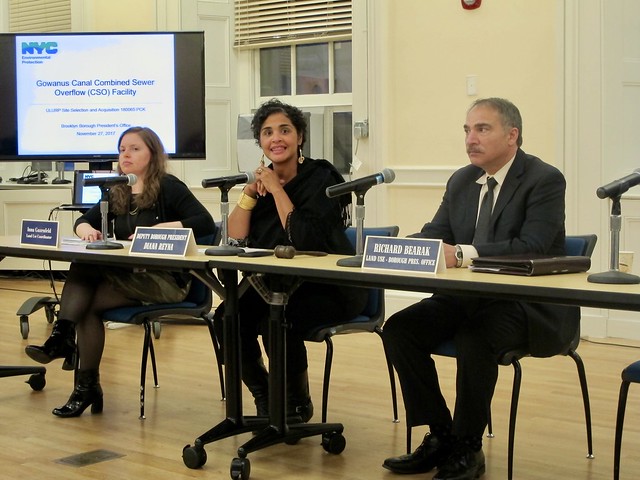
Community Board 6 as already held a public hearing and voted to support the eminent domain action. The next step is to get approval from Brooklyn Borough President Eric Adams. A public hearing was held at Brooklyn Borough Hall on November 27th. Adams will make a determination soon.

If the ULURP process goes according to the De Blasio administration, the city may have to fork over at least $70 million dollars for 242 Nevins Street and 234 Butler Street, according to a recent Crain's article.
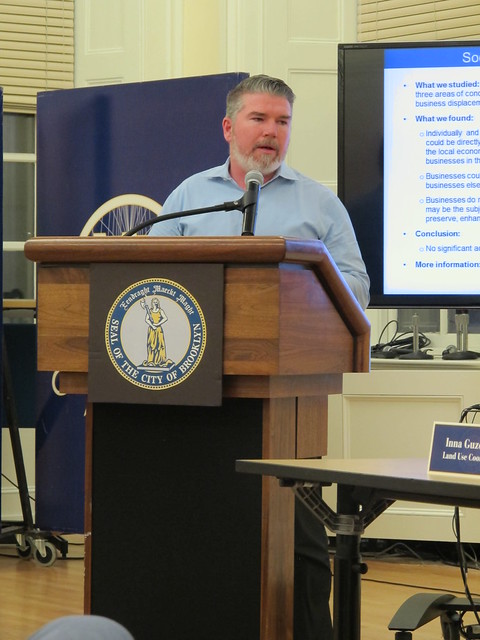
Inna Guzenfeld, Diana Reyna and Richard Bearak of the Brooklyn Borough President's office
during ULURP hearing on eminent domain action for
Combined Sewer Overflow Tank and Facility.
IMG_1406
Kevin Clarke of NYC DEP at ULURP hearing at Brooklyn Borough Hall
IMG_1399
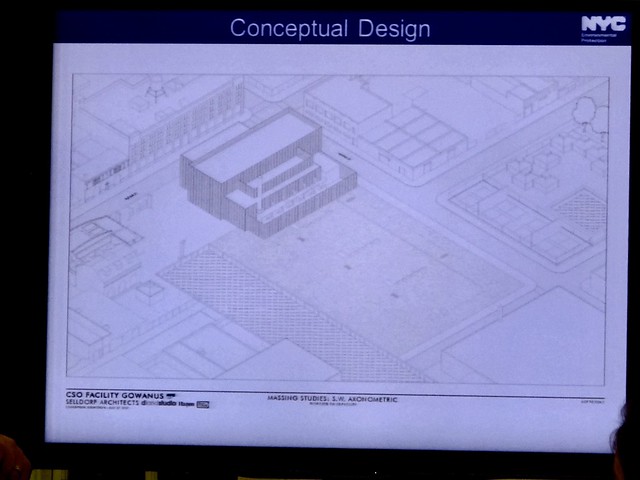
DEP's conceptual design for retention tank head house at
234 Butler Street and 242 Nevins Street

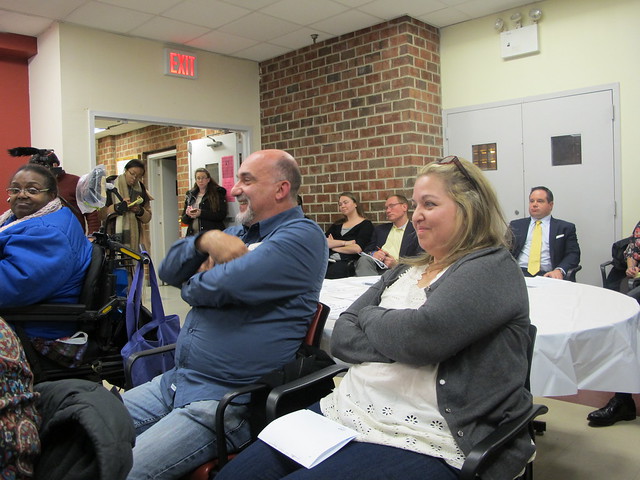
At the Brooklyn Borough President's hearing, Kevin Clarke of NYC's DEP stated that the City hopes to purchase the land as a "willing seller, willing buyer" transaction and said that the City had made the owners an offer.

"Not so," said Salvatore Tagliavia, the owner of 234 Butler Street, and of Sanitation Repairs, Inc. located on the property. At a Gowanus Canal Community Advisory meeting the very next day. Kevin Clarke again claimed that "the City has made offers to the two property owners."

"I would like to disagree," Tagliavia. "I am the owner of one of these properties. All I hear DEP say is that they want to do this and they want to do that, but I have not been approached on any level as far as relocation of my employees, my tenants and the not-for-profit, Spoke The Hub, that is located in my building." He added: "I think I speak for the other two owners. The only thing that we have received is a letter stating that they intend to make an offer and that they intend to acquire the property."

Tagliavia has made clear that he is not a willing seller. He had intended to sign a 100-year lease agreement with real estate development firm Alloy, so that his property could remain in his family for future generations.
IMG_1441
Salvatore Tagliavia and his wive Lena, owners of 234 Butler Street, 
at the November Gowanus Canal CAG meeting.

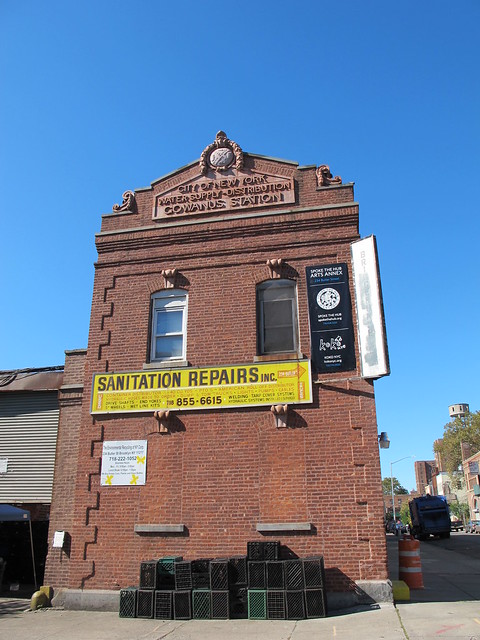
Tagliavia's property happens to also be home to the iconic 'City of New York Water Supply Gowanus Distribution Station.' The charming brick structure, which bears the neighborhood name in terra cotta and sports a medallion showing a windmill, will probably be destroyed if the City acquires the site. Yet, it is of historic significance.

Members of the community are asking DEP to incorporate the building into the CSO tank and proposed head house facility on the site.

They have been backed by Community Board 6, which asked DEP to "consider an alternative design to save the historic structure" as part of their support of the eminent domain action.

More support comes from the New York State Historic Preservation Office (SHPO), which wrote in October 2017:"Based on our review of the project details to date, it appears feasible to retain and incorporate the historic former Gowanus Station Building (234) Butler Street into the project. This building which has a prominent street presence on the corner and the very edge of the city’s preferred site, has overreaching significance on the National Register eligible Gowanus Historic District. Its demolition would adversely affect both the building and the National Register eligible Gowanus Canal Historic District. To destroy this intact, architecturally distinctive example of Brooklyn’s civic and industrial heritage would be a disservice to the Gowanus neighborhood and to the city as a whole.”
IMG_1057
IMG_1056
The Gowanus Station Building at 234 Butler at risk.

Poor Gowanus! So many pressures on such a vulnerable neighborhood. For developers, Gowanus is a dream come true: they have been able to buy low and will profit tremendously as soon as the area is rezoned.  Our politicians are willing to ignore the fact that the area is a flood plain and will always be threatened.
New York City, which has used the Gowanus Canal as an open sewer for decades and opposed the nomination of the canal as an EPA Superfund because it knew that it would be named as a major polluter, is now throwing crazy money at the problem by insisting on building the 8 million gallon CSO tank on private land, instead of City owned land.
There is a real risk of losing everything that is special about Gowanus in the rush to rezone.  The speed of change has accelerated of late and will increase in the next year or two as the rezoning gets pushed through.
When it comes time to attend the public meetings related to the rezoning, I hope you will all join me in voicing our opinions about the future of the neighborhood. If we don't collectively fight for Gowanus, the decision will be made by others.

You may want to start by sending an email to Brooklyn Borough President Eric Adams before December 15, to strongly oppose demolition of the historic Gowanus Water Supply Building at Butler and Nevins Streets.  His email address is askeric@brooklynbp.nyc.gov.


Read more