Showing posts with label Councilman Brad Lander. Show all posts

Thursday, November 19, 2020

Tonight, Tell Council Member Lander That Building Affordable Housing On The Toxic Public Place Site In Carroll Gardens Is Insane ...And Nefarious

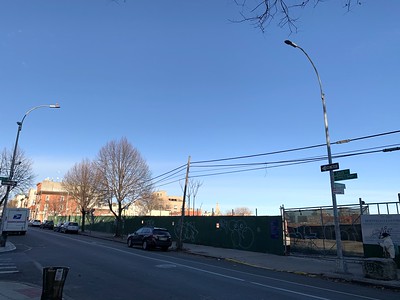
Public Place site at Smith and 5th Street
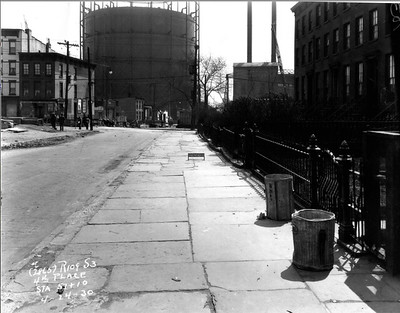
A 1930 view of the former Citizens Gas Work Site on what is now Public Place

TONIGHT, TELL COUNCIL MEMBER LANDER THAT BUILDING AFFORDABLE HOUSING ON LAND THAT WILL FOREVER BE POISONED IS JUST INSANITY!

By now, most residents in Gowanus and neighboring areas have hopefully heard about the proposal by the NYC Department of City Planning  to up-zone the Gowanus Canal area, which calls for 8,200 new units of housing that will bring approximately 20,000 new residents to the area.


If this seems insane to most, the plan has nevertheless the backing of Councilman Brad Lander, who has supported the rezoning from the start.
Though it appears on the surface that Lander wants to make sure that "plans for growth are grounded fully in the public interest, and will achieve our shared goals", the rezoning of the Gowanus area was always a huge giveaway to developers despite all the talk about affordable housing units that may be gained in the process.
Councilmember Brad Lander, supporter of housing on Public Place

Which brings us to Public Place, the City-owned six acre Brownfield site near the intersection of Smith and 5th Streets adjacent to the Gowanus Canal. It is currently in NYC Department of Housing Preservation and Development portfolio.

Brad Lander has been pushing for the development of housing on Public Place from the moment he ran for City Council, if not before.  From 1993 to 2003,  he served as executive director of Park Slope's Fifth Avenue Committee, a not-for-profit community-based organization that develops and manages affordable housing.)

Interestingly enough,  in 2008, Fifth Avenue Committee, together with  Hudson CompaniesJonathan Rose, and the Bluestone Organization was selected to develop the site for affordable housing with retail space, community facilities and open space.
Fifth Avenue Committee's current executive director is Michelle de la Uz, who also currently serves as a Commissioner of NYC Planning Commission. If that is not a conflict of interest, what is?

Gowanus Green: a proposal for about 900 apartments and a school on permanently toxic land

Their proposal was named 'Gowanus Green' and included 774 units of housing, of which 70% would have been permanently affordable. To move forward, the site needed to go through a rezoning from manufacturing to residential, which never moved forward after the Environmental Protection Agency declared the Gowanus Canal a Superfund Site.

Gowanus Green has been revived of late since City Planning has wrapped Public Place into the framework of the agency's Gowanus Neighborhood Planning Study

The new plan for Public Place calls for about 900 units of affordable housing in 30 story buildings as well as a new public school. 

Tonight at 6 pm, the NYC Department of City Planning and the “Gowanus Green” development team are going to present the development at a webinar hosted by Community Board 6.
To register, click here.

In 2019, Brad Lander stated:
"The chance to build a sustainable, mixed-income community in Gowanus is one of the most important and unique opportunities of the Gowanus Neighborhood Rezoning. Gowanus sits in-between Carroll Gardens and Park Slope, two wonderful neighborhoods, with great schools, thriving commercial strips, great access to transit -- and almost no affordable housing. Gowanus Green offers us the opportunity to build hundreds of units of truly affordable housing, right at the heart of the neighborhood, to open up the opportunity of our dynamic community to a much wider range of people than can afford to live here now."

Affordable housing, additional parkland, a new public school...it all sounds great, until you consider the history of Public Place, which Brad Lander refuses to mention in his email to the community.

The truth is that to this day, Public Place will remain one of, if not the most polluted site along the Gowanus Canal even after remediation.

From the 1860s to the early 1960s, the Public Place site was the home of the former Citizens Gas Light Company's 12th Ward Gas Work Plant, a Manufactured Gas Plant (MGP) where coal and petroleum products were turned into flammable gas. The gas was used for cooking, lighting, heating and commercial purposes in the surrounding neighborhoods.

Unfortunately, one of the by-products of this gasification process is coal tar, a black viscous liquid, which is harmful to humans and the environment. At Public Place,  coal tar has been found in significant amounts at depths of 150 feet.   

When the Citizens Gas Works plant was decommissioned in the 60s, the site was given to the city 'by condemnation' as public land in 1975. Hence the name "Public Place". Citizens Gas Light Company later sold to Brooklyn Union Gas, which became Keyspan, which is now National Grid.

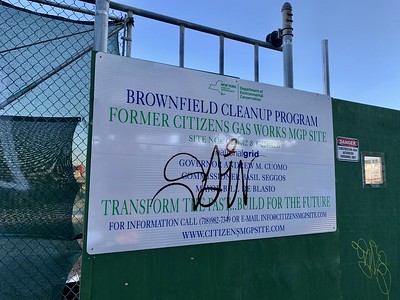
The responsibility for the clean-up falls on National Grid. The work is currently being done under the supervision of NYS Department of Environmental Conservation.

Since coal tar and contaminated groundwater have been found to ooze from the site into the Gowanus Canal for decades, the US Environmental Protection Agency, which declared the canal a Superfund site in 2010, has also been involved.

Though National Grid's contractor, Creamer Environmental, has been recently implementing remedial actions on the site. we are a long way from a clean environment.
Brownfield remediation consists mostly of removing the top layer of existing dirt, adding new clean fill, and installing a plastic vapor barrier before capping the contamination on the site with cement.

How well those sites are monitored and how long the barriers maintain their integrity is anyone's guess. As an example, the Lowe's site in Gowanus at 9th Street, which was also built on an MGP site but cleaned under the NYS Brownfield program a decade ago, was found to be in need of additional remediation by the EPA.

By far the biggest concern about housing on Brownfield sites is the intrusion of vapors into the structures.  According to Public Integrity.org

"Plastic vapor barriers and other soil containment measures are all that states require in some types of redevelopment.

But sometimes, such efforts fail or the science changes. New York’s Department of Environmental Conservation decided to reopen hundreds of Superfund, brownfield, and other sites that had been remediated to investigate potential new threats from vapor intrusion, something that had not been considered at the time of the “cleanups.” The reviews are ongoing, but the agency has already found mitigation will be necessary at more than 70 sites."

If Brad Lander refuses to even acknowledge to his constituents that Public Place will have a plume of coal tar underneath the site in perpetuity, we need tell him that we will hold him ultimately responsible for the health of everyone of the future resident and schoolchild he intends to bring here.

Perhaps he should listen to those who came before him. In 1984, a New York City Partnership withdrew its proposal to build moderate income housing on the site "because of serious environmental problems and exorbitant costs associated with developing the lot."

Read more

Friday, December 20, 2019

Parks Department Presents Updated Visioning Plan For Carroll Park, If You Can Call It A Plan

Untitled
Untitled
Untitled
Brooklyn Parks Commissioner Marty Maher
Untitled
Councilmember Brad Lander with Marty Mahr
Untitled
Assemblywoman JoAnne Simon
Untitled
Existing Conditions of Carroll Park
First Carroll Park conceptual design presented in September 2019
Untitled
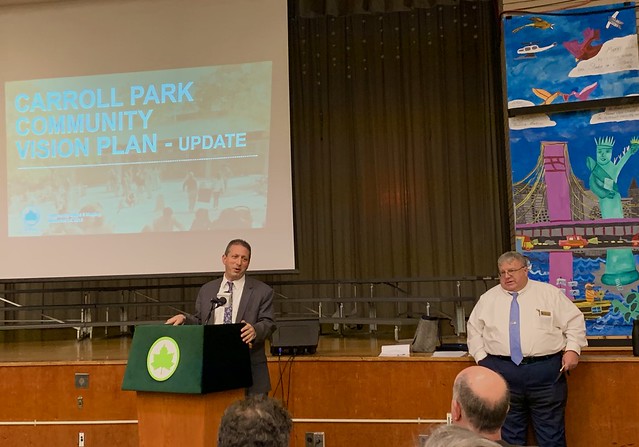
Updated Visioning Plan for Carroll Park, presented this past Wednesday.

The New York Parks Department came to PS58 in Carroll Gardens this past Wednesday evening to present their revised Carroll Park Community Vision Plan to the Community Board Parks and Recreation Committee. The meeting was not well attended, perhaps because it was held so close to the holidays and because of bad weather. That was a pity, since the discussion about a redesign for Carroll Park should involve as many local residents as possible.

The revised Carroll Park Vision Plan presented on Wednesday was created after gathering the community's ideas during the Public Workshop in February 2019 and after hearing the community's feedback at the CB6 meeting in September 2019.  It is fair to say that the community was less than enthusiastic about the first concept, because it would shift the play equipment and water features to the ball field at Court Street.
It was the loss of the multipurpose play area with its baseball and basketball features that prompted a big outcry from local residents.
However, as Brooklyn's Park Commissioner Maher explained in September and on Wednesday evening, much of the recreational and sports features in our park are now out of compliance and need much more space around them to meet current safety codes. In addition, no new equipment that needs to be anchored into the ground can be installed under the canopy of a tree since it could damage the tree's roots.
Given these new regulations and the fact that Carroll Park has many enormous old trees, the options of where to put play equipment and what features can be incorporated in a new design are limited.
With that in mind, Maher presented a revised concept sketch of the vision plan showing one way to incorporate the community's wishes. It was necessarily vague because there is no funding for a redesign at present and our community must continue to work toward consensus and a design which will not result in the loss of what we value most.

The redesign did try to honor the request for preserving most of the ball field as a multi purpose play area, but without the baseball field and fencing.  
In addition, the park house may be renovated, and the bathrooms made handicapped accessible. The area in front of the house would be set aside as a 'civic space' and for special events.
The central portion of the park where the World War 1 Memorial is located would stay pretty much the same as would the seating area along Smith Street.
There was also talk of changing the entrances to the park at Court Street, as well as the possible removal of the iron fencing around the park's periphery or replacing it with a lower one because of the Park's Department's current "Parks Without Borders" initiative.
No dog park will be incorporated into the design.

Carroll Park was last renovated in 1994. Normally, New York City parks get renovated every 30 - 40  years, depending on their use and their condition.There is currently no money set aside in the budget for a total renovation of Carroll Park. Therefore, any such renovation is still five to ten years, if not further down the road and would likely be done in several stages.
This round of visioning, was made possible with a grant of $25,000 by Councilmember Brad Lander.
The next steps, according to the Parks department is to use the current Vision Plan to advocate for funding. Once funded, further community input sessions will be held.

In the meantime, The Friends of Carroll Park will be hosting design workshops and conducting surveys to build consensus and support for new ideas like turning Carroll street into a play street and gaining access to the schoolyard at PS58 outside of school hours so please stay engaged in this issue. 
We have time to think outside of the box and come up with an improved plan, which will help the Parks Department to design an even better Carroll Park.

Read more

Sunday, December 01, 2019

Brad Lander's Brownfield Of Dreams Part 1: Our Councilman's Push To Build Housing And A School On The Most Polluted Site in Gowanus Is Folly

Untitled
Public Place on Smith Street near 5th Street
Untitled
Untitled
Untitled
Untitled
Untitled
Untitled
Screen Shot 2012-04-30 at 9.21.52 AM
A 1930 view of the former Citizens Gas Work Site on what is now Public Place
An arial view of the Citizens Gas Work site in 1926
Councilmember Brad Lander, supporter of housing on Public Place
Gowanus Green: a proposal for 1000 apartments and a school on permanently toxic land

By now, most residents in Gowanus and neighboring areas have hopefully heard about the proposal by the NYC Department of City Planning  to up-zone the Gowanus Canal area, which calls for 8,200 new units of housing that will bring approximately 20,000 new residents to the area.

The rezoning will likely go forward early next year as it moves through the Uniform Land Use Process (ULURP) despite the fact that it will still take years for the Canal to be environmentally remediated as part of the EPA Superfund Clean-up, and despite the fact that the City still uses the waterway as an open sewer and that the area's infrastructure is already stretched to its limits under current conditions. The area is also a FEMA Flood Zone A.

The ULURP process, once it starts, should take between six to nine months. If the rezoning goes through, developers who have already purchased the land around the Gowanus can start building 22 to 30 story high rises.

If this seems insane to most, the plan has nevertheless the backing of Councilman Brad Lander, who has supported the rezoning from the start.
Though it appears on the surface that Lander wants to make sure that "plans for growth are grounded fully in the public interest, and will achieve our shared goals", the rezoning of the Gowanus area was always a huge giveaway to developers despite all the talk about affordable housing units that may be gained in the process.

Which brings us to Public Place, the City-owned six acre Brownfield site near the intersection of Smith and 5th Streets adjacent to the Gowanus Canal. It is currently in NYC Department of Housing Preservation and Development portfolio.

Brad Lander has been pushing for the development of housing on Public Place from the moment he ran for City Council, if not before.  From 1993 to 2003,  he served as executive director of Park Slope's Fifth Avenue Committee, a not-for-profit community-based organization that develops and manages affordable housing.)

Interestingly enough,  in 2008, Fifth Avenue Committee, together with  Hudson CompaniesJonathan Rose, and the Bluestone Organization was selected to develop the site for affordable housing with retail space, community facilities and open space.
Fifth Avenue Committee's current executive director is Michelle de la Uz, who also currently serves as a Commissioner of NYC Planning Commission. If that is not a conflict of interest, what is?

Their proposal was named 'Gowanus Green' and included 774 units of housing, of which 70% would have been permanently affordable. To move forward, the site needed to go through a rezoning from manufacturing to residential, which never moved forward after the Environmental Protection Agency declared the Gowanus Canal a Superfund Site.

Gowanus Green has been revived of late since City Planning has wrapped Public Place into the framework of the agency's Gowanus Neighborhood Planning Study

The new plan for Public Place calls for 1000 units of 100% affordable housing in 30 story buildings as well as a new public school. 

This Monday, December 2, the NYC Department of City Planning and NYC Housing, Preservation, and Development  will be presenting an update on the Public Place / Gowanus Green site to Community Board 6 at PS 32.

Ahead of the meeting, Brad Lander's office released a statement that reads in part:
"The chance to build a sustainable, mixed-income community in Gowanus is one of the most important and unique opportunities of the Gowanus Neighborhood Rezoning. Gowanus sits in-between Carroll Gardens and Park Slope, two wonderful neighborhoods, with great schools, thriving commercial strips, great access to transit -- and almost no affordable housing. Gowanus Green offers us the opportunity to build hundreds of units of truly affordable housing, right at the heart of the neighborhood, to open up the opportunity of our dynamic community to a much wider range of people than can afford to live here now."

Affordable housing, additional parkland, a new public school...it all sounds great, until you consider the history of Public Place, which Brad Lander refuses to mention in his email to the community.


The truth is that to this day, Public Place remains one of, if not the most polluted site along the Gowanus Canal and needs extensive remediation.


From the 1860s to the early 1960s, the Public Place site was the home of the former Citizens Gas Light Company's 12th Ward Gas Work Plant, a Manufactured Gas Plant (MGP) where coal and petroleum products were turned into flammable gas. The gas was used for cooking, lighting, heating and commercial purposes in the surrounding neighborhoods.

Unfortunately, one of the by-products of this gasification process is coal tar, a black viscous liquid, which is harmful to humans and the environment. At Public Place,  coal tar has been found in significant amounts at depths of 150 feet.   

When the Citizens Gas Works plant was decommissioned in the 60s, the site was given to the city 'by condemnation' as public land in 1975. Hence the name "Public Place". Citizens Gas Light Company later sold to Brooklyn Union Gas, which became Keyspan, which is now National Grid.

The responsibility for the clean-up falls on National Grid. The work will be done under the supervision of NYS Department of Environmental Conservation.

Since coal tar and contaminated groundwater have been found to ooze from the site into the Gowanus Canal for decades, the US Environmental Protection Agency, which declared the canal a Superfund site in 2010, is also involved.
Though National Grid's contractor, Creamer Environmental, has been recently implementing remedial actions on the site. we are a long way from a clean environment.
Brownfield remediation consists mostly of removing the top layer of existing dirt, adding new clean fill, and installing a plastic vapor barrier before capping the contamination on the site with cement.

How well those sites are monitored and how long the barriers maintain their integrity is anyone's guess. As an example, the Lowe's site in Gowanus at 9th Street, which was also built on an MGP site but cleaned under the NYS Brownfield program a decade ago, was found to be in need of additional remediation by the EPA.

By far the biggest concern about housing on Brownfield sites is the intrusion of vapors into the structures.  According to Public Integrity.org

"Plastic vapor barriers and other soil containment measures are all that states require in some types of redevelopment.

But sometimes, such efforts fail or the science changes. New York’s Department of Environmental Conservation decided to reopen hundreds of Superfund, brownfield, and other sites that had been remediated to investigate potential new threats from vapor intrusion, something that had not been considered at the time of the “cleanups.” The reviews are ongoing, but the agency has already found mitigation will be necessary at more than 70 sites."

If Brad Lander refuses to even acknowledge to his constituents in a press release that Public Place will always have a plume of coal tar underneath the site, we need to tell him that we will hold him ultimately responsible for the health of every current and future resident, and every schoolchild he intends to bring to Public Place.

Perhaps he should listen to those who came before him. In 1984, a New York City Partnership withdrew its proposal to build moderate income housing on the site "because of serious environmental problems and exorbitant costs associated with developing the lot."

Untitled
Untitled


Brownfield of Dreams: A Film By Matt Sollars from 2008


PLEASE ATTEND!
Public Place/Gowanus Green Presentation to CB6
Monday, December 2, 6:30 PM
P.S. 32
317 Hoyt Street
Read more

Saturday, June 01, 2019

Landersville: Councilman Brad Lander Is Still Promising A Gowanus Rezoning That He Can't Possibly Deliver

Untitled
Untitled
Untitled
Combined Sewer Overflow on the Gowanus Canal after heavy rains on May 30th 2019
Untitled
Toxic oil slicks on the surface of the water
Untitled
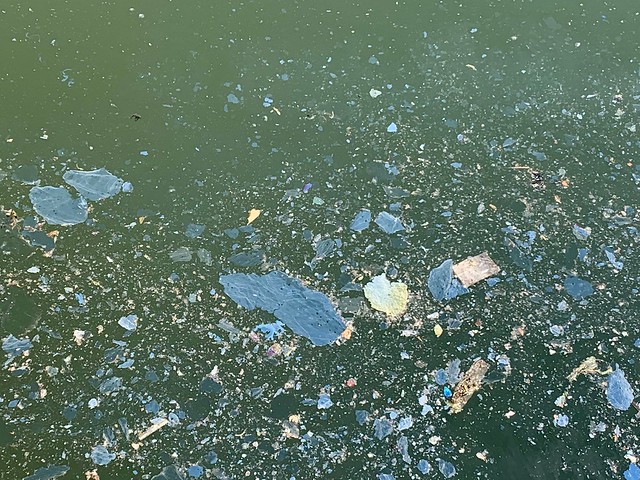
toxins, human waste and sanitary pad floating on the Gowanus
On May 30, 2019, NYC Councilmember Brad Lander, with his Council colleague Steve Levin, jointly released a summary of comments to NY City Department of City Planning(DCP) on the Gowanus Neighborhood Rezoning Draft Scope of Work for an Environmental Impact Statement. 
The proposed rezoning calls for 8,200 new units of housing that will bring approximately 20,000 new residents to the area.

Though it appears on the surface that Lander wants to make sure that "plans for growth are grounded fully in the public interest, and will achieve our shared goals", the rezoning of the Gowanus area was always a huge giveaway to developers despite all the talk about affordable housing.

The simple truth is that up zoning the Gowanus Canal area to allow more residential development without first dealing with its unique environmental challenges is a bad idea:
1) The toxic 1.8 mile long Gowanus Canal, an EPA Superfund site, still needs to be remediated.
2) The City of New York still allows raw sewage to drain into the canal during heavy rains and has yet to build Combined Sewer Overflow retention tanks mandated by the EPA to address current conditions.  The City has no plan in place to address the additional sewage of 20,000 new residents. which the EPA estimates to be 11x the current amount, once Gowanus is fully built out.
3. The area is a FEMA flood zone A and experienced severe flooding during Hurricane Sandy.

Why any representative would want to put his current and future residents in harms way is difficult to comprehend. 
Yet, Brad Lander is pushing the rezoning forward by promising the community a say in the outcome, by assuring residents that it will preserve and strengthen the “Gowanus mix,”  and by promising up to  3000 affordable apartments, many of them in a flood zone. To sweeten the deal, he claims to be pushing for "significant investments in NYCHA’s Gowanus Houses, Wyckoff Gardens, and Warren Street Houses."

Brad Lander knows fully well that City Planning does not have the tools in its toolbox to preserve light industry, the arts and cultural institutions in Gowanus once it becomes mainly residential.
In a mixed-use zone, residential development always takes over sooner or later, because that is where developers make the most money.  We find it quite ironic that Lander will throw himself a 50th Birthday Celebration/ Fundraiser for his Lander For NY coffers at the Royal Palms Shuffleboard Club in Gowanus on June 17, 2019.  The building housing the Shuffleboard Club is not likely to survive the rezoning, when it can be replaced by a 70 feet high structure.

Many of those 3000 units of affordable housing could be surrounded by water in just a few decades if scientists are correct about global warming and sea level rise.  This may make them even more affordable if nobody can or will want to live there as the water rises around them.

The promise of significant investments in Gowanus NYCHA housing rings especially hollow.  Lander, and especially Steve Levin had plenty of time during their three terms as NYC Council members.  The only capital that may be raised for improvements under their tenure is from selling NYCHA air rights to developers.

Lander and Levin can promise Gowanus area residents anything they want...their terms will be over at the end of 2021. The consequences of this ill advised rezoning will not be theirs to deal with.
All their current constituents can do is to remember not to vote for them next time they run for an office.
Levin seems to have checked out as Council member already and has not attended a Gowanus rezoning meetings in a very long time, preferring to let Lander handle things in his name. 
In the case of Lander, he is already actively campaigning  for the  New York City Comptroller spot.

Lander continues to support the Gowanus neighborhood up-zoning despite all the serious environmental issues that still need to be addressed.  Let us remember that he initiated it in the first place back in 2013, when he gathered the community and promised a truly community driven process. Most importantly, let us hold him responsible for the health and safety of those who will live in those new towers, in a flood zone.


Dear ....,
The Gowanus Neighborhood Rezoning presents a real opportunity to create a future for the area around the Gowanus Canal that is more sustainable and resilient, more inclusive and affordable, and that preserves and strengthens the vibrant mix of uses in the area today.
In order to achieve those goals, there is still a long way to go: In what must be rigorously analyzed in the Environmental Impact Statement, to make sure we have considered all the impacts. In changes to the rezoning proposal itself, to better share the benefits and mitigate any potential harms. And in related infrastructure and neighborhood investments to make the proposed growth work for the community.
That’s why Council Member Steve Levin and I worked together to give extensive comments to the Department of City Planning (DCP) on the “Draft Scope of Work” for the Environmental Impact Statement (EIS) for the proposed rezoning. The EIS is the next step in this long, thorough, and inclusive process.
More than five years ago, our community came together to outline goals for the future through the “Bridging Gowanus” community planning process. In 2016, DCP began working with the community, holding scores of meetings including large public sessions and issue-specific working groups open to all who were interested. Building on that work, in June 2018, DCP released Gowanus: A Framework for a Sustainable, Inclusive, Mixed-use Neighborhood. In January 2019, DCP released the Draft Zoning Proposal.
We are grateful to the hundreds of community members who have contributed many hours to shaping this vision, including long-time and newer homeowners, tenants, NYCHA residents, business owners, environmental activists, artists, affordable housing advocates, and more. This is one of the most engaged community planning processes our city has ever seen … and the future of Gowanus will be much better for it.
We are encouraged by many elements of the proposal that the Department of City Planning has put forward:
  • Innovative steps to require a more resilient and continuous waterfront, to advance and support the cleanup of the Canal, and to insure buildings with high environmental standards offer an opportunity for a sustainable and resilient neighborhood.
     
  • Plans to include a significant amount of affordable housing for low- and moderate-income families (estimated at 3000 out of 8200 units, or about 37%) in an area with extremely high housing prices, along with strong policies for preventing displacement, will generate a far more integrated and inclusive neighborhood than nearby Carroll Gardens or Park Slope.
     
  • The new incentive zoning for light industry, arts-related, cultural, and civic uses, along with preservation of mid-block areas for commercial and manufacturing uses, offers space to preserve and strengthen the “Gowanus mix.”  
At the same time, there are numerous areas where the proposal does not yet fulfill our shared vision, and where substantial improvements are needed.
  • The plan must prevent additional sewer overflows (CSOs) from flowing into the Gowanus Canal after rain events, and instead contribute to the canal’s Superfund cleanup (being overseen by the EPA) and broader restoration.
     
  • It must include significant investments in NYCHA’s nearby Gowanus Houses, Wyckoff Gardens, and Warren Street Houses.
     
  • It must strengthen light manufacturing, arts, and artisan uses inside as well as outside the Industrial Business Zone (IBZ).
     
  • It must include a plan to preserve historic buildings and connect people to that history.
     
  • Critically, the plan must include investments to meet the needs of a growing community for schools, transit, open space, flooding and resiliency, energy, and other infrastructure.
Planning for the future of our city is not easy. We are facing an ongoing affordability and inequality crisis, even as the city’s population continues to grow, so we need to build new housing, especially in neighborhoods like Gowanus that offer strong opportunities to connect to good schools, jobs, and transit. This recent Op-Ed in The New York Times by Farhad Manjoo helps make the case for why we need to be open to proposals like this, even if our first (and understandable) reaction is to fear growth and oppose additional development in our neighborhood.
But at the same time, we must make sure that plans for growth are grounded fully in the public interest, and will achieve our shared goals. That we are thoughtful about the impacts of climate change ... that we not only mitigate potential impacts, but actually create a more sustainable and resilient city. That we include the necessary infrastructure. And that we creates a community that is a great place for people across lines of difference to live, work, and raise families. 
It is therefore imperative that the Department of City Planning (DCP) rigorously and transparently analyze all anticipated development impacts and hold the Gowanus Neighborhood Rezoning to the highest standards for public infrastructure and sustainability, from transit and sewers to public schools and open space.
I hope you’ll take a minute to look at the comments that Steve and I submitted (and if you submitted comments, please share them with us as well).
While the Environmental Impact Statement analysis proceeds over the next few months, we’ll continue to engage the community on many of these elements, and we hope you’ll take part:
  • Preserving and renovating the Pacific Street Library: The Pacific Street Library is part of the “social infrastructure” that we want to see strengthened as part of the rezoning. (OK, we know it’s not in Gowanus, but since Fourth Avenue is included in the rezoning proposal, the library is in the rezoning area, which provides us an opportunity to invest there). The much-loved and well-used library, an architectural and community treasure, has extensive capital needs, and there are great opportunities to make it even better. Join us for a public meeting on Tuesday June 4 from 6-8pm at the branch to share what you love about the branch, and to help shape its future:
     
  • Gowanus IBZ Vision Study: City Planning will hold two “business roundtable sessions” in June to help develop a vision for the Gowanus Industrial Business Zone, to help make sure it can support job growth and businesses for many years to come. Gowanus business or property owners can complete an online survey here, to let DCP know about the benefits and challenges of doing business in the area and any improvements you’d like to see implemented. Learn more here.
There will also be more information soon about what buildings the City will propose for landmark designation, and many other critical elements of the plans for the future of Gowanus.
We pledge to make sure this is the most engaged community planning process possible, to get all the information we need, and to work together to make the best decisions for the future of our community. As always, we are eager for your feedback.


Read more

Tuesday, May 28, 2019

EPA Projects A 'Significant Increase' In CSOs Into The Gowanus Canal As Part Of Proposed Area Rezoning

The toxic Gowanus Canal, an EPA Superfund Site
Untitled
Christos Tsiamis, the EPA Senior Project Manager for the Gowanus Canal Superfund
and a recent Gowanus Superfund Community Advisory Group Meeting
Untitled
Untitled
Current conditions!
Raw sewage floating on the Gowanus Canal .

EPA Region 2  has sent  NY City Department of City Planning(DCP) its own comments on the Gowanus Neighborhood Rezoning Draft Scope of Work for an Environmental Impact Statement.(DSOW).

In a letter dated Thursday May 23, 2019, Christos Tsiamis, the EPA Senior Project Manager for the Gowanus Canal Superfund, is projecting a massive 11x increase in Combined Sewer Overflow into the canal as a result of the proposed neighborhood upzoning from manufacturing to residential.

The EPA does not get involved in land use issues. However, as Tsiamis mentions in his comments to NYC DCP, the Federal Agency is protective of its environmental remedies and will get involved if there is a risk of re-contamination to a Superfund site.

It will be interesting to see how New York City's Department of Environmental Protection and City Planning will try to engineer their way out of this, given the fact that the City has not yet managed to capture current CSOs into the waterway, let alone 11 times the amount.

Once again, it would appear that EPA is stepping in to protect the environment and the health of the  Gowanus community. The same cannot be said about Mayor deBlasio, as well as Councilmen Brad Lander and Steve Levin, who are all pushing for the rezoning before environmental remediation.

Here are EPA's comments.

The Environmental Protection Agency (EPA) has reviewed the Environmental Impact Statement (“EIS”) scoping documents, including the “Gowanus Neighborhood Rezoning and Related Actions Draft Scope of Work for an Environmental Impact Statement,” March 22, 2019, that were issued by New York City (“City”) for public comment. The proposed rezoning affects an area on and around the Gowanus Canal.

EPA does not have a role in local land-use or zoning decisions. However, understanding local land use is an important component in EPA’s planning of response actions under the Comprehensive Environmental Response, Compensation and Liability Act (“CERCLA” or “Superfund”). EPA also has a role in ensuring that future land use changes do not adversely affect the integrity of Superfund cleanups. With that context, EPA offers the following comments on the EIS scoping documents.

Background:

The Canal was constructed by bulkheading and dredging a tidal creek and wetland. After its completion in the 1860s, the Canal quickly became one of the nation’s busiest industrial waterways. As a result of decades of direct and indirect discharges of hazardous substances generated by industrial and other activities, the Canal became a repository for untreated industrial wastes, raw sewage, and runoff, causing it to become one of New York’s most polluted waterways.

Following a request from the New York State Department of Environmental Conservation (“NYSDEC”), EPA placed the Canal on the Superfund National Priorities List in March 2010. The Gowanus Canal Superfund Site (“Site”) is defined as the approximately 100-foot wide, 1.8-mile-long canal located in the borough of Brooklyn, Kings County, New York, and also includes any areas that are sources of contamination to the Canal.

In 2013, EPA issued a Record of Decision (“ROD”) for the cleanup of the Canal that included the dredging and off-Site disposal of the contaminated sediment in the Canal, the placement of a multilayer absorbing cap to prevent dissolved contamination from moving with the groundwater into the Canal waterbody, and the control of contamination from upland sources to prevent the recontamination of the clean Canal.

Such upland sources include certain levels of hazardous substances found in solids discharged into the Canal during Combined Sewer Overflow (“CSO”) events when stormwater and sanitary sewage capacity is exceeded within the approximately 1,758-acre Gowanus Canal watershed.

The CSO portion of the EPA-selected remedy includes the construction and operation of two CSO retention tanks by the City, a Potentially Responsible Party (“PRP”) for the Site. The City is currently preparing the CSO remedy design pursuant to two EPA administrative orders[1] and participating in the dredging and capping remedial design, for which work in the upper portion of the Canal is targeted to begin in 2020. Progress on the Canal cleanup is among the factors cited by the City in proposing the rezoning.

In anticipation of potential redevelopment, the ROD requires that any future activities which fall under the City’s purview, including development, do not compromise the effectiveness of the Gowanus Canal remedy. Among other things, the ROD specifically states that “redevelopment projects will need to take mitigation measures to prevent or offset additional sewer loadings” to the Canal to protect the remedy.

EPA review of EIS Scoping Documents:

EPA has reviewed the EIS scoping documents from the perspective of ensuring that the EIS process includes the proper assessment of and mitigation planning for any impacts that the rezoning actions may have on the effectiveness of the selected remedy.

In reviewing the EIS scoping documents, EPA notes that the City preliminarily projects a significant increase in the wastewater generation in the neighborhood as a result of the proposed development. Specifically, for residential development, wastewater generation is estimated to increase from 178,795 gallons per day (“gpd”) at present to 1,977,302 gpd once the proposed development has been completed. (See Gowanus Neighborhood Rezoning and Related Actions at Table B-1).

The EIS process should accurately determine the incremental volume of CSO-related discharges to the Canal and what appropriate mitigation measures, or combination of measures, are required to prevent an adverse effect on the EPA-selected remedy for the Canal.

EPA intends to work cooperatively with the City to ensure that the rezoning process is conducted in a manner that is, with respect to the Canal, protective of human health and the environment.

Sincerely,
Christos Tsiamis
Senior Project Manager
New York Remediation Branch
USEPA, Region 2


The EPA Gowanus Canal Community Advisory Group will be meeting tonight at 6:30 pm at Mary Star of the Sea, Mary Star of the Sea, 41 1st Street

This is what a Gowanus Canal CSO event looks like!

SAY NO TO THE GOWANUS REZONING!
Read more

Monday, April 01, 2019

Gowanus Politics: A Panel Discussion On Landersville You May Want To Attend

A reader just made me aware of a panel discussion held by School of Constructed Environments at Parsons School of Design this coming Thursday in Manhattan entitled Gowanus Politics; Community Approaches To Designing Sustainable and Equitable Cities .

We are posting it here to encourage Gowanus residents to attend. It behooves all  of us to make sure that such discussions on the proposed up-zoning do not get highjacked by Councilman Brad Lander and by organizations that claim to speak for the community, especially because some of them receive money from New York City and from developers. 

Here is a description of the event:
The pressure is on – massive population displacement is forcing cities to develop areas that are scarred by 19th and 20th century industry, have insufficient infrastructure, or are at risk with the rapid environmental changes wrought by global warming. If we want to create sustainable and equitable development amongst these conditions, Designers must get political. An Architect, a Lighting Designer, an Activist, an Environmental Steward, and a Politician, present ongoing work, both realized and theoretical, happening in Gowanus Brooklyn, showing the potential for community-based and cross-disciplinary approaches to design and planning.

Speakers: Andrea Parker (Executive Director of the Gowanus Canal Conservancy), Catherine Zinnel Deputy Chief of Staff, New York City Council Member Brad Lander,  David Briggs (Founder Gowanus By Design / Principal at Loci Architecture), Zac Martin (Founder of Trellis), Alexandra Pappas-Kalber (Part-time Faculty MFA Lighting Design / Principal at Sighte Studio)


Host: Francesca Bastianini (Part Time faculty, MFA Lighting Design / Principal at Sighte Studio)

Could Councilmember Lander and the organizations mentioned above still argue that the upzoning "offers a potential community-based approach to design and planning? "

Those in the community, who spent hours at Lander's Bridging Gowanus sessions, may beg to differ.
Bridging Gowanus was advertised as "a community planning process to shape a sustainable, livable, and inclusive future for the Gowanus neighborhood-in the face of ongoing change, the Superfund clean-up, and real estate pressure."
Instead, it has now become clear that New York City's Gowanus Draft Zoning Proposal, which claims to have incorporated the community's wishes into account, is a big fat lie and a give-away to developers.

Nothing in the proposed upzoning guarantees us new schools, better infrastructure,  studios for artists,  or, most importantly, environmental remediation that would adequately address the fact that the City has no plans to capture the additional Combined Sewer Overflow that will  continue to flow into the Gowanus Canal after the rezoning.

Neither does the plan address the ever worsening floods due to climate change  which have caused billion dollar disasters in coastal cities  like New York.

Gowanus Politics; Community Approaches To Designing Sustainable and Equitable Cities 
THURSDAY, APRIL 4, 2019 AT 6:00 PM to 8:00 PM 
2 West 13th Street, Sky Room, L12012 West 13th Street, 10011, 12th floor


Additional reading:
Read more

Thursday, April 12, 2018

Camouflaged With #METOO Legislation, Eminent Domain Acquisition Of Sites In Gowanus For C.S.O. Tank Easily Sails Through City Council

Untitled
Untitled
Untitled
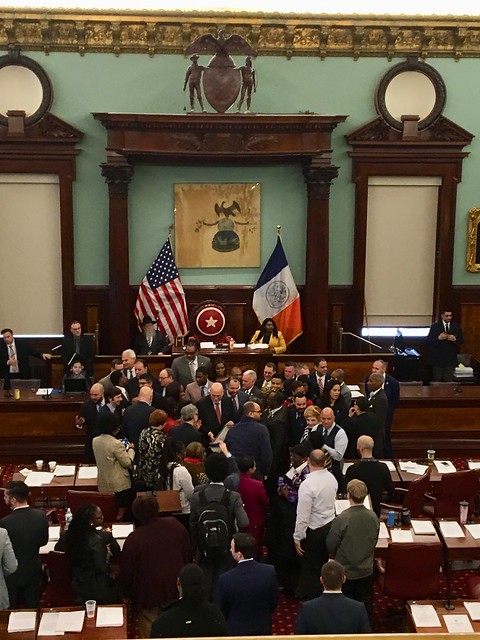
Councilman Steve Levin at yesterday's vote at City Council
Untitled
Untitled


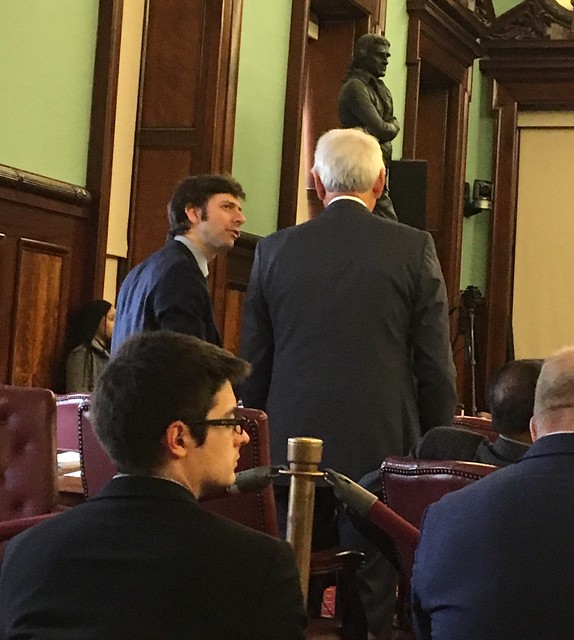
Kevin Clarke of D.E.P. testifying in front of 
Video courtesy of New York City Council
Always an engaged citizen and someone who likes to see things through, I took the time to attend
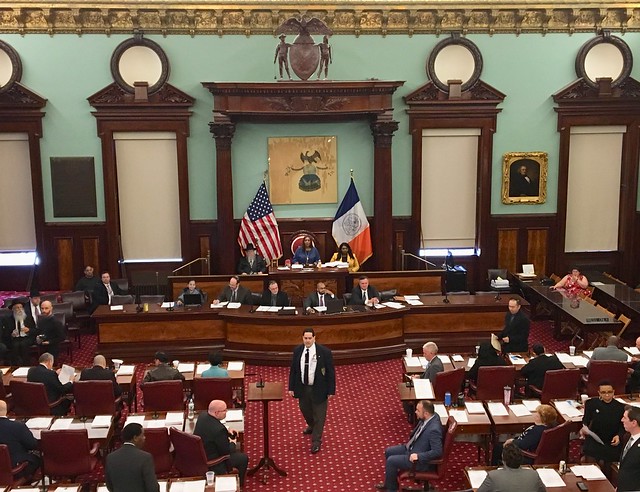
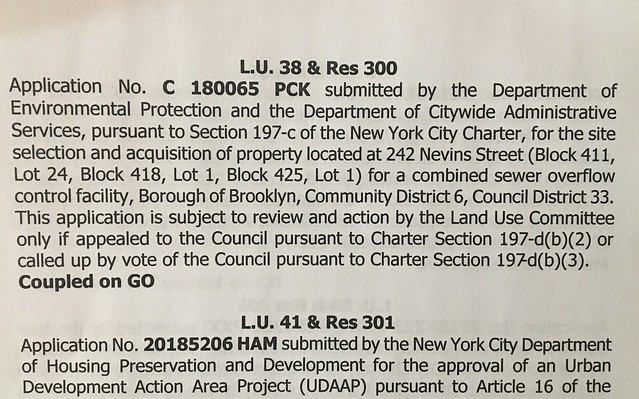
New York City Council's meeting yesterday afternoon.  On the agenda was a vote on an important Gowanus issue that I have written about on this site from the very beginning: an application by the New York City Department of Environmental Protection for the proposed site selection and acquisition of three privately owned properties at 242  Nevins Street, 270 Nevins Street, and 234 Butler Street "to facilitate the construction of the “Head End Facility” as part of the larger project to construct combined sewer overflow (“CSO”) control facilities to reduce the volume of untreated wastewater entering the Gowanus Canal."
This project is located in Council Member Stephen Levin’s district, who attended the meeting. His colleague, Councilmember Brad Lander, whose district covers a larger section of the Gowanus Canal, was absent.

This land acquisition at the head of the canal only accommodates an 8 million gallon CSO retention tank mandated by the Federal government as part of the Environmental Protection Agency's Superfund clean-up of the polluted waterway.  D.E.P. also has to construct a 4 million gallon tank in the middle portion of the canal, in Councilmember Brad Lander's district.

At a hearing of the City Council's  Subcommittee on Landmarks, Public Siting and Maritime Uses on March 12, 2018, D.E.P.'s Kevin Clarke testified that the cost for the entire 'program' that includes both tanks is estimated to reach $1.2 Billion.  That is more than twice the entire cost of the Superfund Clean-Up, which E.P.A. estimates at $500 million.
The estimated cost for the acquisition of the sites at the head of the canal is $90 million, according to Clarke, with an additional $400 million for the construction of the 8 million gallon tank.
(I am really, really not good at math, but that would mean that the smaller tank will cost $700 million? How is that possible?)
Please keep in mind that the EPA estimated the cost at $77 million for both tanks, suggesting that they be build on land already owned by the City to keep cost down.

Given what amounts to a "remarkably expensive endeavor" (Councilman Levin's words),
I had hoped for an animated discussion on the item from his fellow Councilmembers.
After all, it is not every day that the City proposes to spend such a huge amount of money in two Councilmen's districts.

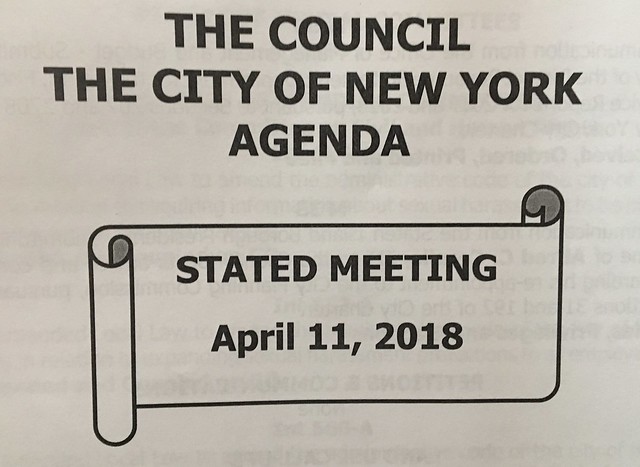
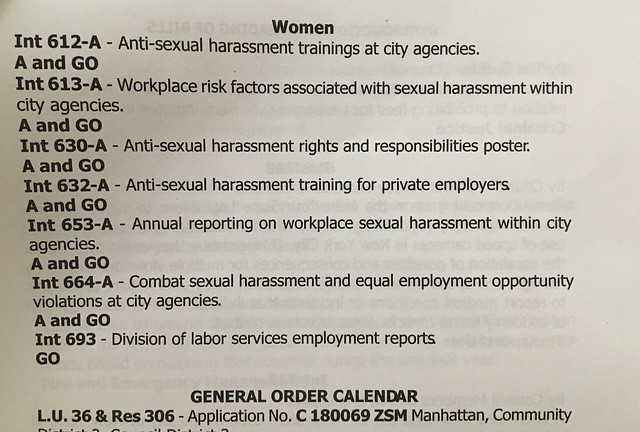
Imagine my surprise when I realized yesterday that application # C 180065 PCK for the site acquisition at the head of the canal was bundled together with at least 25 other items, safely camouflaged with several items pertaining to the “Stop Sexual Harassment in NYC Act".

Now, I applaud all the Councilmembers who voted overwhelmingly to support the #MeToo movement and secure protection from sexual harassment, yet one wonders if they were even aware that they were also voting for such a huge ticket item.
On the other hand, I may just be naïve. After all, such items are regularly slipped into bills and votes in Washington and Albany.

Please don't misunderstand me. I support the construction of both C.S.O. retention tanks. The City has to stop using the Gowanus Canal as an open sewer.  But the City which has ignored the pleas of the community to stop dumping raw sewage into our canal for decades now seems to want to line these tanks in gold.

Indeed, with a massive re-zoning of the Gowanus corridor that would allow the construction of residential buildings in this once vibrant industrial neighborhood, one has to wonder if the City  is instead planning what one Gowanus resident recently called "the Taj Mahal of sewer treatment facilities" to accommodate developers and their planned condos instead of two simple tanks as mandated by the E.P.A.

Read more

Monday, March 19, 2018

Affected By P.S. 32's Construction? Neighbors In Carroll Gardens/Gowanus Holding Community Meeting On The Matter Tonight


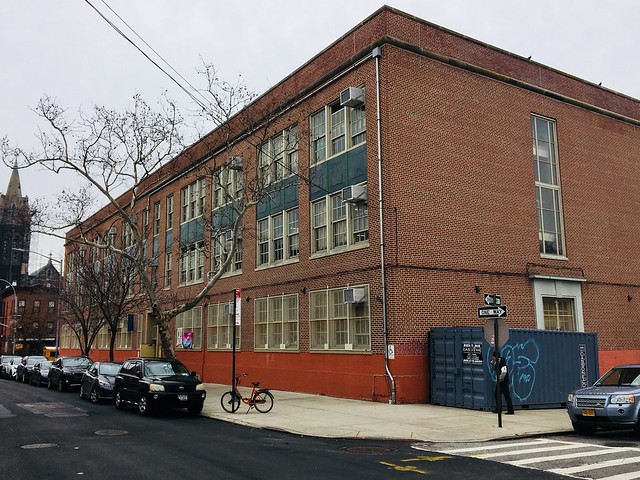
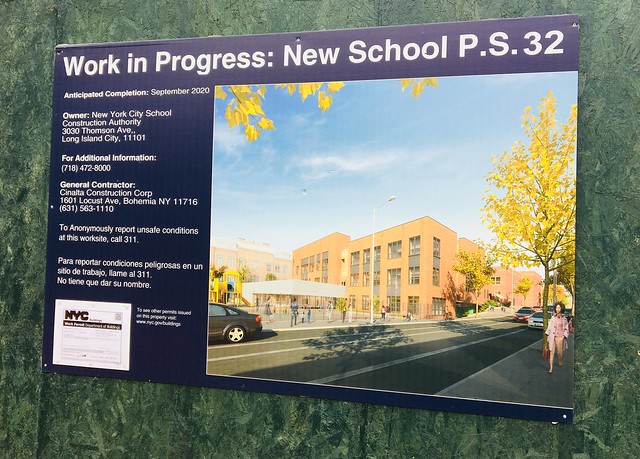
The construction project at  Public School 32, the Samuel Mills Sprole School, located at 317 Hoyt Street between Union and President Streets in Carroll Gardens/ Gowanus, continues to be loud and disruptive to those who live nearby.
Neighbors are organizing a meeting tonight, March 19 from 7 to 8 at PS 32, to seek answers from representatives of the NYC School Construction Authority and to ask for help from our local officials Councilman Brad Lander  and Assemblymember Jo Anne Simon.
The organizers of the meeting have also launched a new "P.S.32 Construction" Facebook Page here.  

The construction relates to the expansion of P.S.32 with a new three-story addition directly behind the current 1950's area structure. Designed by Edelman Sultan Knox Wood/ Architects, the addition will provide the school with approximately 200 additional seats and replaces the trailers that had being used for the lower grades at the back of the schoolyard.
The new building will house a large dining area, administrative offices, as well as pre-k and kindergarten on its first floor. Occupancy of this new wing is slated for September 2020.

In March 2017, the New York City School Construction Authority and Councilman Brad Lander held a joint public meeting meant to give neighbors of the school a chance to address their concerns regarding the construction. A similar meeting was held with parents of students.
At the meeting, Councilman Lander stated: "It is an indisputable fact that we need more school seats in District 15," he told local residents. "It is also an indisputable fact that it is a headache living near a construction site."
Yvette Knight, the Project Support Manager for SCA, assured local residents that her agency has managed many projects like this and "is very experienced in doing this kind of work with kids in the building." However, she added, "I am not going to sugar coat this. Please do not expect that there will be no noise."

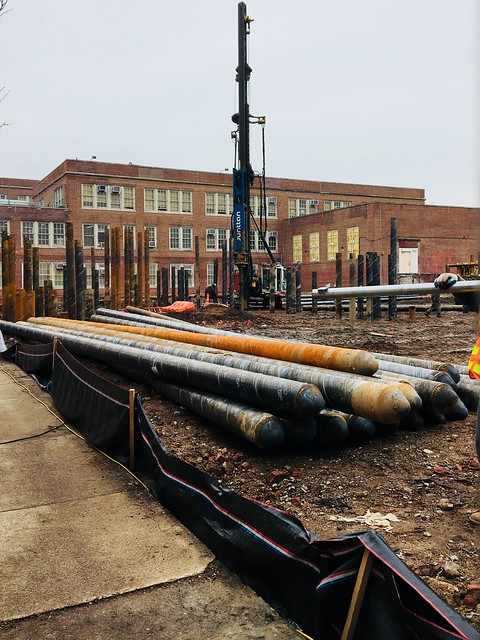
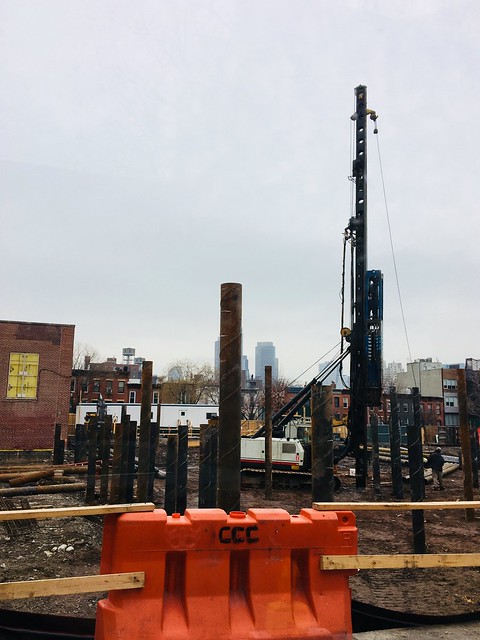
Construction began with the demolition of the trailers this fall. Currently, steel piles are being driven into the ground on the site of the new building. The piles are needed to stabilize a structure of this size, and are most probably an indication of the poor soil in the area. The noise from the pile driving has been reverberating all the way to Smith Street in Carroll Gardens and across the Gowanus Canal in Gowanus.  (One wonders how the kids in the school can even concentrate during classtime.)

Read more