Showing posts with label Gowanus Superfund. Show all posts

Tuesday, March 30, 2021

EPA Issues Administrative Order Requiring City to Construct Sewage Retention Tanks for Gowanus Canal Superfund Site Cleanup

The Environmental Protection Agency just issued the press release below,  stating that the Federal Agency has issued an important Administrative Order requiring New York City to construct two sewage retention tanks as part of the Gowanus Canal Superfund Site Cleanup.
This is great news for the Gowanus community, which has long demanded that the City of New York cease the use of the Gowanus Canal as an open sewer.

As part of the EPA Record of Decision for the Gowanus Canal Superfund clean-up, the EPA had mandated that the NYC Department of Environmental Protection construct two retention tanks to control untreated sewage from entering the canal during heavy downpours.

NYC DEP has tried to delay the tank's construction for the past few years. Just recently,  DEP's Commissioner Vincent Sapienza told EPA Region 2 that the completion date for the larger of the two tanks at the head of the canal would have to be pushed back to 2032, citing "the impact of the Covid-19 pandemic on the city's finances and water revenues."

This EPA order legally compels the City to complete the smaller retention tank on the Salt Lot near 2nd Avenue in 2028 and the larger 8 million gallon tank by 2029.  If the City fails to comply to the order, it will face stiff fines.

It is important to note that the two tanks only address CSO discharges into the canal under current conditions. This is significant given the fact that NY City is currently pushing for a massive rezone that would bring about 20,000 new residents into the area. However, the EPA has publicly assured the community that will carefully monitor sewage discharge from any future residential development to insure that the City does not recontaminate the Gowanus Canal.


NEW YORK (March 30, 2021) 
The U.S. Environmental Protection Agency (EPA) ordered the City of New York (city) to construct and operate two Combined Sewer Overflow (CSO) retention tanks to control contaminated solids discharges at the Gowanus Canal Superfund site in Brooklyn, New York, which is a key component of the Gowanus Canal cleanup. The EPA’s order follows previous orders that EPA issued in 2014 and 2016 to require the city to find a location for and design the two tanks. Controls to reduce CSO discharges and prevent other land-based sources of pollution, such as street runoff, from compromising the cleanup are a critical part of the site’s cleanup plan.
“This order will ensure that EPA’s cleanup efforts will not be undermined by uncontrolled combined sewer overflow discharges that have contributed to the chemical contamination of this waterway and impacted this community for the past century and a half,” said EPA Acting Regional Administrator Walter Mugdan. “To ensure the integrity of the dredging work, the retention tanks will control New York City’s sewer outfalls over the long-term.”

The administrative order, issued on March 29, 2021, requires the city to construct one 8-million-gallon tank, located at the head of the canal, and one 4-million-gallon tank, located at a New York City Department of Sanitation Salt Lot near the middle of the canal.

The order also requires the city to, among other things:
• Ensure that developers comply with municipal stormwater regulations within the Gowanus area to prevent additional sewer volume from impairing the effectiveness of the CSO tanks; • Provide treatment for separated stormwater discharges;

• Perform monitoring of sewer solids discharges to ensure protection of the dredging remedy; • Perform associated maintenance dredging, if determined by EPA to be necessary; • Construct a bulkhead on City-owned property to prepare for the second phase of dredging work; and

• Adhere to an overall schedule for remaining tank design work and construction.

The 2013 cleanup plan for the Gowanus Canal Superfund site includes dredging to remove contaminated sediment from the bottom of the canal, which has accumulated because of industrial activity and CSO discharges. More than a dozen contaminants, including polycyclic aromatic hydrocarbons, polychlorinated biphenyls, and heavy metals, including mercury, lead, and copper, are present at high levels in the Gowanus Canal sediments. Dredged sediment that contains high levels of liquid tar will be thermally treated at an off-site facility and disposed. The less contaminated dredged sediment will be processed at an off-site facility to transform it into a beneficial use product, such as landfill cover. Certain areas of the native sediment, below the original canal bottom, that contain mobile liquid tar and are too deep to excavate, will be mixed with cement and solidified to prevent the migration of the tar into the water of the canal. Following dredging and solidification of areas of the native sediment, construction of a multilayer cap in dredged areas will isolate and prevent migration of any dissolved chemicals remaining in the deep native sediments.

To view EPA’s administrative order, as well as other information and documents concerning cleanup activity and EPA’s efforts at the site, please visit www.epa.gov/superfund/gowanus-canal Follow EPA Region 2 on Twitter at http://twitter.com/eparegion2 and visit our Facebook page, http://facebook.com/eparegion2
Read more

Thursday, February 28, 2019

"The Gowanus Is Dirty": New Web Site Highlights Why Neighborhood Rezoning Is Dirty Politics

A new informative web site with the clever address www.thegowanusisdirty.com  just went live and if you live in Gowanus, Carroll Gardens, Boerum Hill and Park Slope, you should check it out.
The web site's aim seems to be to keep the community in the loop on the proposed rezoning that will line the Gowanus Canal area with 22-story buildings and will bring an approximate 20,000 new residents to the area.
The so far- anonymous owners of the site call the rezoning "dirty politics' and back up the claim with several facts:

Fact 1: from The Gowanus Is Dirty::
As part of the New York State’s brownfields program, developers who build apartment towers along the canal, on Bond and Nevins streets, will not only be reimbursed for the price to clean up the toxic land, but they’ll also be handed taxpayer dollars to cover at least 10% of their building costs, up to $35 million dollars each.

The developer of the luxury towers on Bond between Carroll and 1st streets has already been given over $7 million dollars of taxpayer funds. And because of NYC’s 421a, the developers themselves won’t have to pay any property tax for 10 years.


Fact 2:
The rezoning plan will allow for at least 10 new residential towers to be built along Bond and Nevins St., each up to 22 stories high, with four times as many expensive luxury apartments as affordable ones. These towers will likely bring at least 20,000 new residents to our neighborhood, DOUBLING the population of Gowanus, destroying the liveable neighborhood we know and love forever.

Fact 3:
When the City first presented their Gowanus Rezoning plan, in June of 2018, the new residential towers along the canal were limited to being 14 stories high. But the developers wanted more—much, much more— and so they “lobbied” (gave money to) our electeds. And guess what? In February, a new plan was presented that allows for towers up to 22 stories high on almost all of the rezoned blocks around the canal. So who are our electeds working for, anyway?

The Gowanus Is Dirty site also provides pdfs for the fact sheets along with a protest poster.
Our protest poster has already been printed out and will be hung in the window shortly.


And as a reminder:
The Dept of City Planning Presents its Gowanus Rezoning Plan tonight:
Thursday, Feb 28 at 6pm
PS 133, 610 Baltic St at 4th Ave

Be There!


Read more
Wednesday, October 25, 2017

Spring For Gowanus Canal: By May 2018, For The First Time In Over A Century, A Section Of The Waterway With Be Clean.

Untitled
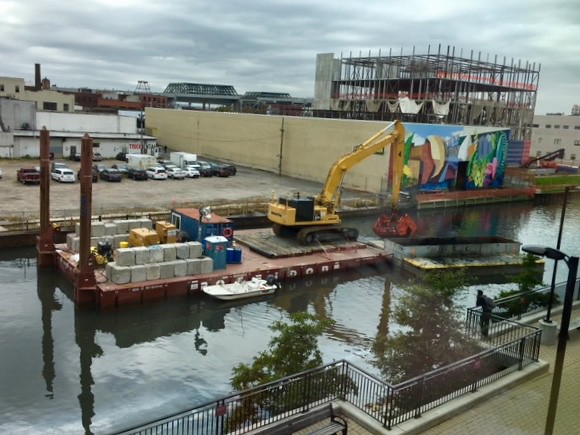
Work currently going on in the 4th Street Turning Basin
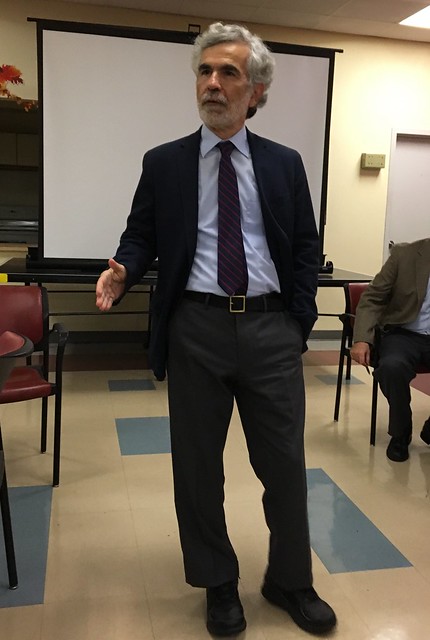
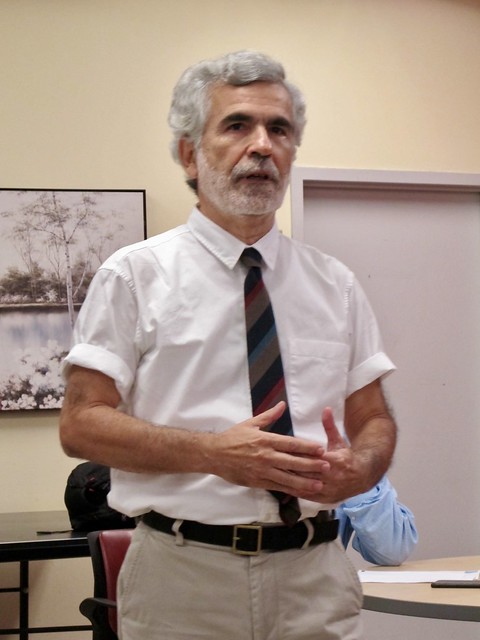
Christos Tsiamis
EPA Senior Project Manager for the Gowanus Superfund
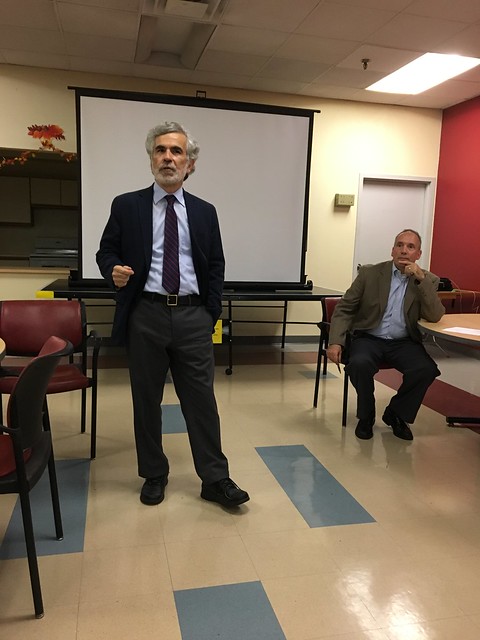
Tsiamis with Doug Sarno, Gowanus Canal CAG facilitator

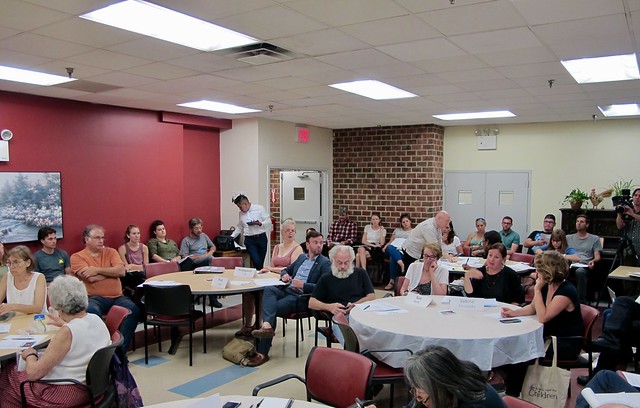
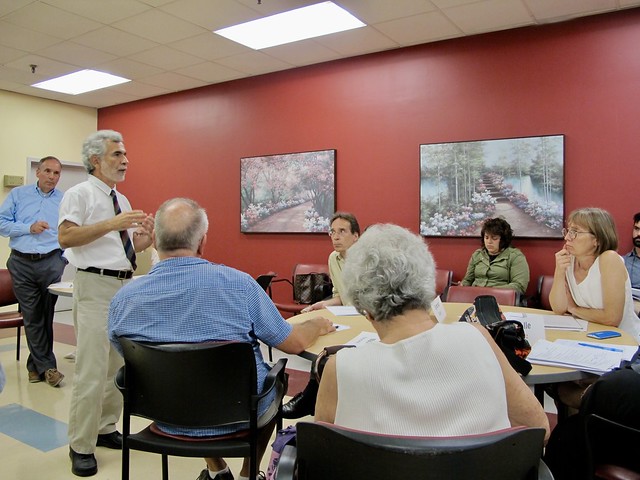
Christos Tsiamis, the Environmental Projection Agency's Senior Project Manager for the Gowanus Superfund attended last night's Gowanus Canal Community Advisory Group's meeting to give an update on the clean-up of our polluted canal.

As you might have noticed, there has been quite a bit of activity on the Gowanus Canal at the 4th Street Basin (TB4), located at the intersection of 4th Street and 3rd Avenue next to the Gowanus Whole Foods. As of the beginning of October, heavy equipment and barges have been moved into the basin to perform preparatory work ahead of Phase Two of the Dredging and Capping Pilot Study, which will begin in a little over a month from now.

The preparatory work consists of dredging an 'access channel' to allow larger vessels to work in TB4, and to install bulkhead support to strengthen the existing bulkheads during the excavation of soft sediment during the pilot study.

The second phase* of the Pilot Study will take place roughly from December 2017 to May 2018. It will consist of dredging the contaminated material at the bottom of the Turning Basin, to screen the material, to remove debris, to stabilize the sediment to render it harmless, and to barge the stabilized material to an off-site facility by barge.
Finally, a multi-layer  protective cover will be placed on the bottom of the canal to prevent re-contamination.  The study will take place roughly from December 2017 To May 2018.

Once the pilot study is completed, all information gathered will be analyzed and incorporated into the design for the entire environmental remediation of the canal from top to bottom. "Then we are, so to speak, off to the races. From then on, it will be a continuous process" according to Tsiamis.

"I don't know if you have realized it, folks, but this is the real deal! Pay attention to this. By the time we finish the pilot study at the end of spring 2018, for the first time in over a century, there will be a clean portion of the canal. It will be spring, and spring for the Gowanus Canal, also," Christos told members of the CAG, who applauded the news loudly.
"You dreamt about a clean Gowanus, we dreamt of a clean Gowanus. We would like for the community to pass around the news."

*The first phase of the Pilot Study was carried out in October 2016 and consisted of clearing debris from the basin which obstructed navigational access. (for photos of the intriguing objects and material dredged up can be found here.)


Read more
Wednesday, September 27, 2017

Gowanus Superfund Update: EPA Ready To Begin Phase 2 Of Pilot Study At Fourth Street Basin Near Whole Foods

IMG_1006
IMG_1017
Christos Tsiamis
EPA Senior Project Manager for the Gowanus Superfund
IMG_1020
Brian Carr, EPA Region 2 Legal Council
IMG_1012
Doug Sarno, Gowanus Canal CAG facilitator
IMG_1022
IMG_1166
4th Street Basin next to Whole Foods in Gowanus
34214222000_34450d4392_k
Get ready to see a lot of activity on the Gowanus Canal related to the U.S. Environmental Protection Agency Superfund clean-up of our polluted waterway.

"We are at a point where the community will see work happening in the canal"
Christos Tsiamis, Senior Project Manager for the Gowanus Superfund site told members of the Gowanus Canal Community Advisory Group at its September meeting last night.

Tsiamis explained that the second phase of a Pilot Study will begin shortly at the 4th Street Turning Basin, located at the intersection of 4th Street and 3rd Avenue next to the Gowanus Whole Foods. The work will comprise dredging the toxic black sediment at the bottom of the basin and capping it to prevent recontamination. The results of this work will inform EPA and help fine-tune different techniques that will eventually be applied to the entire canal.

You may remember that the first phase of the Pilot Study was carried out in October 2016 and consisted of clearing obstructions from the basin which obstructed navigational access.  (for photos of the intriguing objects and material dredged up can be found here.)

Starting next week,  equipment will be moved into the 4th Street Basin.  By October 5th, preparatory dredging will take place  to create enough depth in the basin so that barges can be moved further onto the site.  At the end of October,  both shores of the basin will be stabilized with bulkheads, and by the first week in December,  the actual dredging will begin.  
"The dredging will take at least two months," Tsiamis told CAG members. 
It will be followed by placing the cap.
"The entire pilot study will take us to the end of April, beginning of May," Tsiamis explained.

During the study, as throughout the entire clean-up process, the EPA will use Public Place, the large City-owned site at Smith Street and Huntington Street, as a staging area.

EPA Region 2 will prepare an official fact sheet shortly that will inform the community of the schedule for this work. As soon as we receive a copy, we will post it here.


Read more
Friday, April 15, 2016

A Moment In Time: Superfun(d) Picnic On The Shores Of The Gowanus

IMG_7492
Screen Shot 2016-04-15 at 3.51.52 PM
An elementary school excursion to the shores of the Gowanus Canal, complete with picnic.
Teaching youngsters about contaminants and sewer outflows.
Bon appétit.


Read more
Wednesday, March 09, 2016

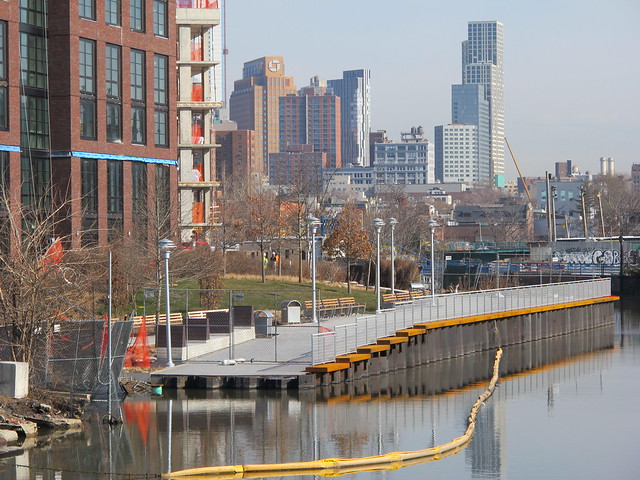
Today's Extra-High Spring Tide Caused Gowanus Canal To Breach At Second Street Near Lightstone Group's Residential Building

(photos courtesy of Frederic Gindrey)

Today, March 9, an extra-close new moon, also called a "Supermoon", created a higher-than-usual tide, which could be observed in the Gowanus Canal. The phenomenon, also called perigean spring tide,  was captured in photos this morning at about 8:30 am by Carroll Gardener and friend Frederic Gindry.
The photos were taken from the Third Street Bridge and the Carroll Street Bridge and show that water level was extremely high.

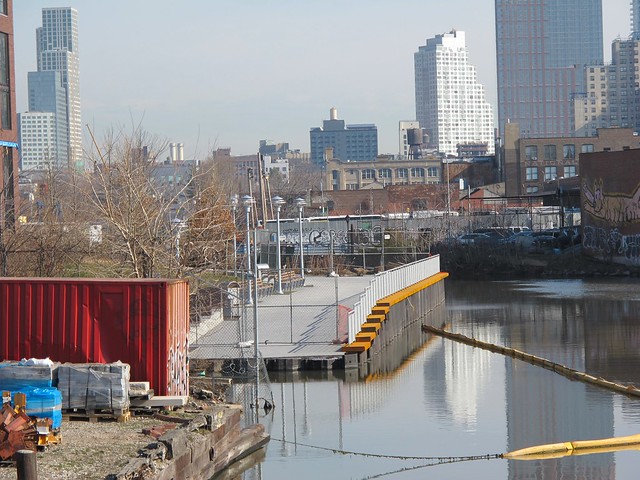
As can be seen on the last photo, the high tide caused the canal to breach its bank at Second Street right next to the Lightstone Group's 700 unit residential development.  The polluted water also appeared to be sweeping over parts of the new promenade in front of the development.

High tide will return tonight and will be even higher tomorrow, March 10th, before returning back to normal.  Luckily, it is not going to rain in the next day or two. Otherwise, Gowanus residents would have a big problem.

However, it does not take a 'super moon' or a perigean spring tide to cause flooding at 2nd Street near the new development.
Friend Martin Bisi sent me the photos below, which he took the night of February 24th, after a day of steady rain. Again, one can clearly see that the Gowanus overflowed at 2nd Street and that the promenade is partly submerged in Gowanus water.
The Gowanus, of course, is an EPA Superfund, which means that contact with its polluted water is not a good idea.
Pretty scary stuff considering that the first tenants will be moving into the development within the next few weeks.

 (photo credit: Martin Bisi)


****Update****
I took some more photos this morning, March 10th, at about 9 AM during high tide. I walked down Second Street towards the canal, but was stopped by construction workers.  I was able to take the one photo below that shows some flooding from the canal near the building at 365 Bond Street . The crew did say that the water front promenade will be open to the public in early April.
IMG_7165
IMG_7166
IMG_7162
IMG_7161
IMG_7159
IMG_7158

I also would like to share an email that I received this morning from Brian Carr of United States Environmental Protection Agency Region 2 regarding the spring tide and the photos of the Gowanus Canal.  He writes:
Just a clarifying note on the supermoon tide story and photos, purely as background info. 
The photos as described are unintentionally a bit misleading.


The end of 1st Street where the gravel is has not been completed, but will be an intertidal habitat area that is supposed to get wet. The bulkhead is lower in this spot on purpose. I believe it will planted when it is completed. It’s supposed to compensate for the encroachment of the new bulkhead into the canal.


The end of 2nd Street is the Sponge Park, which is still under construction I believe, so that street end is more open to flooding. Although I’m not 100% familiar with the final design, I’m pretty sure that this street end will be lower like 1st Street is, which is why the bulkhead steps down to 2nd Street. Part of the “Sponge.”

That said, the elevation change from the supertide to the Lightstone buildings is about 6 feet, and the water is indeed not clean, with contamination and pathogens.


Here is a bit more about spring tides from Earth Sky.Org:
"Spring tides accompany March 2016’s supermoon. Will the tides be larger than usual at the March, April and May new moons? Yes, all new moons (and full moons) combine with the sun to create larger-than-usual tides, but perigee new moons (or perigee full moons) elevate the tides even more.

Each month, on the day of the new moon, the Earth, moon and sun are aligned, with the moon in between. This line-up creates wide-ranging tides, known as spring tides. High spring tides climb up especially high, and on the same day low tides plunge especially low.

The March 9 extra-close new moon will accentuate the spring tide, giving rise to what’s called a perigean spring tide. If you live along an ocean coastline, watch for high tides caused by the March, April and May 2016 new moons – or super moons."

Will these high tides cause flooding? Probably not, unless a strong weather system accompanies the perigean spring tide. Still, keep an eye on the weather, because storms do have a large potential to accentuate perigean spring tides.


Read more
Monday, February 09, 2015

Gowanus Canal Superfund Community Advisory Group To Meet Tomorrow And On February 24

IMG_2933
The Gowanus Canal Superfund Community Advisory Committee (CAG) will be meeting tomorrow evening February 10th at 6:30 at Mary Star of the Sea Senior Center, 41 First Street.

Representatives of the Environmental Protection Agency will be on hand to give an update on upcoming activities on the Canal.
The CAG's Water Quality/Technical Committee will also be discussing its response to NY State's Department of Environmental Conservation's proposed amendments to 6 NYCRR Parts 701 and 703 for Class I and Class SD waters regarding Class 1 and SD waterways to meet the "swimmable" goal of the federal Clean Water Act.
These proposed amendments will have a positive impact on the Gowanus Canal.

The CAG will also be holding a meeting on February 24 at 6:30 (location to be announced)
Councilmember Brad Lander will present the results of "Bridging Gowanus", a  proposed framework for the future development of the Gowanus area.

All CAG meetings are open to the community and I urge everyone to attend.


Read more
Wednesday, November 13, 2013

REMINDER: EPA To Hold Two Informational Meetings About Final Plan To Address Gowanus Canal Contamination This Week

-1
Environmental Protection Agency Region 2 will holding two information meetings on two consecutive nights in November to speak about the Record Of Decision (ROD) that was signed and became law in late September.  The ROD represents the blueprint for the clean-up of the heavily polluted 1.8 mile waterway.
According to the agency, "the purpose of the meetings are to discuss the next steps EPA will be taking to address contamination at the Gowanus Canal Superfund site."

The first meeting will be held tonight, November 13th, 2013 at PS 32, 317 Hoyt Street from 6:30 to 9 PM.
The second one will be held on November 14th in Red Hook at the South Brooklyn Community High School, 173 Conover Street.

The entire Gowanus Canal Superfund Record Of Decision can be accessed here.

Please share this information with your neighbors.


Read more

Monday, June 10, 2013

"It Only Takes 1/10th Of An Inch Of Rain": Flyer Spotted On Smith Street Warns Of CSO Events

IMG_3026
IMG_3025
IMG_3023
IMG_3024
I spotted the flyer above, taped to a pay phone on Smith Street, last Friday. It seemed appropriate since Tropical Storm Andrea was dumping upwards of four inches of rain on the Metropolitan area that day, and breaking previous rainfall records all along the Northeast.
No doubt, the heavy rains flooded quite a few basements in the area, especially in Gowanus,

And today, it's raining heavily once again.

No group or individual took credit for the flyer and it was the only one I spotted on Smith Street.

Its message, however, is relevant and important for this area. As many of you know, New York City has an antiquated combined sewer system, which means that rain run-off from streets and roofs get collected in the same pipes with domestic sewage, and industrial wastewater, which lead to a waste water treatment facility.

The Red Hook and Owls Head Wasterwater Treatment Plants are responsible for our area. However, when the facilities exceed their capacity because of flash floods or heavy rainfall, the excess waste water is discharged into the Gowanus Canal.

There are currently 10 active Combined Sewer Overflows (CSO) and three storm water outfalls that dump directly into the canal.
The largest and most significant outflow is RH-034, which is located at the head of the canal. RH-034 contributes an annual discharge of roughly 121 million gallons.
(Who can forget the 2010 video of the CSO event at RH-034 )
The CSOs aren't just an embarrassment to New York City, they represent a significant risk to human health and to wildlife.

Though the City is currently working on upgrading the Gowanus Canal Flushing Tunnel and Waste Water Pumping Station, the upgrades will only reduce Combined Sewer Overflows into the canal by approximately 34%.

The Environmental Protection Agency has declared the 1.8 mile man-made canal a Superfund Site. The Agency has proposed a comprehensive cleanup plan to address the many decade’s worth of toxic sludge at the bottom at the canal as well as the ongoing pollution from upland sites adjacent to the waterway. In order to ensure continued protection of the canal once it has been remediated, the EPA has determined that future permanent CSO sediment controls are required. The agency has roposed in-line retention tanks be constructed near outfalls RH-034 and OH-007, the two largest contributors of CSOs and solids into the Gowanus.
These retention basins would go a long way towards finding a real solution to the CSO problem.

Mayor Bloomberg and NYC's Department of Environmental Protection Agency's Commissioner Carter Strickland have poo-pooed the idea so far.

What can we do as citizens besides advocating for 100% cessation of CSOs into the Gowanus Canal?
On a rainy day like today or last Friday, don't contribute more waste water to an already overloaded system. Wait till after the rains to run your washing machine or your dishwater. That would already help a tiny bit.

The result of a CSO event on the Gowanus Canal

IMG_7249
IMG_7247
IMG_7243

A visual of CSO sludge accumulation from Outflow RH-034 at the head of the Gowanus Canal, clearly visible during dry weather during a low tide
IMG_2571
IMG_2597
IMG_2594
Gowanus Canal CSO Outflow Locations.
(EPA Map)
Read more

Monday, February 25, 2013

Upcoming Meeting Of EPA Gowanus Canal Superfund Community Advisory Group

IMG_1813
The EPA Gowanus Canal Superfund Community Advisory Group (CAG) will be meeting on Tuesday
Feb. 26 at 6:30 PM at Mary Star of the Sea Senior Housing, 41 1St Street.
The meeting will focus on the Proposed Remedial Action Plan (PRAP), which was released in late 2012.

Just a reminder: the EPA will be accepting public comments on the PRAP till the end of April 2013.
Written comments on the proposed plan should be addressed to:

Christos Tsiamis
Project Manager
Central New York Remediation Section
U.S. Environmental Protection Agency
290 Broadway, 20th Floor
New York, New York 10007-1866
e-mail: GowanusCanalComments.Region2@epa.gov
OR, contact Natalie Loney, Community Involvement Coordinator, at 212-637-3639,

Also, for those interested, the CAG Archaeology Committee will meet on February 27th, 6:30 pm at Proteus Gowanus, 543 Union Street, Brooklyn
On the agenda: Review of PRAP and EPA archaeology documents.
All CAG meetings are open to the community.


Read more