Showing posts with label New York City. Show all posts

Tuesday, August 25, 2020

On the Hudson River To Red Hook: Schooner Apollonia Brings Carbon Neutral Sail Freight To New York City

This past Friday, something quite extraordinary happened. Captain Sam Merrett sailed into New York Harbor from Hudson, New York on his Schooner Apollonia. On board was cargo destined for area businesses, including Van Brunt Stillhouse and Strong Rope Brewery.  The freight was delivered and unloaded in Red Hook, which seems fitting, since Red Hook was once one of the busiest ports in the country.
Apollonia's voyage was entirely wind-powered and proves that sometimes, looking towards a green future means looking back to the past for solutions.

Here is more information on Apollonia and her cargo from a press release:

Sail freight returns to the Hudson- vessel lands maiden voyage in Brooklyn at GBX terminal
Schooner Apollonia Charts New Course for Green, Wind-Powered Shipping

RED HOOK, BROOKLYN – The schooner Apollonia, a new sail freight venture operating out of Hudson, New York, successfully delivered its first cargo of Hudson Valley goods to New York City on Friday.

“We’re thrilled, after years of effort, to put Apollonia to work,” said Sam Merrett, captain of the Apollonia. “We did it. Sail freight is running on the Hudson once again.”

Apollonia delivered hundreds of pounds of brewer’s malt and corn, along with wooden barrels, alpaca wool, petroleum-free pillows, and CBD products to Gowanus Bay Terminal in Red Hook, Brooklyn. In coordination with the climate-focused nonprofit RETI Center, the cargo was unloaded from the vessel at GBX and delivered to end customers, like Brooklyn’s Strong Rope Brewing (receiving malt from Hudson Valley Malt) and Van Brunt Stillhouse (receiving malt, corn, and barrels from Quercus Cooperage), via electric cargo tricycles from Upcycles of Brooklyn - ensuring the products made a truly carbon neutral voyage.

The voyage also included a few novel cargo handoffs: the Inwood Canoe Club and Gowanus Dredgers Canoe Club split a bag of sail freight malt for homebrewing. The Inwood crew paddled a canoe catamaran out to receive their half of the shipment in the Hudson River. The Dredgers managed to capture a bag swinging from Apollonia’s main boom off the Battery in New York Harbor.

Merrett credits the Hudson River Maritime Museum’s RiverWise program with catalyzing the inaugural run this month, alongside the Museum’s solar-powered vessel Solaris:

“So many people have poured themselves into this effort to build a better, greener logistics chain for the future,” Merrett said. “We cannot thank them enough. But we thank Lisa Cline and the crew at the Hudson River Maritime Museum in particular for going above and beyond to make this maiden cargo voyage happen in such uncertain times.”


The Apollonia crew, having returned upriver, looks forward to additional cargo runs up and down the Hudson River this season.  For more information on the project and to arrange for cargo to be shipped via sail freight, see: www.schoonerapollonia.com


***Photos courtesy of Brad Vogel.


Read more

Thursday, May 14, 2020

Place Blocks In Carroll Gardens Now Closed To Traffic From 8am to 8pm As Part Of City's "Open Streets"

Untitled
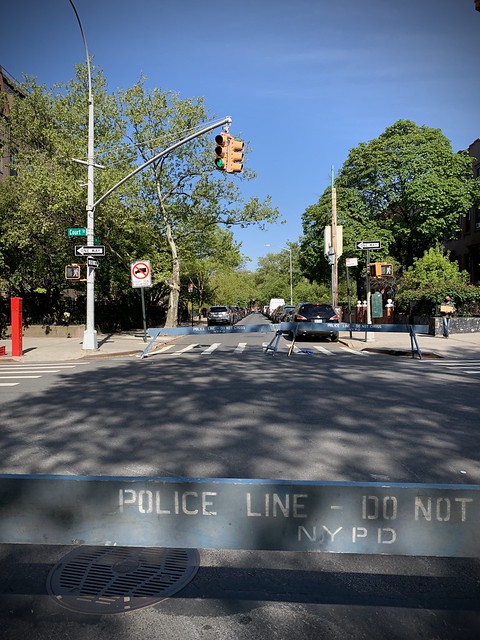
First Place looking towards Smith Street
Untitled
First Place at Smith Street, next to PS58
Untitled
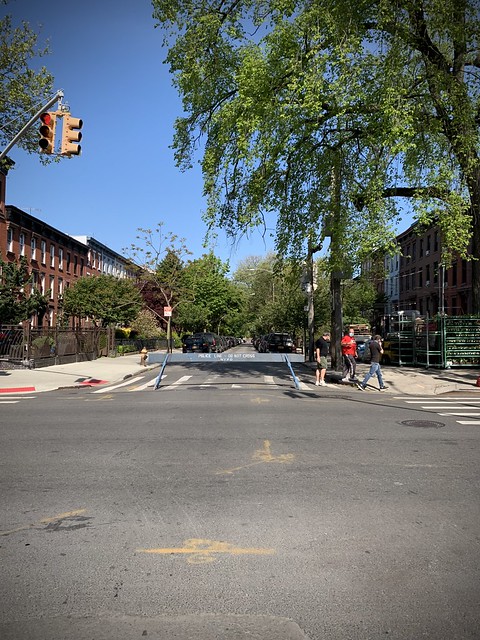
First Place looking towards Court Street
Untitled
Intersection of First Place and Court Street
Untitled
4th Place at Court Street looking towards Henry Street

As of today, several stretched of street in Carroll Gardens have been closed as part of New York City's "Open Streets" campaign.  Barriers across these streets have been erected:
1st Place: Smith Street to Henry Street
2nd Place: Smith Street to Henry Street
4th Place: Smith Street to Henry Street
(* note that 3rd Place is NOT included)

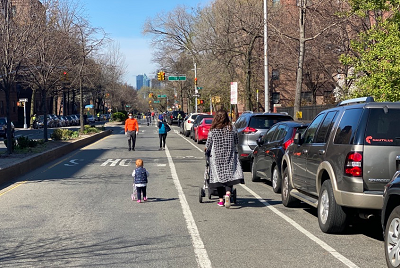
The streets will remain closed to traffic from 8 am to 8 pm so that pedestrians and cyclists can  maintain the proper 6 feet distance while walking through the neighborhood.
Please see New York City's statement below.

One resident already asked fellow members of an online Carroll Gardens group if one could still park on those blocks or if one needs to move one's car during the closure hours.
Apparently, local traffic at 5 mph is allowed. Drivers can also move the barriers to park on these blocks. The expectation is that the barriers will be moved back by the driver after parking.

Here is the statement from New York City
New York City is opening 40 miles of streets to allow for greater social distancing during the COVID-19 crisis, with a plan to expand to a total of 100 miles.
Open Streets are available daily, 8 am to 8 pm (unless otherwise noted) for pedestrians and cyclists to use the roadbed of the street while maintaining at least six feet of distance from others. Opening hours may vary by location due to NYPD staffing.

No through traffic permitted while Open Streets are in effect. Vehicle traffic is limited to local deliveries, pick-ups/drop-offs, necessary city service vehicles, utility vehicles and emergency vehicles only. These drivers are advised to be extremely cautious and to drive 5 MPH or slower.

Members of the public and organizations wishing to have other New York City streets considered for the Open Streets program may fill out an online survey. NYC DOT, NYPD and others will evaluate all suggestions for viability. If you have questions, please contact your NYC DOT Borough Commissioner's office.


***UPDATE***
Reader Stella F. reached out to the 76th Precinct for clarifications and was kind enough to share with PMFA. See the Precinct's response below.


Read more

Friday, April 05, 2019

Dear Brad Lander: Give Us A Democratic Vote On the Gowanus Rezoning

IMG_3969
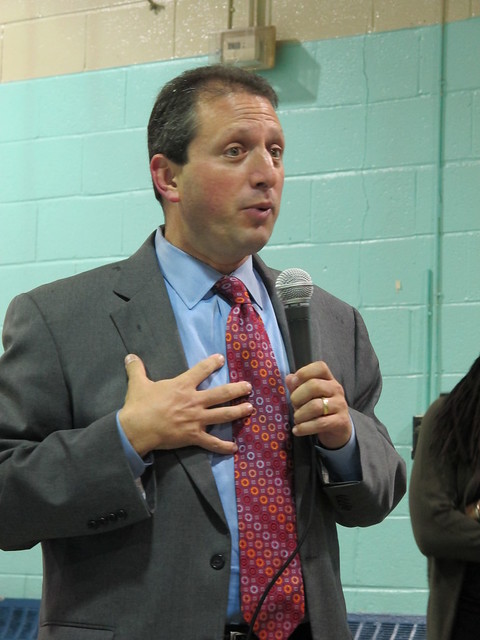
Councilman Brad Lander at the first 39th Council District Participatory Budget Assembly in 2011.
Councilman Brad Lander at a Gowanus Planning meeting in 2014
3D model of a fully built-out Gowanus after rezoning

This week in the 39th Council District, thousands of area residents as young as 11 years old cast their votes to fund neighborhood projects as part of Participatory Budgeting, a "democratic process in which community members directly decide how to spend part of a public budget."

In all, local citizens can have a choice in how $50,000 of expense projects and $1.5 million in capital projects gets spent in our neighborhoods.

Whether one votes for diaper changing stations for nine parks and playgrounds, bilingual mental health First Aid training in Kensington, a down payment for an elevator at 7th Ave F/G Station, a Prospect Park sidewalk at Lichfield Villa for pedestrian safety, or a new all-gender bathrooms and water fountains, the projects are certainly all worthwhile.

Councilmember Brad Lander was one of the first New York City Council members to embrace Participatory Budgeting, Our 39th Council District was one of four to introduce it in New York in 2011.

Back then, Lander told the community:
"This is real grass-roots democracy. We are trying something new. This is a way to work together, identify what your community needs and turn the ideas into real projects."
Lander should be applauded for supporting this democratic process, giving residents an opportunity to shape their community.

However, he is not allowing the community to vote on a much more important issue that will reshape a big swath of his district, one that will have a huge impact on Gowanus, Boerum Hill, Park Slope, Carroll Gardens and even Cobble Hill: the massive up-zoning of Gowanus by the Department of City Planning.

Councilman Lander kicked off Bridging Gowanus, his "community planning process to shape a sustainable, livable, and inclusive future for the Gowanus neighborhood" with stakeholders in August 2013. Hundreds of people took part in the process in subsequent years,

Right from the start, there was skepticism that the Bridging Gowanus process could truly impact the resulting rezoning by the City. How could we, as a community, make sure that our wishes and suggestions would be reflected in the finished product?

Several stakeholders asked Lander directly at that first meeting in 2013 (and subsequently) for a community vote at the end of the process. Making sure that we got the rezoning right by allowing residents a final vote seemed 'democratic.'
Lander's answer was a categorical "NO".

As many suspected, New York City's upzoning of Gowanus, the densest rezoning currently proposed in the City, guarantees none of the things the community had asked for.
-a sustainable , resilient, healthy community 
-a clean Gowanus Canal
-investments in new parks, new schools, and public transit
-sustain and strengthen Gowanus' manufacturing community
-keep Gowanus creative and support the existing artist community.
-keep Gowanus affordable for current, as well as future residents.

That is, sadly, not how planning happens in New York. Brad Lander knew that right from the start. He was also aware that the Department of City Planning did not have the tools in its toolbox to create a unique rezoning, respectful of Gowanus' unique character and sensible to the area's plethora of environmental challenges.

That's what made Lander's Bridging Gowanus such a sham right from the beginning. This is the same technique which is being used all over the city to convince citizens that they have a say in the future shape of our city and is then used to claim that the community supports the resulting proposal which merely pays lip service to the citizen's concerns.

So, let us ask Lander for a DEMOCRATIC COMMUNITY VOTE ON THE GOWANUS REZONING before the official Uniform Land Use Review (ULURP) begins.

Lander claims that his track record shows that "we can strengthen our democracy, make government work better, and build a city that reflects our values."

Let's take him by his word. After all, the Gowanus upzoning is one of the most consequential issue to ever face the 39th Council District.

Please leave a comment and add your voice, email Brad Lander at lander@council.nyc.gov and while you are at it, demand the same of Brooklyn Borough President at askeric@brooklynbp.nyc.gov.
And if you plan on voting at one of the Participatory Budget poling places this week-end, ask his staff directly.

"DEAR BRAD, I AM ONE OF YOUR CONSTITUENTS AND 
I DEMAND A DEMOCRATIC COMMUNITY VOTE ON THE GOWANUS REZONING."

Read more

Friday, March 29, 2019

Behold Landersville!: What Gowanus May Soon Look Like If The Neighborhood Rezoning Becomes Reality

3D image of Gowanus, 2019
photo creditL googlemaps
3D model of a fully built-out Gowanus after rezoning
IMG_1521
Councilman Brad Lander at a Gowanus Planning meeting in 2014

The New York City Department of City Planning (DCP) returned to Community Board 6's Land Use Committee last night to respond to a list of questions that had been sent to the agency by the committee in regards to the Gowanus Draft Zoning Proposal.

We will let you watch the video of the meeting for yourself, since DCP threw a lot of figures around in regards to affordable housing, the area's median income and how many units and new residents the Gowanus upzoning will generate.
(Around 18,000 new residents, 8,200 new units 3,000 (or 37%) of which would be permanently affordable to low- and moderate-income families when it is all built out.)

At the meeting a 3D model of what the Gowanus Corridor could look like in just a few years if the rezoning goes through was distributed.  The model was developed by New York Institute of Technology (NYIT) students and though it may not be entirely accurate because it assumes that developers and land owners will take advantage of every allowable buildable square footage, it is a sobering look at what we may be facing.
We should suppose that the neighborhood will be fully built out in just a few years.  Pretending otherwise and not planning for that eventuality would just be delusional.

Councilman Brad Lander seems to fully back the plan, though he admits that much work still needs to be done. In a letter sent to his constituents just yesterday, he asks local residents to 'keep an open mind",  despite the fact that  "not too many people are excited about new buildings at heights taller than the surrounding brownstones.
Lander does acknowledge the unique environmental issues in Gowanus. "We’ve got a special obligation to pay attention to environmental issues, around a Superfund site that flooded during Hurricane Sandy. That means buildings and a waterfront designed with long-term sea-level rise in mind, and that also reduce energy use, auto-dependence, and combined sewer overflows (CSO) into the canal."

However, the fact remains that our Councilman is pushing to:
- up-zone a FEMA Mandatory Evacuation Flood Zone A
-is willing to bring 18,000 more residents to Gowanus AHEAD of the EPA Superfund Clean-up of the toxic Gowanus Canal 
-and ahead of the City building ADEQUATE retention tanks to keep raw sewage of thousands of additional toilets out of the canal. 

For Lander, the creation of affordable housing seems to trump some of these issues:
"Gowanus would be the first “mandatory inclusionary housing” (MIH) neighborhood re-zoning proposed for a whiter, wealthier neighborhood, where there’s relatively little risk of displacement. So we have the opportunity to create a real model for an integrated neighborhood, with diverse schools, and a vibrant community life, right here in the middle of Brownstone Brooklyn."

Call us idealistic, but regardless of one's income and ability to pay rent, shouldn't the first concern be for the health of current and future residents? Neither Lander, nor NYC DCP, or even NYC DEP can currently assure us that living next to an open sewer or next to a Superfund site like the Goawnus Canal is currently safe.

Let's call this new vision for Gowanus "Landersville", since we should hold him ultimately responsible for what happens here next.


Below is a video of last night's CB6 Land Use Committee meeting.  The NYC DCP's portion begins at  1:07.   (Yours truly asks a question starts at 1:54:15)

Last night's CB6 Land Use Committee meeting.
Read more

Wednesday, February 14, 2018

COURT ST. Becomes Court St . As Street Signs Are Replaced In Carroll Gardens


Untitled
Untitled
Untitled
Untitled
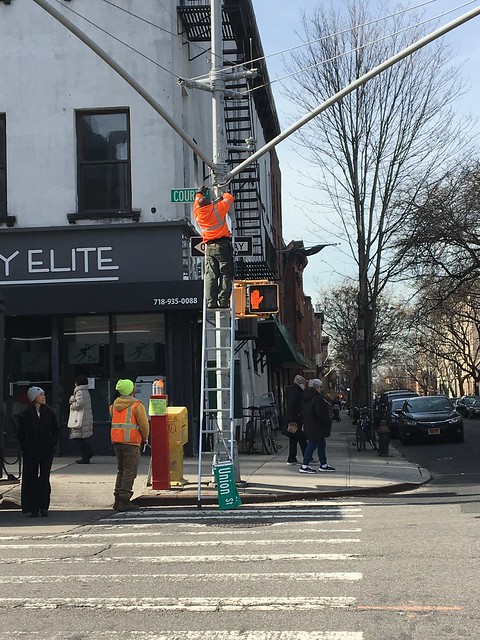
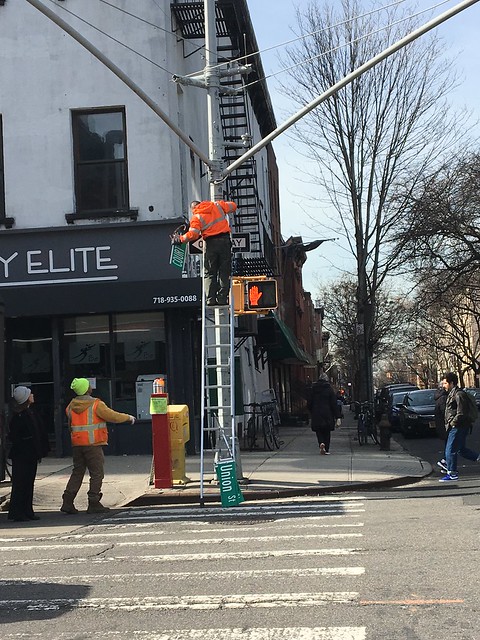
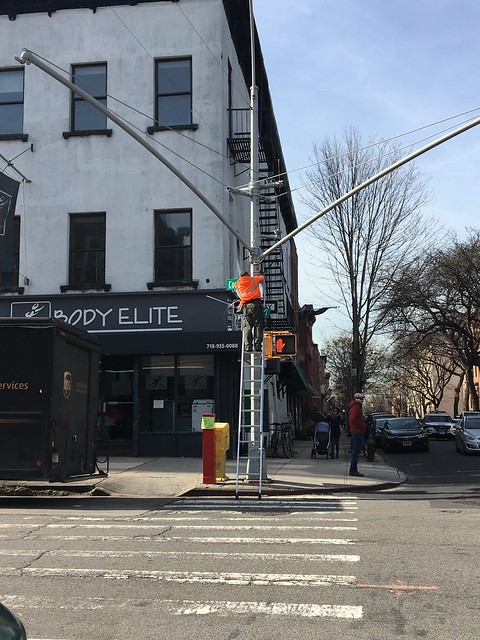
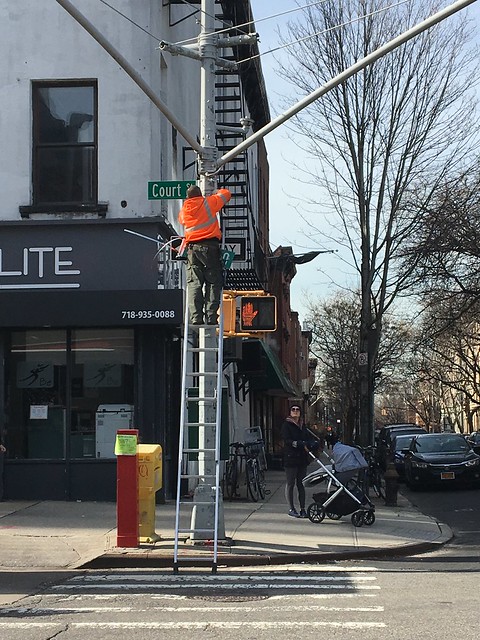
We came across workers swapping out street signs along a large stretch of Court Street yesterday. The old signs still looked relatively new, so we were wondering why they needed to be replaced.

Apparently, the work is part of an effort to replace all 250,000 street name signs across New York City to comply with the Federal Highway Administration's "national standards in typography and surface reflectivity" for street signs.  Who knew that was even a thing?

Don't see much of a difference between the two signs? There really isn't much, except that the older signs have all-uppercase lettering, whereas the newly installed ones feature mixed-case letters in a new typeface called 'Clearview', which is supposed to bring more clarity and simplicity.

According to an article in the New York Times on the subject, 'sign design nationwide is governed by the Manual on Uniform Traffic Control Devices, the latest version of which states: “The lettering for names of places, streets, and highways on conventional road guide signs shall be a combination of lowercase letters with initial uppercase letters.” '

The cost for the mandated street sign change? An estimated $ $27.5 million, though  NYC Department of Transportation apparently received New York State funding for routine sign repairs and replacement, according to the NY Daily News. And if you are wondering, the life expectancy of a street sign is ten years.

Read more

Thursday, June 09, 2016

EPA Finalizes Agreement with New York City on Combined Sewer Overflow Tank Design

IMG_7876
The US Environmental Protection Agency just today issued a press release announcing that the Federal Agency has finalized its agreement with the City of New York regarding the location of one of two Combined Sewer Overflow tanks, which are part of the remedy for the Gowanus Canal clean-up.

This is disappointing but not unexpected news since it seemed clear from the beginning that Regional Administrator Judith Enck was willing to make concessions to the City in regards to the siting of the tank that will:
- include the taking of land by eminent domain
-prolong the timeline of the environmental clean-up 
-allow the City to re-contaminate for a period after the canal has been dredged and capped since the tank may not be completed before then.
-and will cost local residents more money in taxes and water rates.

When the proposed agreement was first outlined for the community this spring, the Gowanus Canal Community Advisory Group asked the EPA to please give local residents and organizations time to comment.  EPA's response to the public's comments can be found here.
The comments may not have made a difference in Enck's mind ultimately, but it was still important to capture them for the record.

What is your reaction to this announcement?

(New York, N.Y. – June 9, 2016) The U.S. Environmental Protection Agency (EPA) today finalized an agreement with the City of New York that secures the design of the larger of two combined sewage and storm water overflow (CSO) retention tanks, which are key components of the Gowanus Canal cleanup, including both the tank’s size and location. It also requires New York City to undertake activities to prepare that location for the tank installation and to pay EPA’s oversight costs. Prior to finalizing the agreement with New York City, the EPA accepted comments from the public for 45 days and attended two Brooklyn community meetings to explain the proposal. A response to the public comments has been issued with the final order.

The final administrative agreement and order released today allows New York City to locate an eight million gallon retention tank in New York City’s preferred location, known as the “Head-of-Canal” location, but it also holds the city to a strict schedule with monetary penalties imposed if violations of the schedule occur. Also, the EPA can require New York City to place the tank in the Thomas Greene Park location instead if certain activities do not occur on schedule, including if New York City is not able to acquire the land at the Head-of-Canal location within approximately four years. Locations for staging and other work related to the construction of the 8 million gallon retention tank will be acquired by New York City as part of the ongoing design phase of the project.

“The New York City Parks Department prefers not to have a large sewage retention tank
permanently located in a city park,” said Judith A. Enck, EPA Regional Administrator. “The EPA is committed to preserving urban parkland and worked with the City of New York on this alternate location. This alternate location meets the dual goals of cleaning up the canal while also protecting urban parkland.”

More than a dozen contaminants, including polycyclic aromatic hydrocarbons (PAHs), polychlorinated biphenyls (PCBs) and heavy metals such as mercury, lead and copper, were found at high levels in the sediment in the Gowanus Canal. PAHs and heavy metals were also found in the canal water. PAHs are a group of chemicals that are formed during the incomplete burning of coal, oil, gas, wood, garbage or other organic substances. PCBs were used as coolants and lubricants in transformers, capacitors and other electrical equipment, and their manufacture was banned in 1979. PCBs and PAHs are suspected of being cancer-causing and PCBs can have neurological effects as well. To this day, people can still be found fishing in the Gowanus, despite advisories about not eating fish from the canal. In 2010, the Gowanus Canal was added to EPA’s Superfund list of the nation’s most contaminated hazardous substance sites.

The EPA issued its final cleanup plan for the Gowanus Canal Superfund site on September 27, 2013. The cleanup includes dredging contaminated sediment that has accumulated on the bottom of the canal as a result of industrial and sewer discharges. The dredged areas will be capped. The EPA’s cleanup plan also calls for the construction of two sewage and storm water retention tanks to significantly reduce CSO discharges from two key locations in the upper portion of the canal. These discharges are not being addressed by current New York City upgrades to the sewer system. Without these controls, CSO discharges would re-contaminate the canal after its cleanup. The plan also includes controls to prevent other land-based sources of contamination from compromising the cleanup. The canal design work is expected to continue for another two years, including a dredging and capping pilot which the EPA expects will be initiated at the 4th Street basin in 2017, followed by the start of full-scale cleanup construction at the top of the canal in 2018.

The EPA’s cleanup plan assumed possible locations for the two tanks, both owned by New York City -- the Thomas Greene Park location for the larger tank at the top of the canal and the Department of Sanitation salt storage lot located at 2nd Avenue and 5th Street for the smaller tank in the middle of the canal. The cleanup plan specified that the final locations would be determined during the design phase of the project. The EPA and New York City have already agreed that one tank, with a capacity of four million gallons, will be located at the Department of Sanitation salt storage lot.

For the larger eight million gallon tank at the top of the canal, New York City proposed as its preferred location two adjacent properties on Nevins Street between Butler and DeGraw Streets. Under the agreement, the larger tank will be located at the Head-of-Canal location. The agreement also requires the City to carry out actions to prepare that site for installation of the tank, including removal of contaminated soil. As a contingency, the agreement also requires New York City to work concurrently on a tank design for the Thomas Greene Park location. If the agreement conditions are not met within timeframes specified in the agreement, the EPA can require New York City to construct the tank at the Thomas Greene Park location.

The final administrative agreement and order will be posted by close of business today at this link:https://semspub.epa.gov/src/collection/02/SC34404

EPA’s responsiveness to comments will be posted today at: https://semspub.epa.gov/src/document/02/395898

To learn more about the Gowanus Canal Superfund site, visit: https://cumulis.epa.gov/supercpad/cursites/csitinfo.cfm?id=0206222


Read more

Thursday, May 26, 2016

"Stop Eminent Domain from Closing our Studio!": Eastern Effects Asks Community For Help In Fighting City's Plan To Seize 270 Nevins Street

12
Eastern Effect's Movie and TV studios at 270 Nevins Street, Gowanus
IMG_7909
IMG_8222
Philip Warren and Scott Levy of  Eastern Effects at  Tuesday's Gowanus Canal Community Advisory Group meeting.
As part of the Gowanus Canal Superfund clean-up, the City of New York and EPA have negotiated a
proposed agreement to situate one of the two retention tanks mandated in the Record of Decision at the head of the Canal rather than at the EPA suggested site which is under the pool in Thomas Greene Park.

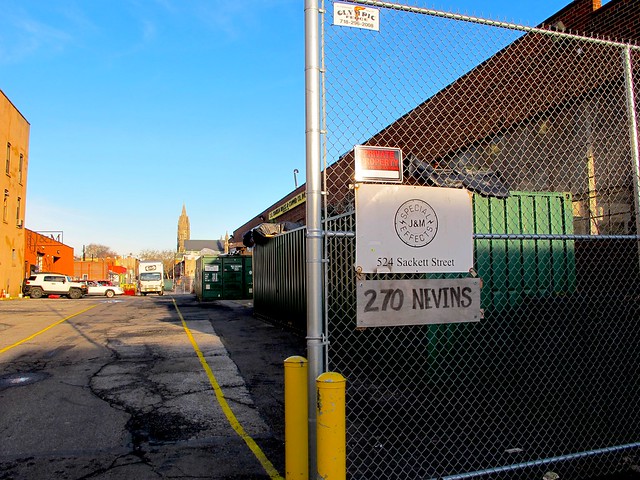
The City's plan relies on the taking of two privately owned sites, 234 Butler Street and 242 Nevins Street, by eminent domain. A third site, 270 Nevins Street will most likely also be seized by the City, which plans to use it for staging purposes during the construction project.

This would displace Eastern Effects, a successful film and television studio, where many commercials, movies and television shows like  FX's "The Americans" are filmed.

Eastern Effects' founder and president Scott Levy and the studio's general manager Philip Warren attended last Tuesday's Gowanus Canal Community Advisory Group's general meeting to make sure the community knew that the closing would mean a 50% loss of business and therefore real hardship. It would also represent  a loss of about 200 union jobs during filming and 31 full-time jobs.
In addition, the company contributes, by their estimate, approximately four million dollars ($4,000,000) per year to the local economy.

Levy argued that it makes little sense for the City to seize the site for temporary use, when Eastern Effects has plowed millions into the building to meet all stage 2 requirements and can support New York City's booming film and movie industry.
"I have invested millions of dollars and have spent three of the most grueling years of my life building this studio," Levy told members of the CAG.  "We did everything we needed to do."
He talked about receives calls every day for studio space, but has to turn production companies down because his are fully booked. Apparently, 46 television productions are currently filming in New York City and are competing for space.
The City of New York has recently notified Eastern Effect that it would be forced to cease operations at 270 Nevins Street.   "The City did not come to us to talk about any of this,' Levy said.  "It was news to us and was announced as 'an agreement between the EPA and the City'.  We were shocked and upset because no one came to us. Only one person from the City came to do a walk through of the building. So it was time for us to do something to protect ourselves."

Eastern Effects is asking the community's help in saving the 270 Nevis Street building, their studios, their investment and local jobs.
"We have no issue with the building of the tank. We understand that the tank is part of the clean-up that is needed for the City and for this local area," said Levy. "We are not here to debate that, but we think we are an afterthought when it comes to where to put a staging site to support that tank."
Rather, Levy makes the point that there are alternatives to the City's proposed plan. Currently, there are several building  located directly adjacent to the lots the City plans to seize by eminent domain, which are currently empty and/or for sale.
That includes 537 Sackett Street, which is located directly across the street from Eastern Effects and is currently empty.

Levy and Warren provided the community with the map pictured above, which shows some alternative sites that could be used by the City.
Eastern Effects also issued the following statement:

Keep Jobs in Gowanus – Stop Eminent Domain from Closing our Studio!
Background:
Eastern Effects, Inc. a film and television production studio adjacent to the Gowanus Canal, was recently notified by the City that it would be forced to cease operations and close in order for the property to be used as a temporary staging area for the construction of two combined sewage overflow (CSO) tanks required to clean up the canal. The Gowanus Canal was designated as a Superfund site by the EPA in 2010.

Eastern Effects leases property at 270 Nevins Street (between Sackett and Degraw Street). The studio is in the 5th year of a 20-year lease. The studio hosts over 230 well-paying jobs, utilizes local vendors, and is the setting for the hit television series The Americans.

There are underutilized and vacant properties surrounding the area that are viable alternatives for this temporary staging location. We propose that the City evaluate such sites, saving the studio from closure and maintaining New York City’s position as a leader in the film and television production industry.

Reasons to Support an Alternate Staging Site:
*Eastern Effects invested over $5 million and three years of exhaustive work in the building at 270 Nevins Street to create a state-of-the-art facility that meets the City’s stringent Level 2 stage requirements to accommodate large scale shows —the type of soundstage that productions are actively seeking in New York City. This is the company’s Flagship Studio.

*Eastern Effects is committed to Brooklyn: all five of the company’s buildings are located in the borough—four buildings are located in Gowanus and one building is currently under construction in East New York.

*Since 2009, Eastern Effects has partnered with Brooklyn Workforce Initiative to provide training and job opportunities in the film industry through the Made in NY PA Training Program. Graduates of the program are currently working on the set of The Americans. Eastern Effects also hires graduates of BWI’s CDL driver training, Red Hook on the Road.

*The site supports over 230 jobs, most of which are union. These union employees are represented by: IATSE Locals 600, 5, 817, 700, 161, 829, 764, 798, WGA, DGA, and SAG/AFTRA. Eastern Effects has 31 direct full-time employees, 3 part-time employees, and is planning an expansion this summer.

*Soundstages are unique facilities that require large, open floor plates, high ceilings, and costly specialized infrastructure. There are no viable alternatives to move the stage in Gowanus. The loss of the Flagship Studio will impact Eastern Effects’ nearby production offices, editing suites, writer’s offices, and support spaces.

*The film and television industry wants to be in New York City. A 2015 report showed that the industry brings $8.7 billion into the local economy, with 46 series produced in the five boroughs during the 2014-2015 season. The spending on production creates a ripple effect in the city’s economy, indirectly supporting an additional 20,000 full-time jobs.

*Production companies currently report difficulty in finding adequate studio space in New York City. If they cannot find space, these productions will turn to other cities, costing New York State jobs and valuable tax revenue.


Meanwhile, our elected officials already threw their support behind the agreement between EPA and the City Of New York, in which the City proposes the taking by eminent domain of 234 Butler Street, 242 Nevins Street, as well as 270 Nevins Street.
New York City Council Member Brad Lander, New York City Council Member Stephen Levin, Brooklyn Borough President Eric L. Adams, and New York State Assembly Member Jo Anne Simon, issued a statement "supportive of the approach described in the proposed agreement"

New York City has already signed the agreement, but the Gowanus Canal Community Advisory Group has asked the EPA for a public comment period before the Federal Government signs it.
Members of the community can send their own comments on the agreement and I strongly encourage you to do so. Please mail to :

Walter Mugdan,
U.S. EPA Superfund Director 290 Broadway, Floor 19, New York, N.Y., 10007 mugdan
or email to : mugdan.walter@epa.gov

To read the agreement between the EPA and New York City, please visit:
https://semspub.epa.gov/work/02/395808.pdf

Click here to write a letter of support for Eastern Effects


Read more

Tuesday, April 26, 2016

Solution To A Problem Or Problem To A Solution? Community Left Wondering About EPA's Gowanus Canal Settlement Agreement With New York City

IMG_7712
IMG_7706
IMG_7736
IMG_7755
IMG_7779
Walter Mugdan, Superfund Director for EPA Region2
IMG_7769
IMG_7775
Marlene, member of Friends And Resident of Greater Gowanus, who expressed concerns about the agreement between EPA and DEP on the siting of the CSO tank
IMG_7796
Philip Warren, Studio General Manager of Eastern Effects at 270 Nevins Street, one of the sites that may be taken by eminent domain, despite the fact that it contributes millions to the local economy.
IMG_7765
Diane Buxbaum. local resident

Notes on last night's EPA community meeting regarding agreement with New York City 
On The Siting Of CSO Tank  at Top Of Gowanus Canal

When the Environmental Protection Agency placed the Gowanus Canal on its National Priorities list, the Agency estimated that the environmental clean-up of our toxic waterway would cost $500 million and last 10 to 12 years.
Why then, is EPA now willing to sign a Settlement Agreement with New York City, one of the responsible polluters, that will allow the City to delay the entire Superfund clean-up by four years, and will cost  $510 million for just one of two overflow retention tanks that the City needs to build in order to keep raw sewage out of the canal.

How did we get to the point where EPA seems to be bending backwards to accommodate New York City, which has used the Gowanus Canal as an open sewer for the past 150 years?
This is what local residents came to find out last night at a community meeting held by the EPA to explain the settlement agreement which it is about to sign with the City.

After giving a brief timeline of the Gowanus Canal Superfund clean-up, Walter Mugdan  gave a detailed presentation that  focused mainly on the agreement that was released to the public on April 14.
"This is as complicated an administrative order under the Superfund program that we have ever been involved with," Mugdan told the audience.

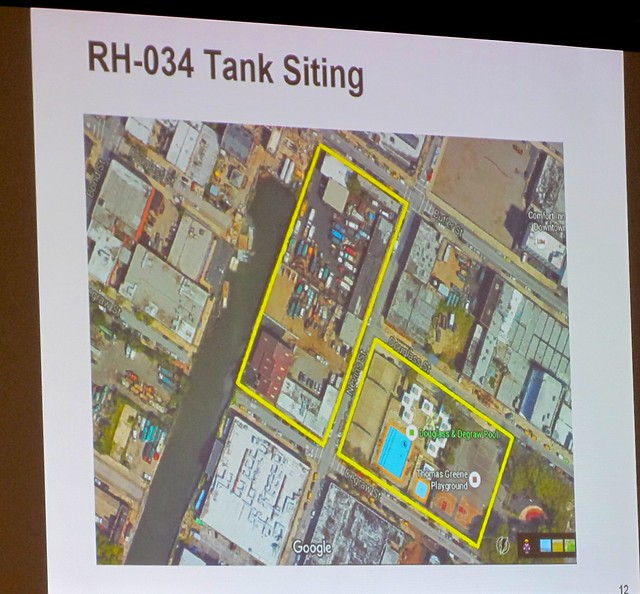
The focus of the agreement is on one of two mandated in-line retention tanks near outflow RH-034 at the head of the canal. The tank is a vital component of the clean-up and will capture Combined Sewage Overflow that, up to now, has just been dumped into the Gowanus during periods of heavy rain.
Since this overflow is laced with Polycyclic Aromatic Hydrocarbons, these tanks are an important source control measure to make sure that the canal does not get re-polluted after it is dredged and capped.

The EPA had suggested that New York City place the RH-034  tank under the Double D Pool at Thomas Greene Park, because it presented  "potential synergies associated with anticipated removal of coal tar from beneath the Park site".  These synergies, according to EPA, could "save time in Site acquisition and save significant construction costs" since National Grid will have to excavate the site anyhow.

The City, on the other hand, wants to site the tank on two privately owned lots adjacent to the canal, directly across from Thomas Greene Park. To do so, New York City intends to seize by eminent domain 334 Butler Street and 242 Nevins Street.  It also expects to either lease or purchase the building at 270 Nevins Street currently occupied by Eastern Effects.  The cost of these three parcels would exceed  $100 million dollars.

The main argument given by the City for siting on the privately owned land at the head of the canal is that it wants to avoid longer disruption or permanent loss (alienation) of parkland at Thomas Green Park.  To justify this claim, the NYC Department of Environmental Protection has, according to EPA,  "excessively designed" the tank, but has also invented the need for a large 3-story head house.

Obviously, the City's park alienation argument has swayed the EPA administration enough to allow the City to move forward with the plan, though Walter Mugdan reiterated that his agency" strongly prefers the park location over the two privately held parcels" and that  "EPA believes construction of the RH034 tank at the Park location could be done more quickly, more easily, and at less expense than the head-of-the-Canal location."
However, Mugdan explained that the Federal Agency still believes that the proposed agreement and order is "a favorable outcome for EPA".

The Agreement gives the City four years to acquire the land, design the tank, remediate the contaminated soil, and prepare the site.
It stipulates monetary penalties if New York City fails to comply and commits DEP to dredge the CSO-related sediment that may accumulate after the Canal is cleaned but before the CSO tank is completed. Most  importantly,  the City waives the right to take legal action "related to the selection of the CSO controls contained in the 2013 Record of Decision."
In addition, New York City is required to simultaneously design a tank for the Park location as a contingency should it become necessary to change from the head-of-the canal location in the event that City falls behind schedule.

The Agreement does NOT include a final timeline for the actual building of the tank, nor does it mention the construction of the smaller tank near outflow OH-007 or specify the mandated size of the tanks (8 million gallon tank for RH-034 and 4 million for OH-007.)

It is especially surprising that the Agreement does not mention the generous offer by the owners of both 334 Butler Street and 242 Nevins Street, who, in order to avoid losing their properties through eminent domain, were willing to donate parts of their parcels to the City to offset the potential loss of parkland if the City were to site the OH-034 tank in Thomas Greene Park.
That would, to many local residents be a win for the landowners,  a win for the City and, most of all, a win for the community.

The EPA will wait to sign the agreement until the end of the (newly extended) public comment period on May 31.  According to Mugdan, EPA is moving forward with it, "unless you [the public] think you have a better mousetrap."

As someone who actively supported the listing of the Gowanus Canal as a Superfund site, as a member of the EPA Community Advisory Group from its inception five years ago, and as someone who has raised two children just two blocks away from the polluted waterway, I am truly amazed that the EPA would allow the City to callously prolong the clean-up, which means that local residents are unnecessarily exposed to toxins longer than they have to be.

Back in February 2011, EPA Adminsitrator Judith Enck appeared in front of the Gowanus community surrounded by the Region 2 team she put in charge of designing the remedy for the Superfund clean-up. In front of the same audience in the same auditorium at PS 32, she declared: "Your canal is in good hands. You have the best and brightest EPA talent working on this."
Five years later, we still have the brightest EPA talent trying to get the canal cleaned up, but they seem to be hindered by their boss, Ms. Enck, who has allowed politics, and not engineering to prevail.  She has undermined her own team by caving in to the City's questionable arguments and agreeing to their over-designed, needlessly expensive plans.

I felt sorry for Walter Mugdan last night.  He did a reasonably good job trying to convince the community that this agreement between EPA and DEP is a good deal for Gowanus, but it was clear from questions and comments made last night that most residents were confused and disappointed by EPA's sudden meekness towards the City, one of the largest canal polluters.

At the end, once again, the community is asked to be patient while politicians and lawyers take over the conversation and drive the agenda. How very foolish and sad this all is.  I hope you will join me in submitting comments to EPA demanding that science, engineering and common sense be allowed to rule.

Yes, there is a better mousetrap. We just need to demand it.

Your comments can be mailed or emailed to: Walter Mugdan, U.S. EPA Superfund Director 290 Broadway, Floor 19, New York, N.Y., 10007 mugdan.walter@epa.gov

To read the agreement between the EPA and New York City, please visit:
https://semspub.epa.gov/work/02/395808.pdf
or visit EPA’s document repository located at the Carroll Gardens Library at 396 Clinton St. in Brooklyn, New York.


Read more

Wednesday, December 02, 2015

Developer Alloy Suggests Idea That May Solve Delay Issue And Park Loss Associated With Siting Of Combined Sewer Overflow Tank In Gowanus

IMG_6430
At last night's Gowanus Canal Superfund Community Advisory Committee meeting
IMG_6421
IMG_6426
Jared Della Valle, President of Alloy
IMG_6448
Councilmember Steve Levin
IMG_6431
Kevin Jeffreys, Brooklyn Parks Commissioner
IMG_6441
Eric Landau, DEP Associate Commissioner
Christopher Swain Gowanus Swim
Looking at 234 Butler Street and 242 Nevins Street from the Gowanus Canal Side
IMG_1725
The Double D Pool at Thomas Greene Park
1928 photo of the former MGP site at Douglass Street, where Thomas Greene Park is now
The park, surrounded by industry, as seen from 4th Avenue 
looking towards the Gowanus Canal in the 1930s.
Alloy Presentation

The discussion of where New York City should be siting the larger of two Combined Sewer Overflow (CSO) retention tanks that the US Environmental Protection Agency has ordered New York City Department Of Environmental Protection  (DEP) to construct in Gowanus to capture raw sewage currently being discharged into the canal  has just become a whole lot more interesting.
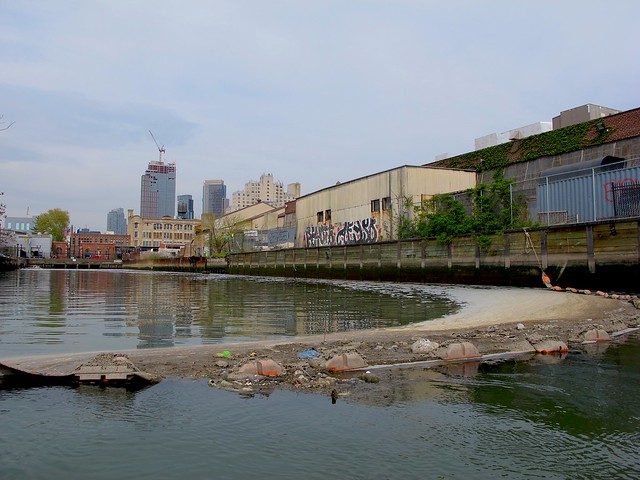
You may remember that EPA's Region 2, responsible for overseeing the Gowanus Superfund clean-up,  has suggested placing a 8-million gallon tank underneath the Double D pool at Thomas Greene Park. The Federal agency reasoned that  the site is already owned by the City, which would save the cost of acquiring land. In addition, the park sits on top of the former Brooklyn Union Gas Fulton  Municipal Manufactured Gas Plant (MGP) which was in operation at this location from 1879 to the early 1930s. Since coal tar is currently oozing under the pool area and flows towards the Gowanus Canal, National Grid, the party responsible for the environmental clean-up, has been asked by EPA to dig up the pool so that the source contamination can be removed. By working in tandem with National Grid, DEP would save money and time. 

The NYC DEP, on the other hand, would prefer to site the 8-million gallon tank on privately owned land along the canal, adjacent to the park.  The sites in question are 234 Butler  Street and  242 Nevins Street.  In addition, the City wants to acquire 270 Nevins Street, which is currently occupied by Eastern Effects Studios, as a staging area.  The City is willing to make use of Eminent Domain to acquire the three  properties if the private owners are unwilling to sell. The necessary legal proceedings involved in making this happen will take time and millions of dollars.

The City wants to place the tank and a 50 feet high head house for the mechanical elements needed for the tank at 234 Butler and  242 Nevins partly because of the proximity to the rest of its Gowanus infrastructure at the head of the canal, and partly to "protect Thomas Greene Park" since the nearby community is underserved when it comes to open space and recreational facilities.

The problem with the City's eminent domain plan is that it will delay the environmental clean up of the Gowanus Canal by about 3 to 5 years, which EPA is very concerned about.

Intriguingly enough,  Alloy, a real estate development firm based in Dumbo, has proposed an alternative solution that may reduce or eliminate the clean-up  delay as well as offset the loss of parkland.

At last night's EPA Gowanus Canal Superfund Community Advisory Group meeting,  Alloy told the community that it had recently signed a binding agreement on a 99 year lease for 234 Butler Street and has been in talks with the owners of 242 Nevins Street,
Alloy is proposing to build an as-of-right commercial development with a 2.0 Floor Area Ratio (FAR)   that will provide much needed creative office space in Gowanus.  Distributing the allowable square footage into two four-story buildings instead of one large two-story structure  would allow Alloy and  the owners of the sites to donate a sizable piece of land to the City. 
According to Jared Della Valle, Alloy's president,  the donation would create additional permanent park land that would exceed the land lost to the head house in the park, if it were placed there.
It would also preserve the properties' tax base and create jobs in the area.
"We believe that our proposal could save the unnecessary time of pursuing eminent domain"Della Valle explained to the Community Advisory Group. "It would also save the City up to a hundred million dollars."

What do Alloy and the owners get out of it?  "No eminent domain. It's that simple," Della Valle said. 
To those who may think that the offer of a land donation to the city is too good to be true, he points out that his firm is confident that there is enough margin to make their project viable even with giving away land.  He believes that Alloy can add some new perspective and help create a meaningful dialog between the parties. "We are offering a resource in this game," Della Valle concluded.

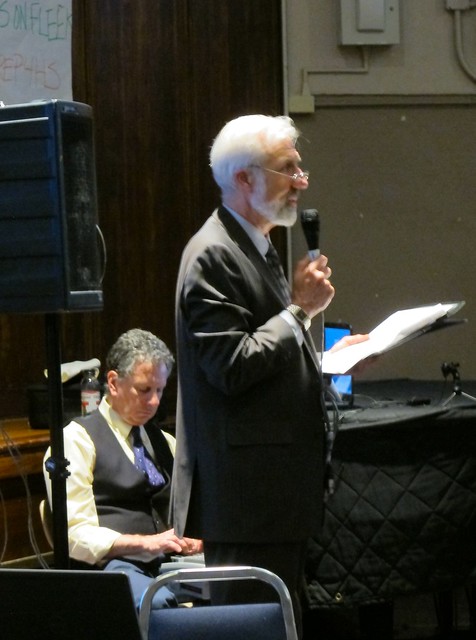
One could imagine that NYC DEP would jump at this chance, but no.  Eric Landau, DEP's Associate Commissioner and Kevin Jeffreys, Brooklyn Parks Commissioner, also attended last night's CAG meeting.  During their presentation to the community, they seemed eager to point out that the'City's recommendation remains unchanged and that it is still pursuing eminent domain.
"It is a very intriguing idea", Jeffreys said about Alloy's proposal, " but it does not eliminate all of the City's concerns. We want to make sure that we do not reduce the current footprint of Thomas Greene Park."  

According to Jeffreys, a head house, if it were built in Thomas Greene Park,  would take up about 29,000 to 30,000 square feet of the total 110,000 s.f. park area. "If you place it in Thomas Green Park, you interrupt the current park program" he stated.  He stated that the land donation proposed by Alloy would only give the City a "marginal increase in park land." (57,000 sf.)
The City's plan would add approximately 75,000 sq ft of open space.

Eric Landau mentioned that construction of tank and head house in the park would take about 8 to 10 years, during which the park would have to remain closed versus 4 years if constructed on the privately owned land.
(One may want to point out here that the EPA estimates that the entire Superfund clean-up will take 12 years. Why it would take the City 8 years to build a pretty straight forward tank is anyone's guess.)

The community reacted with skepticism towards the City, which has been named the # 2 responsible polluter of the Gowanus Canal by EPA.  The City, unfortunately, has been less than transparent in regards to Gowanus.  Landau addressed the deep distrust from the community. "I get that we have a historic credibility problem in the community."  He was quick to blame the previous administration.

Most members of the CAG seemed to be opposed  to any solution that would entail the taking of private land by eminent domain.  There was a genuine interest in the possibilities and solution put forth by Alloy.  One member of the CAG told the City representatives to "get back to the table with Alloy to make it work."  Another member felt that the city had a 'predetermined design' for the tank and for the head house and was failing to embrace more creative solutions that could take care of all concerns.
The sentiment against the City was best expressed by a Gowanus  NYCHA resident, who said: "Right now, the City does not have the money to support public housing.  These people [meaning Alloy] are coming in to give you land versus going to court to do eminent domain. I don't understand going to court because it is going to take money and time to do this." She felt that the money could be better spent on public housing.
Indeed, it is hard to believe that the City is willing to spend $100 + million dollars on the purchase of land and legal wrangling, when there seems to be a perfectly sensible alternative that would increase the overall existing parkland AND keep the Superfund clean-up on schedule.

Sticking to EPA's clean-up timetable is what most CAG members want most. After both the Alloy and DEP presentations, CAG members voted on a resolution urging the EPA, which will have final say regarding the location and design of the required sewage detention tanks, "to make their institutional decisions based on the best recommendations of their project design team and engineers."

You can access Alloy's complete presentation to the CAG here.


Read more